American Elements Logo and U.S. Registered Trademark


METAL FOAM AND CERAMIC FOAM INFORMATION CENTER
AE Foams ™

32.4 (A)/00.022


Hydrogen                                Helium  
Lithium Beryllium                     Boron Carbon Nitrogen Oxygen Fluorine Neon
Sodium Magnesium                     Aluminum Silicon Phosphorus Sulfur Chlorine Argon
Potassium Calcium Scandium Titanium Vanadium Chromium Manganese Iron Cobalt Nickel Copper Zinc Gallium Germanium Arsenic Selenium Bromine Krypton
Rubidium Strontium Yttrium Zirconium Niobium Molybdenum Technetium Ruthenium Rhodium Palladium Silver Cadmium Indium Tin Antimony Tellurium Iodine Xenon
Cesium Barium Lanthanum Hafnium Tantalum Tungsten Rhenium Osmium Iridium Platinum Gold Mercury Thallium Lead Bismuth Polonium Astatine Radon
Francium Radium Actinium Rutherfordium Dubnium Seaborgium Bohrium Hassium Meitnerium Darmstadtium Roentgenium Copernicium Ununtrium Ununquadium Ununpentium Ununhexium Ununseptium Ununoctium
                                   
    Cerium Praseodymium Neodymium Promethium Samarium Europium Gadolinium Terbium Dysprosium Holmium Erbium Thulium Ytterbium Lutetium    
    Thorium Protactinium Uranium Neptunium Plutonium Americium Curium Berkelium Californium Einsteinium Fermium Mendelevium Nobelium Lawerencium      

(click on an element to view our products)

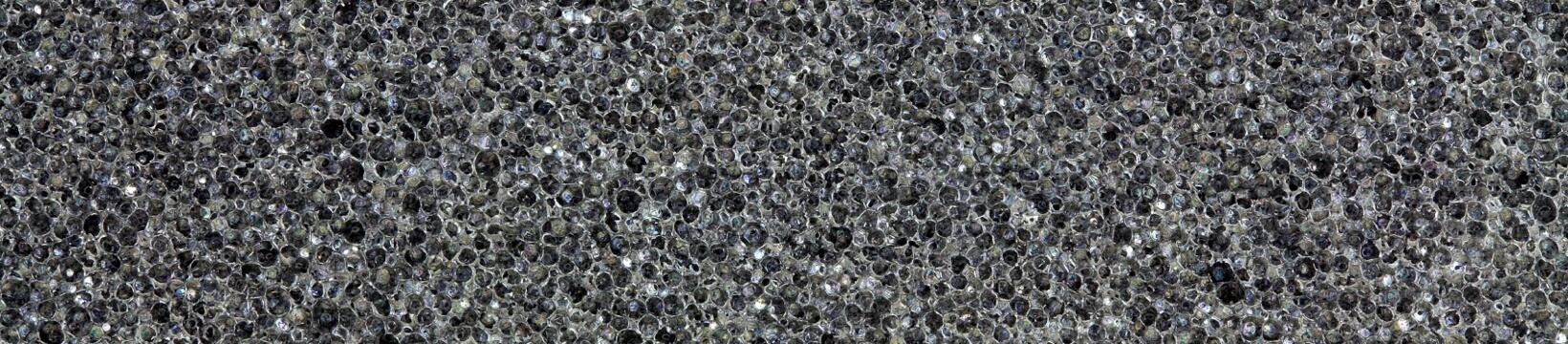
Ultra High Purity Metal FoamsA metallic foam or ceramic foam is a cellular structure consisting of a solid metal or ceramic material containing a large volume fraction of gas-filled pores. The pores can be sealed, closed-cell foam, or they can form an interconnected network, open-cell foam. The defining characteristic of these foams is a very high porosity, typically 75-95% of the volume consisting of void spaces. The strength of foamed material possesses a power law relationship to its density, for example a 20% dense material is more than twice as strong as a 10% dense material. Metallic foams typically retain some physical properties of their base material. Foam made from non-flammable metal will remain non-flammable and the foam is generally recyclable back to its base material. Coefficient of thermal expansion will also remain similar while thermal conductivity is likely to be reduced.

Open-Cell Metal Foams. Open celled metal foams are usually replicas using open-celled polyurethane foams as a skeleton. These foams have found a wide variety of applications in heat exchangers, energy absorption, flow diffusion and lightweight optics. Extremely fine-scale open-cell foams are used as high-temperature filters in the chemical industry. Metallic foams used in compact heat exchangers increase the heat transfer at the cost of an additional pressure drop. However, their use permits the physical size of a heat exchanger to be reduced substantially, and therefore also the fabrication costs.

Closed-Cell Metal Foams.Closed-cell metal foams have been developed since the 1950s, but although prototypes were available, commercial production was started only in the 1990s. Close-celled metal foams are commonly made by injecting a gas or mixing a foaming agent into molten metal. The material is then stabilized using a high temperature foaming agent (usually nano- or micrometer sized solid particles). The size of the pores, or cells, is usually 1 to 8 mm. Closed-cell metal foams are primarily used as an impact-absorbing material. Unlike many polymer foams, metal foams remain deformed after impact and can therefore only be used once. They are light, typically 10-25% of the density of the metal they are made of, which is usually aluminum, and stiff. Closed-cell foams retain the fire resistant and recycling capability of other metallic foams but add an ability to float in water.

Ceramic Foams.Ceramic foam is usually manufactured by impregnating open-cell polymer foams internally with ceramic slurry and then firing in a kiln, leaving only ceramic material. The foams may consist of several ceramic materials such as aluminum oxide. The foam is often used for thermal insulation, acoustic insulation, adsorption of environmental pollutants, filtration of molten metal alloys, and as substrate for catalysts requiring large internal surface area. It has also been used as stiff lightweight structural material, specifically for support of reflecting telescope mirrors.

American Elements maintains industrial scale production for all its foam products.

American Elements will execute Non-Disclosure or Confidentiality Agreements to protect customer know-how

A complete list of AE Foams materials includes:

Aluminum Foam
Aluminum Oxide Foam
Boron Carbide Foam
Boron Nitride Foam
Cadmium Foam
Cobalt Foam
Cobalt Chromium Foam
Copper Foam
Copper Aluminum Foam
Gold Foam
Hafnium Carbide Foam
Iron Foam
Iron Chromium Foam
Iron Chromium Aluminum Foam
Gold Foam
Lead Foam
Molybdenum Foam
Nickel Chromium Aluminum Foam
Nickel Chromium Foam
Nickel Copper Foam
Nickel Foam
Nickel Iron Foam
Nickel Iron Chromium Foam
Nickel Manganese Gallium Foam
Niobium Foam
Rhenium Foam
Silicon Carbide Foam
Silicon Foam
Silicon Nitride Carbide Foam
Silicon Nitride Foam
Silver Foam
Tantalum Foam
Tantalum Carbide Foam
Tin Foam
Titanium Foam
Tungsten Foam
Tungsten Nickel Foam
Vitreous Carbon Foam
Zinc Foam
Zirconium Carbide Foam
Zirconium Foam

French Mousse German Schaum Italian Schiuma Portuguese Espuma Spanish Espuma 泡沫 Swedish Skum
PRODUCT CATALOG U.S. Operations Price Quote Nanoparticles Submicron & Nanopowder Tolling Ultra High Purity Sputtering Target Crystal Growth Advanced Materials Information Center Home


German   Korean   French   Japanese   Spanish   Chinese (Simplified)   Portuguese   Russian   Chinese (Taiwan)  Italian   Turkish   Polish   Dutch   Czech   Swedish   Hungarian   Danish   Hebrew

Production Catalog Available in 36 Countries & Languages
Periodic table of the elements science and academic information, elements and advanced materials data, scientific presentations and all pages, designs, concepts, logos, and color schemes herein are the copyrighted proprietary rights and intellectual property of American Elements. American Elements is a U.S. Registered Trademark. © 1998-2013 American Elements. All rights reserved.
  Print This Page Learn Six Sigma


Recent Research & Development for Metal Foam

  • Foam in the aquatic environment. Schilling K, Zessner M. Water Res. 2011 Oct 1;45(15):4355-66. Epub 2011 Jun 28. PMID: 21757217 [PubMed - in process]

  • Supramolecular Route to Well-Ordered Metal Nanofoams. Vukovic I, Punzhin S, Vukovic Z, Onck P, De Hosson JT, Ten Brinke G, Loos K. ACS Nano. 2011 Jul 15. [Epub ahead of print] PMID: 21739963 [PubMed - as supplied by publisher]

  • Novel biopolymer-coated hydroxyapatite foams for removing heavy-metals from polluted water. Vila M, Sánchez-Salcedo S, Cicuéndez M, Izquierdo-Barba I, Vallet-Regí M. J Hazard Mater. 2011 Aug 15;192(1):71-7. Epub 2011 May 4. PMID: 21616595 [PubMed - in process]

  • Three-dimensional flexible and conductive interconnected graphene networks grown by chemical vapour deposition. Chen Z, Ren W, Gao L, Liu B, Pei S, Cheng HM. Nat Mater. 2011 Jun;10(6):424-8. Epub 2011 Apr 10. PMID: 21478883 [PubMed]

  • Molecular dynamics study of the foam stability of a mixed surfactant/water system with and without calcium ions. Yang W, Yang X. J Phys Chem B. 2011 Apr 28;115(16):4645-53. Epub 2011 Apr 6. PMID: 21469725 [PubMed - indexed for MEDLINE]

  • Self-assembly, foaming, and emulsifying properties of sodium alkyl carboxylate/guanidine hydrochloride aqueous mixtures. Fameau AL, Houinsou-Houssou B, Ventureira JL, Navailles L, Nallet F, Novales B, Douliez JP. Langmuir. 2011 Apr 19;27(8):4505-13. Epub 2011 Mar 15. PMID: 21405069 [PubMed - in process]

  • Strong magnetism observed in carbon nanoparticles produced by the laser vaporization of a carbon pellet in hydrogen-containing Ar balance gas. Asano H, Muraki S, Endo H, Bandow S, Iijima S. J Phys Condens Matter. 2010 Aug 25;22(33):334209. Epub 2010 Aug 4. PMID: 21386499 [PubMed - in process]

  • Influence of carbon source and inoculum type on anaerobic biomass adhesion on polyurethane foam in reactors fed with acid mine drainage. Rodriguez RP, Zaiat M. Bioresour Technol. 2011 Apr;102(8):5060-5. Epub 2011 Feb 23. PMID: 21349708 [PubMed - indexed for MEDLINE]

  • Ag-doped 45S5 Bioglass®-based bone scaffolds by molten salt ion exchange: processing and characterisation. Newby PJ, El-Gendy R, Kirkham J, Yang XB, Thompson ID, Boccaccini AR. J Mater Sci Mater Med. 2011 Mar;22(3):557-69. Epub 2011 Feb 4. PMID: 21293911 [PubMed - indexed for MEDLINE]

  • Effects of hydroxyapatite on titanium foam as a bone ingrowth surface in acetabular shells: a canine study. Mihalko WM, Howard C, Dimaano F, Dimaano N, Hawkins M. J Long Term Eff Med Implants. 2010;20(1):35-42. PMID: 21284586 [PubMed - indexed for MEDLINE]

  • Controlled effect of ultrasonic cavitation on hydrophobic/hydrophilic surfaces. Belova V, Gorin DA, Shchukin DG, Möhwald H. ACS Appl Mater Interfaces. 2011 Feb;3(2):417-25. Epub 2011 Jan 31. PMID: 21280665 [PubMed - indexed for MEDLINE]

  • Oxidative modification of lipoproteins: mechanisms, role in inflammation and potential clinical applications in cardiovascular disease. Tsimikas S, Miller YI. Curr Pharm Des. 2011;17(1):27-37. Review. PMID: 21226665 [PubMed - indexed for MEDLINE]

  • Enhanced hydrogen storage by spillover on metal-doped carbon foam: an experimental and computational study. Psofogiannakis GM, Steriotis TA, Bourlinos AB, Kouvelos EP, Charalambopoulou GCh, Stubos AK, Froudakis GE. Nanoscale. 2011 Mar 10;3(3):933-6. Epub 2011 Jan 7. PMID: 21218229 [PubMed - indexed for MEDLINE] Free Article

  • Extraction of nutrients from foam in a membrane activated sludge system. Lo KV, Chan WI, Lo IW, Koch F, Liao PH. Environ Technol. 2010 Oct;31(11):1281-8. PMID: 21046958 [PubMed - indexed for MEDLINE]

  • The Effect of the iBEAM Evo Carbon Fiber Tabletop on Skin Sparing. Simpson JB, Godwin GA. Med Dosim. 2011 Autumn;36(3):330-3. Epub 2010 Oct 23. PMID: 20970986 [PubMed - in process]

  • Microstructure based model for sound absorption predictions of perforated closed-cell metallic foams. Chevillotte F, Perrot C, Panneton R. J Acoust Soc Am. 2010 Oct;128(4):1766-76. PMID: 20968350 [PubMed - indexed for MEDLINE]

  • Characterization of lead, barium and strontium leachability from foam glasses elaborated using waste cathode ray-tube glasses. Yot PG, Méar FO. J Hazard Mater. 2011 Jan 15;185(1):236-41. Epub 2010 Sep 17. PMID: 20940082 [PubMed - indexed for MEDLINE]

  • Ionic physisorption on bubbles induced by pulsed ultra-sound. Toquer G, Zemb T, Shchukin D, Möhwald H. Phys Chem Chem Phys. 2010 Nov 21;12(43):14553-9. Epub 2010 Oct 7. PMID: 20931120 [PubMed]

  • Mechanisms of LDL oxidation. Yoshida H, Kisugi R. Clin Chim Acta. 2010 Dec 14;411(23-24):1875-82. Epub 2010 Sep 9. Review. PMID: 20816951 [PubMed - indexed for MEDLINE]

  • Hydroxyapatite foam as a catalyst for formaldehyde combustion at room temperature. Xu J, White T, Li P, He C, Han YF. J Am Chem Soc. 2010 Sep 29;132(38):13172-3. PMID: 20815345 [PubMed - indexed for MEDLINE]

American Elements® is a copyrighted U.S. Trademark. All rights reserved.