American Elements


Antimony Oxide/Aluminum Oxide Granules
High Purity Sb2O3• Al2O3 Granules
Product Product Code Order or Specifications
(2N) 99% Antimony Oxide/Aluminum Oxide Granules SBAL-OX-02-GR Contact American Elements
(3N) 99.9% Antimony Oxide/Aluminum Oxide Granules SBAL-OX-03-GR Contact American Elements


Oxide IonAntimony Oxide/Aluminum Oxide Granules are available with an average particle size range of 1 - 3mm. American Elements produces to many standard grades when applicable, including Mil Spec (military grade); ACS, Reagent and Technical Grade; Food, Agricultural and Pharmaceutical Grade; Optical Grade, USP and EP/BP (European Pharmacopeia/British Pharmacopeia) and follows Ultra High Purity Granulesapplicable ASTM testing standards. Additional technical, research and safety (MSDS) information is available as is a Reference Calculator for converting relevant units of measurement. Oxide compounds are not conductive to electricity. However, certain perovskite structured oxides are electronically conductive finding application in the cathode of solid oxide fuel cells and oxygen generation systems. They are compounds containing at least one oxygen anion and one metallic cation. They are typically insoluble in aqueous solutions (water) and extremely stable making them useful in ceramic structures assimple as producing clay bowls to advanced electronics and in light weight structural components in aerospace and electrochemical applications such as fuel cellsin which they exhibitionicconductivity. Activated Chromatographic Grade aluminum oxide is used in lighting, photographic chromatography and various separation techniques of chromatography. Metal oxidecompoundsare basic anhydrides and can therefore react with acids and with strong reducing agents in redox reactions.Additional technical, research and safety (MSDS) information is available.

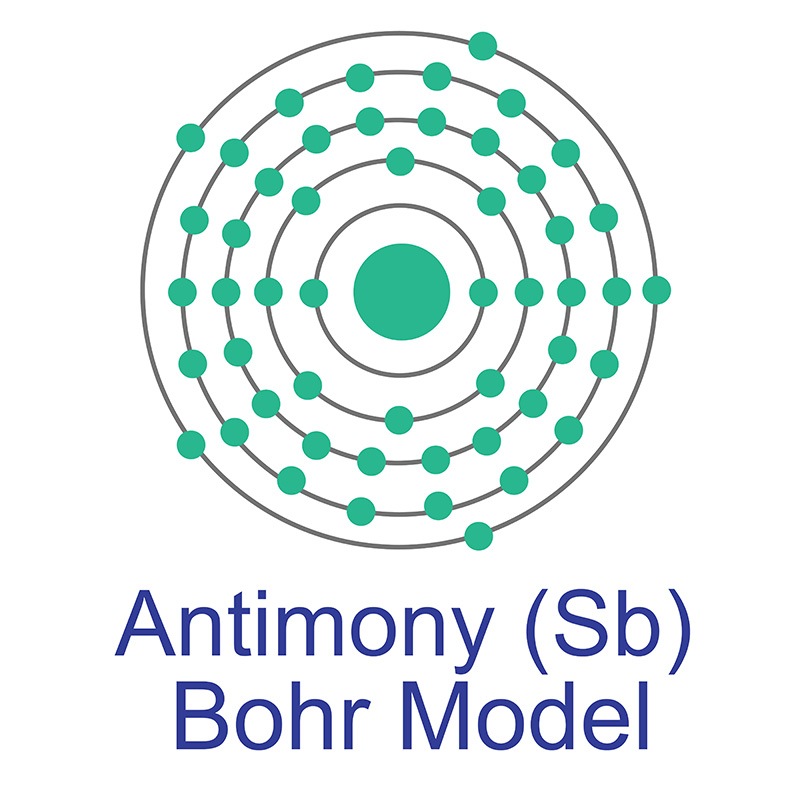
Antimony(Sb)atomic and molecular weight, atomic number and elemental symbolAntimony is a Block P, Group 15, Period 5 element. The number of electrons in each of Antimony's shells is 2, 8, 18, 18, 5 and its electronic configuration is [Kr] 4d10 5s2 5p3. In its elemental form antimony's CAS number is 7440-36-0. The antimony atom has a radius of 145.pm and it's Van der Waals radius is 200.pm. The chemical state of antimony affects the toxicity of the element and itsElemental Antimony compounds. Antimony is finding use in semiconductor technology for making infrared detectors, diodes and Hall-effect devices in crystalline structures, such as antimony telluride and gallium antimonide. Antimony is however a poor conductor of heat and electricity. It greatly increases the hardness and mechanical strength of lead.Antimony Bohr Model This has found applications in batteries, antifriction alloys, small arms and tracer bullets and cable sheathing. Antimony compounds are used in manufacturing flame-proofing compounds, paints, ceramic enamels, glass, and pottery glazes. Antimony is available as metal and compounds with purities from 99% to 99.9999% (ACS grade to ultra-high purity); metals in the form of foil, sputtering target, and rod, and compounds as submicron and nanopowder. See Antimony research below.


Aluminum(Al) atomic and molecular weight, atomic number and elemental symbolAluminum is a Block P, Group 13, Period 3 element. The number of electrons in each of Aluminum's shells is 2, 8, 3 and its electronic configuration is [Ne] 3s2 3p1. In its elemental form aluminum's CAS number is 7429-90-5. The aluminum atom has a radius of 143.2.pm and it's Van der Waals radius is 200.pm. Aluminum is the most abundant metal in the earth's crust. Aluminum is not known to be harmful but ingestion may cause Alzheimer's disease.Aluminum is a silvery-white metal that possesses many desirable characteristics. It is light, nonmagnetic and nonsparking. It stands second among metals in the scale of malleability, and sixth in ductility. It is extensively used in manyAluminum Bohr Model industrial applications where a strong, light, easily constructed material is needed. Although it's electrical conductivity is only about 60% that of copper, it is used in electrical transmission Elemental Aluminumlines because of its light weight. Pure aluminum is soft and lacks strength, but alloyed with small amounts of copper, magnesium, silicon, manganese, or other elements impart a variety of useful properties. These alloys are of vital importance in the construction of modern aircraft and rockets. Aluminum, evaporated in a vacuum, forms a highly reflective coating for both visible light and radiant heat. They are used to coat telescope mirrors. Aluminum is available as metal and compounds with purities from 99% to 99.9999% (ACS grade to ultra-high purity); metals in the form of foil, sputtering target, and rod, and compounds as submicron and nanopowder. See Aluminum research below.

American Elements semi conducting materials are crystal structures produced from ultra high purity starting materials synthesized by our high purity production facility which includes several large electric muffle furnaces, a tube furnace for hydrogen reduction, 50 gallon glass-lined Pfaudler reactors supported by our analytical laboratory containing X-ray diffraction, SEM, AA, BET surface area, and ICP Spectrometry for trace metals analysis. See a discussion of American Elements Ultra High Purity and Analytical capabilities. See Crystal Growth for processes used to fabricate semiconductor materials, which include:

  • Crystal "pulling" by the Czochaiski method for production of semiconductor materials
  • Flux growth and gradient freeze
  • Directional solidification of fluorites using both the Bridgman-Stockbarger and float zoning techniques
PRODUCT CATALOG Foil Submicron & Nanopowder Tolling Ultra High Purity Sputtering Target Crystal Growth Rod, Plate, Powder, etc. Home

Have a Question? Ask a Chemical Engineer or Material Scientist   Request an MSDS or Certificate of Analysis


Search by Material, Product Name, Product Code, CAS Number, Formula, Element, Anion, Form, EC Number, MDL Number or PubChem ID.


German   Korean   French   Japanese   Spanish   Chinese (Simplified)   Portuguese   Russian   Chinese (Taiwan)  Italian   Turkish   Polish   Dutch   Czech   Swedish   Hungarian   Danish   Hebrew

Production Catalog Available in 36 Countries & Languages
  Print this Page
Periodic table of the elements science and academic information, elements and advanced materials data, scientific presentations and all pages, designs, concepts, logos, and color schemes herein are the copyrighted proprietary rights and intellectual property of American Elements. American Elements is a U.S. Registered Trademark. © 1998-2012. American Elements. All rights reserved.
Learn Six Sigma


Customers for this product have also looked at:
Antimony Foil Antimony Chloride Antimony Acetate Antimony Bars Antimony Fluoride
Antimony Nitrate Antimony Nanoparticles Antimony Metal Antimony Oxide Pellets Antimony Sputtering Target
Antimony Oxide Antimony Pellets Antimony Powder Bismuth Antimony Alloy Tin Lead Antimony Alloy

Recent Research & Development for Antimony

  • Increased metacyclogenesis of antimony-resistant Leishmania donovani clinical lines. Ouakad M, Vanaerschot M, Rijal S, Sundar S, Speybroeck N, Kestens L, Boel L, DE Doncker S, Maes I, Decuypere S, Dujardin JC. Parasitology. 2011 Aug 8:1-8. [Epub ahead of print] PMID: 21819638 [PubMed - as supplied by publisher]

  • Factors influencing the time of sentinel node visualization in breast cancer patients using intradermal injection of the radiotracer. Aliakbarian M, Memar B, Jangjoo A, Zakavi SR, Reza Dabbagh Kakhki V, Aryana K, Forghani MN, Sadeghi R. Am J Surg. 2011 Aug;202(2):199-202. PMID: 21810501 [PubMed - in process]

  • Sentinel Lymph Node Biopsy in Esophageal Cancer: Should It Be Standard of Care? Thompson SK, Bartholomeusz D, Jamieson GG. J Gastrointest Surg. 2011 Aug 2. [Epub ahead of print] PMID: 21809166 [PubMed - as supplied by publisher]

  • Continuous flow method for the simultaneous determination of phosphate/arsenate based on their different kinetic characteristics. Borgnino L, Pfaffen V, Depetris PJ, Palomeque M. Talanta. 2011 Sep 15;85(3):1310-6. Epub 2011 Jun 12. PMID: 21807188 [PubMed - in process]

  • Leishmania antimony resistance: what we know what we can learn from the field. Aït-Oudhia K, Gazanion E, Vergnes B, Oury B, Sereno D. Parasitol Res. 2011 Jul 29. [Epub ahead of print] PMID: 21800124 [PubMed - as supplied by publisher]

  • Detection of Blunt, Sharp Force and Gunshot Lesions on Burnt Remains: A Cautionary Note. Poppa P, Porta D, Gibelli D, Mazzucchi A, Brandone A, Grandi M, Cattaneo C. Am J Forensic Med Pathol. 2011 Jul 26. [Epub ahead of print] PMID: 21799393 [PubMed - as supplied by publisher]

  • Skermanella stibiiresistens sp. nov., a highly antimony-resistant bacterium isolated from coal mining soil, and emended description of the genus of Skermanella. Luo G, Shi Z, Wang H, Wang G. Int J Syst Evol Microbiol. 2011 Jul 22. [Epub ahead of print] PMID: 21784960 [PubMed - as supplied by publisher]

  • Differentiation of Bullet Type Based on the Analysis of Gunshot Residue Using Inductively Coupled Plasma Mass Spectrometry* Udey RN, Hunter BC, Smith RW. J Forensic Sci. 2011 Jul 21. doi: 10.1111/j.1556-4029.2011.01836.x. [Epub ahead of print] PMID: 21777243 [PubMed - as supplied by publisher]

  • Cathodoluminescence evaluation of defect structure in hydrothermally grown ZnO:Sb nanorods. González A, Herrera M, Valenzuela J, Escobedo A, Pal U. J Nanosci Nanotechnol. 2011 Jun;11(6):5526-31. PMID: 21770214 [PubMed - in process]

  • Distribution, speciation and availability of antimony (Sb) in soils and terrestrial plants from an active Sb mining area. Okkenhaug G, Zhu YG, Luo L, Lei M, Li X, Mulder J. Environ Pollut. 2011 Jul 16. [Epub ahead of print] PMID: 21767897 [PubMed - as supplied by publisher]

  • Synthesis, spectroscopic characterization and antibacterial activity of antimony(III) bis(dialkyldithiocarbamato)alkyldithiocarbonates. Chauhan HP, Bakshi A, Bhatiya S. Spectrochim Acta A Mol Biomol Spectrosc. 2011 Jun 23. [Epub ahead of print] PMID: 21764366 [PubMed - as supplied by publisher]

  • Lanthanide Antimony Oxohalides: From Discrete Nanoclusters to Inorganic-Organic Hybrid Chains and Layers. Hu B, Feng ML, Li JR, Lin QP, Huang XY. Angew Chem Int Ed Engl. 2011 Jul 14. doi: 10.1002/anie.201103127. [Epub ahead of print] No abstract available. PMID: 21761531 [PubMed - as supplied by publisher]

  • Sonochemical growth of antimony selenoiodide in multiwalled carbon nanotube. Jesionek M, Nowak M, Szperlich P, Stróz D, Szala J, Jesionek K, Rzychon T. Ultrason Sonochem. 2012 Jan;19(1):179-85. Epub 2011 Jun 25. PMID: 21752690 [PubMed - in process]

  • Novel Betulin Derivatives as Antileishmanial Agents with Mode of Action Targeting Type IB DNA Topoisomerase. Chowdhury S, Mukherjee T, Sengupta S, Chowdhury SR, Mukhopadhyay S, Majumder HK. Mol Pharmacol. 2011 Jul 12. [Epub ahead of print] PMID: 21750153 [PubMed - as supplied by publisher]

  • Formation and Structural Characterization of Thioantimony Species and Their Natural Occurrence in Geothermal Waters. Planer-Friedrich B, Scheinost AC. Environ Sci Technol. 2011 Jul 21. [Epub ahead of print] PMID: 21749047 [PubMed - as supplied by publisher]

  • Antimony pollution in China. He M, Wang X, Wu F, Fu Z. Sci Total Environ. 2011 Jul 7. [Epub ahead of print] PMID: 21741676 [PubMed - as supplied by publisher]

  • Differential expression of proteins in antimony-susceptible and -resistant isolates of Leishmania donovani. Biyani N, Singh AK, Mandal S, Chawla B, Madhubala R. Mol Biochem Parasitol. 2011 Jun 25. [Epub ahead of print] PMID: 21736901 [PubMed - as supplied by publisher]

  • Solution synthesis of nanoparticular binary transition metal antimonides. Kieslich G, Birkel CS, Stewart A, Kolb U, Tremel W. Inorg Chem. 2011 Aug 1;50(15):6938-43. Epub 2011 Jul 7. PMID: 21736318 [PubMed - in process]

  • Phase IV Trial of Miltefosine in Adults and Children for Treatment of Visceral Leishmaniasis (Kala-Azar) in Bangladesh. Rahman M, Ahmed BN, Faiz MA, Chowdhury MZ, Islam QT, Sayeedur R, Rahman MR, Hossain M, Bangali AM, Ahmad Z, Islam MN, Mascie-Taylor CG, Berman J, Arana B. Am J Trop Med Hyg. 2011 Jul;85(1):66-69. PMID: 21734127 [PubMed - as supplied by publisher]

  • Behaviors of dissolved antimony in the Yangtze River Estuary and its adjacent waters. Wu XD, Song JM, Li XG, Yuan HM, Li N. J Environ Monit. 2011 Aug 3;13(8):2292-303. Epub 2011 Jul 5. PMID: 21731940 [PubMed - in process]


Customers for this product have also looked at:


Recent Research & Development for Aluminum

  • Characterisation of optically stimulated luminescence dosemeters to measure organ doses in diagnostic radiology. Endo A, Katoh T, Kobayashi I, Joshi R, Sur J, Okano T. Dentomaxillofac Radiol. 2011 Nov 24. [Epub ahead of print] PMID: 22116136 [PubMed - as supplied by publisher]

  • Metal recovery from high-grade WEEE: A life cycle assessment. Bigum M, Brogaard L, Christensen TH. J Hazard Mater. 2011 Oct 17. [Epub ahead of print] PMID: 22115841 [PubMed - as supplied by publisher]

  • Protein interactions with nanosized hydrotalcites of different composition. Bellezza F, Alberani A, Posati T, Tarpani L, Latterini L, Cipiciani A. J Inorg Biochem. 2011 Oct 8;106(1):134-142. [Epub ahead of print] PMID: 22115829 [PubMed - as supplied by publisher]

  • Neurobehavioral toxic effects of perinatal oral exposure to aluminum on the developmental motor reflexes, learning, memory and brain neurotransmitters of mice offspring. Abu-Taweel GM, Ajarem JS, Ahmad M. Pharmacol Biochem Behav. 2011 Nov 13. [Epub ahead of print] PMID: 22115621 [PubMed - as supplied by publisher]

  • Lithium-Ion Conducting Electrolyte Salts for Lithium Batteries. Aravindan V, Gnanaraj J, Madhavi S, Liu HK. Chemistry. 2011 Nov 24. doi: 10.1002/chem.201101486. [Epub ahead of print] PMID: 22114046 [PubMed - as supplied by publisher]

  • Contact fatigue response of porcelain-veneered alumina model systems. Stappert CF, Baldassarri M, Zhang Y, Stappert D, Thompson VP. J Biomed Mater Res B Appl Biomater. 2011 Nov 24. doi: 10.1002/jbm.b.31977. [Epub ahead of print] PMID: 22113973 [PubMed - as supplied by publisher]

  • Influence of formulation pH and suspension state on freezing-induced agglomeration of aluminum adjuvants. Salnikova MS, Davis H, Mensch C, Celano L, Thiriot DS. J Pharm Sci. 2011 Nov 23. doi: 10.1002/jps.22815. [Epub ahead of print] PMID: 22113733 [PubMed - as supplied by publisher]

  • Evidence of foliar aluminium accumulation in local, regional and global datasets of wild plants. Metali F, Salim KA, Burslem DF. New Phytol. 2011 Nov 23. doi: 10.1111/j.1469-8137.2011.03965.x. [Epub ahead of print] PMID: 22111583 [PubMed - as supplied by publisher]

  • Turning aluminium into a noble-metal-like catalyst for low-temperature activation of molecular hydrogen. Chopra IS, Chaudhuri S, Veyan JF, Chabal YJ. Nat Mater. 2011 Nov 23;10(12):986. doi: 10.1038/nmat3174. No abstract available. PMID: 22109610 [PubMed - in process]

  • Fabrication of a dual-layer aluminum nanowires polarization filter array. Gruev V. Opt Express. 2011 Nov 21;19(24):24361-9. doi: 10.1364/OE.19.024361. PMID: 22109463 [PubMed - in process]

  • Image-quality perception as a function of dose in digital radiography. Lehnert T, Naguib NN, Korkusuz H, Bauer RW, Kerl JM, Mack MG, Vogl TJ. AJR Am J Roentgenol. 2011 Dec;197(6):1399-403. PMID: 22109295 [PubMed - in process]

  • Highly sensitive nano-porous lattice biosensor based on localized surface plasmon resonance and interference. Yeom SH, Kim OG, Kang BH, Kim KJ, Yuan H, Kwon DH, Kim HR, Kang SW. Opt Express. 2011 Nov 7;19(23):22882-91. doi: 10.1364/OE.19.022882. PMID: 22109166 [PubMed - in process]

  • Regulatory role of zinc during aluminium-induced altered carbohydrate metabolism in rat brain. Singla N, Dhawan DK. J Neurosci Res. 2011 Nov 23. doi: 10.1002/jnr.22790. [Epub ahead of print] PMID: 22108899 [PubMed - as supplied by publisher]

  • Three-shell-based lens barrel for the effective athermalization of an IR optical system. Yang HS, Kihm H, Moon IK, Jung GJ, Choi SC, Lee KJ, Hwang HY, Kim SW, Lee YW. Appl Opt. 2011 Nov 20;50(33):6206-13. doi: 10.1364/AO.50.006206. PMID: 22108878 [PubMed - in process]

  • Influences of heat seal lacquer thickness on the quality of blister packages. Mühlfeld L, Langguth P, Häusler H, Hagels H. Eur J Pharm Sci. 2011 Nov 16. [Epub ahead of print] PMID: 22108348 [PubMed - as supplied by publisher]

  • Efficient extraction of vaccines formulated in aluminum hydroxide gel by including surfactants in the extraction buffer. Zhu D, Huang S, McClellan H, Dai W, Syed NR, Gebregeorgis E, Mullen GE, Long C, Martin LB, Narum D, Duffy P, Miller LH, Saul A. Vaccine. 2011 Nov 18. [Epub ahead of print] PMID: 22107848 [PubMed - as supplied by publisher]

  • Electronic structure investigation of highly compressed aluminum with k edge absorption spectroscopy. Benuzzi-Mounaix A, Dorchies F, Recoules V, Festa F, Peyrusse O, Levy A, Ravasio A, Hall T, Koenig M, Amadou N, Brambrink E, Mazevet S. Phys Rev Lett. 2011 Oct 14;107(16):165006. Epub 2011 Oct 13. PMID: 22107398 [PubMed - in process]

  • Short-time electron dynamics in aluminum excited by femtosecond extreme ultraviolet radiation. Medvedev N, Zastrau U, Förster E, Gericke DO, Rethfeld B. Phys Rev Lett. 2011 Oct 14;107(16):165003. Epub 2011 Oct 12. PMID: 22107395 [PubMed - in process]

  • Nanoporous Polymeric Nanofibers Based on Selectively Etched PS-b-PDMS Block Copolymers. Birlik Demirel G, Buyukserin F, Morris MA, Demirel G. ACS Appl Mater Interfaces. 2011 Nov 22. [Epub ahead of print] PMID: 22107361 [PubMed - as supplied by publisher]

  • Low bias electron scattering in structure-identified single wall carbon nanotubes: role of substrate polar phonons. Chandra B, Perebeinos V, Berciaud S, Katoch J, Ishigami M, Kim P, Heinz TF, Hone J. Phys Rev Lett. 2011 Sep 30;107(14):146601. Epub 2011 Sep 28. PMID: 22107221 [PubMed - in process]


American Elements is a copyrighted U.S. Trademark. All rights reserved.