Bismuth Tin Cadmium is one of numerous metal alloys sold by American Elements under the tradename AE Alloys™. Bismuth Tin Cadmium is available as bar, Ingot, ribbon, wire, shot, sheet, and foil. Ultra high purity and high purity forms also include metal powder, submicron powder and nanoscale, targets for thin film deposition, and pellets for evaporation. Bismuth Tin Cadmium is generally immediately available in most volumes.American Elements produces to many standard grades when applicable, including Mil Spec (military grade); ACS, Reagent and Technical Grade; Food, Agricultural and Pharmaceutical Grade; Optical Grade, USP and EP/BP (European Pharmacopoeia/British Pharmacopoeia)and follows applicable ASTM testing standards.Typical and custom packaging is available. Primary applications include bearing assembly, ballast, casting, step soldering, and radiation shielding.
Bismuth is a Block P, Group 15, Period 6 element. The number of electrons in each of Bismuth's shells is 2, 8, 18, 32, 18, 5 and its electronic configuration is [Xe] 4f14 5d10 6s2 6p3. In its elemental form bismuth's CAS number is 7440-69-9. The bismuth atom has a radius of 154.5.pm and it's Van der Waals radius is 200.pm. Bismuth is the most diamagnetic of all metals, and the thermal conductivity is lower than any metal, except mercury. Bismuth is not toxic. It has a high electrical resistance, and has the highest Hall Effect of any metal (i.e., greatest increase in electrical resistance when placed in a magnetic field). Bismuth expands on solidification. This property makes bismuth alloys particularly suited to the making of sharp castings of objects subject to damage by high temperatures. With other metals such as tin, cadmium , etc., bismuth forms low-melting alloys which are extensively used for safety devices in fire detection and extinguishing systems. Bismuth is used in producing malleable irons and is finding use as a catalyst for making acrylic fibers. When bismuth is heated in air it burns with a blue flame, forming yellow fumes of the oxide. The metal is also used as a thermocoupling material, and has found application as a carrier for 235 U or 233 U fuel in nuclear reactors. Its soluble salts are characterized by forming unsoluble basic salts on the addition of water, a property sometimes used in detection work. Bismuth oxychloride is used extensively in cosmetics. Bismuth was first discovered by Early Man. The name Bismuth originates from the German word 'wissmuth' meaning white mass. See Bismuth research below.
Germanium is a Block P, Group 14, Period 4 element. The number of electrons in each of Germanium's shells is 2, 8, 18, 4 and its electronic configuration is [Ar] 3d10 4s2 4p2. In its elemental form germanium's CAS number is 7440-56-4. The germanium atom has a radius of 122.5.pm and it's Van der Waals radius is 200.pm. Germanium is not toxic. Germanium is a very important semiconductor. Zone-refining techniques have led to production of crystalline germanium for semiconductor use with extremely high purities. When germanium is doped with arsenic, gallium, or other elements, it is used as a transistor element in thousands of electronic applications. The most common use of germanium is as a semiconductor. Germanium is also finding many other applications including use as an alloying agent, as a phosphor in fluorescent lamps, and as a catalyst. Germanium and germanium oxide are transparent to the infrared and are used in infrared spectroscopes and other optical equipment, including extremely sensitive infrared detectors. The high refractive index and dispersion properties of its oxide's have made germanium useful as a component of wide-angle camera lenses and microscope objectives. The field of organo-germanium chemistry is becoming increasingly important. Germanium was first discovered by Clemens Winkler in 1886. See Germanium research below.
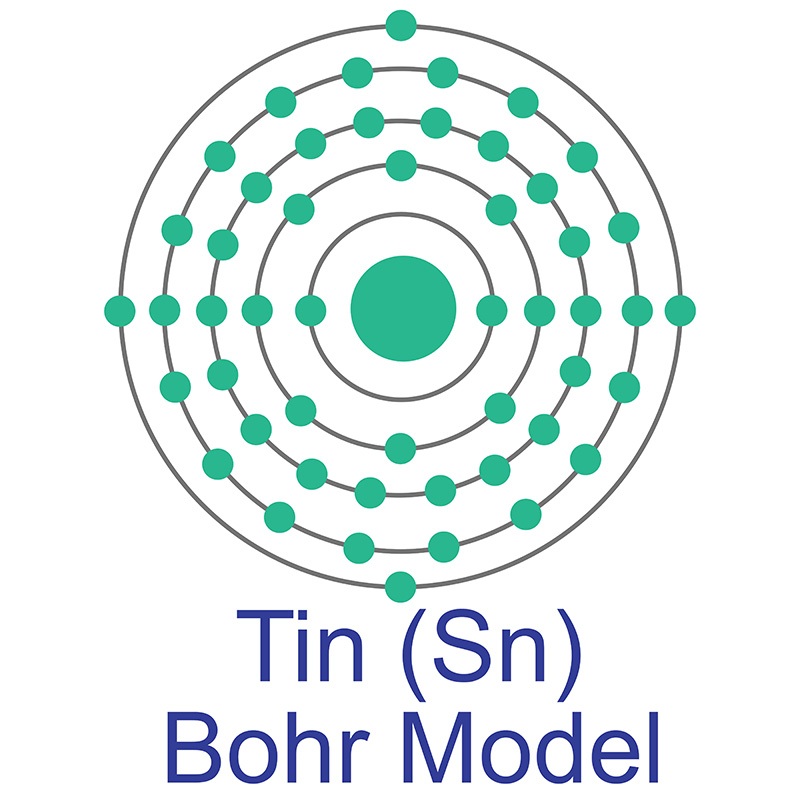
Tin is a Block P, Group 14, Period 5 element. The number of electrons in each of Tin's shells is 2, 8, 18, 18, 4 and its electronic configuration is [Kr] 4d10 5s2 5p2. In its elemental form tin's CAS number is 7440-31-5. The tin atom has a radius of 140.5.pm and it's Van der Waals radius is 217.pm. Organometallic compounds of tin are very toxic and tin salts are also considered to be toxic. Tin as single atoms or molecules are not toxic. Tin compounds sprayed onto glass are used to produce electrically conductive coatings. These have been used for panel lighting and for frost-free windshields. Most window glass is now made by floating molten glass on molten tin (float glass) to produce a flat surface. Crystalline tin-niobium alloy is superconductive at very low temperatures. This promises to be important in the construction of superconductive magnets that generate enormous field strengths but use practically no power. Tin is the basis for many eutectic alloys and the discovery by early man that copper could be better formed and crafted if tin were added producing the first bronze and launching what we refer to as the "Bronze Age" and the first Neolithic metal tools, cooking utensils, and jewelry produced from rudimentary bronze. An important tin compound is the chloride, which is used as a reducing agent and as a mordant in calico printing. Tin is also used in various metal alloys (See AE Alloys). Tin was first discovered by Early Man.The origin of the word tin comes from the Latin word Stannum which translates to the Anglo-Saxon word tin.
See Tin research below.
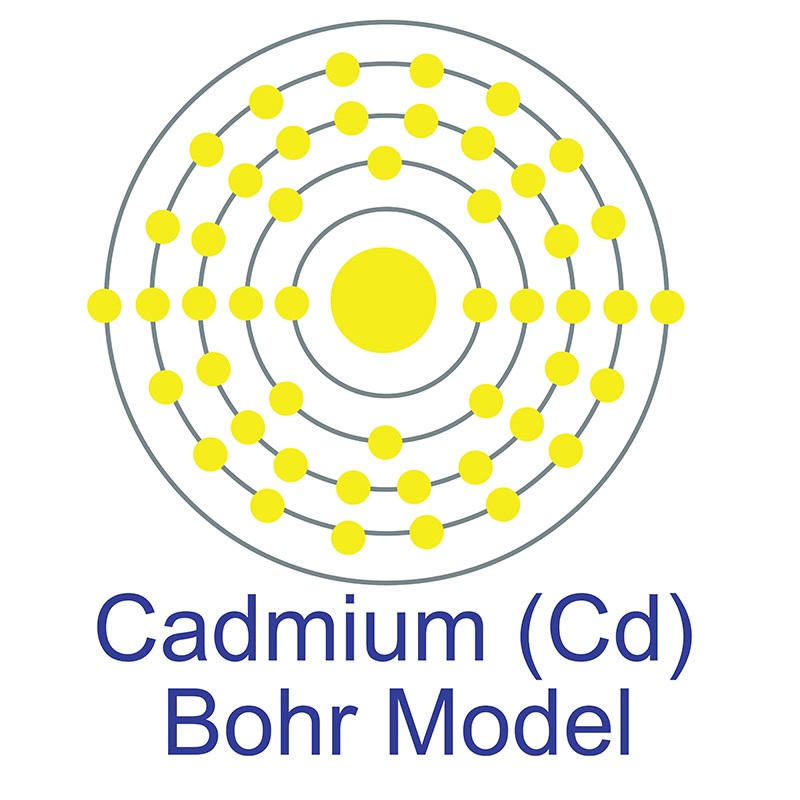
Cadmium is a Block D, Group 12, Period 5 element. The number of electrons in each of Cadmium's shells is 2, 8, 18, 18, 2 and its electronic configuration is [Kr] 4d10 5s2. In its elemental form cadmium's CAS number is 7440-43-9. The cadmium atom has a radius of 148.9.pm and it's Van der Waals radius is 158.pm. Cadmium is a component of some of the lowest melting alloys; it is used in bearing alloys with low coefficients of friction and great resistance to fatigue. Cadmium is used extensively in electroplating, which accounts for about 60% of its use. It is also used in many types of solder, for standard E.M.F.. cells, for nickel-cadmium batteries, and as a barrier to control nuclear fission. Cadmium compounds are used in black and white television phosphors and in blue and green phosphors for color television tubes and CRT monitors. Cadmium in glass and ceramic glazes creates a distinctive cadmium yellow. It forms a number of compounds, of which the sulfate is most common; the sulfide is used as a yellow pigment. Cadmium is similar to carbon in that it has a capacity to form stable covalently bonded molecular networks. Cadmium and its compounds are extremely toxic. Cadmium was first discovered by Fredrich Stromeyer in 1817. See Cadmium research below. It forms a number of compounds, of which the sulfate is most common; the sulfide is used as a yellow pigment. Cadmium is similar to carbon in that it has a capacity to form stable covalently bonded molecular networks. The name Cadmium originates from the Latin word 'cadmia' and the Greek word 'kadmeia'. See Cadmium research below.
PACKAGING SPECIFICATIONS FOR BULK & RESEARCH QUANTITIES
Typical bulk packaging includes palletized plastic 5 gallon/25 kg. pails, fiber and steel drums to 1 ton super sacks in full container (FCL) or truck load (T/L) quantities. Research and sample quantities and hygroscopic, oxidizing or other air sensitive materials may be packaged under argon or vacuum. Shipping documentation includes a Certificate of Analysis and Material Safety Data Sheet (MSDS). Solutions are packaged in polypropylene, plastic or glass jars up to palletized 440 gallon liquid totes.
Helicobacter pylori antibiotic resistance in Brazil: clarithromycin is still a good option.
Jaime Natan E, Silva FM, Barbuti RC, Navarro-Rodriguez T, Moraes-Filho JP, Pedrazzoli J Jr.
Arq Gastroenterol. 2011 Dec;48(4):261-4.
PMID:
22147131
[PubMed - in process]
Towards better photocatalysts: first-principles studies of the alloying effects on the photocatalytic activities of bismuth oxyhalides under visible light.
Zhang H, Liu L, Zhou Z.
Phys Chem Chem Phys. 2011 Dec 7. [Epub ahead of print]
PMID:
22146949
[PubMed - as supplied by publisher]
A stannum-bismuth composite film electrode for simultaneous determination of zinc(ii) and cadmium(ii) using differential pulse anodic stripping voltammetry.
Li NB, Zhu WW, Luo JH, Luo HQ.
Analyst. 2011 Dec 6. [Epub ahead of print]
PMID:
22145153
[PubMed - as supplied by publisher]
Conductive scanning probe microscopy of nanostructured Bi(2)Te(3).
Souier T, Li G, Santos S, Stefancich M, Chiesa M.
Nanoscale. 2011 Dec 6. [Epub ahead of print]
PMID:
22143255
[PubMed - as supplied by publisher]
Near-infrared ultrabroadband luminescence spectra properties of subvalent bismuth in CsI halide crystals.
Su L, Zhao H, Li H, Zheng L, Ren G, Xu J, Ryba-Romanowski W, Lisiecki R, Solarz P.
Opt Lett. 2011 Dec 1;36(23):4551-3. doi: 10.1364/OL.36.004551.
PMID:
22139239
[PubMed - in process]
Bismuth Shields for CT Dose Reduction: Do They Help or Hurt?
McCollough CH, Wang J, Berland LL.
J Am Coll Radiol. 2011 Dec;8(12):878-9. No abstract available.
PMID:
22137008
[PubMed - in process]
Treatment and diagnostic accuracy of neurosyphilis at Boston City Hospital's Neurological Unit, 1930-1979.
Patterson D, Vilensky JA, Robertson WM, Berger J.
J Neurol Sci. 2011 Nov 29. [Epub ahead of print]
PMID:
22129939
[PubMed - as supplied by publisher]
Three novel Bi(iii) complexes with in situ generated anilate ligands: unusual oxidation of cyclohexanedione to dihydroxy benzoquinone.
Gao H, Zhang XM.
Dalton Trans. 2011 Nov 29. [Epub ahead of print]
PMID:
22124341
[PubMed - as supplied by publisher]
Microfabricated disposable lab-on-a-chip sensors with integrated bismuth microelectrode arrays for voltammetric determination of trace metals.
Kokkinos C, Economou A, Raptis I.
Anal Chim Acta. 2012 Jan 13;710:1-8. Epub 2011 Nov 3.
PMID:
22123106
[PubMed - in process]
Novel in situ N-Doped (BiO)2CO3 Hierarchical Microspheres Self-Assembled by Nanosheets as Efficient and Durable Visible Light Driven Photocatalyst.
Dong F, Sun Y, Fu M, Ho WK, Lee SC, Wu Z.
Langmuir. 2011 Nov 28. [Epub ahead of print]
PMID:
22122119
[PubMed - as supplied by publisher]
From {Bi(22) O(26) } to Chiral Ligand-Protected {Bi(38) O(45) }-Based Bismuth Oxido Clusters.
Mansfeld D, Miersch L, Rüffer T, Schaarschmidt D, Lang H, Böhle T, Troff RW, Schalley CA, Müller J, Mehring M.
Chemistry. 2011 Nov 25. doi: 10.1002/chem.201102437. [Epub ahead of print]
PMID:
22120957
[PubMed - as supplied by publisher]
Status of development of gamma-ray detector response function code or GAMDRF.
Li F, Han X.
Appl Radiat Isot. 2011 Nov 18. [Epub ahead of print]
PMID:
22118837
[PubMed - as supplied by publisher]
Metronidazole-based quadruple versus standard triple therapy: which is better as first-line therapy for Helicobacter pylori eradication?
Suzuki H, Matsuzaki J, Hibi T.
Expert Rev Clin Pharmacol. 2011 Sep;4(5):579-82.
PMID:
22114887
[PubMed - in process]
Characteristics of rational harmonic mode-locked short-cavity fiber ring laser using a bismuth-oxide-based erbium-doped fiber and a bismuth-oxide-based highly nonlinear fiber.
Fukuchi Y, Maeda J.
Opt Express. 2011 Nov 7;19(23):22502-9. doi: 10.1364/OE.19.022502.
PMID:
22109128
[PubMed - in process]
Fabrication and supercontinuum generation in dispersion flattened bismuth microstructured optical fiber.
Zhang WQ, Ebendorff-Heidepriem H, Monro TM, Afshar V S.
Opt Express. 2011 Oct 24;19(22):21135-44. doi: 10.1364/OE.19.021135.
PMID:
22108964
[PubMed - in process]
Structural motifs in phenylbismuth heterocyclic carboxylates - secondary interactions leading to oligomers.
Anjaneyulu O, Maddileti D, Kumara Swamy KC.
Dalton Trans. 2011 Nov 21. [Epub ahead of print]
PMID:
22105914
[PubMed - as supplied by publisher]
Influences of Oxygen Pressure on Optical Properties and Interband Electronic Transitions in Multiferroic Bismuth Ferrite Nanocrystalline Films Grown by Pulsed Laser Deposition.
Jiang K, Zhu J, Wu J, Sun J, Hu Z, Chu J.
ACS Appl Mater Interfaces. 2011 Nov 21. [Epub ahead of print]
PMID:
22103473
[PubMed - as supplied by publisher]
Hydride generation in-atomizer collection atomic absorption spectrometry for the determination of antimony in acetic acid leachates from pewter cups.
Dessuy MB, Kratzer J, Vale MG, Welz B, Dedina J.
Talanta. 2011 Dec 15;87:255-61. Epub 2011 Oct 17.
PMID:
22099676
[PubMed - in process]
Preparation and characterization of bismuth oxide nanoparticles-multiwalled carbon nanotube composite for the development of horseradish peroxidase based H(2)O(2) biosensor.
Periasamy AP, Yang S, Chen SM.
Talanta. 2011 Dec 15;87:15-23. Epub 2011 Oct 5.
PMID:
22099642
[PubMed - in process]
Etiopathogenetic principles and peptic ulcer disease classification.
Tytgat GN.
Dig Dis. 2011;29(5):454-8. Epub 2011 Nov 16.
PMID:
22095009
[PubMed - in process]
RECONSTRUCTION OF THE THUMB WITH A MODIFIED WRAP-AROUND FLAP IN A PATIENT SUFFERING FROM ?-THALASSEMIA MINOR.
Galeano M, Checcucci G, Ceruso M.
Hand Surg. 2011;16(3):361-5.
PMID:
22072476
[PubMed - in process]
Isolated complete volar dislocation of the capitate: a case report.
Checcucci G, Bigazzi P, Zucchini M, Ceruso M.
Hand Surg. 2011;16(3):353-6.
PMID:
22072474
[PubMed - in process]
Dielectrophoretic chip with multilayer electrodes and micro-cavity array for trapping and programmably releasing single cells.
Chuang CH, Huang YW, Wu YT.
Biomed Microdevices. 2011 Nov 10. [Epub ahead of print]
PMID:
22072154
[PubMed - as supplied by publisher]
Structures of medium sized tin cluster anions.
Wiesel A, Drebov N, Rapps T, Ahlrichs R, Schwarz U, Kelting R, Weis P, Kappes MM, Schooss D.
Phys Chem Chem Phys. 2011 Nov 9. [Epub ahead of print]
PMID:
22071636
[PubMed - as supplied by publisher]
Discrimination task reveals differences in neural bases of tinnitus and hearing impairment.
Husain FT, Pajor NM, Smith JF, Kim HJ, Rudy S, Zalewski C, Brewer C, Horwitz B.
PLoS One. 2011;6(10):e26639. Epub 2011 Oct 31.
PMID:
22066003
[PubMed - in process]
A suggested technique for the application of the cone beam computed tomography periapical index.
Esposito S, Cardaropoli M, Cotti E.
Dentomaxillofac Radiol. 2011 Dec;40(8):506-12.
PMID:
22065800
[PubMed - in process]
(4-Chloro-3-nitro-benzoato)triphenyl-tin(IV).
Win YF, Choong CS, Teoh SG, Quah CK, Fun HK.
Acta Crystallogr E Struct Rep Online. 2011 Sep 1;67(Pt 9):m1270-1. Epub 2011 Aug 27.
PMID:
22065496
[PubMed]
Bis{2-[(E)-(5-tert-butyl-2-hy-droxy-phen-yl)diazen-yl]benzoato}dimethyl-tin(IV).
Basu Baul TS, Paul A, Tiekink ER.
Acta Crystallogr E Struct Rep Online. 2011 Oct 1;67(Pt 10):m1383-4. Epub 2011 Sep 14.
PMID:
22065466
[PubMed]
catena-Poly[[triphenyl-tin(IV)]-?-5-amino-2-nitro-benzoato-?O:O].
Win YF, Choong CS, Teoh SG, Quah CK, Fun HK.
Acta Crystallogr E Struct Rep Online. 2011 Sep 1;67(Pt 9):m1276-7. Epub 2011 Aug 27.
PMID:
22064934
[PubMed]
Dual detection strategy for electrochemical analysis of glucose and nitrite using a partitionally modified electrode.
Wang J, Diao P, Zhang Q.
Analyst. 2011 Nov 7. [Epub ahead of print]
PMID:
22064849
[PubMed - as supplied by publisher]
fac-(2-Amido-ethyl-?C,O)trichlorido(urea-?O)tin(IV).
Howie RA, de Lima GM, Tiekink ER, Wardell JL, Wardell SM.
Acta Crystallogr E Struct Rep Online. 2011 Oct 1;67(Pt 10):m1420-1. Epub 2011 Sep 30.
PMID:
22064619
[PubMed]
Highly sensitive nonenzymatic glucose sensor based on electrospun copper oxide-doped nickel oxide composite microfibers.
Cao F, Guo S, Ma H, Yang G, Yang S, Gong J.
Talanta. 2011 Oct 30;86:214-20. Epub 2011 Sep 8.
PMID:
22063533
[PubMed - in process]
Cross-Linked Perylene Diimide-Based n-Type Interfacial Layer for Inverted Organic Photovoltaic Devices.
Hains AW, Chen HY, Reilly TH, Gregg BA.
ACS Appl Mater Interfaces. 2011 Nov 7. [Epub ahead of print]
PMID:
22059439
[PubMed - as supplied by publisher]
Bis-(chloro-acetato-?O)bis(trimethyl-silylmethyl)tin(IV).
Ding RF, Wang QB.
Acta Crystallogr E Struct Rep Online. 2011 Sep 1;67(Pt 9):m1190. Epub 2011 Aug 2.
PMID:
22058841
[PubMed]
A new langbeinite-type phosphate: K(2)AlSn(PO(4))(3).
Li HY, Zhao D.
Acta Crystallogr E Struct Rep Online. 2011 Oct 1;67(Pt 10):i56. Epub 2011 Sep 20.
PMID:
22058680
[PubMed]
Enhanced resistance of yeast mutants deficient in low-affinity iron and zinc transporters to stannous-induced toxicity.
Viau CM, Cardone JM, Guecheva TN, Yoneama ML, Dias JF, Pungartnik C, Brendel M, Saffi J, Henriques JA.
Chemosphere. 2011 Nov 2. [Epub ahead of print]
PMID:
22055569
[PubMed - as supplied by publisher]
Allylsilanes in "Tin-free" Oximation, Alkenylation, and Allylation of Alkyl Halides.
Rouquet G, Robert F, Méreau R, Castet F, Landais Y.
Chemistry. 2011 Nov 3. doi: 10.1002/chem.201101842. [Epub ahead of print]
PMID:
22052660
[PubMed - as supplied by publisher]
Surface Modification of Indium-Tin-Oxide Via Self-Assembly of a Donor-Acceptor Complex: A Density Functional Theory Study.
Li H, Winget P, Bredas JL.
Adv Mater. 2011 Nov 3. doi: 10.1002/adma.201103009. [Epub ahead of print] No abstract available.
PMID:
22052626
[PubMed - as supplied by publisher]
Minimally invasive video-assisted cardiac surgery: operative techniques, application fields and clinical outcomes.
Vistarini N, Aiello M, Viganò M.
Future Cardiol. 2011 Nov;7(6):775-87.
PMID:
22050064
[PubMed - in process]
Gadolinium chloride pretreatment ameliorates acute cadmium-induced hepatotoxicity.
Kyriakou LG, Tzirogiannis KN, Demonakou MD, Kourentzi KT, Mykoniatis MG, Panoutsopoulos GI.
Toxicol Ind Health. 2011 Dec 15. [Epub ahead of print]
PMID:
22173957
[PubMed - as supplied by publisher]
In vitro-cultured wheat spikes provide a simplified alternative for studies of cadmium uptake in developing grains.
Ganeshan S, Leis M, Drinkwater JM, Madsen LT, Jain JC, Chibbar RN.
J Sci Food Agric. 2011 Dec 16. doi: 10.1002/jsfa.5540. [Epub ahead of print]
PMID:
22173723
[PubMed - as supplied by publisher]
Evaluation of physiological importance of metallothionein protein expressed by Tetrahymena cadmium metallothionein 1 (TMCd1) gene in Escherichia coli.
Suleman A, Shakoori AR.
J Cell Biochem. 2011 Dec 15. doi: 10.1002/jcb.24030. [Epub ahead of print]
PMID:
22173614
[PubMed - as supplied by publisher]
Kinetic, Equilibrium and Thermodynamic Studies of Cadmium (II) Adsorption by Modified Agricultural Wastes.
Al Othman ZA, Hashem A, Habila MA.
Molecules. 2011 Dec 15;16(12):10443-56.
PMID:
22173337
[PubMed - in process]
Photochemical synthesis of N-adamantylhomoallylamines through addition of cyclic olefins to imines catalyzed by alumina grafted cadmium sulfide.
Aldemir M, Heinemann FW, Kisch H.
Photochem Photobiol Sci. 2011 Dec 14. [Epub ahead of print]
PMID:
22170328
[PubMed - as supplied by publisher]
Evaluation of the toxic effects of arsenite, chromate, cadmium, and copper using a battery of four bioassays.
Ko KS, Lee PK, Kong IC.
Appl Microbiol Biotechnol. 2011 Dec 15. [Epub ahead of print]
PMID:
22170103
[PubMed - as supplied by publisher]
Glutathione degradation is a key determinant of glutathione homeostasis.
Baudouin-Cornu P, Lagniel G, Kumar C, Huang ME, Labarre J.
J Biol Chem. 2011 Dec 13. [Epub ahead of print]
PMID:
22170048
[PubMed - as supplied by publisher]
[Cacoa and dark chocolate in cardiovascular prevention?].
Belz GG, Mohr-Kahaly S.
Dtsch Med Wochenschr. 2011 Dec;136(51-52):2657-63. Epub 2011 Dec 14. German.
PMID:
22169919
[PubMed - in process]
Do toxic heavy metals affect antioxidant defense mechanisms in humans?
Wieloch M, Kaminski P, Ossowska A, Koim-Puchowska B, Stuczynski T, Kuligowska-Prusinska M, Dymek G, Mankowska A, Odrowaz-Sypniewska G.
Ecotoxicol Environ Saf. 2011 Dec 12. [Epub ahead of print]
PMID:
22169892
[PubMed - as supplied by publisher]
Gender differences for associations between circulating levels of metals and coronary risk in the elderly.
Olsén L, Lind PM, Lind L.
Int J Hyg Environ Health. 2011 Dec 8. [Epub ahead of print]
PMID:
22169700
[PubMed - as supplied by publisher]
Differential toxicity of cadmium to mustard (Brassica juncia L.) genotypes under higher metal levels.
Bauddh K, Singh RP.
J Environ Biol. 2011 May;32(3):355-62.
PMID:
22167949
[PubMed - in process]
[Cd uptake in rice cultivars and Cd fractions in soil treated with organic acids and EDTA].
Zhang HB, Li YR, Xu WH, Chen GQ, Wang HX, Han GQ, Zhang XJ, Xiong ZT, Zhang JZ, Xie DT.
Huan Jing Ke Xue. 2011 Sep;32(9):2625-31. Chinese.
PMID:
22165231
[PubMed - in process]
Short-term effects of compost amendment on the fractionation of cadmium in soil and cadmium accumulation in rice plants.
Juang KW, Ho PC, Yu CH.
Environ Sci Pollut Res Int. 2011 Dec 9. [Epub ahead of print]
PMID:
22161300
[PubMed - as supplied by publisher]
Cadmium a metalloestrogen: are we convinced?
Silva N, Peiris-John R, Wickremasinghe R, Senanayake H, Sathiakumar N.
J Appl Toxicol. 2011 Dec 12. doi: 10.1002/jat.1771. [Epub ahead of print]
PMID:
22161274
[PubMed - as supplied by publisher]
Heterologous Expression of a Nelumbo nucifera Phytochelatin Synthase Gene Enhances Cadmium Tolerance in Arabidopsis thaliana.
Liu Z, Gu C, Chen F, Yang D, Wu K, Chen S, Jiang J, Zhang Z.
Appl Biochem Biotechnol. 2011 Dec 9. [Epub ahead of print]
PMID:
22161260
[PubMed - as supplied by publisher]
Low-affinity cation transporter (OsLCT1) regulates cadmium transport into rice grains.
Uraguchi S, Kamiya T, Sakamoto T, Kasai K, Sato Y, Nagamura Y, Yoshida A, Kyozuka J, Ishikawa S, Fujiwara T.
Proc Natl Acad Sci U S A. 2011 Dec 12. [Epub ahead of print]
PMID:
22160725
[PubMed - as supplied by publisher]
Heavy metal contamination in feathers of Western Reef Heron (Egretta gularis) and Siberian gull (Larus heuglini) from Hara biosphere reserve of Southern Iran.
Mansouri B, Babaei H, Hoshyari E.
Environ Monit Assess. 2011 Dec 9. [Epub ahead of print]
PMID:
22160473
[PubMed - as supplied by publisher]
Metal Concentrations in Surface Sediments of Beyler Reservoir (Turkey).
Findik O, Turan MA.
Bull Environ Contam Toxicol. 2011 Dec 9. [Epub ahead of print]
PMID:
22160166
[PubMed - as supplied by publisher]
Evaluation of genotoxic effects of lead in pottery-glaze workers using micronucleus assay, alkaline comet assay and DNA diffusion assay.
Kasuba V, Rozgaj R, Milic M, Zeljezic D, Kopjar N, Pizent A, Kljakovic-Gaspic Z, Jazbec A.
Int Arch Occup Environ Health. 2011 Dec 9. [Epub ahead of print]
PMID:
22160131
[PubMed - as supplied by publisher]
Two-dimensional assembly of tetrahedral chalcogenide clusters with tetrakis(imidazolyl)borate ligands.
Chen Z, Luo D, Luo X, Kang M, Lin Z.
Dalton Trans. 2011 Dec 12. [Epub ahead of print]
PMID:
22159355
[PubMed - as supplied by publisher]