American Elements Logo and U.S. Registered Trademark


Cerium Gadolinium Sputtering Target
High Purity Ce - Gd Sputtering Target
7440-45-1
Product Product Code Order or Specifications
(2N) 99% Cerium Gadolinium Sputtering Target CE-GD-02-ST Contact American Elements
(2N5) 99.5% Cerium Gadolinium Sputtering Target CE-GD-025-ST Contact American Elements
(3N) 99.9% Cerium Gadolinium Sputtering Target CE-GD-03-ST Contact American Elements
(3N5) 99.95% Cerium Gadolinium Sputtering Target CE-GD-035-ST Contact American Elements
(4N) 99.99% Cerium Gadolinium Sputtering Target CE-GD-04-ST Contact American Elements
(5N) 99.999% Cerium Gadolinium Sputtering Target CE-GD-05-ST Contact American Elements
See safety data and research below. American Elements specializes in producing high purity Cerium Gadolinium Sputtering Targets with the highest possible density High Purity (99.99%) Metallic Sputtering Targetand smallest possible average grain sizes for use in semiconductor, chemical vapor deposition (CVD) and physical vapor deposition (PVD) display and optical applications. Our standard Sputtering Targets for thin film are available monoblock or bonded with dimensions and configurations up to 820 mm with hole drill locations and threading, beveling, grooves and backing designed to work with both older sputtering devises as well as the latest process equipment, such as large area coating for solar energy or fuel cells and flip-chip applications. Research sized targets are also produced as well as custom sizes and alloys. All targets are analyzed using best demonstrated techniques including X-Ray Fluorescence (XRF), Glow Discharge Mass Spectrometry (GDMS), and Inductively Coupled Plasma (ICP). "Sputtering" allows for thin film deposition of an ultra high purity sputtering metallic or oxide material onto another solid substrate by the controlled removal and conversion of the target material into a directed gaseous/plasma phase through ionic bombardment. We can also provide targets outside this range in addition to just about any size rectangular, annular, or oval target. Materials are produced using crystallization, solid state and other ultra high purification processes such as sublimation. American Elements specializes in producing custom compositions for commercial and research applications and for new proprietary technologies. American Elements also casts any of the rare earth metals and most other advanced materials into rod, bar or plate form, as well as other machined shapes and through other processes such as nanoparticles (See also application discussion at Nanotechnology Information and at Quantum Dots) and in the form of solutions and organometallics. We also produce Cerium Metal as disc, granules, ingot, pellets, pieces, powder, and rod. Other shapes are available by request.

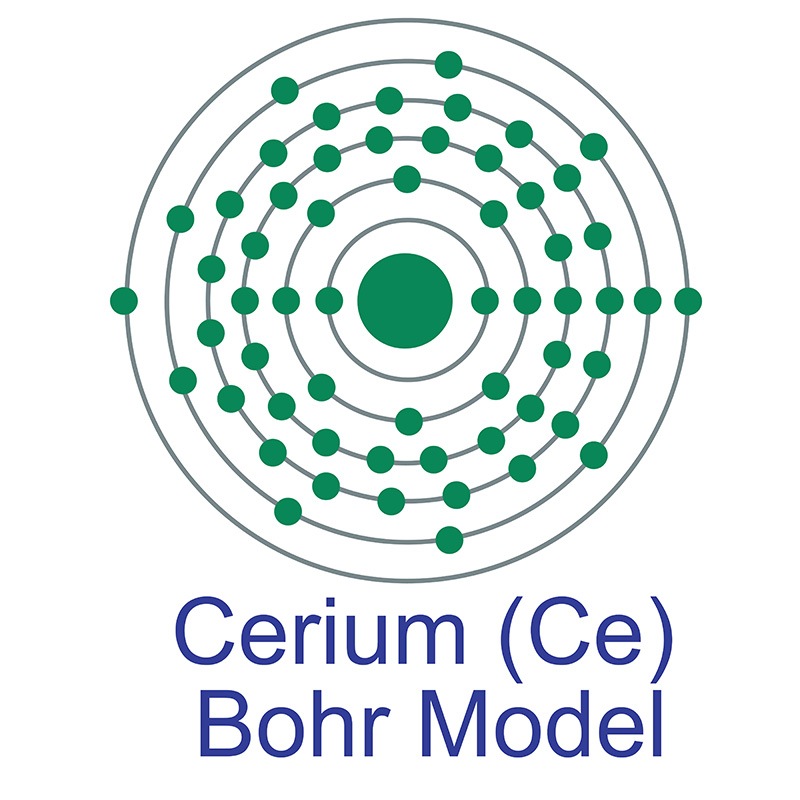
Cerium(Ce) atomic and molecular weight, atomic number and elemental symbolCerium is a Block F, Group 3, Period 6 element. The number of electrons in each of Cerium's shells is 2, 8, 18, 19, 9, 2 and its electronic configuration is [Xe]4f2 6s2. In its elemental form cerium's CAS number is 7440-45-1. The cerium atom has a radius of 182.5.pm and it's Van der Waals radius is 181.pm. Cerium is moderately toxic. Cerium is one of the products manufactured and distributed under the tradename AE Rare Earths. Cerium is the most abundant of the rare earths metals. It is characterized chemically by having two valence states , the +3 cerous and +4 ceric states. The ceric state is the only non-trivalent rare earth ion stable in aqueousCerium Bohr Model solutions.It is, therefore,Elemental Cerium strongly acidic and moderately toxic. It is also a strong oxidizer.The cerous state closely resembles the other trivalent rare earths. The numerous commercial applications for cerium include metallurgy, glass and glass polishing, ceramics, catalysts, as the electrolyte for solid oxide fuel cells when doped with yttrium, gadolinium or samarium and in phosphors. In steel manufacturing it is used to remove free oxygen and sulfur by forming stable oxysulfides and by tying up undesirable trace elements, such as lead and antimony. It is considered to be the most efficient glass polishing agent for precision optical polishing. It is also used to decolor glass by keeping iron in its ferrous state. The ability of cerium-doped glass to block out ultra violet light is utilized in the manufacturing of medical glassware and aerospace windows. It is also used to prevent polymers from darkening in sunlight and to suppress discoloration of television glass. Cerium was first discovered by W. von Hisinger in 1903. The element was named after the asteroid Ceres. See Cerium research below.

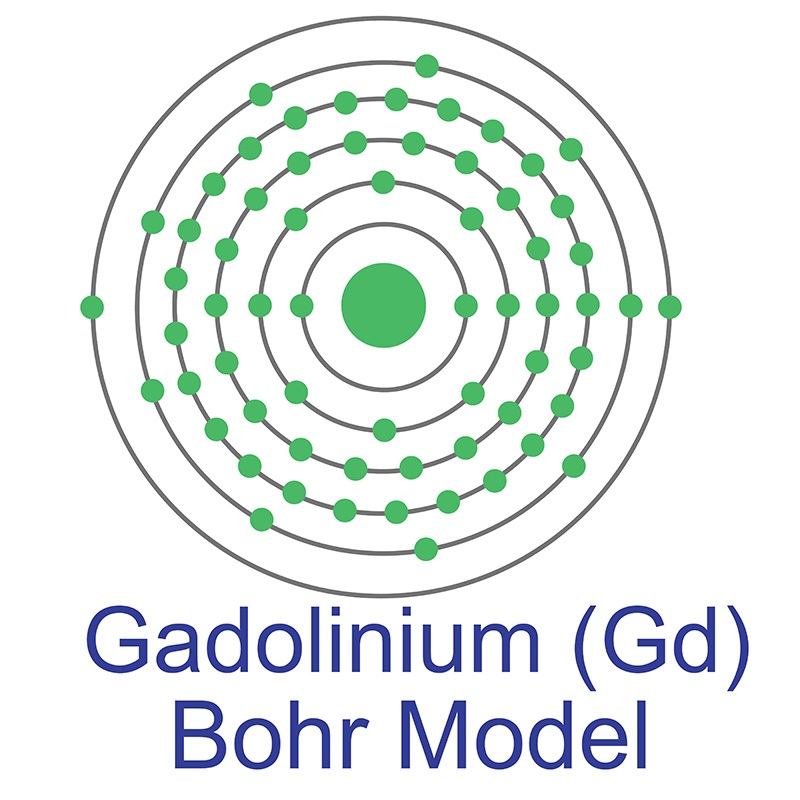
Gadolinium(Gd) atomic and molecular weight, atomic number and elemental symbolGadolinium is a Block F, Group 3, Period 6 element. The number of electrons in each of Gadolinium's shells is 2, 8, 18, 25, 9, 2 and its electronic configuration is [Xe] 4f7 5d1 6s2. In its elemental form gadolinium's CAS number is 7440-54-2. The gadolinium atom has a radius of 178.7.pm and it's Van der Waals radius is unknown. Gadolinium is very toxic. Gadolinium is utilized for both its high magnetic moment (7.94µB) and in phosphors and Gadolinium Bohr Modelscintillator material. When complexed with EDTA ligands, it is used as an injectable contrast agent for patients undergoing magnetic resonance imaging. With its high magnetic moment, gadolinium can reduce relaxation times and thereby enhance signal intensity. The extra stable half-full 4f electron shell with no low lying energy levels creates applications as an inert phosphor host. Gadolinium can therefore act as hosts for x-ray cassettes and in scintillator materials for computer tomography. Gadolinium is available as metal and compounds Elemental Gadoliniumwith purities from 99% to 99.999% (ACS grade to ultra-high purity); metals in the form of foil, sputtering target, and rod, and compounds as submicron and nanopowder. Gadolinium was first discovered by Jean de Marignac in 1880. The element is named after the Finnish chemist and geologist Johan Gadolin. See Gadolinium research below.

Formula CAS No. Appearance Molecular Weight Density Melting Point Boiling Point Solubility Stability
Ce 7440-45-1 Silvery 140.12 6689 kg/m³ 795 °C 3360 °C N/A Easy oxidized in the air.
PRODUCT CATALOG Cerium Products Metals News Cerium Research, Properties, & Information Foil Submicron & Nanopowder Tolling Ultra High Purity Sputtering Target Crystal Growth Rod, Plate, Powder, etc. MSDS Home

Have a Question? Ask a Chemical Engineer or Material Scientist   Request an MSDS or Certificate of Analysis


Search by Material, Product Name, Product Code, CAS Number, Formula, Element, Anion, Form, EC Number, MDL Number or PubChem ID.


German   Korean   French   Japanese   Spanish   Chinese (Simplified)   Portuguese   Russian   Chinese (Taiwan)  Italian   Turkish   Polish   Dutch   Czech   Swedish   Hungarian   Danish   Hebrew

Production Catalog Available in 36 Countries & Languages

PACKAGING SPECIFICATIONS FOR BULK & RESEARCH QUANTITIES


Typical bulk packaging includes palletized plastic 5 gallon/25 kg. pails, fiber and steel drums to 1 ton super sacks in full container (FCL) or truck load (T/L) quantities. Research and sample quantities and hygroscopic, oxidizing or other air sensitive materials may be packaged under argon or vacuum. Shipping documentation includes a Certificate of Analysis and Material Safety Data Sheet (MSDS). Solutions are packaged in polypropylene, plastic or glass jars up to palletized 440 gallon liquid totes.


Show me more forms of Cerium
 
Customers for this product have also looked at:

Recent Research & Development for Cerium

  • Ionic liquid mediated routes to polydentate oxygen-donor adducts of cerium(iii) bromide. Vasudevan KV, Smith NA, Scott BL, Bennett BL, Muenchausen RE, Gordon JC. Dalton Trans. 2011 Dec 23. [Epub ahead of print] PMID: 22193947 [PubMed - as supplied by publisher]

  • Selected Trace Elements in the Sacramento River, California: Occurrence and Distribution. Taylor HE, Antweiler RC, Roth DA, Alpers CN, Dileanis P. Arch Environ Contam Toxicol. 2011 Dec 23. [Epub ahead of print] PMID: 22193863 [PubMed - as supplied by publisher]

  • Electrooxidation of nitrite on a silica-cerium mixed oxide carbon paste electrode. Silveira G, Morais AD, Villis PC, Maroneze CM, Gushikem Y, Lucho AM, Pissetti FL. J Colloid Interface Sci. 2011 Dec 6. [Epub ahead of print] PMID: 22192596 [PubMed - as supplied by publisher]

  • Ceria-engineered nanomaterial distribution in, and clearance from, blood: size matters. Dan M, Wu P, Grulke EA, Graham UM, Unrine JM, Yokel RA. Nanomedicine (Lond). 2012 Jan;7(1):95-110. PMID: 22191779 [PubMed - in process]

  • Effect of Ce(3+) on soluble microbial products production in anaerobic granular sludge digestion. Fu B, Liang R, Xia Q, Ding L, Xu K, Ren H. Water Sci Technol. 2011;64(7):1459-65. PMID: 22179643 [PubMed - in process]

  • [Removal of gaseous elemental mercury over cerium doped low vanadium loading V2O5-WO3/TiO2 in simulated coal-fired flue gas]. Wan Q, Duan L, He KB, Chen L, Li JH. Huan Jing Ke Xue. 2011 Sep;32(9):2800-4. Chinese. PMID: 22165254 [PubMed - in process]

  • Operando DRIFTS study of the redox and catalytic properties of CuO/Ce(1-x)Tb(x)O(2-d) (x = 0-0.5) catalysts: evidence of an induction step during CO oxidation. Martínez-Arias A, Hungría AB, Fernández-García M, Iglesias-Juez A, Soria J, Conesa JC, Anderson JA, Munuera G. Phys Chem Chem Phys. 2011 Dec 8. [Epub ahead of print] PMID: 22159154 [PubMed - as supplied by publisher]

  • Classical oxidant induced chemiluminescence of fluorescent carbon dots. Lin Z, Xue W, Chen H, Lin JM. Chem Commun (Camb). 2011 Dec 8. [Epub ahead of print] PMID: 22158939 [PubMed - as supplied by publisher]

  • Gamma-ray fast-timing coincidence measurements from the (18)O+(18)O fusion-evaporation reaction using a mixed LaBr(3)-HPGe array. Alharbi T, Mason PJ, Regan PH, Podolyák Z, Marginean N, Nakhostin M, Bowry M, Bucurescu D, Cata-Danil G, Cata-Danil I, Deleanu D, Filipescu D, Glodariu T, Ghita D, Marginean R, Mihai C, Negret A, Pascu S, Sava T, Stroe L, Suliman G, Zamfir NV, Bruce AM, Rodriguez Triguero C, Bender PC, Garg U, Erduran MN, Kusoglu A, Bostan M, Detistov P, Alkhomashi N, Sinha AK, Chakrabarti R, Ghugre SS. Appl Radiat Isot. 2011 Dec 3. [Epub ahead of print] PMID: 22154387 [PubMed - as supplied by publisher]

  • Cationic Surface Reconstructions on Cerium Oxide Nanocrystals: An Aberration Corrected HRTEM Study. Bhatta UM, Ross IM, Sayle TX, Sayle DC, Parker SC, Reid D, Seal S, Kumar A, Moebus G. ACS Nano. 2011 Dec 13. [Epub ahead of print] PMID: 22148265 [PubMed - as supplied by publisher]

  • In-house SAD phasing with surface-bound cerium ions. Vennila KN, Velmurugan D. Acta Crystallogr Sect F Struct Biol Cryst Commun. 2011 Dec 1;67(Pt 12):1662-5. Epub 2011 Nov 25. PMID: 22139192 [PubMed - in process]

  • High concentrations of cadmium, cerium and lanthanum in indoor air due to environmental tobacco smoke. Böhlandt A, Schierl R, Diemer J, Koch C, Bolte G, Kiranoglu M, Fromme H, Nowak D. Sci Total Environ. 2011 Dec 1. [Epub ahead of print] PMID: 22137652 [PubMed - as supplied by publisher]

  • A cholesterol and actinide dependent shadow biosphere of archaea and viroids in autoimmune diseases. Kurup R, Kurup PA. Immunobiology. 2011 Oct 25. [Epub ahead of print] PMID: 22137029 [PubMed - as supplied by publisher]

  • On the interaction of Mg with the (111) and (110) surfaces of ceria. Nolan M, Lykhach Y, Tsud N, Skála T, Staudt T, Prince KC, Matolín V, Libuda J. Phys Chem Chem Phys. 2011 Dec 14;14(3):1293-301. Epub 2011 Dec 1. PMID: 22134463 [PubMed - in process]

  • Measurement of redox potential in nanoecotoxicological investigations. Tantra R, Cackett A, Peck R, Gohil D, Snowden J. J Toxicol. 2012;2012:270651. Epub 2011 Oct 31. PMID: 22131988 [PubMed - in process]

  • In situ characterization of Pt catalysts supported on ceria modified TiO(2) for the WGS reaction: influence of ceria loading. Barrio L, Zhou G, González ID, Estrella M, Hanson J, Rodriguez JA, Navarro RM, Fierro JL. Phys Chem Chem Phys. 2011 Dec 1. [Epub ahead of print] PMID: 22130010 [PubMed - as supplied by publisher]

  • The oxidation state of Hadean magmas and implications for early Earth's atmosphere. Trail D, Watson EB, Tailby ND. Nature. 2011 Nov 30;480(7375):79-82. doi: 10.1038/nature10655. PMID: 22129728 [PubMed - in process]

  • Preparation methods and thermal stability of Ba-Mn-Ce oxide catalyst for NO(x)-assisted soot oxidation. Wu X, Lin F, Wang L, Weng D, Zhou Z. J Environ Sci (China). 2011;23(7):1205-10. PMID: 22125916 [PubMed - indexed for MEDLINE]

  • The oxidative degradation of dibenzoazepine derivatives by cerium(iv) complexes in acidic sulfate media. Wisniewska J, Wrzeszcz G, Kurzawa M, van Eldik R. Dalton Trans. 2011 Nov 29. [Epub ahead of print] PMID: 22124379 [PubMed - as supplied by publisher]

  • Effect of support size on the catalytic activity of metal-oxide-doped silica particles in the glycolysis of polyethylene terephthalate. Wi R, Imran M, Lee KG, Yoon SH, Cho BG, Kim do H. J Nanosci Nanotechnol. 2011 Jul;11(7):6544-9. PMID: 22121753 [PubMed - in process]

Customers for this product have also looked at:
Gadolinium Oxide Gadolinium Oxide Nanopowder Gadolinium Sputtering Target Gadolinium Oxide Pellets Gadolinium Acetylacetonate
Gadolinium Pellets Gadolinium Powder Gadolinium Acetate Gadolinium Pellets Gadolium Phosphide
Gadolinium Metal Gadolinia Doped Ceria Gadolinium Foil Gadolinium Chloride Gadolinium Nitrate

Recent Research & Development for Gadolinium

  • T(1) assessment of hip joint cartilage following intra-articular gadolinium injection: A pilot study. Bittersohl B, Hosalkar HS, Kim YJ, Werlen S, Trattnig S, Siebenrock KA, Mamisch TC. Magn Reson Med. 2010 Oct;64(4):1200-7. PubMed PMID: 20872764.

  • The time window of MRI of murine atherosclerotic plaques after administration of CB2 receptor targeted micelles: inter-scan variability and relation between plaque signal intensity increase and gadolinium content of inversion recovery prepared versus non-prepared fast spin echo. Te Boekhorst BC, Bovens SM, van de Kolk CW, Cramer MJ, Doevendans PA, Ten Hove M, van der Weerd L, Poelmann R, Strijkers GJ, Pasterkamp G, van Echteld CJ. NMR Biomed. 2010 Oct;23(8):939-51. PubMed PMID: 20878972.

  • Coordination chemistry of amide-functionalised tetraazamacrocycles: structural, relaxometric and cytotoxicity studies. Martinelli J, Balali-Mood B, Panizzo R, Lythgoe MF, White AJ, Ferretti P, Steinke JH, Vilar R. Dalton Trans. 2010 Sep 28. [Epub ahead of print] PubMed PMID: 20877892.

  • Gadolinium released from MR contrast agents is deposited in brain tumors: in situ demonstration using scanning electron microscopy with energy dispersive X-ray spectroscopy. Xia D, Davis RL, Crawford JA, Abraham JL. Acta Radiol. 2010 Sep 26. [Epub ahead of print] PubMed PMID: 20868305.

  • Midregional pro-atrial natriuretic peptide: a novel marker of myocardial fibrosis in patients with hypertrophic cardiomyopathy. Elmas E, Doesch C, Fluechter S, Freundt M, Weiss C, Lang S, Kälsch T, Haghi D, Papassotiriou J, Kunde J, Schoenberg SO, Borggrefe M, Papavassiliu T. Int J Cardiovasc Imaging. 2010 Sep 26. [Epub ahead of print] PubMed PMID: 20872251.

  • Translocator Protein PET Imaging for Glial Activation in Multiple Sclerosis. Oh U, Fujita M, Ikonomidou VN, Evangelou IE, Matsuura E, Harberts E, Ohayon J, Pike VW, Zhang Y, Zoghbi SS, Innis RB, Jacobson S. J Neuroimmune Pharmacol. 2010 Sep 25. [Epub ahead of print] PubMed PMID: 20872081.

  • Influence of small caliber coronary arteries on the diagnostic accuracy of adenosine stress cardiac magnetic resonance imaging. Pilz G, Heer T, Graw M, Ali E, Klos M, Scheck R, Zeymer U, Höfling B. Clin Res Cardiol. 2010 Sep 24. [Epub ahead of print] PubMed PMID: 20862587.

  • Reference region-based pharmacokinetic modeling in quantitative dynamic contract-enhanced MRI allows robust treatment monitoring in a rat liver tumor model despite cardiovascular changes. Steingoetter A, Svensson J, Kosanke Y, Botnar RM, Schwaiger M, Rummeny E, Braren R. Magn Reson Med. 2010 Sep 24. [Epub ahead of print] PubMed PMID: 20872863.

  • Comparison of half-dose and full-dose gadolinium MR contrast on the enhancement of bone and soft tissue tumors. Costelloe CM, Murphy WA Jr, Haygood TM, Kumar R, McEnery KW, Stafford RJ, Roy A, Bassett RL Jr, Harrell RK, Madewell JE. Skeletal Radiol. 2010 Sep 24. [Epub ahead of print] PubMed PMID: 20862469.

  • Gd-EOB-DTPA enhanced MR imaging: Evaluation of biliary and renal excretion in normal and cirrhotic livers. Tamada T, Ito K, Sone T, Kanki A, Sato T, Higashi H. Eur J Radiol. 2010 Sep 23. [Epub ahead of print] PubMed PMID: 20869827.

  • Increases in the number of brain metastases detected at frame-fixed, thin-slice MRI for gamma knife surgery planning. Nagai A, Shibamoto Y, Mori Y, Hashizume C, Hagiwara M, Kobayashi T. Neuro Oncol. 2010 Sep 23. [Epub ahead of print] PubMed PMID: 20864500.

  • BOLD cardiovascular magnetic resonance at 3.0 tesla in myocardial ischemia. Manka R, Paetsch I, Schnackenburg B, Gebker R, Fleck E, Jahnke C. J Cardiovasc Magn Reson. 2010 Sep 22;12(1):54. [Epub ahead of print] PubMed PMID: 20860792.

  • Revisiting an old friend: manganese-based MRI contrast agents. Pan D, Caruthers SD, Senpan A, Schmieder AH, Wickline SA, Lanza GM. Wiley Interdiscip Rev Nanomed Nanobiotechnol. 2010 Sep 21. [Epub ahead of print] PubMed PMID: 20860051.

  • Childhood cholesteatoma. Nevoux J, Lenoir M, Roger G, Denoyelle F, Ducou Le Pointe H, Garabédian EN.Eur Ann Otorhinolaryngol Head Neck Dis. 2010 Sep;127(4):143-50. Epub 2010 Aug 11. PubMed PMID: 20860924.

  • Comparison of portal venous and delayed phases of gadolinium-enhanced magnetic resonance imaging study of cirrhotic liver for the detection of contrast washout of hypervascular hepatocellular carcinoma. Cereser L, Furlan A, Bagatto D, Girometti R, Como G, Avellini C, Orsaria M, Zuiani C, Bazzocchi M. J Comput Assist Tomogr. 2010 Sep-Oct;34(5):706-11. PubMed PMID: 20861773.

  • Three-dimensional multiphase time-resolved low-dose contrast-enhanced magnetic resonance angiography using TWIST on a 32-channel coil at 3 T: a quantitative and qualitative comparison of a conventional gadolinium chelate with a high-relaxivity agent. Giesel FL, Runge V, Kirchin M, Mehndiratta A, Gerigk L, Corell B, von Gall C, Kauczor HU, Essig M. J Comput Assist Tomogr. 2010 Sep-Oct;34(5):678-83. PubMed PMID: 20861769.

  • [Accessory nerve schwannoma of the intracisternal type: a case report.]. Sadatomo T, Yuki K, Migita K, Hidaka T, Kurisu K. No Shinkei Geka. 2010 Sep;38(9):831-7. Japanese. PubMed PMID: 20864772.

  • Use of cardiac magnetic resonance imaging to evaluate cardiac structure, function and fibrosis in children with infantile Pompe disease on enzyme replacement therapy. Barker PC, Pasquali SK, Darty S, Ing RJ, Li JS, Kim RJ, Dearmey S, Kishnani PS, Campbell MJ. Mol Genet Metab. 2010 Jul 23. [Epub ahead of print] PubMed PMID: 20875764.

  • Differential diagnosis and prognosis of T1-weighted post-gadolinium intralabyrinthine hyperintensities. Dubrulle F, Kohler R, Vincent C, Puech P, Ernst O. Eur Radiol. 2010 Jun 10. [Epub ahead of print] PubMed PMID: 20862477.
Material Safety Data Sheet
  • 1 Identification of substance

    • Product details

    • Trade name Cerium

  • 2 Composition/Data on components:

    • Chemical characterization:
                 Designation: (CAS#)                                        
      cerium (CAS# 7440-45-1); 100%
    • Identification number(s):
    • EINECS Number: 231-154-9
  • 3 Hazards identification

    • Hazard designation: F Highly flammable
    • Information pertaining to particular dangers for man and environment
      R 11 Highly flammable.
      R 15 Contact with water liberates extremely flammable gases.
  • 4 First aid measures

    • After inhalation
      Supply fresh air. If required, provide artificial respiration. Keep patient warm. Consult doctor if symptoms persist.
      Seek immediate medical advice.
    • After skin contact
      Instantly wash with water and soap and rinse thoroughly.
      Seek immediate medical advice.
    • After eye contact
      Rinse opened eye for several minutes under running water. Then consult doctor.
    • After swallowing Seek immediate medical advice.
  • 5 Fire fighting measures

    • Suitable extinguishing agents
      Special powder for metal fires. Do not use water.
    • For safety reasons unsuitable extinguishing agents
      Water.
      Carbon dioxide
    • Protective equipment:
      Wear self-contained breathing apparatus.
      Wear full protective suit.
  • 6 Accidental release measures

    • Person-related safety precautions:
      Wear protective equipment. Keep unprotected persons away.
      Ensure adequate ventilation
      Keep away from ignition sources
    • Measures for environmental protection:
      Do not allow material to be released to the environment without proper governmental permits.
    • Measures for cleaning/collecting:
      Ensure adequate ventilation.
      Do not flush with water or aqueous cleansing agents
      Keep away from ignition sources.
    • Additional information:
      See Section 7 for information on safe handling
      See section 8 for information on personal protection equipment.
      See Section 13 for information on disposal.
  • 7 Handling and storage


    • Handling
    • Information for safe handling:
      Keep containers tightly sealed.
      Store in cool, dry place in tightly closed containers.
      Ensure good ventilation/exhaustion at the workplace.
    • Information about protection against explosions and fires:
      Keep ignition sources away - Do not smoke.
      Protect against electrostatic charges.

    • Storage
    • Requirements to be met by storerooms and containers:
      Store in cool location.
    • Information about storage in one common storage facility:
      Do not store together with oxidizing and acidic materials.
      Store away from water.
      Store away from air.
    • Further information about storage conditions:
      Keep container tightly sealed.
      Store in cool, dry conditions in well sealed containers.
  • 8 Exposure controls and personal protection

    • Additional information about design of technical systems:
      Properly operating chemical fume hood designed for hazardous chemicals and having an average face velocity of at least 100 feet per minute.

    • Components with critical values that require monitoring at the
      workplace:                                                             
      Not required.
    • Additional information: No data

    • Personal protective equipment
    • General protective and hygienic measures
      The usual precautionary measures should be adhered to in handling the chemicals.
      Keep away from foodstuffs, beverages and food.
      Instantly remove any soiled and impregnated garments.
      Wash hands during breaks and at the end of the work.
    • Breathing equipment: Use breathing protection with high concentrations.
    • Protection of hands: Impervious gloves
    • Eye protection:
      Safety glasses
      Full face protection
      Face protection
    • Body protection: Protective work clothing.
  • 9 Physical and chemical properties:

    • General Information

    • Form: Solid.
    • Colour: Grey
    • Smell: Odourless
    •   Value/Range  Unit    Method      
    • Change in condition
    • Melting point/Melting range:                   795 ° C
    • Boiling point/Boiling range:                  3468 ° C
    • Sublimation temperature / start:   Not determined

    • Flash point:                       Not applicable

    • Inflammability (solid, gaseous)    Highly flammable.
      Contact with water liberates extremely flammable gases.

    • Ignition temperature:              Not determined

    • Decomposition temperature:         Not determined

    • Critical values for explosion:
    • Lower:                             Not determined
    • Upper:                             Not determined

    • Steam pressure:                    Not determined

    • Density                at   20 ° C            6.67 g/cm³

    • Solubility in / Miscibility with
    • Water:                             Not determined
  • 10 Stability and reactivity

    • Thermal decomposition / conditions to be avoided:
      No decomposition if used and stored according to specifications.
    • Materials to be avoided:
      Water/moisture
      Acids
      Oxidizing agents
      Oxygen
    • Dangerous reactions:
      Contact with water releases flammable gases
      Reacts with moist air
      Contact with acids releases flammable gases
      Reacts with oxidizing agents
    • Dangerous products of decomposition: Metal oxide
  • 11 Toxicological information

    • Acute toxicity:
    • Primary irritant effect:
    • on the skin: Irritant for skin and mucous membranes.
    • on the eye: Irritant effect.
    • Sensitization: No sensitizing effect known.
    • Additional toxicological information:
      To the best of our knowledge the acute and chronic toxicity of this substance is not fully known.
      No classification data on carcinogenic properties of this material is available from the EPA, IARC, NTP, OSHA or ACGIH.
  • 12 Ecological information:

    • General notes:
      Do not allow material to be released to the environment without proper governmental permits.
      Water hazard class 1 (Self-assessment): slightly hazardous for water.
      Do not allow undiluted product or large quantities of it to reach ground water, water bodies or sewage system.
  • 13 Disposal considerations


    • Product:
    • Recommendation
      Consult state, local or national regulations for proper disposal.
      Hand over to disposers of hazardous waste.
      Must be specially treated under adherence to official regulations.

    • Uncleaned packagings:
    • Recommendation:
      Disposal must be made according to official regulations.
  • 14 Transport information


    • Land transport ADR/RID and GGVS/GGVE (cross-border/domestic)
    • ADR/RID-GGVS/E Class:     4.1 (F3) Flammable solids.
    • Kemler Number:            40
    • UN-Number:                1333
    • Packaging group:          II
    • Label                     4.1
    • Designation of goods:     1333 CERIUM

    • Maritime transport IMDG/GGVSea:
    • IMDG/GGVSea Class:        4.1
    • UN Number:                1333
    • Label                     4.1
    • Packaging group:          II
    • Correct technical name:   CERIUM

    • Air transport ICAO-TI and IATA-DGR:
    • ICAO/IATA Class:          4.1
    • UN/ID Number:             1333
    • Label                     4.1
    • Packaging group:          II
    • Correct technical name:   CERIUM
  • 15 Regulatory information


    • Designation according to EC guidelines:

    • Code letter and hazard designation of product: F Highly flammable

    • Risk phrases:
      11  Highly flammable.
      15  Contact with water liberates extremely flammable gases.

    • Safety phrases:
      7/8 Keep container tightly closed and dry.
      43  In case of fire, use metallic extinguishing powder. Never use water.

    • National regulations

    • Information about limitation of use:
      For use only by technically qualified individuals.
      Employment restrictions concerning young persons must be observed.

    • Water hazard class:
      Water hazard class 1 (Self-assessment): slightly hazardous for water.
  • 16 Other information:

      Employers should use this information only as a supplement to other information gathered by them, and should make independent judgement of suitability of this information to ensure proper use and protect the health and safety of employees.  This information is furnished without warranty, and any use of the product not in conformance with this Material Safety Data Sheet, or in combination with any other product or process, is the responsibility of the user.
  •  


    USA Science & Engineering FestivalSponsors of the United States Science & Engineering Festival on April 28, 2012 in Washington D.C. Please join us and our customers & co-sponsors NASA, Lockheed Martin and the Department of Defense inspiring the next generation of scientists and engineers.


      Print this Page
    Periodic table of the elements science and academic information, elements and advanced materials data, scientific presentations and all pages, designs, concepts, logos, and color schemes herein are the copyrighted proprietary rights and intellectual property of American Elements. American Elements is a U.S. Registered Trademark. © 2001-2012. American Elements. All rights reserved.
    Learn Six Sigma


    American Elements is a copyrighted U.S. Trademark. All rights reserved.