Cerium Oxide, Praseodymium doped is a highly insoluble thermally stable Cerium source suitable for glass, optic and ceramic applications. Cerium Oxide, Praseodymium doped is generally immediately available in most volumes. Ultra high purity and high purity compositions improve both optical quality and usefulness as scientific standards. Nanoscale (See also Nanotechnology Information and Quantum Dots) elemental powders and suspensions, as alternative high surface area forms, may be considered. The numerous commercial applications for cerium include metallurgy, glass and glass polishing, ceramics, catalysts, and in phosphors. In steel manufacturing it is used to remove free oxygen and sulfur by forming stable oxysulfides and by tying up undesirable trace elements, such as lead and antimony. It is considered to be the most efficient glass polishing agent for precision optical polishing. Oxide compounds are not conductive to electricity. However, certain perovskite structured oxides are electronically conductive finding application in the cathode of solid oxide fuel cells and oxygen generation systems.
Rare Earth oxide compounds are basic anhydrides and can therefore react with acids and with strong reducing agents in redox reactions. They are compounds containing at least one oxygen anion and one metallic cation. They are typically insoluble in aqueous solutions (water) and extremely stable making them useful in ceramic structures as simple as producing clay bowls to advanced electronics and in light weight structural components in aerospace and electrochemical applications such as fuel cells in which they exhibit ionic conductivity. Cerium Oxide, Praseodymium doped is also available in pellets, pieces, powder, sputtering targets, tablets, and nanopowder (from American Elements' nanoscale production facilities). See Nanotechnology for more nanotechnology applications information. Additional technical, research and safety (MSDS) information is available.
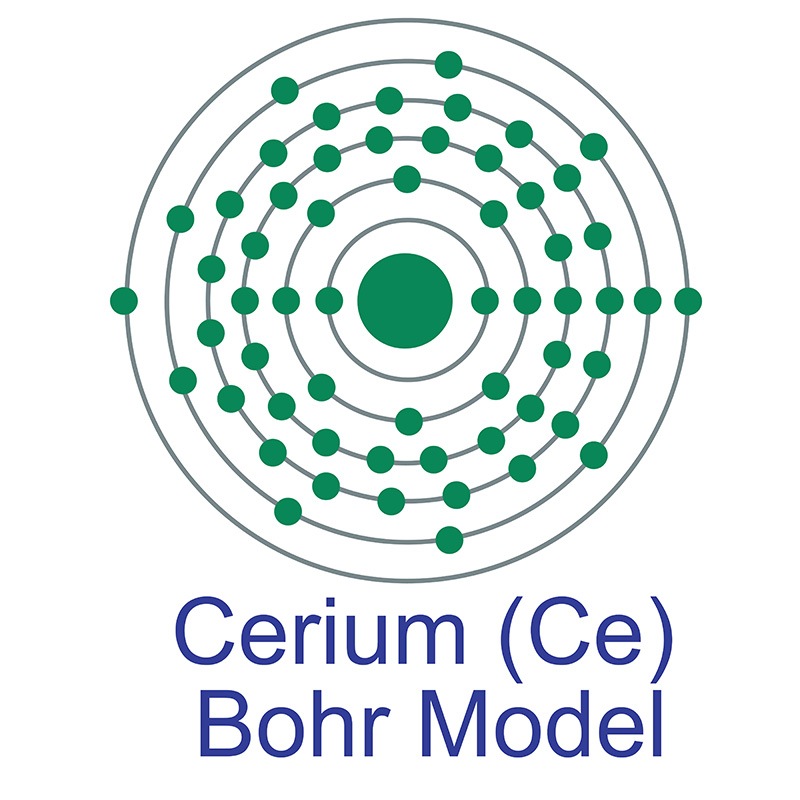
Cerium is a Block F, Group 3, Period 6 element. The number of electrons in each of Cerium's shells is 2, 8, 18, 19, 9, 2 and its electronic configuration is [Xe]4f2 6s2. In its elemental form cerium's CAS number is 7440-45-1. The cerium atom has a radius of 182.5.pm and it's Van der Waals radius is 181.pm. Cerium is moderately toxic. Cerium is one of the products manufactured and distributed under the tradename AE Rare Earths. Cerium is the most abundant of the rare earths metals. It is characterized chemically by having two valence states , the +3 cerous and +4 ceric states. The ceric state is the only non-trivalent rare earth ion stable in aqueoussolutions.It is, therefore, strongly acidic and moderately toxic. It is also a strong oxidizer.The cerous state closely resembles the other trivalent rare earths. The numerous commercial applications for cerium include metallurgy, glass and glass polishing, ceramics, catalysts, as the electrolyte for solid oxide fuel cells when doped with yttrium, gadolinium or samarium and in phosphors. In steel manufacturing it is used to remove free oxygen and sulfur by forming stable oxysulfides and by tying up undesirable trace elements, such as lead and antimony. It is considered to be the most efficient glass polishing agent for precision optical polishing. It is also used to decolor glass by keeping iron in its ferrous state. The ability of cerium-doped glass to block out ultra violet light is utilized in the manufacturing of medical glassware and aerospace windows. It is also used to prevent polymers from darkening in sunlight and to suppress discoloration of television glass.
Cerium was first discovered by W. von Hisinger in 1903. The element was named after the asteroid Ceres. See Cerium research below.
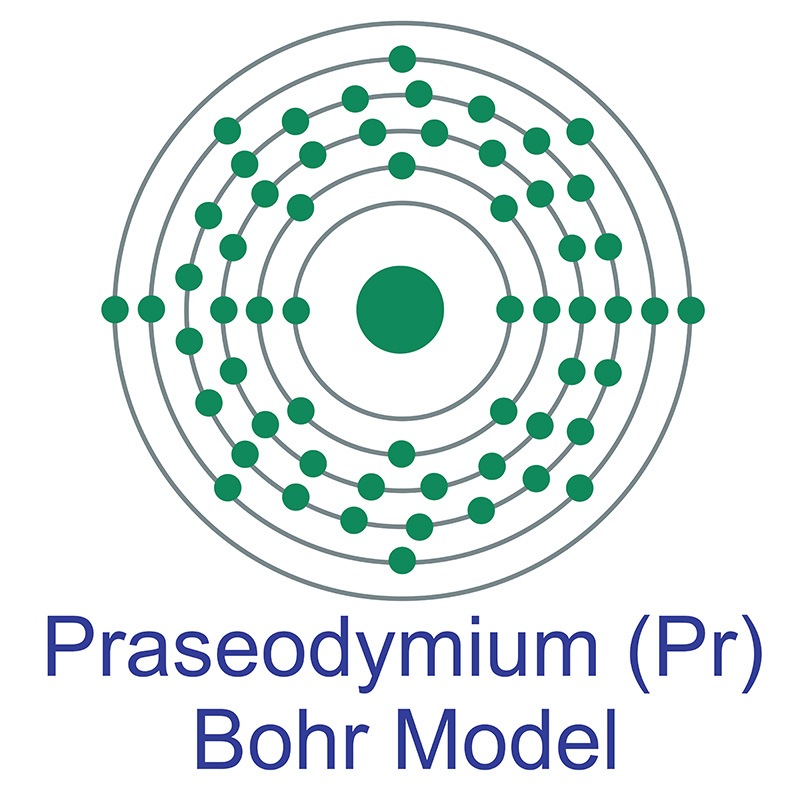
Praseodymium is a Block F, Group 3, Period 6 element. The number of electrons in each of Praseodymium's shells is 2, 8, 18, 21, 8, 2 and its electronic configuration is [Xe]4f3 6s2. In its elemental form praseodymium's CAS number is 7440-10-0. The praseodymium atom has a radius of 182.pm and it's Van der Waals radius is is unknown. Praseodymium is somewhat toxic. Praseodymium resembles the typical trivalent rare earths, however, it will exhibit a +4 state when stabilized in a zirconia host. Praseodymium is available as metal and compounds with purities from 99% to 99.999% (ACS grade to ultra-high purity); metals in the form of foil, sputtering target, and rod, and compounds as submicron and nanopowder. The element is found in most all light rare earth derivatives. It is highly valued in glass and ceramic production as a bright yellow pigment because of its optimum reflectance at 560 nm. Much research is being done on its optical properties for use in amplification of telecommunication systems, including as a doping agent in fluoride fibers. The origin of the element name comes from the Greek words 'prasios didymos' meaning green twin. See Praseodymium research below.
PACKAGING SPECIFICATIONS FOR BULK & RESEARCH QUANTITIES
Typical bulk packaging includes palletized plastic 5 gallon/25 kg. pails, fiber and steel drums to 1 ton super sacks in full container (FCL) or truck load (T/L) quantities. Research and sample quantities and hygroscopic, oxidizing or other air sensitive materials may be packaged under argon or vacuum. Shipping documentation includes a Certificate of Analysis and Material Safety Data Sheet (MSDS). Solutions are packaged in polypropylene, plastic or glass jars up to palletized 440 gallon liquid totes.
Combined cytotoxic and anti-invasive properties of redox-active nanoparticles in tumor-stroma interactions.
Alili L, Sack M, Karakoti AS, Teuber S, Puschmann K, Hirst SM, Reilly CM, Zanger K, Stahl W, Das S, Seal S, Brenneisen P.
Biomaterials. 2011 Jan 25. [Epub ahead of print]PMID: 21269688 [PubMed - as supplied by publisher]
Two-Phase Synthesis of Colloidal Annular-Shaped Ce(x)La(1-x)CO(3)OH Nanoarchitectures Assemblied from Small Particles and Their Thermal Conversion to Derived Mixed Oxides.
Nguyen TD, Dinh CT, Do TO.
Inorg Chem. 2011 Jan 21. [Epub ahead of print]PMID: 21254784 [PubMed - as supplied by publisher]
Ultrasensitive Study of Gatifloxacin Based on Its Enhancing Effect on the Cerium (IV)-Sodium Hyposulfite Chemiluminescence Reaction in a Micellar Medium.
Kamruzzaman M, Alam AM, Ferdous T, Lee SH, Kim YH, Kim SH.
J Fluoresc. 2011 Jan 19. [Epub ahead of print]PMID: 21246264 [PubMed - as supplied by publisher]
Exposure, Health and Ecological Effects Review of Engineered Nanoscale Cerium and Cerium Oxide, Praseodymium doped Associated with its Use as a Fuel Additive.
Cassee FR, van Balen EC, Singh C, Green D, Muijser H, Weinstein J, Dreher K.
Crit Rev Toxicol. 2011 Jan 18. [Epub ahead of print]PMID: 21244219 [PubMed - as supplied by publisher]
Expedient Route to the Tigliane-Daphnane Skeleton via Oxonium Ylide [1,2]-Shift.
Stewart C, McDonald R, West FG.
Org Lett. 2011 Jan 11. [Epub ahead of print]PMID: 21241059 [PubMed - as supplied by publisher]
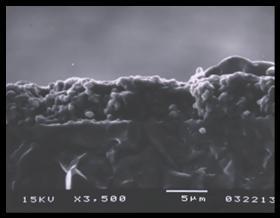
Formation of a porous Cerium Oxide, Praseodymium doped membrane by anodization.
Lawrence NJ, Jiang K, Cheung CL.
Chem Commun (Camb). 2011 Jan 13. [Epub ahead of print]PMID: 21234482 [PubMed - as supplied by publisher]
Me(2)-NHC based robust Ir catalyst for efficient water oxidation.
Hetterscheid DG, Reek JN.
Chem Commun (Camb). 2011 Jan 11. [Epub ahead of print]PMID: 21225028 [PubMed - as supplied by publisher]
A review of selected engineered nanoparticles in the atmosphere: sources, transformations, and techniques for sampling and analysis.
Majestic BJ, Erdakos GB, Lewandowski M, Oliver KD, Willis RD, Kleindienst TE, Bhave PV.
Int J Occup Environ Health. 2010 Oct-Dec;16(4):488-507.PMID: 21222392 [PubMed - in process]
A structured observational method to assess dermal exposure to manufactured nanoparticles DREAM as an initial assessment tool.
Van Duuren-Stuurman B, Pelzer J, Moehlmann C, Berges M, Bard D, Wake D, Mark D, Jankowska E, Brouwer D.
Int J Occup Environ Health. 2010 Oct-Dec;16(4):399-405.PMID: 21222384 [PubMed - in process]
Synthesis and physicochemical characterizations of nanostructured Pt/Al(2)O(3)-CeO(2) catalysts for total oxidation of VOCs.
Abbasi Z, Haghighi M, Fatehifar E, Saedy S.
J Hazard Mater. 2010 Dec 14. [Epub ahead of print]PMID: 21216099 [PubMed - as supplied by publisher]
Cerium (IV) oxide nanotubes prepared by low temperature deposition at normal pressure.
Boehme M, Fu G, Ionescu E, Ensinger W.
Nanotechnology. 2011 Feb 11;22(6):065602. Epub 2011 Jan 7.PMID: 21212481 [PubMed - in process]
High-flux solar-driven thermochemical dissociation of CO2 and H2O using nonstoichiometric ceria.
Chueh WC, Falter C, Abbott M, Scipio D, Furler P, Haile SM, Steinfeld A.
Science. 2010 Dec 24;330(6012):1797-801.PMID: 21205663 [PubMed]
Extra-Low-Temperature Oxygen Storage Capacity of CeO(2) Nanocrystals with Cubic Facets.
Zhang J, Kumagai H, Yamamura K, Ohara S, Takami S, Morikawa A, Shinjoh H, Kaneko K, Adschiri T, Suda A.
Nano Lett. 2011 Jan 4. [Epub ahead of print]PMID: 21204550 [PubMed - as supplied by publisher]
Splenocyte apoptotic pathway in mice following oral exposure to cerium trichloride.
Cheng J, Li N, Cheng Z, Hua R, Cai J, Si W, Hong F.
Chemosphere. 2010 Dec 30. [Epub ahead of print]PMID: 21195450 [PubMed - as supplied by publisher]
Hydrolysis of phosphatidylcholine by cerium(IV) releases significant amounts of choline and inorganic phosphate at lysosomal pH.
Kassai M, Teopipithaporn R, Grant KB.
J Inorg Biochem. 2011 Feb;105(2):215-23. Epub 2010 Nov 13.PMID: 21194621 [PubMed - in process]
Kinetic spectrophotometric methods for the determination of artificial sweetener (sucralose) in tablets.
Youssef RM, Korany MA, Khamis EF, Mahgoub H, Kamal MF.
Drug Test Anal. 2010 Dec 29. [Epub ahead of print]PMID: 21191969 [PubMed - as supplied by publisher]
Removal of cerium ions from aqueous solution by hydrous ferric oxide - A radiotracer study.
Dubey SS, Rao BS.
J Hazard Mater. 2010 Nov 30. [Epub ahead of print]PMID: 21168956 [PubMed - as supplied by publisher]
Influence of Ce addition on the catalytic behavior of alumina-supported Cu-Co catalysts in NO reduction with CO.
Spassova I, Velichkova N, Nihtianova D, Khristova M.
J Colloid Interface Sci. 2011 Feb 15;354(2):777-84. Epub 2010 Dec 9.PMID: 21145560 [PubMed - in process]
Stable nanoparticle aggregates/agglomerates of different sizes and the effect of their size on hemolytic cytotoxicity.
Zook JM, Maccuspie RI, Locascio LE, Halter MD, Elliott JT.
Nanotoxicology. 2010 Dec 13. [Epub ahead of print]PMID: 21142841 [PubMed - as supplied by publisher]
Catalytic Decomposition of Toxic Chemicals over Metal-Promoted Carbon Nanotubes.
Li L, Han C, Han X, Zhou Y, Yang L, Zhang B, Hu J.
Environ Sci Technol. 2011 Jan 15;45(2):726-31. Epub 2010 Dec 8.PMID: 21141883 [PubMed - in process]
Praseodymium(III) sulfate hydroxide, Pr(SO(4))(OH).
Wang XJ, Cheng JW.
Acta Crystallogr Sect E Struct Rep Online. 2011 Jan 15;67(Pt 2):i12.
PMID:
21522810
[PubMed - in process]
Electrical conductivity and defect equilibria of Pr(0.1)Ce(0.9)O(2-d).
Bishop SR, Stefanik TS, Tuller HL.
Phys Chem Chem Phys. 2011 Apr 26. [Epub ahead of print]
PMID:
21519609
[PubMed - as supplied by publisher]
Effect of graded levels of rare earth elements in diets of fattening bulls on growing and slaughtering performance, and on nutrient digestibility of wethers.
Schwabe A, Meyer U, Flachowsky G, Dänicke S.
Arch Anim Nutr. 2011 Feb;65(1):55-73.
PMID:
21452614
[PubMed - indexed for MEDLINE]
Influence of rare-earth ions on SiO2-Na2O-RE2O3 glass structure.
Johnson JA, Benmore CJ, Holland D, Du J, Beuneu B, Mekki A.
J Phys Condens Matter. 2011 Feb 16;23(6):065404. Epub 2011 Jan 27.
PMID:
21406929
[PubMed]
Poly[[tetra-µ3-acetato-hexa-µ2-acetato-diaqua-µ2-oxalato-tetrapraseodymium(III)] dihydrate].
Gutkowski K, Freire E, Baggio R.
Acta Crystallogr C. 2011 Mar;67(Pt 3):m77-80. Epub 2011 Feb 18.
PMID:
21368405
[PubMed]
Metallic and insulating oxide interfaces controlled by electronic correlations.
Jang HW, Felker DA, Bark CW, Wang Y, Niranjan MK, Nelson CT, Zhang Y, Su D, Folkman CM, Baek SH, Lee S, Janicka K, Zhu Y, Pan XQ, Fong DD, Tsymbal EY, Rzchowski MS, Eom CB.
Science. 2011 Feb 18;331(6019):886-9.
PMID:
21330538
[PubMed]
Decrease of liposomal size and retarding effect on fluconazole skin permeation by lysine derivatives.
Schwarz JC, Kählig H, Matsko NB, Kratzel M, Husa M, Valenta C.
J Pharm Sci. 2011 Jul;100(7):2911-9. doi: 10.1002/jps.22513. Epub 2011 Feb 11.
PMID:
21319163
[PubMed - in process]
Interferometric measurement of laser heating in praseodymium-doped YAG crystal.
Farley CW 3rd, Reddy BR.
Appl Opt. 2011 Feb 1;50(4):526-31. doi: 10.1364/AO.50.000526.
PMID:
21283244
[PubMed - in process]
Spectroscopic studies on the interaction between Pr(III) complex of an ofloxacin derivative and bovine serum albumin or DNA.
Xu M, Ma ZR, Huang L, Chen FJ, Zeng ZZ.
Spectrochim Acta A Mol Biomol Spectrosc. 2011 Jan;78(1):503-11. Epub 2010 Nov 23.
PMID:
21156349
[PubMed - indexed for MEDLINE]
Study on fluorescence and DNA-binding of praseodymium(III) complex containing 2,2'-bipyridine.
Khorasani-Motlagh M, Noroozifar M, Khmmarnia S.
Spectrochim Acta A Mol Biomol Spectrosc. 2011 Jan;78(1):389-95. Epub 2010 Oct 30.
PMID:
21130681
[PubMed - indexed for MEDLINE]
The Correlation Between f-f Absorption and Sensitized Visible Light Emission of Luminescent Pr(III) Complexes: Role of Solvents and Ancillary Ligands on Sensitivity.
Irfanullah M, Iftikhar K.
J Fluoresc. 2010 Nov 3. [Epub ahead of print]
PMID:
21046438
[PubMed - as supplied by publisher]
Synthesis, characterization, antioxidant activities, and DNA-binding studies of (E)-N'-[1-(pyridin-2-yl)ethylidene]isonicotinohydrazide and its Pr(III) and Nd(III) complexes.
Hao ZY, Liu QW, Xu J, Jia L, Li SB.
Chem Pharm Bull (Tokyo). 2010 Oct;58(10):1306-12.
PMID:
20930395
[PubMed - indexed for MEDLINE]
Autogenic synthesis of green- and red-emitting single-phase Pr(2)O(2)CO(3) and PrO(1.833) luminescent nanopowders.
Calderon Moreno JM, Pol VG, Suh SH, Popa M.
Inorg Chem. 2010 Nov 1;49(21):10067-73.
PMID:
20923161
[PubMed]
Morphological and Electrochemical Properties of Crystalline Praseodymium Oxide Nanorods.
Shamshi Hassan M, Shaheer Akhtar M, Shim KB, Yang OB.
Nanoscale Res Lett. 2010 Feb 5;5(4):735-740.
PMID:
20672103
[PubMed]
Efficient green continuous-wave lasing of blue-diode-pumped solid-state lasers based on praseodymium-doped LiYF4.
Hansen NO, Bellancourt AR, Weichmann U, Huber G.
Appl Opt. 2010 Jul 10;49(20):3864-8. doi: 10.1364/AO.49.003864.
PMID:
20648158
[PubMed]
Cationic rare-earth-metal methyl complexes: a new preparative access exemplified for Y and Pr.
Nieland A, Mix A, Neumann B, Stammler HG, Mitzel NW.
Dalton Trans. 2010 Aug 7;39(29):6753-60. Epub 2010 May 4.
PMID:
20442946
[PubMed]
Conversion of orange light into blue light.
Rai N, Jha Y, Kamal KP, Kumar S, Rai VK.
Spectrochim Acta A Mol Biomol Spectrosc. 2010 Aug;76(3-4):311-4. Epub 2010 Mar 6.
PMID:
20430692
[PubMed - indexed for MEDLINE]
Praseodymium(III)-based bis-metallacalix[4]arene with host-guest behaviour.
Xu GF, Gamez P, Teat SJ, Tang J.
Dalton Trans. 2010 May 14;39(18):4353-7. Epub 2010 Mar 24.
PMID:
20422093
[PubMed]
Synthesis and luminescent properties of CaTiO3: Pr3+ microfibers prepared by electrospinning method.
Peng C, Hou Z, Zhang C, Li G, Lian H, Cheng Z, Lin J.
Opt Express. 2010 Mar 29;18(7):7543-53. doi: 10.1364/OE.18.007543.
PMID:
20389776
[PubMed - indexed for MEDLINE]
Demonstration of atomic frequency comb memory for light with spin-wave storage.
Afzelius M, Usmani I, Amari A, Lauritzen B, Walther A, Simon C, Sangouard N, Minár J, de Riedmatten H, Gisin N, Kröll S.
Phys Rev Lett. 2010 Jan 29;104(4):040503. Epub 2010 Jan 27.
PMID:
20366694
[PubMed - indexed for MEDLINE]
Material Safety Data Sheet
1 Identification of substance
Product details
Trade name Cerium (IV) oxide
2 Composition/Data on components:
Chemical characterization: Designation: (CAS#)
Cerium (IV) oxide (CAS# 1306-38-3), 100%
Identification number(s):
EINECS Number: 215-150-4
3 Hazards identification
Hazard designation: · void
Information pertaining to particular dangers for man and environment
Not applicable
4 First aid measures
After inhalation
Supply fresh air. If required, provide artificial respiration. Keep patient warm. Consult doctor if symptoms persist.
Seek immediate medical advice.
After skin contact
Instantly wash with water and soap and rinse thoroughly.
Seek immediate medical advice.
After eye contact
Rinse opened eye for several minutes under running water. Then consult doctor.
After swallowing Seek medical treatment.
Information for doctor
The following symptoms may occur: Gastric or intestinal trouble
5 Fire fighting measures
Suitable extinguishing agents
Use fire fighting measures that suit the environment.
Protective equipment:
Wear self-contained breathing apparatus.
Wear full protective suit.
Measures for environmental protection:
Do not allow material to be released to the environment without proper governmental permits.
Measures for cleaning/collecting: Collect mechanically.
Additional information:
See Section 7 for information on safe handling
See section 8 for information on personal protection equipment.
See Section 13 for information on disposal.
7 Handling and storage
Handling
Information for safe handling:
Keep containers tightly sealed.
Store in cool, dry place in tightly closed containers.
No special precautions necessary if used correctly.
Information about protection against explosions and fires:
The product is not flammable
Storage
Requirements to be met by storerooms and containers:
No special requirements.
Information about storage in one common storage facility:
Store away from oxidizing agents.
Further information about storage conditions:
Protect from carbon dioxide.
Keep container tightly sealed.
Store in cool, dry conditions in well sealed containers.
8 Exposure controls and personal protection
Additional information about design of technical systems:
Properly operating chemical fume hood designed for hazardous chemicals and having an average face velocity of at least 100 feet per minute.
Components with critical values that require monitoring at the workplace:
Not required.
Additional information: No data
Personal protective equipment
General protective and hygienic measures
The usual precautionary measures should be adhered to in handling the chemicals.
Keep away from foodstuffs, beverages and food.
Instantly remove any soiled and impregnated garments.
Wash hands during breaks and at the end of the work.
Breathing equipment: Use breathing protection with high concentrations.
Protection of hands: Impervious gloves
Eye protection: Safety glasses
Body protection: Protective work clothing.
9 Physical and chemical properties:
General Information
Form: Powder
Colour: Light yellow
Smell: Not determined
Value/Range Unit Method
Change in condition
Melting point/Melting range: 2600 ° C
Boiling point/Boiling range: Not determined
Sublimation temperature / start: Not determined
Flash point: Not applicable
Inflammability (solid, gaseous) Product is not inflammable.
Ignition temperature: Not determined
Decomposition temperature: Not determined
Danger of explosion: Product is not explosive.
Critical values for explosion:
Lower: Not determined
Upper: Not determined
Steam pressure: Not determined
Density at 20 ° C 7.132 g/cm³
Solubility in / Miscibility with
Water: Insoluble
10 Stability and reactivity
Thermal decomposition / conditions to be avoided:
No decomposition if used and stored according to specifications.
Materials to be avoided: Oxidizing agents
Dangerous reactions: No dangerous reactions known
Dangerous products of decomposition: None known.
11 Toxicological information
Acute toxicity: LD/LC50 values that are relevant for classification:
Oral: LD50: >5000 mg/kg (rat)
Primary irritant effect:
on the skin: Powder: irritant effect
on the eye: Powder: irritant effect
Sensitization: No sensitizing effect known.
Additional toxicological information:
To the best of our knowledge the acute and chronic toxicity of this substance is not fully known.
No classification data on carcinogenic properties of this material is available from the EPA, IARC, NTP, OSHA or ACGIH.
12 Ecological information:
General notes:
Do not allow material to be released to the environment without proper governmental permits.
Generally not hazardous for water.
13 Disposal considerations
Product:
Recommendation
Consult state, local or national regulations for proper disposal.
Hand over to disposers of hazardous waste.
Must be specially treated under adherence to official regulations.
Uncleaned packagings:
Recommendation:
Disposal must be made according to official regulations.
14 Transport information
Land transport ADR/RID and GGVS/GGVE (cross-border/domestic)
ADR/RID-GGVS/E Class: None
Maritime transport IMDG/GGVSea:
IMDG/GGVSea Class: None
Air transport ICAO-TI and IATA-DGR:
ICAO/IATA Class: None
Transport/Additional information:
Not dangerous according to the above specifications.
15 Regulatory information
Designation according to EC guidelines:
Observe the normal safety regulations when handling chemicals
The product is not subject to identification regulations under EC Directives and the Ordinance on Hazardous Materials (GefStoffV).
National regulations
Information about limitation of use:
For use only by technically qualified individuals.
Water hazard class: Generally not hazardous for water.
16 Other information:
Employers should use this information only as a supplement to other information gathered by them, and should make independent judgement of suitability of this information to ensure proper use and protect the health and safety of employees. This information is furnished without warranty, and any use of the product not in conformance with this Material Safety Data Sheet, or in combination with any other product or process, is the responsibility of the user.
Proud sponsors of Aeromat 2012. Please join us and our customers & co-sponsors Boeing and ATI on
June 18-20, 2012
in Charlotte, North Carolina