American Elements


Chromium Selenide Sputtering Target
High Purity Cr-Se Sputtering Target
Product Product Code Order or Specifications
(2N) 99% Chromium Selenide Sputtering Target CR-SE-02-ST Contact American Elements
(2N5) 99.5% Chromium Selenide Sputtering Target CR-SE-025-ST Contact American Elements
(3N) 99.9% Chromium Selenide Sputtering Target CR-SE-03-ST Contact American Elements
(3N5) 99.95% Chromium Selenide Sputtering Target CR-SE-035-ST Contact American Elements
(4N) 99.99% Chromium Selenide Sputtering Target CR-SE-04-ST Contact American Elements
(5N) 99.999% Chromium Selenide Sputtering Target CR-SE-05-ST Contact American Elements
American Elements produces to many standard grades when applicable, including Mil Spec (military grade); ACS, Reagent and Technical Grade; Food, Agricultural and Pharmaceutical Grade; Optical Grade, USP and EP/BP (European Pharmacopeia/British Pharmacopeia) and follows applicable ASTM testing standards.See safety data and research below and pricing/lead time above. American Elements specializes in producing high purity Chromium Selenide Sputtering targets with the highest possible density High Purity (99.99%) Metallic Sputtering Targetand smallest possible average grain sizes for use in semiconductor, chemical vapor deposition (CVD) and physical vapor deposition (PVD) display and optical applications. Our standard Sputtering Targets for thin film are available monoblock or bonded with dimensions and configurations up to 820 mm with hole drill locations and threading, beveling, grooves and backing designed to work with both older sputtering devises as well as the latest process equipment, such as large area coating for solar energy or fuel cells and flip-chip applications. Research sized targets are also produced as well as custom sizes and alloys. All targets are analyzed using best demonstrated techniques including X-Ray Fluorescence (XRF), Glow Discharge Mass Spectrometry (GDMS), and Inductively Coupled Plasma (ICP). "Sputtering" allows for thin film deposition of an ultra high purity sputtering metallic or oxide material onto another solid substrate by the controlled removal and conversion of the target material into a directed gaseous/plasma phase through ionic bombardment. "Sputtering" allows for thin film deposition of an ultra high purity sputtering metallic or oxide material onto another solid substrate by the controlled removal and conversion of the target material into a directed gaseous/plasma phase through ionic bombardment. We can also provide targets outside this range in addition to just about any size rectangular, annular, or oval target. Materials are produced using crystallization, solid state and other ultra high purification processes such as sublimation. American Elements specializes in producing custom compositions for commercial and research applications and for new proprietary technologies. American Elements also casts any of the rare earth metals and most other advanced materials into rod, bar or plate form, as well as other machined shapes and through other processes nanoparticles. We also produce Chromium as disc, granules, ingot, pellets, pieces, powder, and rod. Other shapes are available by request.

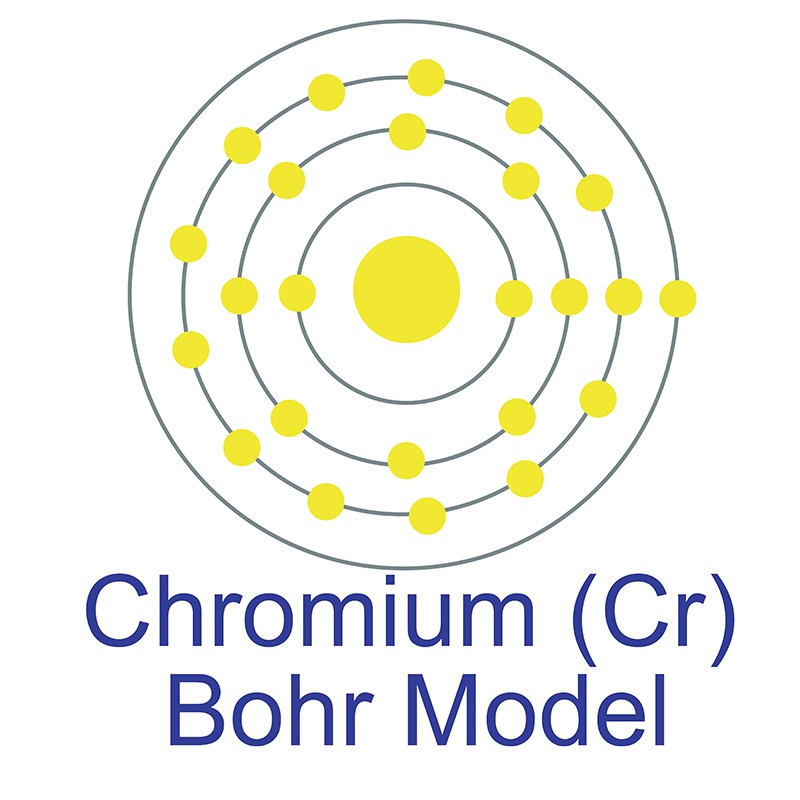
Chromium(Cr) atomic and molecular weight, atomic number and elemental symbolChromium is a Block D, Group 6, Period 4 element. The number of electrons in each of Chromium's shells is 2, 8, 13, 1 and its electronic configuration is [Ar] 3d5 4s1. In its elemental form chromium's CAS number is 7440-47-3. The chromium atom has a radius of 124.9.pm and it's Van der Waals radius is 200.pm. Hexavalent chromium is toxic. Chromium is highly resistant to corrosion. This has led to its use in numerous alloying and steel producing applications. When chromium is added to glass or ceramic glazes, it produces a brilliant green. Chromium is available as metal and compounds with purities from 99% to 99.999% (ACS grade to ultra-high purity); metals in the form of foil, sputtering target, and rod, and compounds as submicron and nanopowder. It is also used as a paint pigment for this purpose.Although chromium metal is an essential trace element, hexavalent chromium (Cr(VI)) is especially toxic and carcinogenic. Recently, chromites have formed the basis for cathode compositions for oxygen generation and fuel cell applications. Chromium information, including Technical Data, Safety Data and its High Purity properties, research, applications and other useful facts are discussed here. Scientific facts such as the atomic structure, ionization energy, abundance on Earth, conductivity and thermal properties are included. Chromium was first discovered by Anders Ekeberg in 1802.

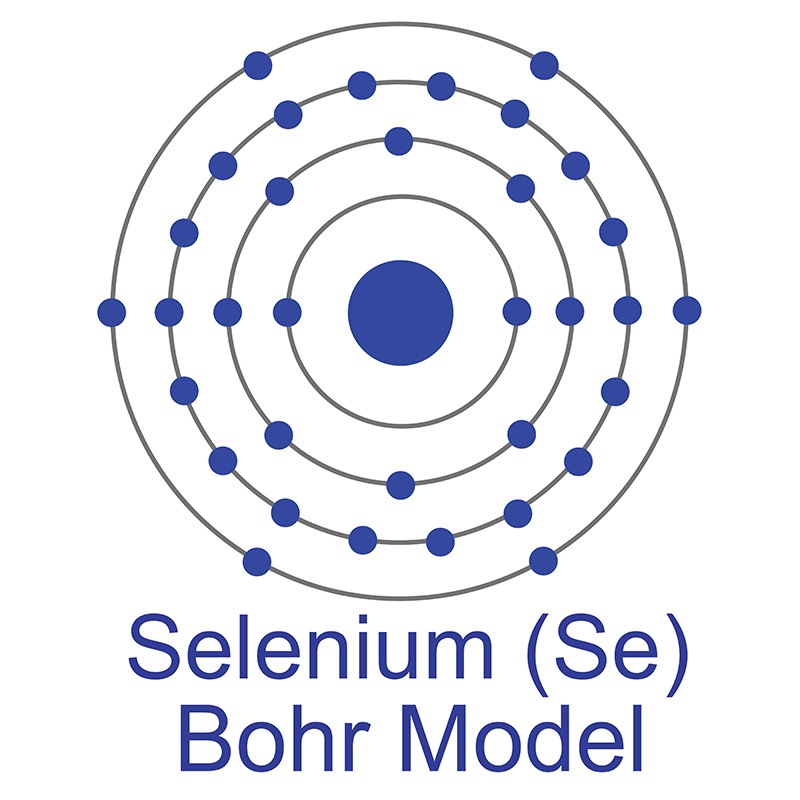
Selenide(Se) atomic and molecular weight, atomic number and elemental symbolSelenium is a Block P, Group 16, Period 4 element. The number of electrons in each of Selenium's shells is 2, 8, 18, 6 and its electronic configuration is [Ar] 3d10 4s2 4p4. In its elemental form selenium's CAS number is 7782-49-2. The selenium atom has a radius of 116.pm and it's Van der Waals radius is 190.pm. The EPA does not classify selenium as carcinogenic, although selenium sulfide Elemental Seleniumis a probable carcinogen. Selenates and selenites which are compounds of selenium, are highly toxic. Hydrogen selenide gas (SeH2) is the most acutely toxic compound of selenium. Selenium exhibits both photovoltaic action, where light is converted directly into electricity, and photoconductive action, where the electrical resistance decreases with increased illumination. of photocells and exposure meters for photographic use, as Selenium Bohr Modelwell as solar cells. Below its melting point, selenium is a p-type semiconductor and has many uses in electronic and solid-state applications. Selenium is available as metal and compounds with purities from 99% to 99.9999% (ACS grade to ultra-high purity); metals in the form of foil, sputtering target, and rod, and compounds as submicron and nanopowder. Selenium was first discovered by Jons Berzelius in 1817. The origin of the name Selenium comes from the Greek word "Selênê" meaning moon. See selenium research below.

PRODUCT CATALOG News Foil Submicron & Nanopowder Tolling Ultra High Purity Sputtering Target Crystal Growth Rod, Plate, Powder, etc. Home

Have a Question? Ask a Chemical Engineer or Material Scientist   Request an MSDS or Certificate of Analysis


Search by Material, Product Name, Product Code, CAS Number, Formula, Element, Anion, Form, EC Number, MDL Number or PubChem ID.


German   Korean   French   Japanese   Spanish   Chinese (Simplified)   Portuguese   Russian   Chinese (Taiwan)   Italian   Turkish   Polish   Dutch   Czech   Swedish   Hungarian   Danish   Hebrew

Production Catalog Available in 36 Countries & Languages

Recent Research & Development for Chromium

  • Effect of ionic environment on the transport of Chromium ion in alkali chloride solutions from radio tracer studies. Chakrabarti H, Kundu S. Appl Radiat Isot. 2010 Dec;68(12):2189-96. Epub 2010 May 27. PubMed PMID: 20828659.

  • Caesium ion sequestration by a fluoro-metallocrown [16]-MC-8. Faust TB, Heath PG, Muryn CA, Timco GA, Winpenny RE. Chem Commun (Camb). 2010 Sep 14;46(34):6258-60. Epub 2010 Aug 9. PubMed PMID: 20694231.

  • Arsenic-Containing Chalcophosphate Molecular Anions. Morris CD, Kanatzidis MG. Inorg Chem. 2010 Sep 8. [Epub ahead of print] PubMed PMID: 20825231.

  • Effect of Chromium radioisotope on humoral immune status in Ukrainian children with clinical symptoms of irritable bowel syndrome related to Chernobyl disaster. Sheikh Sajjadieh M, Kuznetsova L, Bojenko V. Toxicol Ind Health. 2010 Sep 8. [Epub ahead of print] PubMed PMID: 20826551.

  • Colloid-Facilitated Transport of Chromium in Vadose-Zone Sediments: The Importance of Flow Transients. Cheng T, Saiers JE. Environ Sci Technol. 2010 Sep 2. [Epub ahead of print] PubMed PMID: 20812714.

  • Atom gravimeters and gravitational redshift. Wolf P, Blanchet L, Bordé CJ, Reynaud S, Salomon C, Cohen-Tannoudji C. Nature. 2010 Sep 2;467(7311):E1; discussion E2. PubMed PMID: 20811407.

  • High-level exposure to lithium, boron, Chromium, and arsenic via drinking water in the Andes of northern Argentina. Concha G, Broberg K, Grandér M, Cardozo A, Palm B, Vahter M. Environ Sci Technol. 2010 Sep 1;44(17):6875-80. PubMed PMID: 20701280.

  • In vitro and in vivo evaluation of a novel ferrocyanide functionalized nanopourous silica decorporation agent for Chromium in rats. Timchalk C, Creim JA, Sukwarotwat V, Wiacek R, Addleman RS, Fryxell GE, Yantasee W. Health Phys. 2010 Sep;99(3):420-9. PubMed PMID: 20699707; PubMed Central PMCID: PMC2921228.

  • Miscibility of choline-substituted polyphosphazenes with PLGA and osteoblast activity on resulting blends. Weikel AL, Owens SG, Morozowich NL, Deng M, Nair LS, Laurencin CT, Allcock HR. Biomaterials. 2010 Aug 25. [Epub ahead of print] PubMed PMID: 20800277.

  • Acute bowel morbidity after prostate brachytherapy with Chromium-131. Jacobs BL, Gibbons EP, Smith RP, Beriwal S, Benoit RM. Brachytherapy. 2010 Aug 24. [Epub ahead of print] PubMed PMID: 20797922.

  • Regulation and mechanism of potassium release from barley roots: an in planta(42)K analysis. Coskun D, Britto DT, Kronzucker HJ. New Phytol. 2010 Aug 20. [Epub ahead of print] PubMed PMID: 20731780.

  • Electrolyte effects on the chiral induction and on its temperature dependence in a chiral nematic lyotropic liquid crystal. Dawin UC, Osipov MA, Giesselmann F. J Phys Chem B. 2010 Aug 19;114(32):10327-36. PubMed PMID: 20734493.

  • Strontium-90 and caesium-137 activity concentrations in bats in the Chernobyl exclusion zone. Gashchak S, Beresford NA, Maksimenko A, Vlaschenko AS. Radiat Environ Biophys. 2010 Aug 17. [Epub ahead of print] PubMed PMID: 20714905.

  • Linear complex polarization propagator in a four-component Kohn-Sham framework. Villaume S, Saue T, Norman P. J Chem Phys. 2010 Aug 14;133(6):064105. PubMed PMID: 20707559.

  • Chromium-137 monitoring using lichens from W. Macedonia, N. Greece. Sawidis T, Tsigaridas K, Tsikritzis L. Ecotoxicol Environ Saf. 2010 Aug 13. [Epub ahead of print] PubMed PMID: 20709398.

  • Boronated phosphonium salts containing arylboronic acid, closo-carborane, or nido-carborane: synthesis, X-ray diffraction, in vitro cytotoxicity, and cellular uptake. Morrison DE, Issa F, Bhadbhade M, Groebler L, Witting PK, Kassiou M, Rutledge PJ, Rendina LM. J Biol Inorg Chem. 2010 Aug 6. [Epub ahead of print] PubMed PMID: 20694490.

  • DNA stable-isotope probing (DNA-SIP). Dunford EA, Neufeld JD. J Vis Exp. 2010 Aug 2;(42). pii: 2027. doi: 10.3791/2027. PubMed PMID: 20729803.

  • The North Atlantic subpolar gyre and the marine migration of Atlantic salmon Salmo salar: the 'Merry-Go-Round' hypothesis. Dadswell MJ, Spares AD, Reader JM, Stokesbury MJ. J Fish Biol. 2010 Aug;77(3):435-67. PubMed PMID: 20701633.

  • Kinetic and equilibrium studies of Chromium adsorption on ceiling tiles from aqueous solutions. Miah MY, Volchek K, Kuang W, Tezel FH. J Hazard Mater. 2010 Jul 30. [Epub ahead of print] PubMed PMID: 20727676.

  • Gamma ray dosimetry and mating capacity studies in the laboratory on Aedes albopictus males. Balestrino F, Medici A, Candini G, Carrieri M, Maccagnani B, Calvitti M, Maini S, Bellini R. J Med Entomol. 2010 Jul;47(4):581-91. PubMed PMID: 20695273.


Customers for this product have also looked at:
Selenium Wire Selenium Oxide Pellets Iron Selenide Selenium Chloride Europium Selenide
Selenium Oxide Nanopowder Selenium Sheet Selenium Sheet Selenium Sputtering Target Selenium Oxide
Selenium Pellets Selenium Metal Selenium Oxide Selenium Powder Selenium Foil


Recent Research & Development for Selenium

  • Selenoprotein K binds multi-protein complexes and is involved in the regulation of ER homeostasis. Shchedrina VA, Everley RA, Zhang Y, Gygi SP, Hatfield DL, Gladyshev VN. J Biol Chem. 2011 Oct 20. [Epub ahead of print] PMID: 22016385 [PubMed - as supplied by publisher]

  • Catalytic activity of selenomethionine in removing amino acid, peptide, and protein hydroperoxides. Suryo Rahmanto A, Davies MJ. Free Radic Biol Med. 2011 Oct 1. [Epub ahead of print] PMID: 22015433 [PubMed - as supplied by publisher]

  • Combination of chemometrically assisted voltammetry, calorimetry, and circular dichroism as a new method for the study of bioinorganic substances: application to selenocystine metal complexes. Gusmão R, Prohens R, Díaz-Cruz JM, Ariño C, Esteban M. J Biol Inorg Chem. 2011 Oct 21. [Epub ahead of print] PMID: 22015398 [PubMed - as supplied by publisher]

  • Marine and farmed fish on the Polish market: Comparison of the nutritive value and human exposure to PCDD/Fs and other contaminants. Szlinder-Richert J, Usydus Z, Malesa-Ciecwierz M, Polak-Juszczak L, Ruczynska W. Chemosphere. 2011 Oct 17. [Epub ahead of print] PMID: 22014661 [PubMed - as supplied by publisher]

  • Dietary selenium reduces retention of methyl mercury in freshwater fish. Bjerregaard P, Fjordside S, Hansen MG, Petrova MB. Environ Sci Technol. 2011 Oct 20. [Epub ahead of print] PMID: 22014184 [PubMed - as supplied by publisher]

  • Plant and fungal food components with potential activity on the development of microbial oral diseases. Daglia M, Papetti A, Mascherpa D, Grisoli P, Giusto G, Lingström P, Pratten J, Signoretto C, Spratt DA, Wilson M, Zaura E, Gazzani G. J Biomed Biotechnol. 2011;2011:274578. Epub 2011 Oct 17. PMID: 22013381 [PubMed - in process]

  • Selenium, selenoproteins and the thyroid gland: interactions in health and disease. Schomburg L. Nat Rev Endocrinol. 2011 Oct 18. doi: 10.1038/nrendo.2011.174. [Epub ahead of print] PMID: 22009156 [PubMed - as supplied by publisher]

  • Selenium inhibits migration of murine melanoma cells via down-modulation of IL-18 expression. Song H, Kim J, Lee HK, Park HJ, Nam J, Park GB, Kim YS, Cho D, Hur DY. Int Immunopharmacol. 2011 Oct 15. [Epub ahead of print] PMID: 22008306 [PubMed - as supplied by publisher]

  • Detection, Identification, and Quantification of Selenoproteins in a Candidate Human Plasma Standard Reference Material. Ballihaut G, Kilpatrick LE, Davis WC. Anal Chem. 2011 Oct 18. [Epub ahead of print] PMID: 22007999 [PubMed - as supplied by publisher]

  • Severe pre-eclampsia is associated with abnormal trace elements concentrations in maternal and fetal blood. Katz O, Paz-Tal O, Lazer T, Aricha-Tamir B, Mazor M, Wiznitzer A, Sheiner E. J Matern Fetal Neonatal Med. 2011 Oct 18. [Epub ahead of print] PMID: 22007865 [PubMed - as supplied by publisher]

  • Effects of Selenium Supplements on Cancer Prevention: Meta-analysis of Randomized Controlled Trials. Lee EH, Myung SK, Jeon YJ, Kim Y, Chang YJ, Ju W, Seo HG, Huh BY. Nutr Cancer. 2011 Oct 17. [Epub ahead of print] PMID: 22004275 [PubMed - as supplied by publisher]

  • Study of the correlation of serum selenium level with Behcet's disease. Esalatmanesh K, Jamshidi A, Shahram F, Davatchi F, Masoud SA, Soleimani Z, Salesi M, Ghaffarpasand I. Int J Rheum Dis. 2011 Oct;14(4):375-8. doi: 10.1111/j.1756-185X.2011.01649.x. Epub 2011 Sep 5. PMID: 22004235 [PubMed - in process]

  • Multi-metal(loid) methylation in methanoarchaea is linked to central intermediates of methanogenesis. Thomas F, Diaz-Bone RA, Wuerfel O, Huber B, Weidenbach K, Schmitz RA, Hensel R. Appl Environ Microbiol. 2011 Oct 14. [Epub ahead of print] PMID: 22003009 [PubMed - as supplied by publisher]

  • The Effects of Di(2-Ethylhexyl)Phthalate Exposure and Selenium Nutrition on Sertoli Cell Vimentin Structure and Germ-Cell Apoptosis in Rat Testis. Erkekoglu P, Zeybek ND, Giray B, Asan E, Hincal F. Arch Environ Contam Toxicol. 2011 Oct 16. [Epub ahead of print] PMID: 22002783 [PubMed - as supplied by publisher]

  • A superoxide anion-scavenger, 1,3-selenazolidin-4-one suppresses serum deprivation-induced apoptosis in PC12 cells by activating MAP kinase. Nishina A, Kimura H, Kozawa K, Sommen G, Nakamura T, Heimgartner H, Koketsu M, Furukawa S. Toxicol Appl Pharmacol. 2011 Oct 2. [Epub ahead of print] PMID: 22001386 [PubMed - as supplied by publisher]

  • Nutrition, dietary supplements and adenocarcinoma of the prostate. Schultz C, Meier M, Schmid HP. Maturitas. 2011 Oct 12. [Epub ahead of print] PMID: 22001108 [PubMed - as supplied by publisher]

  • Interactions of Cu(I) with Selenium-Containing Amino Acids Determined by NMR, XAS, and DFT Studies. Wang HC, Riahi M, Pothen J, Bayse CA, Riggs-Gelasco P, Brumaghim JL. Inorg Chem. 2011 Oct 14. [Epub ahead of print] PMID: 21999616 [PubMed - as supplied by publisher]

  • Effects of Basal Media and Supplements on Diethylstilbestrol-Treated Immature Mouse Primary Granulosa Cell Growth and Regulation of Steroidogenesis In Vitro. Ding T, Luo A, Yang S, Lai Z, Wang Y, Shen W, Jiang J, Lu Y, Ma D, Wang S. Reprod Domest Anim. 2011 Oct 15. doi: 10.1111/j.1439-0531.2011.01879.x. [Epub ahead of print] PMID: 21999365 [PubMed - as supplied by publisher]

  • Demographic and lifestyle factors and selenium levels in men and women in the U.S. Park K, Rimm E, Siscovick D, Spiegelman D, Morris JS, Mozaffarian D. Nutr Res Pract. 2011 Aug;5(4):357-64. Epub 2011 Aug 31. PMID: 21994531 [PubMed - in process]

  • New group 11 complexes with metal-selenium bonds of methyldiphenylphosphane selenide: a solid state, solution and theoretical investigation. Pop A, Silvestru A, Gimeno MC, Laguna A, Kulcsar M, Arca M, Lippolis V, Pintus A. Dalton Trans. 2011 Oct 13. [Epub ahead of print] PMID: 21993712 [PubMed - as supplied by publisher]


Aeromat 2012 Sponsor
Proud sponsors of Aeromat 2012. Please join us and our customers & co-sponsors Boeing and ATI on June 18-20, 2012
in Charlotte, North Carolina

  Print this Page
Periodic table of the elements science and academic information, elements and advanced materials data, scientific presentations and all pages, designs, concepts, logos, and color schemes herein are the copyrighted proprietary rights and intellectual property of American Elements. American Elements is a U.S. Registered Trademark. © 1998-2012. American Elements. All rights reserved.
Learn Six Sigma


American Elements is a copyrighted U.S. Trademark. All rights reserved.
Untitled Document