American Elements specializes in producing high purity Cobalt Boron Sputtering Targets with the highest possible density and smallest possible average grain sizes for use in semiconductor, chemical vapor deposition (CVD) and physical vapor deposition (PVD) display and optical applications. Our standard Sputtering Targets for thin film are available monoblock or bonded with dimensions and configurations up to 820 mm with hole drill locations and threading, beveling, grooves and backing designed to work with both older sputtering devises as well as the latest process equipment, such as large area coating for solar energy or fuel cells and flip-chip applications. Research sized targets are also produced as well as custom sizes and alloys. All targets are analyzed using best demonstrated techniques including X-Ray Fluorescence (XRF), Glow Discharge Mass Spectrometry (GDMS), and Inductively Coupled Plasma (ICP). "Sputtering" allows for thin film deposition of an ultra high purity sputtering metallic or oxide material onto another solid substrate by the controlled removal and conversion of the target material into a directed gaseous/plasma phase through ionic bombardment. We can also provide targets outside this range in addition to just about any size rectangular, annular, or oval target. Materials are produced using crystallization, solid state and other ultra high purification processes such as sublimation. American Elements specializes in producing custom compositions for commercial and research applications and for new proprietary technologies. American Elements also casts any of the rare earth metals and most other advanced materials into rod, bar or plate form, as well as other machined shapes and through other processes such as nanoparticles (See also application discussion at Nanotechnology Information and at Quantum Dots) and in the form of solutions and organometallics. We also produce Cobalt as disc, granules, ingot, pellets, pieces, powder, and rod. Other shapes are available by request.
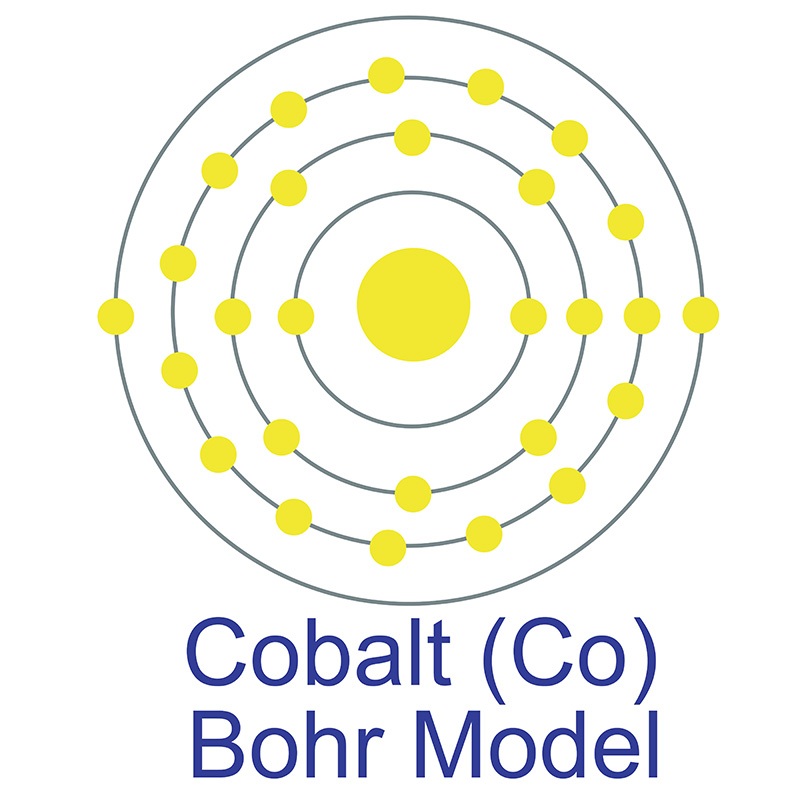
Cobalt is a Block D, Group 9, Period 4 element. The number of electrons in each of Cobalt's shells is 2, 8, 15, 2 and its electronic configuration is [Ar] 3d7 4s2. In its elemental form cobalt's CAS number is 7440-48-4. The cobalt atom has a radius of 125.3.pm and it's Van der Waals radius is 200.pm. Cobalt and its compounds are somewhat toxic by skin contact and moderately toxic by inhalation. Cobalt has a metallic permeability two thirds that of iron. It exists as a mixture of two allotropes over a wide temperature range. The transformation is slow and accounts in part for the wide variation in the physical properties of cobalt. It is alloyed with iron, nickel and other metals to make Alnico, an alloy of unusual magnetic strength with many important uses. Samarium-cobalt is one of the highest strength magnet alloys known. Cobalt compounds produce a brilliant and permanent blue color in ceramic glazes, glass, pottery, tiles, and enamels. Co-60 is useful as a gamma ray source. Toxicity of cobalt and its compounds are mild by skin contact and moderate by ingestion. Cobalt is available as metal and compounds with purities from 99% to 99.999% (ACS grade to ultra-high purity); metals in the form of foil, sputtering target, and rod, and compounds as submicron and nanopowder. Cobalt was first discovered by George Brandt in 1737. The origin of the word Cobalt comes from the German word 'Kobalt or Kobold' which translates as "goblin", "elf" or "evil spirit". See Cobalt research below.
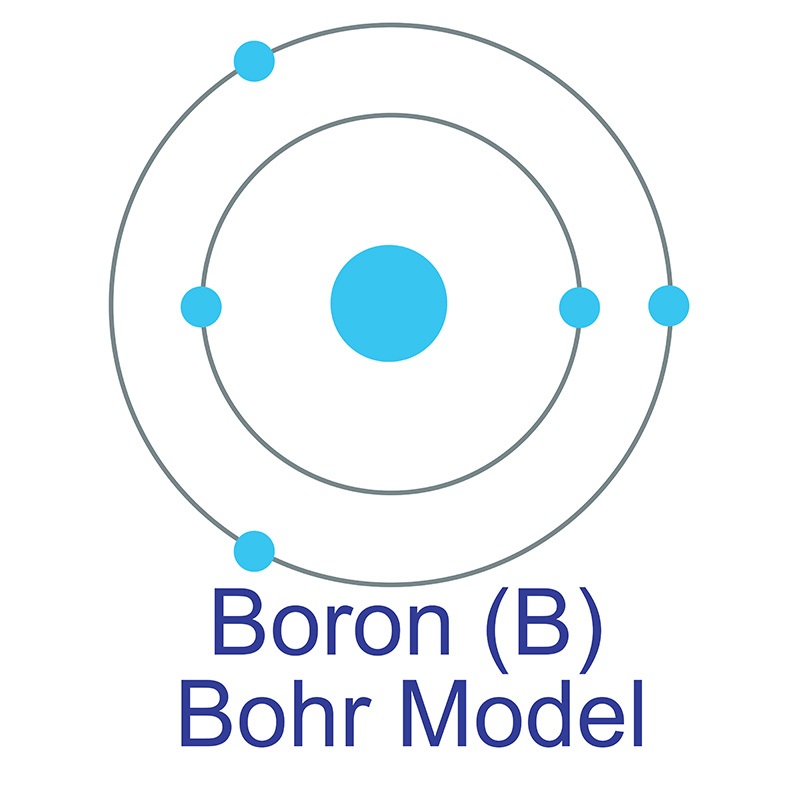
Boron is a Block P, Group 13, Period 2 element. The number of electrons in each of Boron's shells is 2, 3 and its electronic configuration is [He] 2s2 2p1. In its elemental form boron's CAS number is 7440-42-8. The boron atom has a radius of 79.5.pm and it's Van der Waals radius is 200.pm. Boron has an energy band gap of 1.50 to 1.56 eV, which is higher than that of either silicon or germanium. Optical characteristics include transmitting portions of the infrared. Boron is a poor conductor of electricity at room temperature but a good conductor at high temperature. Boron in its elemental form is not toxic. Amorphous boron is used in pyrotechnic flares to provide a distinctive green color, and in rockets as an igniter Boric acid is also an important boron compound with major markets in textile products. Boron compounds are also extensively used in the manufacture of borosilicate glasses. The isotope Boron-10 is used as a control for nuclear reactors, as a shield for nuclear radiation, and in instruments used for detecting neutrons. Boron nitride has remarkable properties and can be used to make a material as hard as diamond. The nitride also behaves like an electrical insulator but conducts heat like a metal. Boron also has lubricating properties similar to graphite. Boron was first discovered by Sir Humphry Davy and J.L Gay-Lussac in 1808. The name Boron originates from a combination of carbon and the Arabic word 'buraqu meaning borax. See Boron research below.
PACKAGING SPECIFICATIONS FOR BULK & RESEARCH QUANTITIES
Typical bulk packaging includes palletized plastic 5 gallon/25 kg. pails, fiber and steel drums to 1 ton super sacks in full container (FCL) or truck load (T/L) quantities. Research and sample quantities and hygroscopic, oxidizing or other air sensitive materials may be packaged under argon or vacuum. Shipping documentation includes a Certificate of Analysis and Material Safety Data Sheet (MSDS). Solutions are packaged in polypropylene, plastic or glass jars up to palletized 440 gallon liquid totes.
Tetra-kis(3-cyano-pyridine-?N)bis-(thio-cyanato-?N)cobalt(II) 1,4-dioxane disolvate.
Diehr S, Wöhlert S, Boeckmann J, Näther C.
Acta Crystallogr Sect E Struct Rep Online. 2011 Dec 1;67(Pt 12):m1898. Epub 2011 Nov 30.
PMID:
22199656
[PubMed - as supplied by publisher]
Bis(2,4-dioxo-5,5-diphenyl-imidazol-idin-ido-?N)bis-(propane-1,3-diamine-?N,N')cobalt(II).
Hu X, Jiang Q, Wang D, Liu H.
Acta Crystallogr Sect E Struct Rep Online. 2011 Dec 1;67(Pt 12):m1885. Epub 2011 Nov 30.
PMID:
22199646
[PubMed - as supplied by publisher]
Poly[aqua-{?(3)-5-[(pyridin-2-ylmeth-yl)amino]-isophthalato-?N,N':O,O:O}cobalt(II)].
Zhu XH, Cheng XC.
Acta Crystallogr Sect E Struct Rep Online. 2011 Dec 1;67(Pt 12):m1862. Epub 2011 Nov 30.
PMID:
22199630
[PubMed - as supplied by publisher]
catena-Poly[[[cis-aqua-dibromido-cobalt(II)]-?-(pyrazine-2-carb-oxy-lic acid)-?N,O:N] monohydrate].
Dares C, Fournier R, Lever AB.
Acta Crystallogr Sect E Struct Rep Online. 2011 Dec 1;67(Pt 12):m1798-m1799. Epub 2011 Nov 23.
PMID:
22199583
[PubMed - as supplied by publisher]
Poly[di-?(2)-aqua-?(5)-(pyridine-2,6-dicarboxyl-ato)-?(3)-(pyridine-2,6-dicarboxyl-ato)-cobalt(II)disodium].
Boyko AN, Golenya IA, Izotova YA, Haukka M, Prisyazhnaya EV.
Acta Crystallogr Sect E Struct Rep Online. 2011 Dec 1;67(Pt 12):m1782-m1783. Epub 2011 Nov 19.
PMID:
22199572
[PubMed - as supplied by publisher]
Diaqua-bis-(pyridine-2-sulfonato-?N,O)cobalt(II).
Li ZS, Ng SW.
Acta Crystallogr Sect E Struct Rep Online. 2011 Dec 1;67(Pt 12):m1781. Epub 2011 Nov 19.
PMID:
22199571
[PubMed - as supplied by publisher]
Bis[tris-(ethyl-enediamine-?N,N')cobalt(III)] octa-kis-?-(3)-oxido-hexa-deca-?(2)-oxido-tetra-deca-oxido-?(12)-tetra-oxo-silicato-octa-molybdenum(VI)hexa-vanadium(IV,V) hexa-hydrate.
Lu YK, Tian MM, Xu SG, Lü RQ, Liu YQ.
Acta Crystallogr Sect E Struct Rep Online. 2011 Dec 1;67(Pt 12):m1776-m1777. Epub 2011 Nov 19.
PMID:
22199568
[PubMed - as supplied by publisher]
Tetra-aqua-bis-(2-{[5-(pyridin-4-yl)-1,3,4-oxadiazol-2-yl]sulfan-yl}acetato)-cobalt(II) monohydrate.
Yang GR, Li GT.
Acta Crystallogr Sect E Struct Rep Online. 2011 Dec 1;67(Pt 12):m1746-m1747. Epub 2011 Nov 12.
PMID:
22199545
[PubMed - as supplied by publisher]
Tetra-aqua-bis-[3-(pyridin-4-yl)benzoato-?N]cobalt(II).
Wang HR, Li GT.
Acta Crystallogr Sect E Struct Rep Online. 2011 Dec 1;67(Pt 12):m1743. Epub 2011 Nov 12.
PMID:
22199542
[PubMed - as supplied by publisher]
Poly[[tetra-aqua-(?(4)-imidazole-4,5-dicarboxyl-ato)(?(3)-imidazole-4,5-dicarboxyl-ato)-?(3)-sulfato-?(2)-sulfato-cobalt(II)digadolinium(III)] monohydrate].
Zhu LC.
Acta Crystallogr Sect E Struct Rep Online. 2011 Dec 1;67(Pt 12):m1741-m1742. Epub 2011 Nov 12.
PMID:
22199541
[PubMed - as supplied by publisher]
Hexaaqua-cobalt(II) bis-(5-acetyl-2-hy-droxy-benzoate) dihydrate.
Han LJ, Yang SP, Fu LL, Gao HL.
Acta Crystallogr Sect E Struct Rep Online. 2011 Dec 1;67(Pt 12):m1733. Epub 2011 Nov 9.
PMID:
22199535
[PubMed - as supplied by publisher]
Dichlorido[(4E,11E)-5,7,12,14-tetra-benzyl-7,14-dimethyl-1,4,8,11-tetra-aza-cyclo-tetra-deca-4,11-diene]cobalt(III) perchlorate.
Roy TG, Hazari SK, Barua KK, Ng SW, Tiekink ER.
Acta Crystallogr Sect E Struct Rep Online. 2011 Dec 1;67(Pt 12):m1722-m1723. Epub 2011 Nov 9.
PMID:
22199529
[PubMed - as supplied by publisher]
{1,2-Bis[(3,5-dimethyl-1H-pyrazol-1-yl-?N)meth-yl]benzene}-dichloridozinc(II).
Guzei IA, Spencer LC, Budhai A, Darkwa J.
Acta Crystallogr Sect E Struct Rep Online. 2011 Dec 1;67(Pt 12):m1715-m1716. Epub 2011 Nov 9.
PMID:
22199525
[PubMed - as supplied by publisher]
catena-Poly[[bis-(2,4-dichloro-benzoato)bis-(methanol-?O)cobalt(II)]-?-4,4'-bipyridine-?N:N'].
Hyun MY, Kim PG, Kim C, Kim Y.
Acta Crystallogr Sect E Struct Rep Online. 2011 Dec 1;67(Pt 12):m1705. Epub 2011 Nov 9.
PMID:
22199519
[PubMed - as supplied by publisher]
Bis(pentane-2,4-dionato-?O,O')(1,10-phenanthroline-?N,N')cobalt(II).
Perdih F.
Acta Crystallogr Sect E Struct Rep Online. 2011 Dec 1;67(Pt 12):m1697. Epub 2011 Nov 5.
PMID:
22199513
[PubMed - as supplied by publisher]
Diaqua-bis-(dihydrogen 3-aza-niumyl-1-hy-droxy-propyl-idene-1,1-di-phos-phon-ato-?O,O')cobalt(II).
Tsaryk NV, Dudko AV, Kozachkova AN, Pekhnyo VI.
Acta Crystallogr Sect E Struct Rep Online. 2011 Dec 1;67(Pt 12):m1694. Epub 2011 Nov 5.
PMID:
22199511
[PubMed - as supplied by publisher]
Tetra-aqua-bis-{3-carb-oxy-5-[(4-carb-oxy-phen-yl)diazen-yl]benzoato-?O}cobalt(II) dihydrate.
Bai L, Zhao J.
Acta Crystallogr Sect E Struct Rep Online. 2011 Dec 1;67(Pt 12):m1689. Epub 2011 Nov 5.
PMID:
22199506
[PubMed - as supplied by publisher]
Tetra-aqua-bis-(2-methyl-1H-imidazole-?N)cobalt(II) naphthalene-1,5-disulfonate.
Jin Y.
Acta Crystallogr Sect E Struct Rep Online. 2011 Dec 1;67(Pt 12):m1686. Epub 2011 Nov 5.
PMID:
22199503
[PubMed - as supplied by publisher]
Diaqua-bis-(dimethyl sulfoxide-?O)bis(saccharinato-?N)cobalt(II).
Potwana FS, Van Zyl WE.
Acta Crystallogr Sect E Struct Rep Online. 2011 Dec 1;67(Pt 12):m1667-m1668. Epub 2011 Nov 5.
PMID:
22199492
[PubMed - as supplied by publisher]
Pulmonary toxicity after exposure to military-relevant heavy metal tungsten alloy particles.
Roedel EQ, Cafasso DE, Lee KW, Pierce LM.
Toxicol Appl Pharmacol. 2011 Dec 16. [Epub ahead of print]
PMID:
22198552
[PubMed - as supplied by publisher]
Photoluminescence, white light emitting properties and related aspects of ZnO
nanoparticles admixed with graphene and GaN. Kumar P, Panchakarla LS, Venkataprasad Bhat S, Maitra U, Subrahmanyam KS, Rao
CN. Nanotechnology. 2010 Sep
24;21(38):385701. Epub 2010 Aug 26. PubMed PMID: 20739740.
Reactivity of an oxoboryl complex
toward fluorinated aryl boron reagents. Braunschweig H, Radacki K, Schneider A. Chem Commun (Camb). 2010 Sep
21;46(35):6473-5. Epub 2010 Aug 19. PubMed PMID: 20721386.
Direct
separation of boron from Na- and Ca-rich matrices by sublimation for stable
isotope measurement by MC-ICP-MS. Wang BS, You CF, Huang KF, Wu SF, Aggarwal SK, Chung CH, Lin PY. Talanta. 2010 Sep 15;82(4):1378-1384. Epub 2010
Jul 31. PubMed PMID: 20801344.
Synthesis and Reactivity of Boron-, Silicon-, and
Tin-Bridged ansa-Cyclopentadienyl-Cycloheptatrienyl Titanium Complexes
(Troticenophanes). Braunschweig H, Fuß M, Mohapatra SK, Kraft K, Kupfer T, Lang M, Radacki K,
Daniliuc CG, Jones PG, Tamm M. Chemistry. 2010 Aug 27. [Epub ahead of print] PubMed PMID:
20803585.
Cloning and
characterization of a zebrafish homologue of human AQP1: A bifunctional water and
gas channel. Chen LM, Zhao J, Musa-Aziz R, Pelletier MF, Drummond IA, Boron WF. Am J Physiol Regul Integr Comp Physiol. 2010 Aug 25. [Epub ahead of
print] PubMed PMID: 20739606.
Mechanisms of Boron
Tolerance and Accumulation in Plants: A Physiological Comparison of the Extremely
Boron-Tolerant Plant Species, Puccinellia distans, with the Moderately
Boron-Tolerant Gypsophila arrostil. Stiles AR, Bautista D, Atalay E, Babaog?lu M, Terry N. Environ Sci Technol. 2010 Aug 25. [Epub ahead
of print] PubMed PMID: 20738130.
Incorporation of Boron,
Aluminum, and Gallium Derivatives into
[{Ti(eta(5)-C(5)Me(5))(mu-O)}(3)(mu(3)-CR)] (R = H, Me). Herna´n-Go´mez A, Marti´n A, Mena M, Santamari´a C. Inorg Chem. 2010 Aug 25.
[Epub ahead of print] PubMed PMID: 20738137.
Spectroscopic and
Modeling Investigations of the Gas Phase Chemistry and Composition in Microwave
Plasma Activated B(2)H(6)/CH(4)/Ar/H(2) Mixtures. Ma J, Richley JC, Davies DR, Ashfold MN, Mankelevich YA. J Phys Chem A. 2010 Aug 25.
[Epub ahead of print] PubMed PMID: 20735120.
Total
Syntheses of Tubulysins. Shibue T, Hirai T, Okamoto I, Morita N, Masu H, Azumaya I, Tamura O. Chemistry. 2010 Aug 23. [Epub ahead of print] PubMed
PMID: 20734394.
Structure and Bonding of gamma-B(28): Is
the High Pressure Form of Elemental Boron Ionic? Ha¨ussermann U, Mikhaylushkin AS. Inorg Chem. 2010 Aug 23. [Epub
ahead of print] PubMed PMID: 20731410.
Boron nitride substrates for high-quality
graphene electronics. Dean CR, Young AF, Meric I, Lee C, Wang L, Sorgenfrei S, Watanabe K,
Taniguchi T, Kim P, Shepard KL, Hone J. Nat Nanotechnol. 2010 Aug 22. [Epub ahead of print] PubMed
PMID: 20729834.
Synthesis and
formation mechanism of hydrogenated boron clusters B(12)H(n) with controlled
hydrogen content. Ohishi Y, Kimura K, Yamaguchi M, Uchida N, Kanayama T. J Chem Phys. 2010 Aug 21;133(7):074305. PubMed PMID: 20726640.
Tensile Tests on Individual Multi-Walled
Boron Nitride Nanotubes. Wei X, Wang MS, Bando Y, Golberg D. Adv Mater. 2010 Aug 20. [Epub ahead of print] PubMed
PMID: 20730820.
Two
Concise Total Syntheses of (-)-Bitungolide F. Elmarrouni A, Joolakanti SR, Colon A, Heras M, Arseniyadis S, Cossy J. Org Lett. 2010 Aug 20. [Epub ahead
of print] PubMed PMID: 20726574.
Cell Adhesion Properties on Chemically
Micropatterned Boron-Doped Diamond Surfaces. Marcon L, Spriet C, Coffinier Y, Galopin E, Rosnoblet C, Szunerits S, He´liot
L, Angrand PO, Boukherroub R. Langmuir. 2010 Aug 18. [Epub ahead
of print] PubMed PMID: 20715878.
Probing the active-site requirements
of human intestinal N-terminal maltase glucoamylase: The effect of replacing the
sulfate moiety by a methyl ether in ponkoranol, a naturally occurring
alpha-glucosidase inhibitor. Eskandari R, Jones K, Rose DR, Pinto BM. Bioorg Med Chem Lett. 2010 Aug 11. [Epub ahead of
print] PubMed PMID: 20801033.
Porosity calculations using a C/O logging tool with boron-lined
NaI detectors. Metwally WA. Appl Radiat Isot. 2010 Aug 10. [Epub ahead of print] PubMed PMID:
20727774.
Novel
macrocyclic HCV NS3 protease inhibitors derived from alpha-amino cyclic
boronates. Li X, Zhang YK, Liu Y, Ding CZ, Zhou Y, Li Q, Plattner JJ, Baker SJ, Zhang S,
Kazmierski WM, Wright LL, Smith GK, Grimes RM, Crosby RM, Creech KL, Carballo LH,
Slater MJ, Jarvest RL, Thommes P, Hubbard JA, Convery MA, Nassau PM, McDowell W,
Skarzynski TJ, Qian X, Fan D, Liao L, Ni ZJ, Pennicott LE, Zou W, Wright J. Bioorg Med Chem Lett. 2010 Aug 10. [Epub ahead of print] PubMed PMID:
20801653.
[Evaluation of the efficiency of measures to reduce the influence of risk
factors on human health]. Gig Sanit. 2010 May-Jun;(3):7-8. Russian. PubMed PMID:
20734732.
Electrochemical disinfection
of secondary wastewater treatment plant (WWTP) effluent. Pérez G, Gómez P, Ibañez R, Ortiz I, Urtiaga AM. Water Sci Technol.
2010;62(4):892-7. PubMed PMID: 20729593.