American Elements Logo and U.S. Registered Trademark


Cobalt Iron Boron
High Purity Co - Fe - B
7440-48-4
Product Product Code Order or Specifications
(2N) 99% Cobalt Iron Boron Sputtering Target CO-FEB-M-02 Contact American Elements
(3N) 99.9% Cobalt Iron Boron Sputtering Target CO-FEB-M-03 Contact American Elements
(4N) 99.99% Cobalt Iron Boron Sputtering Target CO-FEB-M-04 Contact American Elements
(5N) 99.999% Cobalt Iron Boron Sputtering Target CO-FEB-M-05 Contact American Elements


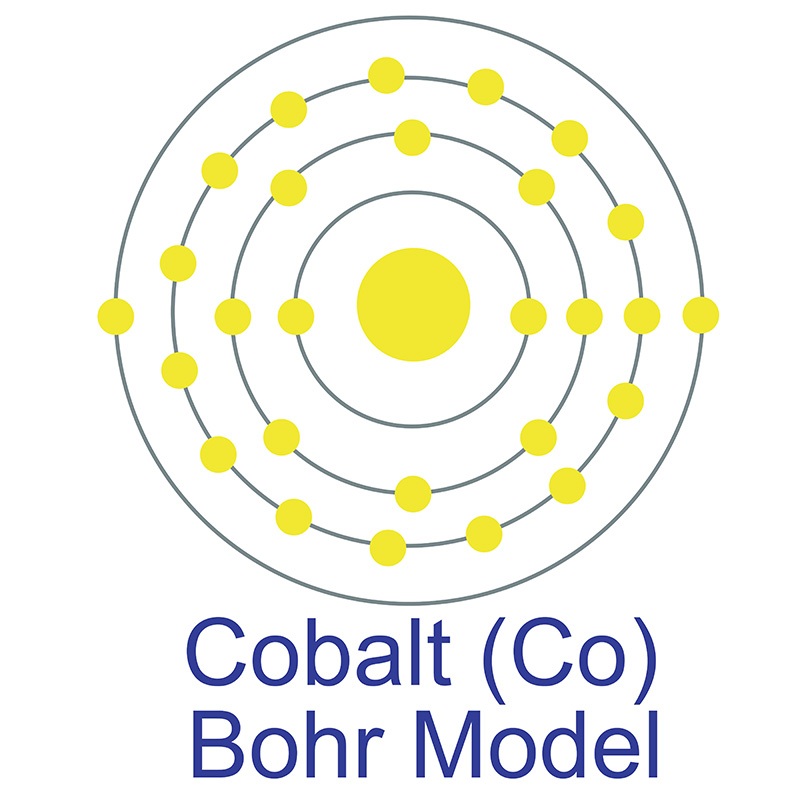
Cobalt(Co) atomic and molecular weight, atomic number and elemental symbolCobalt is a Block D, Group 9, Period 4 element. The number of electrons in each of Cobalt's shells is 2, 8, 15, 2 and its electronic configuration is [Ar] 3d7 4s2. In its elemental form cobalt's CAS number is 7440-48-4. The Ultra High Purity Ingot of Dysprosium Metal by Distillationcobalt atom has a radius of 125.3.pm and it's Van der Waals radius is 200.pm. Cobalt has a metallic permeability two thirds that of iron. It exists as a mixture of two allotropes over a wide temperature range. The transformation is slow and accounts in part for the wide variation in the physical properties of cobalt. It is alloyed with iron, nickel and other metals to make Alnico, an alloy of unusual magnetic strength with many important uses. Samarium-cobalt is one of the highest strength magnet alloys known. Cobalt compounds produce a brilliant and permanent blue color in ceramic glazes, glass, pottery, tiles, and enamels. Co-60 is useful as a gamma ray source. Toxicity of cobalt and its compounds are mild by skin contact and moderate by ingestion. Cobalt is available as metal and compounds with purities from 99% to 99.999% (ACS grade to ultra-high purity); metals in the form of foil, sputtering target, and rod, and compounds as submicron and nanopowder. Cobalt was first discovered by George Brandt in 1737.

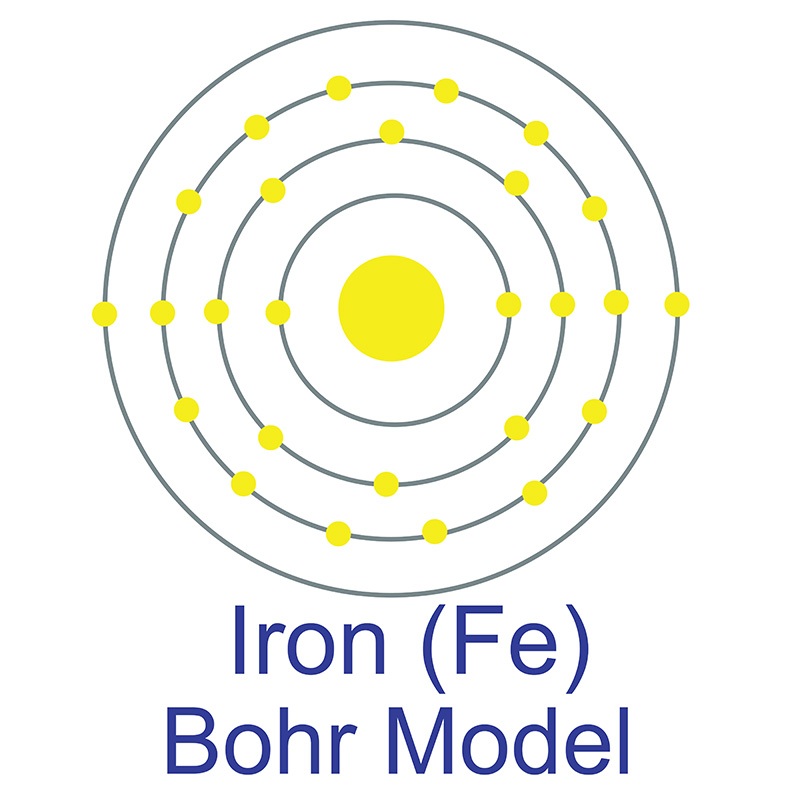
Iron(Fe) atomic and molecular weight, atomic number and elemental symbolIron is a Block D, Group 8, Period 4 element. The number of electrons in each of Iron's shells is 2, 8, 14, 2 and its electronic configuration is [Ar] 3d6 4s2. In its elemental form iron's CAS number is 7439-89-6. The iron atom has a radius of 124.1.pm and it's Van der Waals radius is 200.pm. Iron is not toxic. Iron is the most commonly used metal for commercial applications due to its hardness, historical availability and low cost. Once used on its own, it is now alloyed with nickel and other elements to produce steel and other high strength, non-corrosive structural metals. Iron as a metal and as its Elemental Ironmany compounds has numerous uses. It is a primary colorant in glass and ceramics. It is a catalyst. It is the basis for low grade magnets and because of its magnetic properties is used extensively in memory tape. Recent applications for Iron nanoparticles includeIron Bohr Model in water treatment of carbon tetrachloride in contaminated groundwater, magnetic data storage and resonance imaging (MRI) and in certain alloy and catalyst applications. Iron can also be introduced into processes using iron foil, pellets, rod and wire by thin film Chemical Vapor Deposition (CVD) and Physical Vapor Deposition (PVD) processes including Thermal and Electron Beam (E-Beam) Evaporation, Low Temperature Organic Evaporation, Atomic Layer Deposition (ALD), Organometallic and Chemical Vapor Deposition (MOCVD) for specific applications such as fuel cells and solar energy. Iron is available as metal and compounds with purities from 99% to 99.999% (ACS grade to ultra-high purity); metals in the form of foil, sputtering target, and rod, and compounds as submicron and nanopowder. Iron was first discovered by Early Man.See Iron research below.

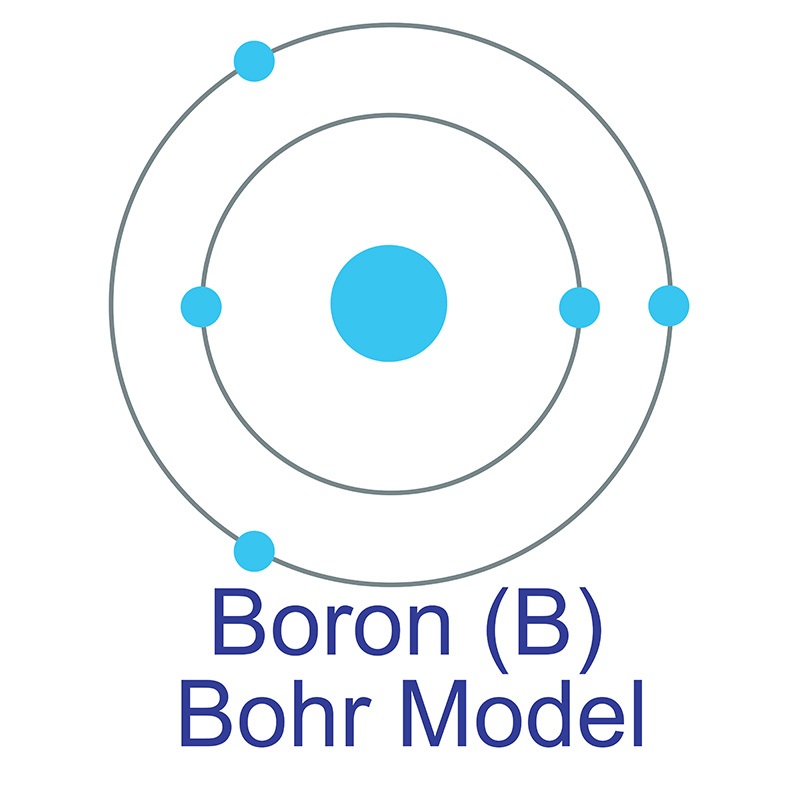
Boron(B) atomic and molecular weight, atomic number and elemental symbolBoron is a Block P, Group 13, Period 2 element. The number of electrons in each of Boron's shells is 2, 3 and its electronic configuration is [He] 2s2 2p1. In its elemental form boron's CAS number is 7440-42-8. The boron atom has a radius of 79.5.pm and it's Van der Waals radius is 200.pm. Boron is not toxic. Boron has an energy band gap of 1.50 to 1.56 eV, which is higher than that of either silicon or germanium. Optical characteristics include transmitting portions of the infrared. Boron is a poor conductor of electricity at room temperature but a good conductor at high temperature. Boron in its elemental form is not toxic. Amorphous Elemental Boronboron is used in pyrotechnic flares to provide a distinctive green color, and in rockets as an igniter Boric acid is also an important boron compound with major markets in textile products. Boron compounds are also extensively used in the manufacture of borosilicate Boron Bohr Modelglasses. The isotope Boron-10 is used as a control for nuclear reactors, as a shield for nuclear radiation, and in instruments used for detecting neutrons. Boron nitride has remarkable properties and can be used to make a material as hard as diamond. The nitride also behaves like an electrical insulator but conducts heat like a metal. Boron also has lubricating properties similar to graphite. Boron was first discovered by Sir Humphry Davy and J.L Gay-Lussac in 1808. The name Boron originates from a combination of carbon and the Arabic word 'buraqu meaning borax. See Boron research below.

Formula CAS No. Appearance Molecular Weight
Co 7440-48-4 Gray 58.93
PRODUCT CATALOG Cobalt Products News Foil Submicron & Nanopowder Tolling Ultra High Purity Sputtering Target Crystal Growth Rod, Plate, Powder, etc. Home

Have a Question? Ask a Chemical Engineer or Material Scientist   Request an MSDS or Certificate of Analysis


Search by Material, Product Name, Product Code, CAS Number, Formula, Element, Anion, Form, EC Number, MDL Number or PubChem ID.


German   Korean   French   Japanese   Spanish   Chinese (Simplified)   Portuguese   Russian   Chinese (Taiwan)  Italian   Turkish   Polish   Dutch   Czech   Swedish   Hungarian   Danish   Hebrew

Production Catalog Available in 36 Countries & Languages

PACKAGING SPECIFICATIONS FOR BULK & RESEARCH QUANTITIES


Typical bulk packaging includes palletized plastic 5 gallon/25 kg. pails, fiber and steel drums to 1 ton super sacks in full container (FCL) or truck load (T/L) quantities. Research and sample quantities and hygroscopic, oxidizing or other air sensitive materials may be packaged under argon or vacuum. Shipping documentation includes a Certificate of Analysis and Material Safety Data Sheet (MSDS). Solutions are packaged in polypropylene, plastic or glass jars up to palletized 440 gallon liquid totes.


Show me more forms of Cobalt

Recent Research & Development for Cobalt

  • Tetra-kis(3-cyano-pyridine-?N)bis-(thio-cyanato-?N)cobalt(II) 1,4-dioxane disolvate. Diehr S, Wöhlert S, Boeckmann J, Näther C. Acta Crystallogr Sect E Struct Rep Online. 2011 Dec 1;67(Pt 12):m1898. Epub 2011 Nov 30. PMID: 22199656 [PubMed - as supplied by publisher]

  • Bis(2,4-dioxo-5,5-diphenyl-imidazol-idin-ido-?N)bis-(propane-1,3-diamine-?N,N')cobalt(II). Hu X, Jiang Q, Wang D, Liu H. Acta Crystallogr Sect E Struct Rep Online. 2011 Dec 1;67(Pt 12):m1885. Epub 2011 Nov 30. PMID: 22199646 [PubMed - as supplied by publisher]

  • Poly[aqua-{?(3)-5-[(pyridin-2-ylmeth-yl)amino]-isophthalato-?N,N':O,O:O}cobalt(II)]. Zhu XH, Cheng XC. Acta Crystallogr Sect E Struct Rep Online. 2011 Dec 1;67(Pt 12):m1862. Epub 2011 Nov 30. PMID: 22199630 [PubMed - as supplied by publisher]

  • catena-Poly[[[cis-aqua-dibromido-cobalt(II)]-?-(pyrazine-2-carb-oxy-lic acid)-?N,O:N] monohydrate]. Dares C, Fournier R, Lever AB. Acta Crystallogr Sect E Struct Rep Online. 2011 Dec 1;67(Pt 12):m1798-m1799. Epub 2011 Nov 23. PMID: 22199583 [PubMed - as supplied by publisher]

  • Poly[di-?(2)-aqua-?(5)-(pyridine-2,6-dicarboxyl-ato)-?(3)-(pyridine-2,6-dicarboxyl-ato)-cobalt(II)disodium]. Boyko AN, Golenya IA, Izotova YA, Haukka M, Prisyazhnaya EV. Acta Crystallogr Sect E Struct Rep Online. 2011 Dec 1;67(Pt 12):m1782-m1783. Epub 2011 Nov 19. PMID: 22199572 [PubMed - as supplied by publisher]

  • Diaqua-bis-(pyridine-2-sulfonato-?N,O)cobalt(II). Li ZS, Ng SW. Acta Crystallogr Sect E Struct Rep Online. 2011 Dec 1;67(Pt 12):m1781. Epub 2011 Nov 19. PMID: 22199571 [PubMed - as supplied by publisher]

  • Bis[tris-(ethyl-enediamine-?N,N')cobalt(III)] octa-kis-?-(3)-oxido-hexa-deca-?(2)-oxido-tetra-deca-oxido-?(12)-tetra-oxo-silicato-octa-molybdenum(VI)hexa-vanadium(IV,V) hexa-hydrate. Lu YK, Tian MM, Xu SG, Lü RQ, Liu YQ. Acta Crystallogr Sect E Struct Rep Online. 2011 Dec 1;67(Pt 12):m1776-m1777. Epub 2011 Nov 19. PMID: 22199568 [PubMed - as supplied by publisher]

  • Tetra-aqua-bis-(2-{[5-(pyridin-4-yl)-1,3,4-oxadiazol-2-yl]sulfan-yl}acetato)-cobalt(II) monohydrate. Yang GR, Li GT. Acta Crystallogr Sect E Struct Rep Online. 2011 Dec 1;67(Pt 12):m1746-m1747. Epub 2011 Nov 12. PMID: 22199545 [PubMed - as supplied by publisher]

  • Tetra-aqua-bis-[3-(pyridin-4-yl)benzoato-?N]cobalt(II). Wang HR, Li GT. Acta Crystallogr Sect E Struct Rep Online. 2011 Dec 1;67(Pt 12):m1743. Epub 2011 Nov 12. PMID: 22199542 [PubMed - as supplied by publisher]

  • Poly[[tetra-aqua-(?(4)-imidazole-4,5-dicarboxyl-ato)(?(3)-imidazole-4,5-dicarboxyl-ato)-?(3)-sulfato-?(2)-sulfato-cobalt(II)digadolinium(III)] monohydrate]. Zhu LC. Acta Crystallogr Sect E Struct Rep Online. 2011 Dec 1;67(Pt 12):m1741-m1742. Epub 2011 Nov 12. PMID: 22199541 [PubMed - as supplied by publisher]

  • Hexaaqua-cobalt(II) bis-(5-acetyl-2-hy-droxy-benzoate) dihydrate. Han LJ, Yang SP, Fu LL, Gao HL. Acta Crystallogr Sect E Struct Rep Online. 2011 Dec 1;67(Pt 12):m1733. Epub 2011 Nov 9. PMID: 22199535 [PubMed - as supplied by publisher]

  • Dichlorido[(4E,11E)-5,7,12,14-tetra-benzyl-7,14-dimethyl-1,4,8,11-tetra-aza-cyclo-tetra-deca-4,11-diene]cobalt(III) perchlorate. Roy TG, Hazari SK, Barua KK, Ng SW, Tiekink ER. Acta Crystallogr Sect E Struct Rep Online. 2011 Dec 1;67(Pt 12):m1722-m1723. Epub 2011 Nov 9. PMID: 22199529 [PubMed - as supplied by publisher]

  • {1,2-Bis[(3,5-dimethyl-1H-pyrazol-1-yl-?N)meth-yl]benzene}-dichloridozinc(II). Guzei IA, Spencer LC, Budhai A, Darkwa J. Acta Crystallogr Sect E Struct Rep Online. 2011 Dec 1;67(Pt 12):m1715-m1716. Epub 2011 Nov 9. PMID: 22199525 [PubMed - as supplied by publisher]

  • catena-Poly[[bis-(2,4-dichloro-benzoato)bis-(methanol-?O)cobalt(II)]-?-4,4'-bipyridine-?N:N']. Hyun MY, Kim PG, Kim C, Kim Y. Acta Crystallogr Sect E Struct Rep Online. 2011 Dec 1;67(Pt 12):m1705. Epub 2011 Nov 9. PMID: 22199519 [PubMed - as supplied by publisher]

  • Bis(pentane-2,4-dionato-?O,O')(1,10-phenanthroline-?N,N')cobalt(II). Perdih F. Acta Crystallogr Sect E Struct Rep Online. 2011 Dec 1;67(Pt 12):m1697. Epub 2011 Nov 5. PMID: 22199513 [PubMed - as supplied by publisher]

  • Diaqua-bis-(dihydrogen 3-aza-niumyl-1-hy-droxy-propyl-idene-1,1-di-phos-phon-ato-?O,O')cobalt(II). Tsaryk NV, Dudko AV, Kozachkova AN, Pekhnyo VI. Acta Crystallogr Sect E Struct Rep Online. 2011 Dec 1;67(Pt 12):m1694. Epub 2011 Nov 5. PMID: 22199511 [PubMed - as supplied by publisher]

  • Tetra-aqua-bis-{3-carb-oxy-5-[(4-carb-oxy-phen-yl)diazen-yl]benzoato-?O}cobalt(II) dihydrate. Bai L, Zhao J. Acta Crystallogr Sect E Struct Rep Online. 2011 Dec 1;67(Pt 12):m1689. Epub 2011 Nov 5. PMID: 22199506 [PubMed - as supplied by publisher]

  • Tetra-aqua-bis-(2-methyl-1H-imidazole-?N)cobalt(II) naphthalene-1,5-disulfonate. Jin Y. Acta Crystallogr Sect E Struct Rep Online. 2011 Dec 1;67(Pt 12):m1686. Epub 2011 Nov 5. PMID: 22199503 [PubMed - as supplied by publisher]

  • Diaqua-bis-(dimethyl sulfoxide-?O)bis(saccharinato-?N)cobalt(II). Potwana FS, Van Zyl WE. Acta Crystallogr Sect E Struct Rep Online. 2011 Dec 1;67(Pt 12):m1667-m1668. Epub 2011 Nov 5. PMID: 22199492 [PubMed - as supplied by publisher]

  • Pulmonary toxicity after exposure to military-relevant heavy metal tungsten alloy particles. Roedel EQ, Cafasso DE, Lee KW, Pierce LM. Toxicol Appl Pharmacol. 2011 Dec 16. [Epub ahead of print] PMID: 22198552 [PubMed - as supplied by publisher]

Customers for this product have also looked at:

Recent Research & Development for Iron

  • The role of zinc protoporphyrin measurement in the differentiation between primary myelofibrosis and essential thrombocythaemia. Metzgeroth G, Kanders EM, Erben P, Hofmann WK, Hastka J. Ann Hematol. 2010 Oct 5. [Epub ahead of print] PubMed PMID: 20922526.

  • Isolation and Identification of a Novel Antioxidant with Antitumour Activity from Serratia ureilytica Using Squid Pen as Fermentation Substrate. Kuo YH, Liang TW, Liu KC, Hsu YW, Hsu HC, Wang SL. Mar Biotechnol (NY). 2010 Oct 5. [Epub ahead of print] PubMed PMID: 20922553.

  • Low prevalence of iron-deficiency anaemia among Inuit preschool children: Nunavut Inuit Child Health Survey, 2007-2008. Pacey A, Weiler H, Egeland GM. Public Health Nutr. 2010 Oct 5:1-9. [Epub ahead of print] PubMed PMID: 20920385.

  • The impact of training for day-care educators on childhood anaemia in nurseries: an institutional randomised clinical trial. Konstantyner T, Taddei JA, Oliveira MD, Palma D, Colugnati FA. Public Health Nutr. 2010 Oct 5:1-8. [Epub ahead of print] PubMed PMID: 20920384.

  • XAS study on copper red in ancient glass beads from Thailand. Klysubun W, Thongkam Y, Pongkrapan S, Won-In K, T-Thienprasert J, Dararutana P. Anal Bioanal Chem. 2010 Oct 4. [Epub ahead of print] PubMed PMID: 20890783.

  • Engineered Biocompatible Nanoparticles for in Vivo Imaging Applications. Chen S, Wang L, Duce SL, Brown S, Lee S, Melzer A, Cuschieri SA, Andre´ P. J Am Chem Soc. 2010 Oct 4. [Epub ahead of print] PubMed PMID: 20919679.

  • Bacterial Na+-translocating ferredoxin:NAD+ oxidoreductase. Biegel E, Müller V. Proc Natl Acad Sci U S A. 2010 Oct 4. [Epub ahead of print] PubMed PMID: 20921383.

  • Insights into the Mechanism of Magnetic Particle Assisted Gene Delivery. Ang D, Nguyen QV, Kayal S, Preiser PR, Rawat RS, Ramanujan RV. Acta Biomater. 2010 Oct 1. [Epub ahead of print] PubMed PMID: 20920614.

  • A new coordination complex based on a polynitrile ligand: bis(4-amino-3,5-di-2-pyridyl-4H-1,2,4-triazole)diaquairon(II) bis(1,1,3,3-tetracyano-2-methylsulfanylpropenide). Setifi Z, Gaamoune B, Stoeckli-Evans H, Rouag DA, Setifi F. Acta Crystallogr C. 2010 Oct;66(Pt 10):m286-9. Epub 2010 Sep 17. PubMed PMID: 20921605.

  • Evaluation of exercise-induced changes in concentrations of C-reactive protein and serum biochemical values in sled dogs completing a long-distance endurance race. Wakshlag JJ, Stokol T, Geske SM, Greger CE, Angle CT, Gillette RL. Am J Vet Res. 2010 Oct;71(10):1207-13. PubMed PMID: 20919909.

  • PHK from phenol hydroxylase of Pseudomonas sp. OX1. Insight into the role of an accessory protein in Bacterial Multicomponent Monooxygenases. Izzo V, Leo G, Scognamiglio R, Troncone L, Birolo L, Di Donato A. Arch Biochem Biophys. 2010 Oct 1. [Epub ahead of print] PubMed PMID: 20920460.

  • Higher expression of ferritin protects Chlamydia trachomatis infected HeLa 229 cells from reactive oxygen species mediated cell death. Vardhan H, Bhengraj AR, Jha R, Srivastava P, Jha HC, Mittal A. Biochem Cell Biol. 2010 Oct;88(5):835-42. PubMed PMID: 20921994.

  • Endoplasmic Reticulum Protein 29 (ERp29): The emerging role in cancer. Zhang D, Richardson DR. Int J Biochem Cell Biol. 2010 Oct 1. [Epub ahead of print] PubMed PMID: 20920593.

  • The Safety, Tolerability, and Efficacy of a Liquid Formulation of Deferiprone in Young Children With Transfusional Iron Overload. El Alfy M, Sari TT, Lee CL, Tricta F, El-Beshlawy A. J Pediatr Hematol Oncol. 2010 Oct 1. [Epub ahead of print] PubMed PMID: 20921906.

  • Plummer-Vinson syndrome. Hefaiedh R, Kharrat J, Kilani A, Romani M, Kochlef A, Elloumi H, Gargouri D, Ouakaa-Kchaou A, Boutreaa Y, Ghorbel A. Tunis Med. 2010 Oct;88(10):721-4. PubMed PMID: 20890819.

  • Low zinc in drinking water is associated with the risk of type 1 diabetes in children. Ulf S, Sami O, Heikki H, Ludvigsson J. Pediatr Diabetes. 2010 Sep 7. doi: 10.1111/j.1399-5448.2010.00678.x. [Epub ahead of print] PubMed PMID: 20920146.

  • Prevalence of Anemia in Children Three to 12 Months Old in a Health Service in Ribeirão Preto, SP, Brazil. Reis MC, Nakano AM, Silva IA, Gomes FA, Pereira MJ. Rev Lat Am Enfermagem. 2010 Jul-Aug;18(4):792-9. PubMed PMID: 20922328.

  • Eukaryotic microbial diversity of phototrophic microbial mats in two Icelandic geothermalhot springs. Aguilera A, Souza-Egipsy V, González-Toril E, Rendueles O, Amils R. Int Microbiol. 2010 Mar;13(1):21-32. PubMed PMID: 20890838.

  • Eukaryotic microbial diversity of phototrophic microbial mats in two Icelandic geothermal hot springs. Teixidó L, Cortés P, Bigas A, Alvarez G, Barbé J, Campoy S. Int Microbiol. 2010 Mar;13(1):21-32. PubMed PMID: 20890837.

  • [Endemic and biogeochemical features of the territory of Chuvash Republic]. Vestn Ross Akad Med Nauk. 2010;(8):40-6. Russian. PubMed PMID: 20922843.
Customers for this product have also looked at:
Boron Pellets Boron Rod Boron Bars Aluminum Boron Alloy Boron Oxide Nanopowder
Boron Chloride Boron Metal Boron Oxide Boron Oxide Pellets Boron Phosphate
Boron Powder Boron Foil Boron Sputtering Target Nickel Silicon Boron Alloy Boron NanoPowder

Recent Research & Development for Boron

  • Photoluminescence, white light emitting properties and related aspects of ZnO nanoparticles admixed with graphene and GaN. Kumar P, Panchakarla LS, Venkataprasad Bhat S, Maitra U, Subrahmanyam KS, Rao CN. Nanotechnology. 2010 Sep 24;21(38):385701. Epub 2010 Aug 26. PubMed PMID: 20739740.

  • Reactivity of an oxoboryl complex toward fluorinated aryl boron reagents. Braunschweig H, Radacki K, Schneider A. Chem Commun (Camb). 2010 Sep 21;46(35):6473-5. Epub 2010 Aug 19. PubMed PMID: 20721386.

  • Direct separation of boron from Na- and Ca-rich matrices by sublimation for stable isotope measurement by MC-ICP-MS. Wang BS, You CF, Huang KF, Wu SF, Aggarwal SK, Chung CH, Lin PY. Talanta. 2010 Sep 15;82(4):1378-1384. Epub 2010 Jul 31. PubMed PMID: 20801344.

  • Synthesis and Reactivity of Boron-, Silicon-, and Tin-Bridged ansa-Cyclopentadienyl-Cycloheptatrienyl Titanium Complexes (Troticenophanes). Braunschweig H, Fuß M, Mohapatra SK, Kraft K, Kupfer T, Lang M, Radacki K, Daniliuc CG, Jones PG, Tamm M. Chemistry. 2010 Aug 27. [Epub ahead of print] PubMed PMID: 20803585.

  • Cloning and characterization of a zebrafish homologue of human AQP1: A bifunctional water and gas channel. Chen LM, Zhao J, Musa-Aziz R, Pelletier MF, Drummond IA, Boron WF. Am J Physiol Regul Integr Comp Physiol. 2010 Aug 25. [Epub ahead of print] PubMed PMID: 20739606.

  • Mechanisms of Boron Tolerance and Accumulation in Plants: A Physiological Comparison of the Extremely Boron-Tolerant Plant Species, Puccinellia distans, with the Moderately Boron-Tolerant Gypsophila arrostil. Stiles AR, Bautista D, Atalay E, Babaog?lu M, Terry N. Environ Sci Technol. 2010 Aug 25. [Epub ahead of print] PubMed PMID: 20738130.

  • Incorporation of Boron, Aluminum, and Gallium Derivatives into [{Ti(eta(5)-C(5)Me(5))(mu-O)}(3)(mu(3)-CR)] (R = H, Me). Herna´n-Go´mez A, Marti´n A, Mena M, Santamari´a C. Inorg Chem. 2010 Aug 25. [Epub ahead of print] PubMed PMID: 20738137.

  • Spectroscopic and Modeling Investigations of the Gas Phase Chemistry and Composition in Microwave Plasma Activated B(2)H(6)/CH(4)/Ar/H(2) Mixtures. Ma J, Richley JC, Davies DR, Ashfold MN, Mankelevich YA. J Phys Chem A. 2010 Aug 25. [Epub ahead of print] PubMed PMID: 20735120.

  • Total Syntheses of Tubulysins. Shibue T, Hirai T, Okamoto I, Morita N, Masu H, Azumaya I, Tamura O. Chemistry. 2010 Aug 23. [Epub ahead of print] PubMed PMID: 20734394.

  • Structure and Bonding of gamma-B(28): Is the High Pressure Form of Elemental Boron Ionic? Ha¨ussermann U, Mikhaylushkin AS. Inorg Chem. 2010 Aug 23. [Epub ahead of print] PubMed PMID: 20731410.

  • Boron nitride substrates for high-quality graphene electronics. Dean CR, Young AF, Meric I, Lee C, Wang L, Sorgenfrei S, Watanabe K, Taniguchi T, Kim P, Shepard KL, Hone J. Nat Nanotechnol. 2010 Aug 22. [Epub ahead of print] PubMed PMID: 20729834.

  • Synthesis and formation mechanism of hydrogenated boron clusters B(12)H(n) with controlled hydrogen content. Ohishi Y, Kimura K, Yamaguchi M, Uchida N, Kanayama T. J Chem Phys. 2010 Aug 21;133(7):074305. PubMed PMID: 20726640.

  • Tensile Tests on Individual Multi-Walled Boron Nitride Nanotubes. Wei X, Wang MS, Bando Y, Golberg D. Adv Mater. 2010 Aug 20. [Epub ahead of print] PubMed PMID: 20730820.

  • Two Concise Total Syntheses of (-)-Bitungolide F. Elmarrouni A, Joolakanti SR, Colon A, Heras M, Arseniyadis S, Cossy J. Org Lett. 2010 Aug 20. [Epub ahead of print] PubMed PMID: 20726574.

  • Cell Adhesion Properties on Chemically Micropatterned Boron-Doped Diamond Surfaces. Marcon L, Spriet C, Coffinier Y, Galopin E, Rosnoblet C, Szunerits S, He´liot L, Angrand PO, Boukherroub R. Langmuir. 2010 Aug 18. [Epub ahead of print] PubMed PMID: 20715878.

  • Probing the active-site requirements of human intestinal N-terminal maltase glucoamylase: The effect of replacing the sulfate moiety by a methyl ether in ponkoranol, a naturally occurring alpha-glucosidase inhibitor. Eskandari R, Jones K, Rose DR, Pinto BM. Bioorg Med Chem Lett. 2010 Aug 11. [Epub ahead of print] PubMed PMID: 20801033.

  • Porosity calculations using a C/O logging tool with boron-lined NaI detectors. Metwally WA. Appl Radiat Isot. 2010 Aug 10. [Epub ahead of print] PubMed PMID: 20727774.

  • Novel macrocyclic HCV NS3 protease inhibitors derived from alpha-amino cyclic boronates. Li X, Zhang YK, Liu Y, Ding CZ, Zhou Y, Li Q, Plattner JJ, Baker SJ, Zhang S, Kazmierski WM, Wright LL, Smith GK, Grimes RM, Crosby RM, Creech KL, Carballo LH, Slater MJ, Jarvest RL, Thommes P, Hubbard JA, Convery MA, Nassau PM, McDowell W, Skarzynski TJ, Qian X, Fan D, Liao L, Ni ZJ, Pennicott LE, Zou W, Wright J. Bioorg Med Chem Lett. 2010 Aug 10. [Epub ahead of print] PubMed PMID: 20801653.

  • [Evaluation of the efficiency of measures to reduce the influence of risk factors on human health]. Gig Sanit. 2010 May-Jun;(3):7-8. Russian. PubMed PMID: 20734732.

  • Electrochemical disinfection of secondary wastewater treatment plant (WWTP) effluent. Pérez G, Gómez P, Ibañez R, Ortiz I, Urtiaga AM. Water Sci Technol. 2010;62(4):892-7. PubMed PMID: 20729593.


American Elements is a copyrighted U.S. Trademark. All rights reserved.