American Elements Logo and U.S. Registered Trademark


Dysprosium Iron Cobalt Sputtering Target
High Purity Dy Fe Co Sputtering Target
Product
Product Code
Order or Specifications
(2N) 99% Dysprosium Iron Cobalt Sputtering Target
DY-FECO-02-ST
Contact American Elements
(2N5) 99.5% Dysprosium Iron Cobalt Sputtering Target
DY-FECO-025-ST
Contact American Elements
(3N) 99.9% Dysprosium Iron Cobalt Sputtering Target
DY-FECO-03-ST
Contact American Elements
(3N5) 99.95% Dysprosium Iron Cobalt Sputtering Target
DY-FECO-035-ST
Contact American Elements
(3N5) 99.95% Dysprosium Iron Cobalt Sputtering Target
DY-FECO-05-ST
Contact American Elements
See safety data and research below. American Elements specializes in producing high purity Dysprosium Iron Cobalt Sputtering targets with the highest possible density High Purity (99.99%) Metallic Sputtering Targetand smallest possible average grain sizes for use in semiconductor, chemical vapor deposition (CVD) and physical vapor deposition (PVD) display and optical applications. Our standard Sputtering Targets for thin film are available monoblock or bonded with dimensions and configurations up to 820 mm with hole drill locations and threading, beveling, grooves and backing designed to work with both older sputtering devises as well as the latest process equipment, such as large area coating for solar energy or fuel cells and flip-chip applications. Research sized targets are also produced as well as custom sizes and alloys. All targets are analyzed using best demonstrated techniques including X-Ray Fluorescence (XRF), Glow Discharge Mass Spectrometry (GDMS), and Inductively Coupled Plasma (ICP). "Sputtering" allows for thin film deposition of an ultra high purity sputtering metallic or oxide material onto another solid substrate by the controlled removal and conversion of the target material into a directed gaseous/plasma phase through ionic bombardment. We can also provide targets outside this range in addition to just about any size rectangular, annular, or oval target. Materials are produced using crystallization, solid state and other ultra high purification processes such as sublimation. American Elements specializes in producing custom compositions for commercial and research applications and for new proprietary technologies. American Elements also casts any of the rare earth metals and most other advanced materials into rod, bar or plate form, as well as other machined shapes and through other processes such as nanoparticles (See also application discussion at Nanotechnology Information and at Quantum Dots) and in the form of solutions and organometallics. We also produce Dysprosium as rods, powder and plates. Other shapes are available by request.

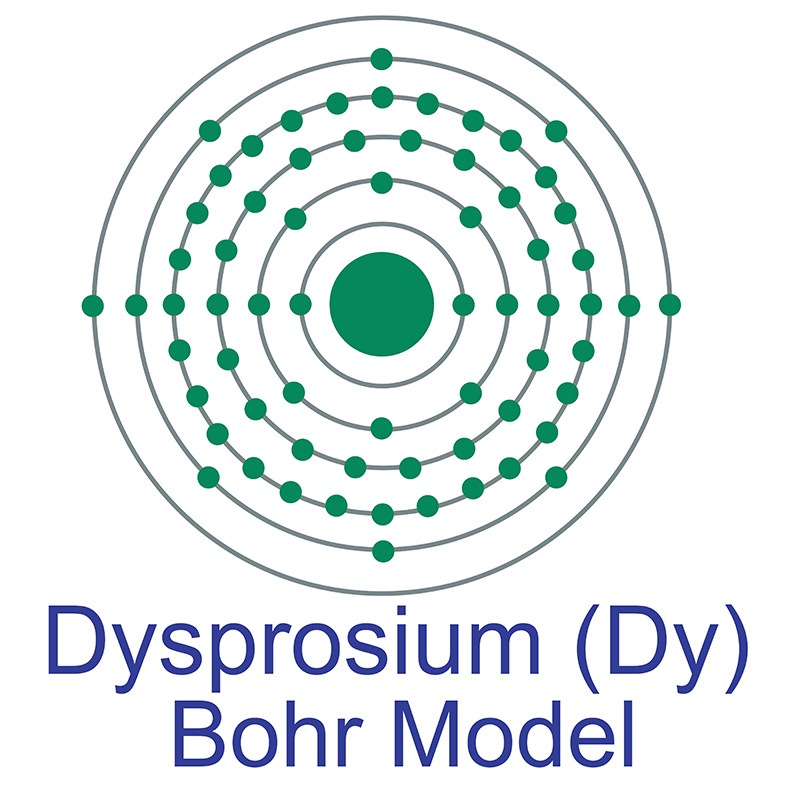
Dysporsium(Dy)atomic and molecular weight, atomic number and elemental symbolDysprosium is a Block F, Group 3, Period 6 element. The number of electrons in each of Dysprosium's shells is 2, 8, 18, 28, 8, 2 and its electronic configuration is [Xe] 4f10 6s2. In its elemental form dysprosium's CAS number is 7429-91-6. The dysprosium atom has a radius of 175.2.pm and it's Van der Waals radius is unknown. Dysprosium is moderately toxic. Dysprosium is most commonly used in neodymium-iron-boron high strength permanent magnets. Dysprosium is available as metal and compounds with purities from 99% to 99.999% (ACS grade to ultra-high purity); metals in the form of foil, sputtering target, and rod, and compounds as submicron and nanopowder. While Elemental Dysprosiumit has one of the highest magnetic moments of any of the rare earths (10.6µB), this has not resulted in an ability to perform on its own as a practical alternative to neodymium compositions. It isDysprosium Bohr Model however now an essential additive in NdFeB production. It is also used in special ceramic compositions based on BaTiO formulations. Recent research has examined the use of dysprosium in dysprosium-iron-garnet (DyIG) and silicon implanted with dysprosium and holmium to form donor centers. Dysprosium is added to various advanced optical formulations due to the fact that it emits in the 470-500 and 570-600 nm wavelengths. Dysprosium was first discovered by Paul Emile Lecoq de Boisbaudran in 1886. The element name originates from the Greek word 'dysprositos' meaning hard to get at. See Dysprosium research below.

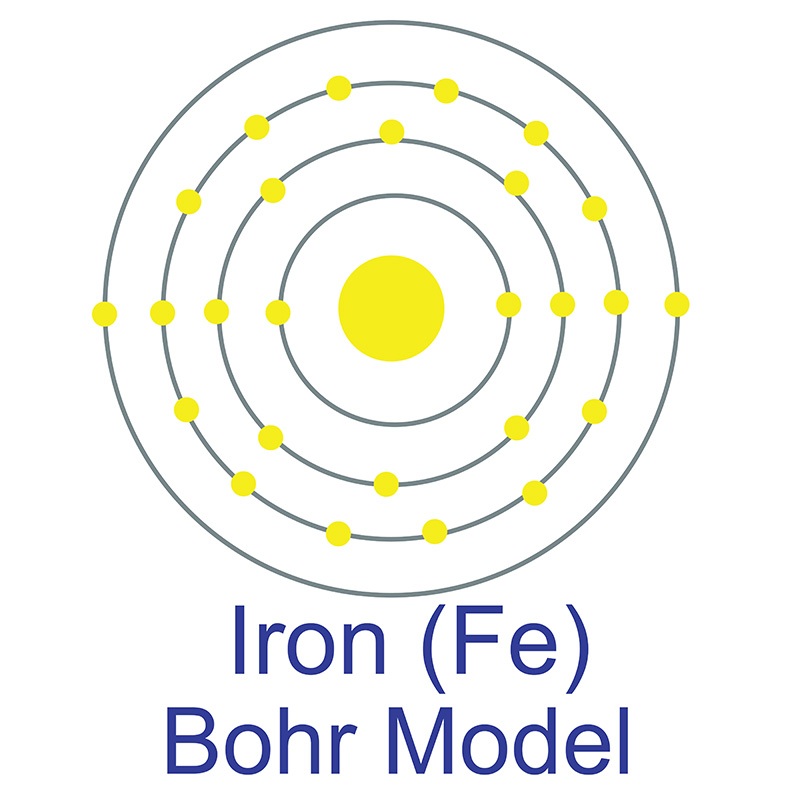
Iron(Fe) atomic and molecular weight, atomic number and elemental symbolIron is a Block D, Group 8, Period 4 element. The number of electrons in each of Iron's shells is 2, 8, 14, 2 and its electronic configuration is [Ar] 3d6 4s2. In its elemental form iron's CAS number is 7439-89-6. The iron atom has a radius of 124.1.pm and it's Van der Waals radius is 200.pm. Iron is not toxic. Iron is the most commonly used metal for commercial applications due to its hardness, historical availability and low cost. Once used on its own, it is now alloyed with nickel and other elements to produce steel and other high strength, non-corrosive structural metals. Iron as a metal and as its Elemental Ironmany compounds has numerous uses. It is a primary colorant in glass and ceramics. It is a catalyst. It is the basis for low grade magnets and because of its magnetic properties is used extensively in memory tape. Recent applications for Iron nanoparticles includeIron Bohr Model in water treatment of carbon tetrachloride in contaminated groundwater, magnetic data storage and resonance imaging (MRI) and in certain alloy and catalyst applications. Iron can also be introduced into processes using iron foil, pellets, rod and wire by thin film Chemical Vapor Deposition (CVD) and Physical Vapor Deposition (PVD) processes including Thermal and Electron Beam (E-Beam) Evaporation, Low Temperature Organic Evaporation, Atomic Layer Deposition (ALD), Organometallic and Chemical Vapor Deposition (MOCVD) for specific applications such as fuel cells and solar energy. Iron is available as metal and compounds with purities from 99% to 99.999% (ACS grade to ultra-high purity); metals in the form of foil, sputtering target, and rod, and compounds as submicron and nanopowder. Iron was first discovered by Early Man.See Iron research below.

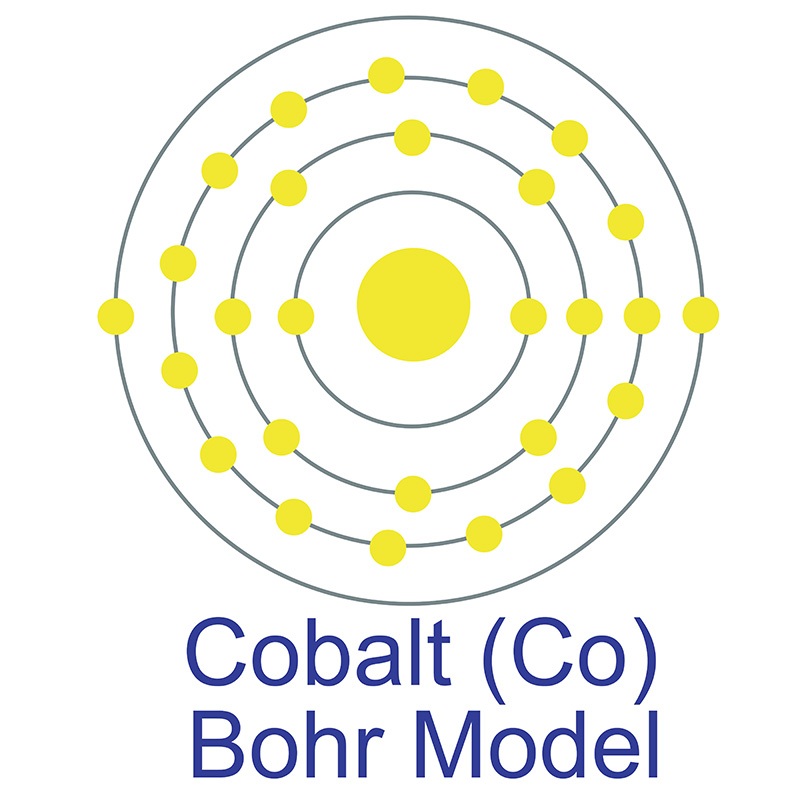
Cobalt(Co) atomic and molecular weight, atomic number and elemental symbolCobalt is a Block D, Group 9, Period 4 element. The number of electrons in each of Cobalt's shells is 2, 8, 15, 2 and its electronic configuration is [Ar] 3d7 4s2. In its elemental form cobalt's CAS number is 7440-48-4. The cobalt atom has a radius of 125.3.pm and it's Van der Waals radius is 200.pm. Cobalt and its compounds are somewhat toxic by skin contact and moderately toxic by inhalation. Cobalt has a metallic permeability two thirds that of iron. It exists as a mixture of two allotropes over a wide temperature range. The transformation is slow and accounts in part for the wide variation in the physical properties of cobalt. It is alloyed with iron, nickel and other metals to make Alnico, an alloy of unusual magnetic strength with many Cobalt Bohr Modelimportant Elemental Cobaltuses. Samarium-cobalt is one of the highest strength magnet alloys known. Cobalt compounds produce a brilliant and permanent blue color in ceramic glazes, glass, pottery, tiles, and enamels. Co-60 is useful as a gamma ray source. Toxicity of cobalt and its compounds are mild by skin contact and moderate by ingestion. Cobalt is available as metal and compounds with purities from 99% to 99.999% (ACS grade to ultra-high purity); metals in the form of foil, sputtering target, and rod, and compounds as submicron and nanopowder. Cobalt was first discovered by George Brandt in 1737. The origin of the word Cobalt comes from the German word 'Kobalt or Kobold' which translates as "goblin", "elf" or "evil spirit". See Cobalt research below.

Formula CAS No.
Dy
Fe
Co

7429-91-6
7439-89-6
7440-48-4
PRODUCT CATALOG AE Alloys™ News Foil Submicron & Nanopowder Tolling Ultra High Purity Sputtering Target Crystal Growth Rod, Plate, Powder, etc. Home

Have a Question? Ask a Chemical Engineer or Material Scientist   Request an MSDS or Certificate of Analysis


Search by Material, Product Name, Product Code, CAS Number, Formula, Element, Anion, Form, EC Number, MDL Number or PubChem ID.


German   Korean   French   Japanese   Spanish   Chinese (Simplified)   Portuguese   Russian   Chinese (Taiwan)   Italian   Turkish   Polish   Dutch   Czech   Swedish   Hungarian   Danish   Hebrew

Production Catalog Available in 36 Countries & Languages

PACKAGING SPECIFICATIONS FOR BULK & RESEARCH QUANTITIES


Typical bulk packaging includes palletized plastic 5 gallon/25 kg. pails, fiber and steel drums to 1 ton super sacks in full container (FCL) or truck load (T/L) quantities. Research and sample quantities and hygroscopic, oxidizing or other air sensitive materials may be packaged under argon or vacuum. Shipping documentation includes a Certificate of Analysis and Material Safety Data Sheet (MSDS). Solutions are packaged in polypropylene, plastic or glass jars up to palletized 440 gallon liquid totes.


Show me more forms of Dysprosium
 
Customers for this product have also looked at:
Dysprosium Wire Dysprosium Oxide Pellets Dysprosium Erbium Aluminum alloy Dysprosium Sulfate Dysprosium Sputtering Target
Dysprosium Nitrate Dysprosium Metal Dysprosium Scandium Oxide Dysprosium Pellets Dysprosium Acetate Solution
Dysprosium Nanoparticles Dysprosium Foil Dysprosium Acetylacetonate Dysprosium Chloride Dysprosium Oxide

Recent Research & Development for Dysprosium

  • Selected Trace Elements in the Sacramento River, California: Occurrence and Distribution. Taylor HE, Antweiler RC, Roth DA, Alpers CN, Dileanis P. Arch Environ Contam Toxicol. 2011 Dec 23. [Epub ahead of print] PMID: 22193863 [PubMed - as supplied by publisher]

  • High energy electron beams characterization using CaSO(4):Dy+PTFE Phosphors for clinical therapy applications. Rivera T, Espinoza A, Von SM, Alvarez R, Jiménez Y. Appl Radiat Isot. 2011 Dec 13. [Epub ahead of print] PMID: 22182630 [PubMed - as supplied by publisher]

  • Strongly dipolar bose-einstein condensate of dysprosium. Lu M, Burdick NQ, Youn SH, Lev BL. Phys Rev Lett. 2011 Nov 4;107(19):190401. Epub 2011 Oct 31. PMID: 22181585 [PubMed - in process]

  • Lipophilic phosphonium-lanthanide compounds with magnetic, luminescent, and tumor targeting properties. Li M, Ganea GM, Lu C, De Rooy SL, El-Zahab B, Fernand VE, Jin R, Aggarwal S, Warner IM. J Inorg Biochem. 2011 Nov 3;107(1):40-46. [Epub ahead of print] PMID: 22172501 [PubMed - as supplied by publisher]

  • Differential genotoxicity of chemical properties and particle size of rare metal and metal oxide nanoparticles. Hasegawa G, Shimonaka M, Ishihara Y. J Appl Toxicol. 2012 Jan;32(1):72-80. doi: 10.1002/jat.1719. Epub 2011 Aug 23. PMID: 22162085 [PubMed - in process]

  • A Discrete Dysprosium Trigonal Prism Showing Single-Molecule Magnet Behaviour. Tian H, Wang M, Zhao L, Guo YN, Guo Y, Tang J, Liu Z. Chemistry. 2011 Dec 12. doi: 10.1002/chem.201102547. [Epub ahead of print] PMID: 22161973 [PubMed - as supplied by publisher]

  • Synthesis, characterisation and magnetic study of a cyano-substituted dysprosium double decker single-molecule magnet. Waters M, Moro F, Krivokapic I, McMaster J, Slageren JV. Dalton Trans. 2011 Dec 6. [Epub ahead of print] PMID: 22146842 [PubMed - as supplied by publisher]

  • Molecular Structure and Vibrational Spectra of Mixed MDyX(4) (M = Li, Na, K, Rb, Cs; X = F, Cl, Br, I) Vapor Complexes: A Computational and Matrix-Isolation Infrared Spectroscopic Study. Groen CP, Kovács A, Varga Z, Hargittai M. Inorg Chem. 2011 Dec 2. [Epub ahead of print] PMID: 22136352 [PubMed - as supplied by publisher]

  • Quadruple-CO(3)(2-) bridged octanuclear dysprosium(iii) compound showing single-molecule magnet behaviour. Tian H, Zhao L, Guo YN, Guo Y, Tang J, Liu Z. Chem Commun (Camb). 2012 Jan 18;48(5):708-10. Epub 2011 Dec 1. PMID: 22129652 [PubMed - in process]

  • Salen-based coordination polymers of iron and the rare Earth elements. Bhunia A, Lan Y, Mereacre V, Gamer MT, Powell AK, Roesky PW. Inorg Chem. 2011 Dec 19;50(24):12697-704. Epub 2011 Nov 14. PMID: 22082051 [PubMed - in process]

  • Novel lanthanide-based polymeric chains and corresponding ultrafast dynamics in solution. Thielemann DT, Klinger M, Wolf TJ, Lan Y, Wernsdorfer W, Busse M, Roesky PW, Unterreiner AN, Powell AK, Junk PC, Deacon GB. Inorg Chem. 2011 Dec 5;50(23):11990-2000. Epub 2011 Nov 8. PMID: 22066577 [PubMed - in process]

  • Tetra-kis(?-2-phen-oxy-propionato)-?O,O':O';?O:O,O',?O:O'-bis-[(1,10-phenanthroline-?N,N')(2-phen-oxy-propionato-?O,O')praseodymium(III)]. Shen JB, Liu JL, Zhao GL. Acta Crystallogr Sect E Struct Rep Online. 2011 Sep 1;67(Pt 9):m1321. Epub 2011 Aug 31. PMID: 22058896 [PubMed]

  • Tetra-kis(?-2-phen-oxy-propionato)-?O,O':O';?O:O,O',?O:O'-bis-[(1,10-phenanthroline-?N,N')(2-phen-oxy-propionato-?O,O')dysprosium(III)]. Shen JB, Liu JL, Zhao GL. Acta Crystallogr Sect E Struct Rep Online. 2011 Sep 1;67(Pt 9):m1320. Epub 2011 Aug 31. PMID: 22058895 [PubMed]

  • An organometallic sandwich lanthanide single-ion magnet with an unusual multiple relaxation mechanism. Jeletic M, Lin PH, Le Roy JJ, Korobkov I, Gorelsky SI, Murugesu M. J Am Chem Soc. 2011 Dec 7;133(48):19286-9. Epub 2011 Nov 11. PMID: 22032273 [PubMed - in process]

  • A tetragonal form of dysprosium orthomolybdate at room temperature. Dorzhieva S, Chumak I, Sarapulova A, Mikhailova D, Bazarova J, Ehrenberg H. Acta Crystallogr C. 2011 Oct;67(Pt 10):i50-2. Epub 2011 Sep 15. PMID: 21979965 [PubMed - in process]

  • Note: simple means for selective removal of the 365 nm line from the Hg spectrum using Dy. Vesborg PC, Chorkendorff I, Brock-Nannestad T, Dethlefsen JR, Bendix J. Rev Sci Instrum. 2011 Sep;82(9):096102. PMID: 21974629 [PubMed - in process]

  • Effects of chronic ?-irradiation on the aquatic microbial microcosm: equi-dosimetric comparison with effects of heavy metals. Fuma S, Kawaguchi I, Kubota Y, Yoshida S, Kawabata Z, Polikarpov GG. J Environ Radioact. 2012 Feb;103(2):81-6. Epub 2011 Sep 29. PMID: 21962482 [PubMed - in process]

  • Cool White Light Emission in Dysprosium and Salicylic Acid Doped Poly Vinyl Alcohol Film Under UV Excitation. Kaur G, Rai SB. J Fluoresc. 2011 Sep 27. [Epub ahead of print] PMID: 21947610 [PubMed - as supplied by publisher]

  • [Synthesis, crystal structure and luminescent properties of a dysprosium coordinaation polymer based on pyridine-2, 6-dicarboxylic acid]. Fan RQ, Wang P, Ren JY, Zhou GP, Yang YL. Guang Pu Xue Yu Guang Pu Fen Xi. 2011 Jul;31(7):1734-8. Chinese. PMID: 21942013 [PubMed - in process]

  • Anisotropic dysprosium. Gatteschi D. Nat Chem. 2011 Sep 23;3(10):830. doi: 10.1038/nchem.1157. No abstract available. PMID: 21941259 [PubMed - indexed for MEDLINE]
Customers for this product have also looked at:

Recent Research & Development for Iron

  • The role of zinc protoporphyrin measurement in the differentiation between primary myelofibrosis and essential thrombocythaemia. Metzgeroth G, Kanders EM, Erben P, Hofmann WK, Hastka J. Ann Hematol. 2010 Oct 5. [Epub ahead of print] PubMed PMID: 20922526.

    Isolation and Identification of a Novel Antioxidant with Antitumour Activity from Serratia ureilytica Using Squid Pen as Fermentation Substrate. Kuo YH, Liang TW, Liu KC, Hsu YW, Hsu HC, Wang SL. Mar Biotechnol (NY). 2010 Oct 5. [Epub ahead of print] PubMed PMID: 20922553.

    Low prevalence of iron-deficiency anaemia among Inuit preschool children: Nunavut Inuit Child Health Survey, 2007-2008. Pacey A, Weiler H, Egeland GM. Public Health Nutr. 2010 Oct 5:1-9. [Epub ahead of print] PubMed PMID: 20920385.

    The impact of training for day-care educators on childhood anaemia in nurseries: an institutional randomised clinical trial. Konstantyner T, Taddei JA, Oliveira MD, Palma D, Colugnati FA. Public Health Nutr. 2010 Oct 5:1-8. [Epub ahead of print] PubMed PMID: 20920384.

    XAS study on copper red in ancient glass beads from Thailand. Klysubun W, Thongkam Y, Pongkrapan S, Won-In K, T-Thienprasert J, Dararutana P. Anal Bioanal Chem. 2010 Oct 4. [Epub ahead of print] PubMed PMID: 20890783.

    Engineered Biocompatible Nanoparticles for in Vivo Imaging Applications. Chen S, Wang L, Duce SL, Brown S, Lee S, Melzer A, Cuschieri SA, Andre´ P. J Am Chem Soc. 2010 Oct 4. [Epub ahead of print] PubMed PMID: 20919679.

    Bacterial Na+-translocating ferredoxin:NAD+ oxidoreductase. Biegel E, Müller V. Proc Natl Acad Sci U S A. 2010 Oct 4. [Epub ahead of print] PubMed PMID: 20921383.

    Insights into the Mechanism of Magnetic Particle Assisted Gene Delivery. Ang D, Nguyen QV, Kayal S, Preiser PR, Rawat RS, Ramanujan RV. Acta Biomater. 2010 Oct 1. [Epub ahead of print] PubMed PMID: 20920614.

    A new coordination complex based on a polynitrile ligand: bis(4-amino-3,5-di-2-pyridyl-4H-1,2,4-triazole)diaquairon(II) bis(1,1,3,3-tetracyano-2-methylsulfanylpropenide). Setifi Z, Gaamoune B, Stoeckli-Evans H, Rouag DA, Setifi F. Acta Crystallogr C. 2010 Oct;66(Pt 10):m286-9. Epub 2010 Sep 17. PubMed PMID: 20921605.

    Evaluation of exercise-induced changes in concentrations of C-reactive protein and serum biochemical values in sled dogs completing a long-distance endurance race. Wakshlag JJ, Stokol T, Geske SM, Greger CE, Angle CT, Gillette RL. Am J Vet Res. 2010 Oct;71(10):1207-13. PubMed PMID: 20919909.

    PHK from phenol hydroxylase of Pseudomonas sp. OX1. Insight into the role of an accessory protein in Bacterial Multicomponent Monooxygenases. Izzo V, Leo G, Scognamiglio R, Troncone L, Birolo L, Di Donato A. Arch Biochem Biophys. 2010 Oct 1. [Epub ahead of print] PubMed PMID: 20920460.

    Higher expression of ferritin protects Chlamydia trachomatis infected HeLa 229 cells from reactive oxygen species mediated cell death. Vardhan H, Bhengraj AR, Jha R, Srivastava P, Jha HC, Mittal A. Biochem Cell Biol. 2010 Oct;88(5):835-42. PubMed PMID: 20921994.

    Endoplasmic Reticulum Protein 29 (ERp29): The emerging role in cancer. Zhang D, Richardson DR. Int J Biochem Cell Biol. 2010 Oct 1. [Epub ahead of print] PubMed PMID: 20920593.

    The Safety, Tolerability, and Efficacy of a Liquid Formulation of Deferiprone in Young Children With Transfusional Iron Overload. El Alfy M, Sari TT, Lee CL, Tricta F, El-Beshlawy A. J Pediatr Hematol Oncol. 2010 Oct 1. [Epub ahead of print] PubMed PMID: 20921906.

    Plummer-Vinson syndrome. Hefaiedh R, Kharrat J, Kilani A, Romani M, Kochlef A, Elloumi H, Gargouri D, Ouakaa-Kchaou A, Boutreaa Y, Ghorbel A. Tunis Med. 2010 Oct;88(10):721-4. PubMed PMID: 20890819.

    Low zinc in drinking water is associated with the risk of type 1 diabetes in children. Ulf S, Sami O, Heikki H, Ludvigsson J. Pediatr Diabetes. 2010 Sep 7. doi: 10.1111/j.1399-5448.2010.00678.x. [Epub ahead of print] PubMed PMID: 20920146.

    Prevalence of Anemia in Children Three to 12 Months Old in a Health Service in Ribeirão Preto, SP, Brazil. Reis MC, Nakano AM, Silva IA, Gomes FA, Pereira MJ. Rev Lat Am Enfermagem. 2010 Jul-Aug;18(4):792-9. PubMed PMID: 20922328.

    Eukaryotic microbial diversity of phototrophic microbial mats in two Icelandic geothermalhot springs. Aguilera A, Souza-Egipsy V, González-Toril E, Rendueles O, Amils R. Int Microbiol. 2010 Mar;13(1):21-32. PubMed PMID: 20890838.

    Eukaryotic microbial diversity of phototrophic microbial mats in two Icelandic geothermal hot springs. Teixidó L, Cortés P, Bigas A, Alvarez G, Barbé J, Campoy S. Int Microbiol. 2010 Mar;13(1):21-32. PubMed PMID: 20890837.

  • [Endemic and biogeochemical features of the territory of Chuvash Republic]. Vestn Ross Akad Med Nauk. 2010;(8):40-6. Russian. PubMed PMID: 20922843.

Customers for this product have also looked at:

Recent Research & Development for Cobalt

  • Tetra-kis(3-cyano-pyridine-?N)bis-(thio-cyanato-?N)cobalt(II) 1,4-dioxane disolvate. Diehr S, Wöhlert S, Boeckmann J, Näther C. Acta Crystallogr Sect E Struct Rep Online. 2011 Dec 1;67(Pt 12):m1898. Epub 2011 Nov 30. PMID: 22199656 [PubMed - as supplied by publisher]

  • Bis(2,4-dioxo-5,5-diphenyl-imidazol-idin-ido-?N)bis-(propane-1,3-diamine-?N,N')cobalt(II). Hu X, Jiang Q, Wang D, Liu H. Acta Crystallogr Sect E Struct Rep Online. 2011 Dec 1;67(Pt 12):m1885. Epub 2011 Nov 30. PMID: 22199646 [PubMed - as supplied by publisher]

  • Poly[aqua-{?(3)-5-[(pyridin-2-ylmeth-yl)amino]-isophthalato-?N,N':O,O:O}cobalt(II)]. Zhu XH, Cheng XC. Acta Crystallogr Sect E Struct Rep Online. 2011 Dec 1;67(Pt 12):m1862. Epub 2011 Nov 30. PMID: 22199630 [PubMed - as supplied by publisher]

  • catena-Poly[[[cis-aqua-dibromido-cobalt(II)]-?-(pyrazine-2-carb-oxy-lic acid)-?N,O:N] monohydrate]. Dares C, Fournier R, Lever AB. Acta Crystallogr Sect E Struct Rep Online. 2011 Dec 1;67(Pt 12):m1798-m1799. Epub 2011 Nov 23. PMID: 22199583 [PubMed - as supplied by publisher]

  • Poly[di-?(2)-aqua-?(5)-(pyridine-2,6-dicarboxyl-ato)-?(3)-(pyridine-2,6-dicarboxyl-ato)-cobalt(II)disodium]. Boyko AN, Golenya IA, Izotova YA, Haukka M, Prisyazhnaya EV. Acta Crystallogr Sect E Struct Rep Online. 2011 Dec 1;67(Pt 12):m1782-m1783. Epub 2011 Nov 19. PMID: 22199572 [PubMed - as supplied by publisher]

  • Diaqua-bis-(pyridine-2-sulfonato-?N,O)cobalt(II). Li ZS, Ng SW. Acta Crystallogr Sect E Struct Rep Online. 2011 Dec 1;67(Pt 12):m1781. Epub 2011 Nov 19. PMID: 22199571 [PubMed - as supplied by publisher]

  • Bis[tris-(ethyl-enediamine-?N,N')cobalt(III)] octa-kis-?-(3)-oxido-hexa-deca-?(2)-oxido-tetra-deca-oxido-?(12)-tetra-oxo-silicato-octa-molybdenum(VI)hexa-vanadium(IV,V) hexa-hydrate. Lu YK, Tian MM, Xu SG, Lü RQ, Liu YQ. Acta Crystallogr Sect E Struct Rep Online. 2011 Dec 1;67(Pt 12):m1776-m1777. Epub 2011 Nov 19. PMID: 22199568 [PubMed - as supplied by publisher]

  • Tetra-aqua-bis-(2-{[5-(pyridin-4-yl)-1,3,4-oxadiazol-2-yl]sulfan-yl}acetato)-cobalt(II) monohydrate. Yang GR, Li GT. Acta Crystallogr Sect E Struct Rep Online. 2011 Dec 1;67(Pt 12):m1746-m1747. Epub 2011 Nov 12. PMID: 22199545 [PubMed - as supplied by publisher]

  • Tetra-aqua-bis-[3-(pyridin-4-yl)benzoato-?N]cobalt(II). Wang HR, Li GT. Acta Crystallogr Sect E Struct Rep Online. 2011 Dec 1;67(Pt 12):m1743. Epub 2011 Nov 12. PMID: 22199542 [PubMed - as supplied by publisher]

  • Poly[[tetra-aqua-(?(4)-imidazole-4,5-dicarboxyl-ato)(?(3)-imidazole-4,5-dicarboxyl-ato)-?(3)-sulfato-?(2)-sulfato-cobalt(II)digadolinium(III)] monohydrate]. Zhu LC. Acta Crystallogr Sect E Struct Rep Online. 2011 Dec 1;67(Pt 12):m1741-m1742. Epub 2011 Nov 12. PMID: 22199541 [PubMed - as supplied by publisher]

  • Hexaaqua-cobalt(II) bis-(5-acetyl-2-hy-droxy-benzoate) dihydrate. Han LJ, Yang SP, Fu LL, Gao HL. Acta Crystallogr Sect E Struct Rep Online. 2011 Dec 1;67(Pt 12):m1733. Epub 2011 Nov 9. PMID: 22199535 [PubMed - as supplied by publisher]

  • Dichlorido[(4E,11E)-5,7,12,14-tetra-benzyl-7,14-dimethyl-1,4,8,11-tetra-aza-cyclo-tetra-deca-4,11-diene]cobalt(III) perchlorate. Roy TG, Hazari SK, Barua KK, Ng SW, Tiekink ER. Acta Crystallogr Sect E Struct Rep Online. 2011 Dec 1;67(Pt 12):m1722-m1723. Epub 2011 Nov 9. PMID: 22199529 [PubMed - as supplied by publisher]

  • {1,2-Bis[(3,5-dimethyl-1H-pyrazol-1-yl-?N)meth-yl]benzene}-dichloridozinc(II). Guzei IA, Spencer LC, Budhai A, Darkwa J. Acta Crystallogr Sect E Struct Rep Online. 2011 Dec 1;67(Pt 12):m1715-m1716. Epub 2011 Nov 9. PMID: 22199525 [PubMed - as supplied by publisher]

  • catena-Poly[[bis-(2,4-dichloro-benzoato)bis-(methanol-?O)cobalt(II)]-?-4,4'-bipyridine-?N:N']. Hyun MY, Kim PG, Kim C, Kim Y. Acta Crystallogr Sect E Struct Rep Online. 2011 Dec 1;67(Pt 12):m1705. Epub 2011 Nov 9. PMID: 22199519 [PubMed - as supplied by publisher]

  • Bis(pentane-2,4-dionato-?O,O')(1,10-phenanthroline-?N,N')cobalt(II). Perdih F. Acta Crystallogr Sect E Struct Rep Online. 2011 Dec 1;67(Pt 12):m1697. Epub 2011 Nov 5. PMID: 22199513 [PubMed - as supplied by publisher]

  • Diaqua-bis-(dihydrogen 3-aza-niumyl-1-hy-droxy-propyl-idene-1,1-di-phos-phon-ato-?O,O')cobalt(II). Tsaryk NV, Dudko AV, Kozachkova AN, Pekhnyo VI. Acta Crystallogr Sect E Struct Rep Online. 2011 Dec 1;67(Pt 12):m1694. Epub 2011 Nov 5. PMID: 22199511 [PubMed - as supplied by publisher]

  • Tetra-aqua-bis-{3-carb-oxy-5-[(4-carb-oxy-phen-yl)diazen-yl]benzoato-?O}cobalt(II) dihydrate. Bai L, Zhao J. Acta Crystallogr Sect E Struct Rep Online. 2011 Dec 1;67(Pt 12):m1689. Epub 2011 Nov 5. PMID: 22199506 [PubMed - as supplied by publisher]

  • Tetra-aqua-bis-(2-methyl-1H-imidazole-?N)cobalt(II) naphthalene-1,5-disulfonate. Jin Y. Acta Crystallogr Sect E Struct Rep Online. 2011 Dec 1;67(Pt 12):m1686. Epub 2011 Nov 5. PMID: 22199503 [PubMed - as supplied by publisher]

  • Diaqua-bis-(dimethyl sulfoxide-?O)bis(saccharinato-?N)cobalt(II). Potwana FS, Van Zyl WE. Acta Crystallogr Sect E Struct Rep Online. 2011 Dec 1;67(Pt 12):m1667-m1668. Epub 2011 Nov 5. PMID: 22199492 [PubMed - as supplied by publisher]

  • Pulmonary toxicity after exposure to military-relevant heavy metal tungsten alloy particles. Roedel EQ, Cafasso DE, Lee KW, Pierce LM. Toxicol Appl Pharmacol. 2011 Dec 16. [Epub ahead of print] PMID: 22198552 [PubMed - as supplied by publisher]


Material Safety Data Sheet
  • 1 Identification of substance

    • Product details

    • Trade name Dysprosium metal
  • 2 Composition/Data on components:

    • Chemical characterization:
                 Designation: (CAS#)                                        
      Dysprosium (CAS# 7429-91-6), 100%
    • Identification number(s):
    • EINECS Number: 231-073-9
  • 3 Hazards identification

    • Hazard designation: F Highly flammable
    • Information pertaining to particular dangers for man and environment
      R 11 Highly flammable.
      R 15 Contact with water liberates extremely flammable gases.
  • 4 First aid measures

    • After inhalation
      Supply fresh air. If required, provide artificial respiration. Keep patient warm. Consult doctor if symptoms persist.
      Seek immediate medical advice.
    • After skin contact
      Instantly wash with water and soap and rinse thoroughly.
      Seek immediate medical advice.
    • After eye contact
      Rinse opened eye for several minutes under running water. Then consult doctor.
    • After swallowing Seek immediate medical advice.
  • 5 Fire fighting measures

    • Suitable extinguishing agents Extinguishing powder. Do not use water.
    • For safety reasons unsuitable extinguishing agents
      Water.
      Halocarbon extinguisher
    • Special hazards caused by the material, its products of combustion or
        flue gases:
      Contact with water releases hydrogen (explosive).
    • Protective equipment:
      Wear self-contained breathing apparatus.
      Wear full protective suit.
  • 6 Accidental release measures

    • Person-related safety precautions:
      Wear protective equipment. Keep unprotected persons away.
      Ensure adequate ventilation
      Keep away from ignition sources
    • Measures for environmental protection:
      Do not allow material to be released to the environment without proper governmental permits.
    • Measures for cleaning/collecting:
      Ensure adequate ventilation.
      Do not flush with water or aqueous cleansing agents
      Keep away from ignition sources.
    • Additional information:
      See Section 7 for information on safe handling
      See section 8 for information on personal protection equipment.
      See Section 13 for information on disposal.
  • 7 Handling and storage


    • Handling
    • Information for safe handling:
      Keep containers tightly sealed.
      Store in cool, dry place in tightly closed containers.
      Ensure good ventilation/exhaustion at the workplace.
      Open and handle container with care.
    • Information about protection against explosions and fires:
      Keep ignition sources away - Do not smoke.
      Protect against electrostatic charges.
      Fumes can combine with air to form an explosive mixture.

    • Storage
    • Requirements to be met by storerooms and containers:
      Store in cool location.
    • Information about storage in one common storage facility:
      Store away from water.
      Do not store together with oxidizing and acidic materials.
      Store away from halogens.
    • Further information about storage conditions:
      Store in petroleum or under dry argon.
      Protect from humidity and keep away from water.
      Keep container tightly sealed.
      Store in cool, dry conditions in well sealed containers.
  • 8 Exposure controls and personal protection

    • Additional information about design of technical systems:
      Properly operating chemical fume hood designed for hazardous chemicals and having an average face velocity of at least 100 feet per minute.

    • Components with critical values that require monitoring at the
      workplace:                                                             
      Not required.
    • Additional information: No data

    • Personal protective equipment
    • General protective and hygienic measures
      The usual precautionary measures should be adhered to in handling the chemicals.
      Keep away from foodstuffs, beverages and food.
      Instantly remove any soiled and impregnated garments.
      Wash hands during breaks and at the end of the work.
    • Breathing equipment: Use breathing protection with high concentrations.
    • Protection of hands: Impervious gloves
    • Eye protection:
      Safety glasses
      Full face protection
      Face protection
    • Body protection: Protective work clothing.
  • 9 Physical and chemical properties:

    • General Information

    • Form: Solid.
    • Colour: Silver-coloured
    • Smell: Odourless
    •   Value/Range  Unit    Method      
    • Change in condition
    • Melting point/Melting range:                  1407 ° C
    • Boiling point/Boiling range:                  2600 ° C
    • Sublimation temperature / start:   Not determined

    • Flash point:                       Not applicable

    • Inflammability (solid, gaseous)    Highly flammable.
      Contact with water liberates extremely flammable gases.

    • Ignition temperature:              Not determined

    • Decomposition temperature:         Not determined

    • Critical values for explosion:
    • Lower:                             Not determined
    • Upper:                             Not determined

    • Steam pressure:                    Not determined

    • Density                at   20 ° C            8.54 g/cm³

    • Solubility in / Miscibility with
    • Water:                             Not determined
  • 10 Stability and reactivity

    • Thermal decomposition / conditions to be avoided:
      No decomposition if used and stored according to specifications.
    • Materials to be avoided:
      Oxidizing agents
      Water/moisture
      Acids
      Halogens
      Air
    • Dangerous reactions: Contact with water releases flammable gases
    • Dangerous products of decomposition: Hydrogen
  • 11 Toxicological information

    • Acute toxicity:
    • Primary irritant effect:
    • on the skin: Irritant for skin and mucous membranes.
    • on the eye: Irritant effect.
    • Sensitization: No sensitizing effect known.
    • Additional toxicological information:
      To the best of our knowledge the acute and chronic toxicity of this substance is not fully known.
  • 12 Ecological information:

    • General notes:
      Do not allow material to be released to the environment without proper governmental permits.
      Water hazard class 1 (Self-assessment): slightly hazardous for water.
      Do not allow undiluted product or large quantities of it to reach ground water, water bodies or sewage system.
  • 13 Disposal considerations


    • Product:
    • Recommendation
      Consult state, local or national regulations for proper disposal.
      Hand over to disposers of hazardous waste.
      Must be specially treated under adherence to official regulations.

    • Uncleaned packagings:
    • Recommendation:
      Disposal must be made according to official regulations.
  • 14 Transport information


    • Land transport ADR/RID and GGVS/GGVE (cross-border/domestic)
    • ADR/RID-GGVS/E Class:     4.1 (F3) Flammable solids.
    • Kemler Number:            40
    • UN-Number:                3178
    • Packaging group:          III
    • Label                     4.1
    • Designation of goods:     3178 FLAMMABLE SOLID, INORGANIC, N.O.S.
                                 (dysprosium)

    • Maritime transport IMDG/GGVSea:
    • IMDG/GGVSea Class:        4.1
    • UN Number:                3178
    • Label                     4.1
    • Packaging group:          III
    • Correct technical name:   FLAMMABLE SOLID, INORGANIC, N.O.S.
                                 (dysprosium)

    • Air transport ICAO-TI and IATA-DGR:
    • ICAO/IATA Class:          4.1
    • UN/ID Number:             3178
    • Label                     4.1
    • Packaging group:          III
    • Correct technical name:   FLAMMABLE SOLID, INORGANIC, N.O.S.
                                 (dysprosium)
  • 15 Regulatory information


    • Designation according to EC guidelines:

    • Code letter and hazard designation of product: F Highly flammable

    • Risk phrases:
      11 Highly flammable.
      15 Contact with water liberates extremely flammable gases.

    • National regulations

    • Information about limitation of use:
      For use only by technically qualified individuals.
      Employment restrictions concerning young persons must be observed.

    • Water hazard class:
      Water hazard class 1 (Self-assessment): slightly hazardous for water.
  • 16 Other information:

      Employers should use this information only as a supplement to other information gathered by them, and should make independent judgement of suitability of this information to ensure proper use and protect the health and safety of employees.  This information is furnished without warranty, and any use of the product not in conformance with this Material Safety Data Sheet, or in combination with any other product or process, is the responsibility of the user.
  •  


    Customers for this product have also looked at:
    Dysprosium Wire Dysprosium Oxide Pellets Dysprosium Erbium Aluminum alloy Dysprosium Sulfate Dysprosium Sputtering Target
    Dysprosium Nitrate Dysprosium Metal Dysprosium Scandium Oxide Dysprosium Pellets Dysprosium Acetate Solution
    Dysprosium Nanoparticles Dysprosium Foil Dysprosium Acetylacetonate Dysprosium Chloride Dysprosium Oxide

    Recent Research & Development for Dysprosium Metal

    • Selected Trace Elements in the Sacramento River, California: Occurrence and Distribution. Taylor HE, Antweiler RC, Roth DA, Alpers CN, Dileanis P. Arch Environ Contam Toxicol. 2011 Dec 23. [Epub ahead of print] PMID: 22193863 [PubMed - as supplied by publisher]

    • High energy electron beams characterization using CaSO(4):Dy+PTFE Phosphors for clinical therapy applications. Rivera T, Espinoza A, Von SM, Alvarez R, Jiménez Y. Appl Radiat Isot. 2011 Dec 13. [Epub ahead of print] PMID: 22182630 [PubMed - as supplied by publisher]

    • Strongly dipolar bose-einstein condensate of dysprosium. Lu M, Burdick NQ, Youn SH, Lev BL. Phys Rev Lett. 2011 Nov 4;107(19):190401. Epub 2011 Oct 31. PMID: 22181585 [PubMed - in process]

    • Lipophilic phosphonium-lanthanide compounds with magnetic, luminescent, and tumor targeting properties. Li M, Ganea GM, Lu C, De Rooy SL, El-Zahab B, Fernand VE, Jin R, Aggarwal S, Warner IM. J Inorg Biochem. 2011 Nov 3;107(1):40-46. [Epub ahead of print] PMID: 22172501 [PubMed - as supplied by publisher]

    • Differential genotoxicity of chemical properties and particle size of rare metal and metal oxide nanoparticles. Hasegawa G, Shimonaka M, Ishihara Y. J Appl Toxicol. 2012 Jan;32(1):72-80. doi: 10.1002/jat.1719. Epub 2011 Aug 23. PMID: 22162085 [PubMed - in process]

    • A Discrete Dysprosium Trigonal Prism Showing Single-Molecule Magnet Behaviour. Tian H, Wang M, Zhao L, Guo YN, Guo Y, Tang J, Liu Z. Chemistry. 2011 Dec 12. doi: 10.1002/chem.201102547. [Epub ahead of print] PMID: 22161973 [PubMed - as supplied by publisher]

    • Synthesis, characterisation and magnetic study of a cyano-substituted dysprosium double decker single-molecule magnet. Waters M, Moro F, Krivokapic I, McMaster J, Slageren JV. Dalton Trans. 2011 Dec 6. [Epub ahead of print] PMID: 22146842 [PubMed - as supplied by publisher]

    • Molecular Structure and Vibrational Spectra of Mixed MDyX(4) (M = Li, Na, K, Rb, Cs; X = F, Cl, Br, I) Vapor Complexes: A Computational and Matrix-Isolation Infrared Spectroscopic Study. Groen CP, Kovács A, Varga Z, Hargittai M. Inorg Chem. 2011 Dec 2. [Epub ahead of print] PMID: 22136352 [PubMed - as supplied by publisher]

    • Quadruple-CO(3)(2-) bridged octanuclear dysprosium(iii) compound showing single-molecule magnet behaviour. Tian H, Zhao L, Guo YN, Guo Y, Tang J, Liu Z. Chem Commun (Camb). 2012 Jan 18;48(5):708-10. Epub 2011 Dec 1. PMID: 22129652 [PubMed - in process]

    • Salen-based coordination polymers of iron and the rare Earth elements. Bhunia A, Lan Y, Mereacre V, Gamer MT, Powell AK, Roesky PW. Inorg Chem. 2011 Dec 19;50(24):12697-704. Epub 2011 Nov 14. PMID: 22082051 [PubMed - in process]

    • Novel lanthanide-based polymeric chains and corresponding ultrafast dynamics in solution. Thielemann DT, Klinger M, Wolf TJ, Lan Y, Wernsdorfer W, Busse M, Roesky PW, Unterreiner AN, Powell AK, Junk PC, Deacon GB. Inorg Chem. 2011 Dec 5;50(23):11990-2000. Epub 2011 Nov 8. PMID: 22066577 [PubMed - in process]

    • Tetra-kis(?-2-phen-oxy-propionato)-?O,O':O';?O:O,O',?O:O'-bis-[(1,10-phenanthroline-?N,N')(2-phen-oxy-propionato-?O,O')praseodymium(III)]. Shen JB, Liu JL, Zhao GL. Acta Crystallogr Sect E Struct Rep Online. 2011 Sep 1;67(Pt 9):m1321. Epub 2011 Aug 31. PMID: 22058896 [PubMed]

    • Tetra-kis(?-2-phen-oxy-propionato)-?O,O':O';?O:O,O',?O:O'-bis-[(1,10-phenanthroline-?N,N')(2-phen-oxy-propionato-?O,O')dysprosium(III)]. Shen JB, Liu JL, Zhao GL. Acta Crystallogr Sect E Struct Rep Online. 2011 Sep 1;67(Pt 9):m1320. Epub 2011 Aug 31. PMID: 22058895 [PubMed]

    • An organometallic sandwich lanthanide single-ion magnet with an unusual multiple relaxation mechanism. Jeletic M, Lin PH, Le Roy JJ, Korobkov I, Gorelsky SI, Murugesu M. J Am Chem Soc. 2011 Dec 7;133(48):19286-9. Epub 2011 Nov 11. PMID: 22032273 [PubMed - in process]

    • A tetragonal form of dysprosium orthomolybdate at room temperature. Dorzhieva S, Chumak I, Sarapulova A, Mikhailova D, Bazarova J, Ehrenberg H. Acta Crystallogr C. 2011 Oct;67(Pt 10):i50-2. Epub 2011 Sep 15. PMID: 21979965 [PubMed - in process]

    • Note: simple means for selective removal of the 365 nm line from the Hg spectrum using Dy. Vesborg PC, Chorkendorff I, Brock-Nannestad T, Dethlefsen JR, Bendix J. Rev Sci Instrum. 2011 Sep;82(9):096102. PMID: 21974629 [PubMed - in process]

    • Effects of chronic ?-irradiation on the aquatic microbial microcosm: equi-dosimetric comparison with effects of heavy metals. Fuma S, Kawaguchi I, Kubota Y, Yoshida S, Kawabata Z, Polikarpov GG. J Environ Radioact. 2012 Feb;103(2):81-6. Epub 2011 Sep 29. PMID: 21962482 [PubMed - in process]

    • Cool White Light Emission in Dysprosium and Salicylic Acid Doped Poly Vinyl Alcohol Film Under UV Excitation. Kaur G, Rai SB. J Fluoresc. 2011 Sep 27. [Epub ahead of print] PMID: 21947610 [PubMed - as supplied by publisher]

    • [Synthesis, crystal structure and luminescent properties of a dysprosium coordinaation polymer based on pyridine-2, 6-dicarboxylic acid]. Fan RQ, Wang P, Ren JY, Zhou GP, Yang YL. Guang Pu Xue Yu Guang Pu Fen Xi. 2011 Jul;31(7):1734-8. Chinese. PMID: 21942013 [PubMed - in process]

    • Anisotropic dysprosium. Gatteschi D. Nat Chem. 2011 Sep 23;3(10):830. doi: 10.1038/nchem.1157. No abstract available. PMID: 21941259 [PubMed - indexed for MEDLINE]


    Aeromat 2012 Sponsor
    Proud sponsors of Aeromat 2012. Please join us and our customers & co-sponsors Boeing and ATI on June 18-20, 2012
    in Charlotte, North Carolina

      Print this Page
    Periodic table of the elements science and academic information, elements and advanced materials data, scientific presentations and all pages, designs, concepts, logos, and color schemes herein are the copyrighted proprietary rights and intellectual property of American Elements. American Elements is a U.S. Registered Trademark. © 1998-2012. American Elements. All rights reserved.
    Learn Six Sigma


    American Elements is a copyrighted U.S. Trademark. All rights reserved.