American Elements Logo and U.S. Registered Trademark


Iron Gadolinium Sputtering Target
High Purity Fe - Gd Sputtering Target
7439-89-6
Product Product Code Order or Specifications
(2N) 99% Iron Gadolinium Sputtering Target FE-GD-02-ST Contact American Elements
(2N5) 99.5% Iron Gadolinium Sputtering Target FE-GD-025-ST Contact American Elements
(3N) 99.9% Iron Gadolinium Sputtering Target FE-GD-03-ST Contact American Elements
(3N5) 99.95% Iron Gadolinium Sputtering Target FE-GD-035-ST Contact American Elements
(4N) 99.99% Iron Gadolinium Sputtering Target FE-GD-04-ST Contact American Elements
(5N) 99.999% Iron Gadolinium Sputtering Target FE-GD-05-ST Contact American Elements
American Elements produces to many standard grades when applicable, including Mil Spec (military grade); ACS, Reagent and Technical Grade; Food, Agricultural and Pharmaceutical Grade; Optical Grade, USP and EP/BP (European Pharmacopeia/British Pharmacopeia) and follows applicable ASTM testing standards.See safety data and research below and pricing/lead time above. American Elements specializes in producing high purity Iron Gadolinium Sputtering Targets with the highest possible density High Purity (99.99%) Metallic Sputtering Targetand smallest possible average grain sizes for use in semiconductor, chemical vapor deposition (CVD) and physical vapor deposition (PVD) display and optical applications. Our standard Sputtering Targets for thin film are available monoblock or bonded with dimensions and configurations up to 820 mm with hole drill locations and threading, beveling, grooves and backing designed to work with both older sputtering devises as well as the latest process equipment, such as large area coating for solar energy or fuel cells and flip-chip applications. Research sized targets are also produced as well as custom sizes and alloys. All targets are analyzed using best demonstrated techniques including X-Ray Fluorescence (XRF), Glow Discharge Mass Spectrometry (GDMS), and Inductively Coupled Plasma (ICP). "Sputtering" allows for thin film deposition of an ultra high purity sputtering metallic or oxide material onto another solid substrate by the controlled removal and conversion of the target material into a directed gaseous/plasma phase through ionic bombardment. We can also provide targets outside this range in addition to just about any size rectangular, annular, or oval target. Materials are produced using crystallization, solid state and other ultra high purification processes such as sublimation. American Elements specializes in producing custom compositions for commercial and research applications and for new proprietary technologies. American Elements also casts any of the rare earth metals and most other advanced materials into rod, bar or plate form, as well as other machined shapes and through other processes such as nanoparticles (See also application discussion at Nanotechnology Information and at Quantum Dots) and in the form of solutions and organometallics. We also produce Iron as disc, granules, ingot, pellets, pieces, powder, and rod. Other shapes are available by request.

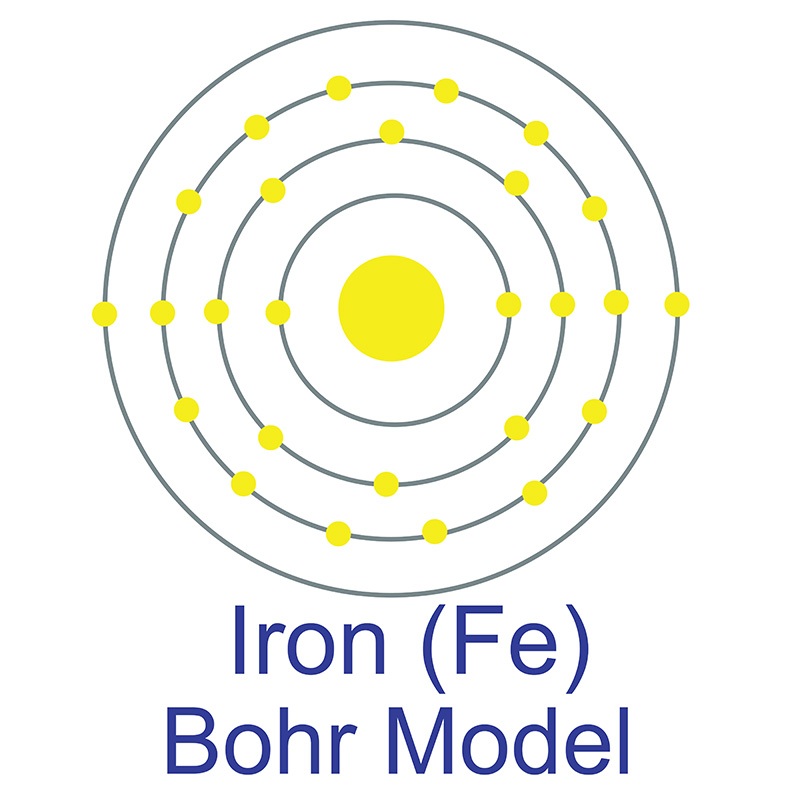
Iron(Fe) atomic and molecular weight, atomic number and elemental symbolIron is a Block D, Group 8, Period 4 element. The number of electrons in each of Iron's shells is 2, 8, 14, 2 and its electronic configuration is [Ar] 3d6 4s2. In its elemental form iron's CAS number is 7439-89-6. The iron atom has a radius of 124.1.pm and it's Van der Waals radius is 200.pm. Iron is not toxic. Iron is the most commonly used metal for commercial applications due to its hardness, historical availability and low cost. Once used on its own, it is now alloyed with nickel and other elements to produce steel and other high strength, non-corrosive structural metals. Iron as a metal and as its Elemental Ironmany compounds has numerous uses. It is a primary colorant in glass and ceramics. It is a catalyst. It is the basis for low grade magnets and because of its magnetic properties is used extensively in memory tape. Recent applications for Iron nanoparticles includeIron Bohr Model in water treatment of carbon tetrachloride in contaminated groundwater, magnetic data storage and resonance imaging (MRI) and in certain alloy and catalyst applications. Iron can also be introduced into processes using iron foil, pellets, rod and wire by thin film Chemical Vapor Deposition (CVD) and Physical Vapor Deposition (PVD) processes including Thermal and Electron Beam (E-Beam) Evaporation, Low Temperature Organic Evaporation, Atomic Layer Deposition (ALD), Organometallic and Chemical Vapor Deposition (MOCVD) for specific applications such as fuel cells and solar energy. Iron is available as metal and compounds with purities from 99% to 99.999% (ACS grade to ultra-high purity); metals in the form of foil, sputtering target, and rod, and compounds as submicron and nanopowder. Iron was first discovered by Early Man.See Iron research below.

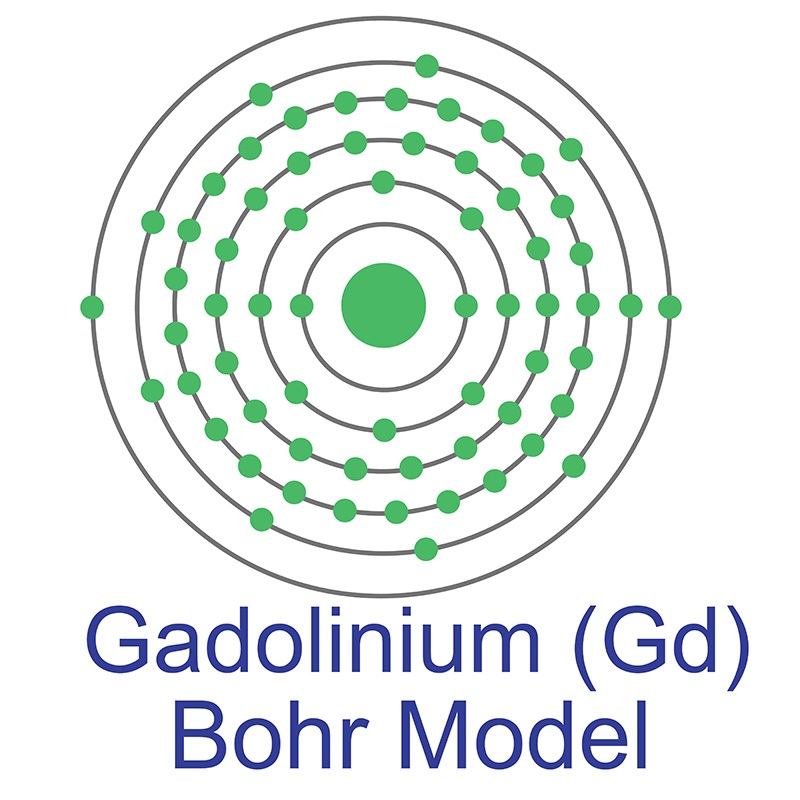
Gadolinium(Gd) atomic and molecular weight, atomic number and elemental symbolGadolinium is a Block F, Group 3, Period 6 element. The number of electrons in each of Gadolinium's shells is 2, 8, 18, 25, 9, 2 and its electronic configuration is [Xe] 4f7 5d1 6s2. In its elemental form gadolinium's CAS number is 7440-54-2. The gadolinium atom has a radius of 178.7.pm and it's Van der Waals radius is unknown. Gadolinium is very toxic. Gadolinium is utilized for both its high magnetic moment (7.94µB) and in phosphors and Gadolinium Bohr Modelscintillator material. When complexed with EDTA ligands, it is used as an injectable contrast agent for patients undergoing magnetic resonance imaging. With its high magnetic moment, gadolinium can reduce relaxation times and thereby enhance signal intensity. The extra stable half-full 4f electron shell with no low lying energy levels creates applications as an inert phosphor host. Gadolinium can therefore act as hosts for x-ray cassettes and in scintillator materials for computer tomography. Gadolinium is available as metal and compounds Elemental Gadoliniumwith purities from 99% to 99.999% (ACS grade to ultra-high purity); metals in the form of foil, sputtering target, and rod, and compounds as submicron and nanopowder. Gadolinium was first discovered by Jean de Marignac in 1880. The element is named after the Finnish chemist and geologist Johan Gadolin. See Gadolinium research below. With its high magnetic moment, gadolinium can reduce relaxation times and thereby enhance signal intensity. The extra stable half-full 4f electron shell with no low lying energy levels creates applications as an inert phosphor host. Gadolinium can therefore act as hosts for x-ray cassettes and in scintillator materials for computer tomography.

Formula CAS No. Appearance Molecular Weight
Fe 7439-89-6 Gray 55.85
PRODUCT CATALOG Iron Products News Foil Submicron & Nanopowder Tolling Ultra High Purity Sputtering Target Crystal Growth Rod, Plate, Powder, etc. Home

Have a Question? Ask a Chemical Engineer or Material Scientist   Request an MSDS or Certificate of Analysis


Search by Material, Product Name, Product Code, CAS Number, Formula, Element, Anion, Form, EC Number, MDL Number or PubChem ID.
German   Korean   French   Japanese   Spanish   Chinese (Simplified)   Portuguese   Russian   Chinese (Taiwan)   Italian   Turkish   Polish   Dutch   Czech   Swedish   Hungarian   Danish   Hebrew

Production Catalog Available in 36 Countries & Languages

PACKAGING SPECIFICATIONS FOR BULK & RESEARCH QUANTITIES


Typical bulk packaging includes palletized plastic 5 gallon/25 kg. pails, fiber and steel drums to 1 ton super sacks in full container (FCL) or truck load (T/L) quantities. Research and sample quantities and hygroscopic, oxidizing or other air sensitive materials may be packaged under argon or vacuum. Shipping documentation includes a Certificate of Analysis and Material Safety Data Sheet (MSDS). Solutions are packaged in polypropylene, plastic or glass jars up to palletized 440 gallon liquid totes.


Show me more forms of Iron
 
Customers for this product have also looked at:

Recent Research & Development for Iron

  • Cytochrome b mutation Y268S conferring the atovaquone resistance phenotype in the malaria parasite results in reduced parasite bc1 catalytic turnover and protein expression. Fisher N, Abd Majid R, Antoine T, Al-Helal M, Warman AJ, Johnson DJ, Lawrenson AS, Ranson H, O'Neill PM, Ward SA, Biagini GA. J Biol Chem. 2012 Jan 26. [Epub ahead of print] PMID: 22282497 [PubMed - as supplied by publisher]

  • Serum ferritin levels and endocrinopathy in medically treated patients with ß thalassemia major. Belhoul KM, Bakir ML, Saned MS, Kadhim AM, Musallam KM, Taher AT. Ann Hematol. 2012 Jan 28. [Epub ahead of print] PMID: 22281991 [PubMed - as supplied by publisher]

  • Iron supplementation to treat anemia in patients with chronic kidney disease. Besarab A, Coyne DW. Nat Rev Nephrol. 2012 Jan 27;8(2):63. doi: 10.1038/nrneph.2011.217. No abstract available. PMID: 22281971 [PubMed - in process]

  • Anemia in Critical Illness: Insights into Etiology, Consequences and Management. Hayden SJ, Albert TJ, Watkins TR, Swenson ER. Am J Respir Crit Care Med. 2012 Jan 26. [Epub ahead of print] PMID: 22281832 [PubMed - as supplied by publisher]

  • IRON fMRI measurements of CBV and implications for BOLD signal. Mandeville JB. Neuroimage. 2012 Jan 16. [Epub ahead of print] PMID: 22281669 [PubMed - as supplied by publisher]

  • Fatal idiopathic pulmonary haemosiderosis in association with pregnancy - Medico-legal evaluation. Töro K, Herjavecz I, Vereckei E, Kovács M. J Forensic Leg Med. 2012 Feb;19(2):101-104. Epub 2011 Oct 24. PMID: 22281220 [PubMed - as supplied by publisher]

  • Reduction of Fe(III)EDTA(-) in a NO(x) scrubbing solution by magnetic Fe(3)O(4)-chitosan microspheres immobilized mixed culture of iron-reducing bacteria. Jing G, Zhou J, Zhou Z, Lin T. Bioresour Technol. 2011 Dec 27. [Epub ahead of print] PMID: 22281145 [PubMed - as supplied by publisher]

  • Reactive oxygen species are involved in ferroportin degradation induced by ceruloplasmin mutant Arg701Trp. Persichini T, Francesco GD, Capone C, Cutone A, Bonaccorsi di Patti MC, Colasanti M, Musci G. Neurochem Int. 2012 Jan 20. [Epub ahead of print] PMID: 22281056 [PubMed - as supplied by publisher]

  • Effects of hypoxic preconditioning on the expression of iron influx and efflux proteins in primary neuron culture. Du F, Fan M, Gong Q, Zhu LL, Zhu ZJ, Lu L, Ke Y. Neurochem Int. 2012 Jan 18. [Epub ahead of print] PMID: 22281055 [PubMed - as supplied by publisher]

  • Iron deposition of the deep grey matter in patients with multiple sclerosis and neuromyelitis optica: A control quantitative study by 3D-enhanced susceptibility-weighted angiography (ESWAN). Chen X, Zeng C, Luo T, Ouyang Y, Lv F, Rumzan R, Wang Z, Li Q, Wang J, Hou H, Huang F, Li Y. Eur J Radiol. 2012 Jan 24. [Epub ahead of print] PMID: 22280874 [PubMed - as supplied by publisher]

  • Iron golf club with improved mass properties and vibration damping. Roach RL. J Acoust Soc Am. 2012 Jan;131(1):643. No abstract available. PMID: 22280652 [PubMed - in process]

  • Stability analysis of ultrasound thick-shell contrast agents. Lu X, Chahine GL, Hsiao CT. J Acoust Soc Am. 2012 Jan;131(1):24. PMID: 22280568 [PubMed - in process]

  • Role of Ureaplasma urealyticum in altering the endothelial metal concentration during preeclampsia. Padmini E, Uthra V. Placenta. 2012 Jan 24. [Epub ahead of print] PMID: 22280558 [PubMed - as supplied by publisher]

  • A polar corundum oxide displaying weak ferromagnetism at room temperature. Li MR, Adem U, McMitchell SR, Xu Z, Thomas CI, Warren JE, Giap DV, Niu HJ, Wan X, Palgrave RG, Schiffmann F, Cora F, Slater B, Burnett TL, Cain MG, Abakumov AM, Van Tendeloo G, Thomas MF, Rosseinsky MJ, Claridge JB. J Am Chem Soc. 2012 Jan 23. [Epub ahead of print] PMID: 22280499 [PubMed - as supplied by publisher]

  • Targeting Vascular Changes in Lesions in Multiple Sclerosis and Experimental Autoimmune Encephalomyelitis. Karlik SJ, Roscoe WA, Patinote C, Contino-Pépin C. Cent Nerv Syst Agents Med Chem. 2012 Jan 25. [Epub ahead of print] PMID: 22280405 [PubMed - as supplied by publisher]

  • [Transformation of copper and chromium in co-contaminated soil and its influence on bioavailability for pakchoi (Brassica chinensis)]. Wang D, Wei W, Liang DL, Wang SS, Hu B. Huan Jing Ke Xue. 2011 Oct;32(10):3113-20. Chinese. PMID: 22279932 [PubMed - in process]

  • [Distribution characteristic and assessment of soil heavy metal pollution in the iron mining of Baotou in Inner Mongolia]. Guo W, Zhao RX, Zhang J, Bao YY, Wang H, Yang M, Sun XL, Jin F. Huan Jing Ke Xue. 2011 Oct;32(10):3099-105. Chinese. PMID: 22279930 [PubMed - in process]

  • [Study of inactivating sulfate reducing bacteria with zero-valent iron nanoparticles]. Shu ZY, Wang J, Huang Y. Huan Jing Ke Xue. 2011 Oct;32(10):3040-4. Chinese. PMID: 22279921 [PubMed - in process]

  • [Combination of intersticial cystitis and adenomyosis in females suffering from chronic pelvic pain syndrome]. [No authors listed] Urologiia. 2011 Sep-Oct;(5):10, 12-4. Russian. PMID: 22279779 [PubMed - in process]

  • [Antidiabetes drug metformin is a donor of nitric oxide: ESR measurement of efficiency]. [No authors listed] Biofizika. 2011 Nov-Dec;56(6):1125-33. Russian. PMID: 22279758 [PubMed - in process]

Recent Research & Development for Gadolinium

  • T(1) assessment of hip joint cartilage following intra-articular gadolinium injection: A pilot study. Bittersohl B, Hosalkar HS, Kim YJ, Werlen S, Trattnig S, Siebenrock KA, Mamisch TC. Magn Reson Med. 2010 Oct;64(4):1200-7. PubMed PMID: 20872764.

  • The time window of MRI of murine atherosclerotic plaques after administration of CB2 receptor targeted micelles: inter-scan variability and relation between plaque signal intensity increase and gadolinium content of inversion recovery prepared versus non-prepared fast spin echo. Te Boekhorst BC, Bovens SM, van de Kolk CW, Cramer MJ, Doevendans PA, Ten Hove M, van der Weerd L, Poelmann R, Strijkers GJ, Pasterkamp G, van Echteld CJ. NMR Biomed. 2010 Oct;23(8):939-51. PubMed PMID: 20878972.

  • Coordination chemistry of amide-functionalised tetraazamacrocycles: structural, relaxometric and cytotoxicity studies. Martinelli J, Balali-Mood B, Panizzo R, Lythgoe MF, White AJ, Ferretti P, Steinke JH, Vilar R. Dalton Trans. 2010 Sep 28. [Epub ahead of print] PubMed PMID: 20877892.

  • Gadolinium released from MR contrast agents is deposited in brain tumors: in situ demonstration using scanning electron microscopy with energy dispersive X-ray spectroscopy. Xia D, Davis RL, Crawford JA, Abraham JL. Acta Radiol. 2010 Sep 26. [Epub ahead of print] PubMed PMID: 20868305.

  • Midregional pro-atrial natriuretic peptide: a novel marker of myocardial fibrosis in patients with hypertrophic cardiomyopathy. Elmas E, Doesch C, Fluechter S, Freundt M, Weiss C, Lang S, Kälsch T, Haghi D, Papassotiriou J, Kunde J, Schoenberg SO, Borggrefe M, Papavassiliu T. Int J Cardiovasc Imaging. 2010 Sep 26. [Epub ahead of print] PubMed PMID: 20872251.

  • Translocator Protein PET Imaging for Glial Activation in Multiple Sclerosis. Oh U, Fujita M, Ikonomidou VN, Evangelou IE, Matsuura E, Harberts E, Ohayon J, Pike VW, Zhang Y, Zoghbi SS, Innis RB, Jacobson S. J Neuroimmune Pharmacol. 2010 Sep 25. [Epub ahead of print] PubMed PMID: 20872081.

  • Influence of small caliber coronary arteries on the diagnostic accuracy of adenosine stress cardiac magnetic resonance imaging. Pilz G, Heer T, Graw M, Ali E, Klos M, Scheck R, Zeymer U, Höfling B. Clin Res Cardiol. 2010 Sep 24. [Epub ahead of print] PubMed PMID: 20862587.

  • Reference region-based pharmacokinetic modeling in quantitative dynamic contract-enhanced MRI allows robust treatment monitoring in a rat liver tumor model despite cardiovascular changes. Steingoetter A, Svensson J, Kosanke Y, Botnar RM, Schwaiger M, Rummeny E, Braren R. Magn Reson Med. 2010 Sep 24. [Epub ahead of print] PubMed PMID: 20872863.

  • Comparison of half-dose and full-dose gadolinium MR contrast on the enhancement of bone and soft tissue tumors. Costelloe CM, Murphy WA Jr, Haygood TM, Kumar R, McEnery KW, Stafford RJ, Roy A, Bassett RL Jr, Harrell RK, Madewell JE. Skeletal Radiol. 2010 Sep 24. [Epub ahead of print] PubMed PMID: 20862469.

  • Gd-EOB-DTPA enhanced MR imaging: Evaluation of biliary and renal excretion in normal and cirrhotic livers. Tamada T, Ito K, Sone T, Kanki A, Sato T, Higashi H. Eur J Radiol. 2010 Sep 23. [Epub ahead of print] PubMed PMID: 20869827.

  • Increases in the number of brain metastases detected at frame-fixed, thin-slice MRI for gamma knife surgery planning. Nagai A, Shibamoto Y, Mori Y, Hashizume C, Hagiwara M, Kobayashi T. Neuro Oncol. 2010 Sep 23. [Epub ahead of print] PubMed PMID: 20864500.

  • BOLD cardiovascular magnetic resonance at 3.0 tesla in myocardial ischemia. Manka R, Paetsch I, Schnackenburg B, Gebker R, Fleck E, Jahnke C. J Cardiovasc Magn Reson. 2010 Sep 22;12(1):54. [Epub ahead of print] PubMed PMID: 20860792.

  • Revisiting an old friend: manganese-based MRI contrast agents. Pan D, Caruthers SD, Senpan A, Schmieder AH, Wickline SA, Lanza GM. Wiley Interdiscip Rev Nanomed Nanobiotechnol. 2010 Sep 21. [Epub ahead of print] PubMed PMID: 20860051.

  • Childhood cholesteatoma. Nevoux J, Lenoir M, Roger G, Denoyelle F, Ducou Le Pointe H, Garabédian EN.Eur Ann Otorhinolaryngol Head Neck Dis. 2010 Sep;127(4):143-50. Epub 2010 Aug 11. PubMed PMID: 20860924.

  • Comparison of portal venous and delayed phases of gadolinium-enhanced magnetic resonance imaging study of cirrhotic liver for the detection of contrast washout of hypervascular hepatocellular carcinoma. Cereser L, Furlan A, Bagatto D, Girometti R, Como G, Avellini C, Orsaria M, Zuiani C, Bazzocchi M. J Comput Assist Tomogr. 2010 Sep-Oct;34(5):706-11. PubMed PMID: 20861773.

  • Three-dimensional multiphase time-resolved low-dose contrast-enhanced magnetic resonance angiography using TWIST on a 32-channel coil at 3 T: a quantitative and qualitative comparison of a conventional gadolinium chelate with a high-relaxivity agent. Giesel FL, Runge V, Kirchin M, Mehndiratta A, Gerigk L, Corell B, von Gall C, Kauczor HU, Essig M. J Comput Assist Tomogr. 2010 Sep-Oct;34(5):678-83. PubMed PMID: 20861769.

  • [Accessory nerve schwannoma of the intracisternal type: a case report.]. Sadatomo T, Yuki K, Migita K, Hidaka T, Kurisu K. No Shinkei Geka. 2010 Sep;38(9):831-7. Japanese. PubMed PMID: 20864772.

  • Use of cardiac magnetic resonance imaging to evaluate cardiac structure, function and fibrosis in children with infantile Pompe disease on enzyme replacement therapy. Barker PC, Pasquali SK, Darty S, Ing RJ, Li JS, Kim RJ, Dearmey S, Kishnani PS, Campbell MJ. Mol Genet Metab. 2010 Jul 23. [Epub ahead of print] PubMed PMID: 20875764.

  • Differential diagnosis and prognosis of T1-weighted post-gadolinium intralabyrinthine hyperintensities. Dubrulle F, Kohler R, Vincent C, Puech P, Ernst O. Eur Radiol. 2010 Jun 10. [Epub ahead of print] PubMed PMID: 20862477.


Aeromat 2012 Sponsor
Proud sponsors of Aeromat 2012. Please join us and our customers & co-sponsors Boeing and ATI on June 18-20, 2012
in Charlotte, North Carolina

  Print this Page
Periodic table of the elements science and academic information, elements and advanced materials data, scientific presentations and all pages, designs, concepts, logos, and color schemes herein are the copyrighted proprietary rights and intellectual property of American Elements. American Elements is a U.S. Registered Trademark. © 1998-2012. American Elements. All rights reserved.
Learn Six Sigma


American Elements is a copyrighted U.S. Trademark. All rights reserved.