American Elements Logo and U.S. Registered Trademark


Iron Magnesium Zinc Oxide
Product Product Code Order or Specifications
(2N) 99% Iron Magnesium Zinc Oxide FEMGZN-OX-02 Contact American Elements
(3N) 99.9% Iron Magnesium Zinc Oxide FEMGZN-OX-03 Contact American Elements
(4N) 99.99% Iron Magnesium Zinc Oxide FEMGZN-OX-04 Contact American Elements
(5N) 99.999% Iron Magnesium Zinc Oxide FEMGZN-OX-05 Contact American Elements
Iron Magnesium Zinc Oxide is a highly insoluble thermally stable Aluminum source suitable for glass, optic and ceramic applications. Oxide compounds are not conductive to electricity. However, certain perovskite structured oxides are electronically conductive finding application in the cathode of solid oxide fuel cells and oxygen generation systems. They are compounds containing at least one oxygen anion and one metallic cation. They are typically insoluble in aqueous solutions (water) and extremely stable making them useful in ceramic structures as simple as producing clay bowls to advanced electronics and in light weight structural components in aerospace and electrochemical applications such as fuel cells in which they exhibit ionic conductivity. Metal oxide compounds are basic anhydrides and can therefore react with acids and with strong reducing agents in redox reactions. Iron Magnesium Zinc Oxide is also available in pellets, pieces, powder, sputtering targets, tablets, and nanopowder (from American Elements' nanoscale production facilities). See Nanotechnology for more nanotechnology applications information. High purity, submicron and nanopowder forms may be considered. Additional technical, research and safety (MSDS) information is available.

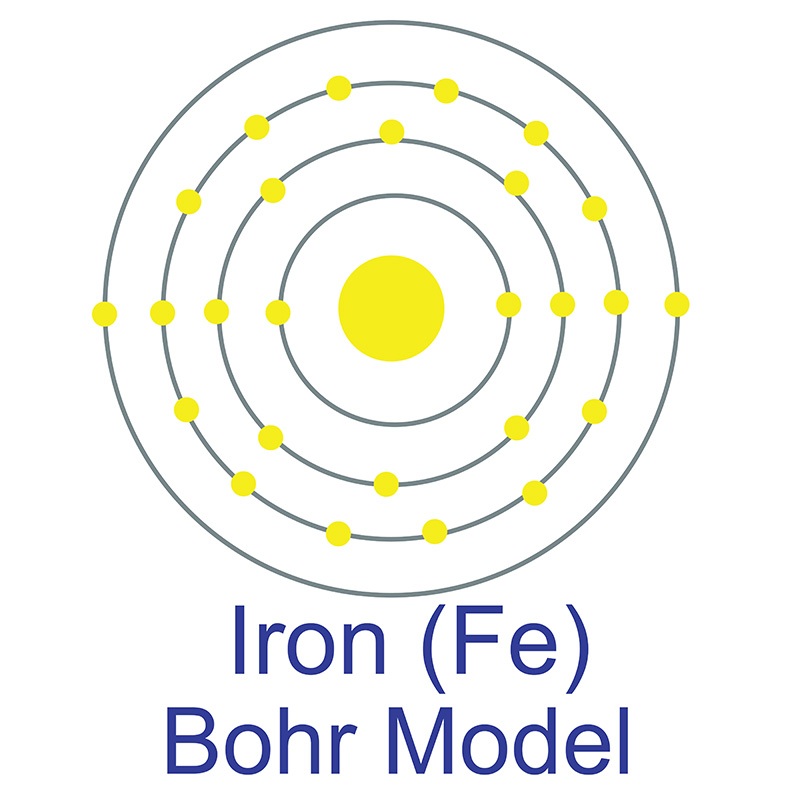
Iron(Fe) atomic and molecular weight, atomic number and elemental symbolIron is a Block D, Group 8, Period 4 element. The number of electrons in each of Iron's shells is 2, 8, 14, 2 and its electronic configuration is [Ar] 3d6 4s2. In its elemental form iron's CAS number is 7439-89-6. The iron atom has a radius of 124.1.pm and it's Van der Waals radius is 200.pm. Iron is not toxic. Iron is the most commonly used metal for commercial applications due to its hardness, historical availability and low cost. Once used on its own, it is now alloyed with nickel and other elements to produce steel and other high strength, non-corrosive structural metals. Iron as a metal and as its Elemental Ironmany compounds has numerous uses. It is a primary colorant in glass and ceramics. It is a catalyst. It is the basis for low grade magnets and because of its magnetic properties is used extensively in memory tape. Recent applications for Iron nanoparticles includeIron Bohr Model in water treatment of carbon tetrachloride in contaminated groundwater, magnetic data storage and resonance imaging (MRI) and in certain alloy and catalyst applications. Iron can also be introduced into processes using iron foil, pellets, rod and wire by thin film Chemical Vapor Deposition (CVD) and Physical Vapor Deposition (PVD) processes including Thermal and Electron Beam (E-Beam) Evaporation, Low Temperature Organic Evaporation, Atomic Layer Deposition (ALD), Organometallic and Chemical Vapor Deposition (MOCVD) for specific applications such as fuel cells and solar energy. Iron is available as metal and compounds with purities from 99% to 99.999% (ACS grade to ultra-high purity); metals in the form of foil, sputtering target, and rod, and compounds as submicron and nanopowder. Iron was first discovered by Early Man.See Iron research below.

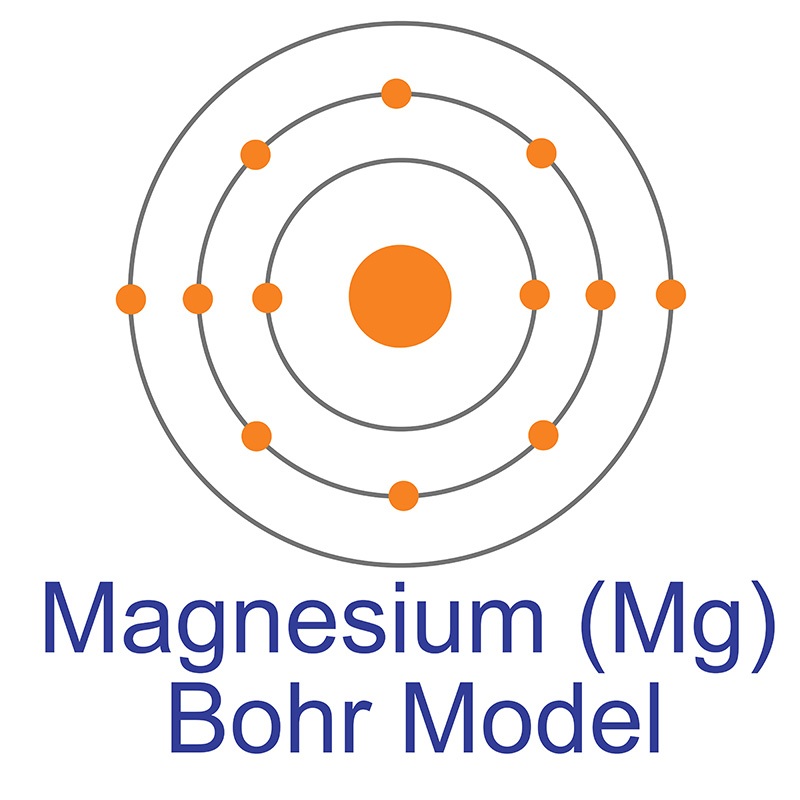
Magnesium (Mg) atomic and molecular weight, atomic number and elemental symbolMagnesium is a Block S, Group 2, Period 3 element. The number of electrons in each of Magnesium's shells is 2, 8, 2 and its electronic configuration is [Ne] 3s2. In its elemental form magnesium's CAS number is 7439-95-4. The magnesium atom has a radius of 159.9.pm and it's Van der Waals radius is 173.pm. Magnesium the eighth most abundant element in the earth's crust. It is one third lighter than aluminum, and because of this is used in alloys that are essential for aerospace, satellite and missile construction. The metal improves the mechanical, fabrication, and welding characteristics of aluminum when used as anMagnesium Bohr Model alloying agent. Uses also include flares and pyrotechnics due to its pyrophoric properties. Magnesium compounds, primarily magnesium oxide, are Elemental Magnesiumused mainly as refractory material in furnace linings for producing iron and steel, nonferrous metals, glass, and cement. High purity magnesium is found in dietary supplements. Magnesium was first discovered by Sir Humphrey Davy in 1808. The name Magnesium originates from a Greek district in Thessaly called Magnesia. See Magnesium research below.

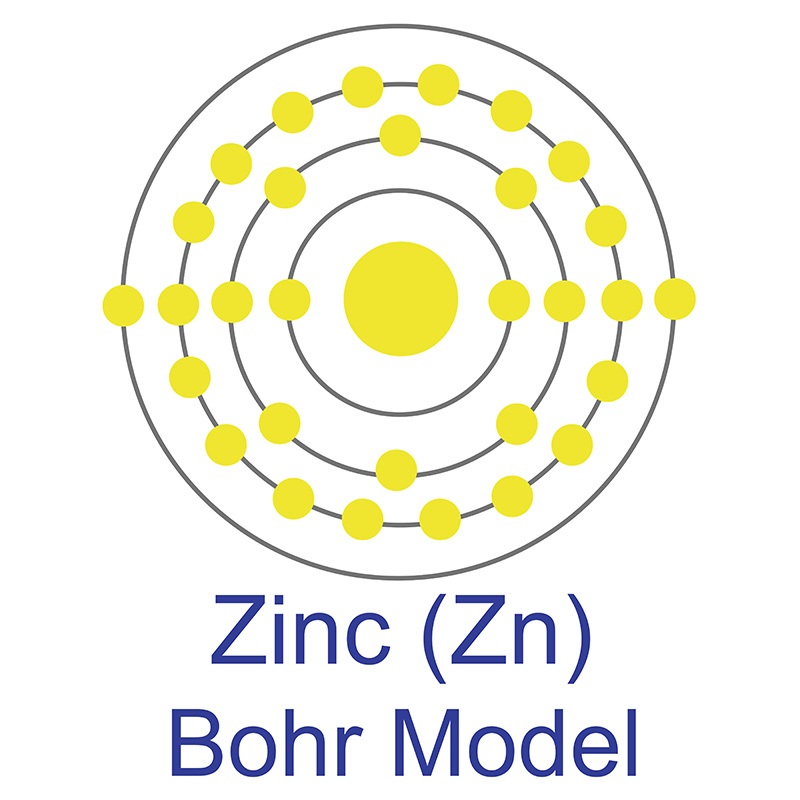
Zinc(Zn) atomic and molecular weight, atomic number and elemental symbolZinc is a Block D, Group 12, Period 4 element. The number of electrons in each of Zinc's shells is 2, 8, 18, 2, and its electronic configuration is [Ar] 3d10 4s2. In its elemental form zinc's CAS number is 7440-66-6. The zinc atom has a radius of 133.5.pm and it's Van der Waals radius is 139.pm. Combined with other elements as ores, Zinc is found in nature. Zinc is considered non-toxicin healthy doses but can cause nausea if taken in excess. Zinc is a bluish-white, lustrous metal which we produce in Special High Grade (SHG) purities. It is brittle at ordinary temperatures but malleable at 100 to 150 o C. It is a fair conductor of electricity, and burns in air at high red heat with evolution of white clouds of the oxide. Elemental ZincIt has unusual electrical, thermal, optical, and Zinc Bohr Modelsolid-state properties that have not been fully investigated. The metal is employed to form numerous alloys with other metals. Brass, nickel, silver, commercial bronze, soft solder, and aluminum solder are some of the more important alloys. Large quantities of zinc are used to produce die castings, which are used extensively by the automotive, electrical, and hardware industries. Zinc is also used extensively togalvanize other metals such as iron to prevent corrosion. Zinc oxide is widely used in the manufacture of paints, rubber products, cosmetics, pharmaceuticals, floor coverings, plastics, printing inks, soap, storage batteries, textiles, electrical equipment, and other products. Zinc sulfide is used in making luminous dials, X-ray and TV screens, and fluorescent lights The chloride and chromate are also important compounds. Zinc is available as metal and compounds with purities from 99% to 99.9999% (ACS grade to ultra-high purity); metals in the form of foil, sputtering target, and rod, and compounds as submicron and nanopowder. Zinc was first discovered by Andreas Marggraf in 1746. The element name Zinc originates from the German word "zin" meaning tin. See Zinc research below.

 
PRODUCT CATALOG Oxide Products Nanoparticles News Foil Submicron & Nanopowder Tolling Ultra High Purity Sputtering Target Crystal Growth Rod, Plate, Powder, etc. Home

Have a Question? Ask a Chemical Engineer or Material Scientist   Request an MSDS or Certificate of Analysis


Search by Material, Product Name, Product Code, CAS Number, Formula, Element, Anion, Form, EC Number, MDL Number or PubChem ID.


German   Korean   French   Japanese   Spanish   Chinese (Simplified)   Portuguese   Russian   Chinese (Taiwan)   Italian   Turkish   Polish   Dutch   Czech   Swedish   Hungarian   Danish   Hebrew

Production Catalog Available in 36 Countries & Languages


Recent Research & Development for Oxides

  • Andrographolide Inhibits PI3K/AKT-Dependent NOX2 and iNOS Expression Protecting Mice against Hypoxia/Ischemia-Induced Oxidative Brain Injury. Chern CM, Liou KT, Wang YH, Liao JF, Yen JC, Shen YC. Planta Med. 2011 Apr 21. [Epub ahead of print] PMID: 21512969 [PubMed - as supplied by publisher]

  • Reexamination of the ORAC assay: effect of metal ions. Nkhili E, Brat P. Anal Bioanal Chem. 2011 May;400(5):1451-1458. Epub 2011 Apr 6. PMID: 21512895 [PubMed - as supplied by publisher]

  • Muscle intracellular oxygenation during exercise: optimization for oxygen transport, metabolism, and adaptive change. Wagner PD. Eur J Appl Physiol. 2011 Apr 22. [Epub ahead of print] PMID: 21512800 [PubMed - as supplied by publisher]

  • CuCl-catalyzed aerobic oxidation of 2,3-allenols to 1,2-allenic ketones with 1:1 combination of phenanthroline and bipyridine as ligands. Gao S, Liu Y, Ma S. Beilstein J Org Chem. 2011 Apr 7;7:396-403. PMID: 21512599 [PubMed - as supplied by publisher]

  • Mitochondrial Structure and Function Are Disrupted by Standard Isolation Methods. Picard M, Taivassalo T, Ritchie D, Wright KJ, Thomas MM, Romestaing C, Hepple RT. PLoS One. 2011 Mar 28;6(3):e18317. PMID: 21512578 [PubMed - as supplied by publisher]

  • Oxidative stress and endothelial dysfunction in hypertension. Schulz E, Gori T, Münzel T. Hypertens Res. 2011 Apr 21. [Epub ahead of print] PMID: 21512515 [PubMed - as supplied by publisher]

  • Salidroside Attenuates Hydrogen Peroxide-Induced Cell Damage Through a cAMP-Dependent Pathway. Guan S, Wang W, Lu J, Qian W, Huang G, Deng X, Wang X. Molecules. 2011 Apr 19;16(4):3371-3379. PMID: 21512445 [PubMed - as supplied by publisher]

  • Factors Predicting Mortality in Invasive Pneumococcal Disease in Adults in Alberta. Marrie TJ, Tyrrell GJ, Garg S, Vanderkooi OG. Medicine (Baltimore). 2011 Apr 21. [Epub ahead of print] PMID: 21512414 [PubMed - as supplied by publisher]

  • Estimation of Oxygen Uptake From Heart Rate and Ratings of Perceived Exertion in Young Soccer Players. Wong DP, Carling C, Chaouachi A, Dellal A, Castagna C, Chamari K, Behm DG. J Strength Cond Res. 2011 Apr 20. [Epub ahead of print] PMID: 21512400 [PubMed - as supplied by publisher]

  • Mitochondrial pathway leading to programmed cell death induced by aluminum phytotoxicity in Arabidopsis. Li Z, Xing D. Plant Signal Behav. 2010 Dec 1;5(12):1660-1662. PMID: 21512328 [PubMed - as supplied by publisher]

  • Autophagy in the pathogenesis of myelodysplastic syndrome and acute myeloid leukemia. Watson AS, Mortensen M, Simon AK. Cell Cycle. 2011 Jun 1;10(11). [Epub ahead of print] PMID: 21512311 [PubMed - as supplied by publisher]

  • Direct Assessments of the Antioxidant Effects of the Novel Collagen Peptide on Reactive Oxygen Species Using Electron Spin Resonance Spectroscopy. Kobayashi K, Maehata Y, Kawamura Y, Kusubata M, Hattori S, Tanaka K, Miyamoto C, Yoshino F, Yoshida A, Wada-Takahashi S, Komatsu T, Takahashi SS, Lee MC. J Pharmacol Sci. 2011 Apr 21. [Epub ahead of print] PMID: 21512306 [PubMed - as supplied by publisher]

  • A Strong Protective Action of Guttiferone-A, a Naturally Occurring Prenylated Benzophenone, Against Iron-Induced Neuronal Cell Damage. Figueredo YN, García-Pupo L, Rubio OC, Hernández RD, Naal Z, Curti C, Andreu GL. J Pharmacol Sci. 2011 Apr 21. [Epub ahead of print] PMID: 21512303 [PubMed - as supplied by publisher]

  • Effects of Intestinal Microflora on Superoxide Dismutase Activity in the Mouse Cecum. Dobashi Y, Miyakawa Y, Yamamoto I, Amao H. Exp Anim. 2011;60(2):133-139. PMID: 21512268 [PubMed - as supplied by publisher]

  • ??????Conservative Management of Achilles Tendon Wounds: Results of a Retrospective Study. Kleinman Y, Cahn A. Ostomy Wound Manage. 2011 Apr;57(4):32-40. PMID: 21512191 [PubMed - as supplied by publisher]

  • Laser-based absorption spectroscopy as a technique for rapid in-line analysis of respired gas concentrations of oxygen and carbon dioxide. Cummings B, Hamilton ML, Ciaffoni L, Pragnell TR, Peverall R, Ritchie GA, Hancock G, Robbins PA. J Appl Physiol. 2011 Apr 21. [Epub ahead of print] PMID: 21512147 [PubMed - as supplied by publisher]

  • The hypoxia associated factor (HAF) switches cells from HIF-1{alpha} to HIF-2{alpha} dependent signaling promoting stem cell characteristics, aggressive tumor growth and invasion. Koh MY, Lemos R Jr, Liu XP, Powis G. Cancer Res. 2011 Apr 21. [Epub ahead of print] PMID: 21512133 [PubMed - as supplied by publisher]

  • Coactivators necessary for transcriptional output of the hypoxia inducible factor, HIF, are directly recruited by ARNT PAS-B. Partch CL, Gardner KH. Proc Natl Acad Sci U S A. 2011 Apr 21. [Epub ahead of print] PMID: 21512126 [PubMed - as supplied by publisher]

  • Latitudinal Gradients in Greenhouse Seawater {delta}18O: Evidence from Eocene Sirenian Tooth Enamel. Clementz MT, Sewall JO. Science. 2011 Apr 22;332(6028):455-458. PMID: 21512030 [PubMed - as supplied by publisher]

  • High-Performance Electrocatalysts for Oxygen Reduction Derived from Polyaniline, Iron, and Cobalt. Wu G, More KL, Johnston CM, Zelenay P. Science. 2011 Apr 22;332(6028):443-447. PMID: 21512028 [PubMed - as supplied by publisher]


Aeromat 2012 Sponsor
Proud sponsors of Aeromat 2012. Please join us and our customers & co-sponsors Boeing and ATI on June 18-20, 2012
in Charlotte, North Carolina

  Print this Page
Periodic table of the elements science and academic information, elements and advanced materials data, scientific presentations and all pages, designs, concepts, logos, and color schemes herein are the copyrighted proprietary rights and intellectual property of American Elements. American Elements is a U.S. Registered Trademark. © 1998-2012. American Elements. All rights reserved.
Learn Six Sigma


American Elements is a copyrighted U.S. Trademark. All rights reserved.