Gallium Acetylacetonate

Ga(CH3COCHCOCH3)3
CAS 14405-43-7


Product Product Code Order or Specifications
(2N) 99% Gallium Acetylacetonate GA-ACAC-02 Contact American Elements
(3N) 99.9% Gallium Acetylacetonate GA-ACAC-03 Contact American Elements
(4N) 99.99% Gallium Acetylacetonate GA-ACAC-04 Contact American Elements
(5N) 99.999% Gallium Acetylacetonate GA-ACAC-05 Contact American Elements

CHEMICAL
IDENTIFIER
Formula CAS No. PubChem SID PubChem CID MDL No. EC No IUPAC Name Beilstein
Re. No.
SMILES
Identifier
InChI
Identifier
InChI
Key
Ga(CH3COCHCOCH3)3 14405-43-7 24864524 16717626 MFCD00013492 238-377-0 (Z)-4-bis[(Z)-1-methyl-3-oxobut-1-enoxy]gallanyloxypent-3-en-2-one N/A [Ga+3].O=C(/C=C(\[O-])C)C.[O-]\C(=C/C(=O)C)C.[O-]\C(=C/C(=O)C)C InChI=1S/3C5H8O2.Ga/c3*1-4(6)3-5(2)7;/h3*3,6H,1-2H3;/q;;;+3/p-3/b3*4-3-; ZVYYAYJIGYODSD-LNTINUHCSA-K

PROPERTIES Compound Formula Mol. Wt. Appearance Density

Exact Mass

Monoisotopic Mass Charge MSDS
C15H21GaO6 367.05 White to Pale Yellow 1.42 g/cm3 366.053 366.059394 Da 0 Safety Data Sheet

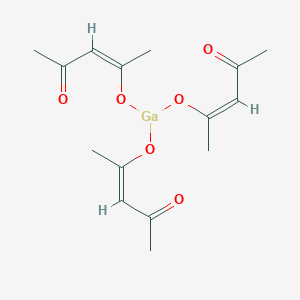
Acetylaceton Formula Diagram (C5H8O2)Gallium Acetylacetonate is a Gallium source that is soluble in organic solvents as an organometallic compound (also known as metalorganic, organo-inorganic and metallo-organic Acetylacetonate Packaging, Lab Quantitycompounds). The high purity acetylacetonate anion complexes by bonding each oxygen atom to the metallic cation to form a chelate ring; because of this property, acetylacetonates are commonly used in various catalysts and catalytic reagents for organic synthesis, including the fabrication of various shapes of carbon nanostructures (as demonstrated by a 2013 experiment by researchers at the Leibniz Institute for Solid State and Materials Research Dresden) via the use of chemical vapor deposition (CVD) and laser evaporation techniques. It is generally immediately available in most volumes. Ultra high purity and high purity forms may be considered. Gallium Acetylacetonate is one of numerous organo-metallic compounds (also known as metalorganic, organo-inorganic and metallo-organic compounds) sold by American Elements under the tradename AE Organo-Metallics™ for uses requiring non-aqueous solubility such as recent solar energy and water treatment applications. Similar results can sometimes also be achieved with Nanoparticles (also see Nanotechnology and Quantum Dots) and by thin film deposition. Note American Elements additionally supplies many materials as solutions. The application of Gallium that has received the most attention is the production of semiconducting compounds. Nowadays gallium arsenide (Ga-As) is undoubtedly the most used. This compound is used in the production of several electronic parts such as diodes and transistors, made for voltage rectification, signal amplification, etc. American Elements produces to many standard grades when applicable, including Mil Spec (military grade); ACS, Reagent and Technical Grade; Food, Agricultural and Pharmaceutical Grade; Optical Grade, USP and EP/BP (European Pharmacopoeia/British Pharmacopoeia) and follows applicable ASTM testing standards. Typical and custom packaging is available. Additional technical, research and safety (MSDS) information is available as is a Reference Calculator for converting relevant units of measurement.

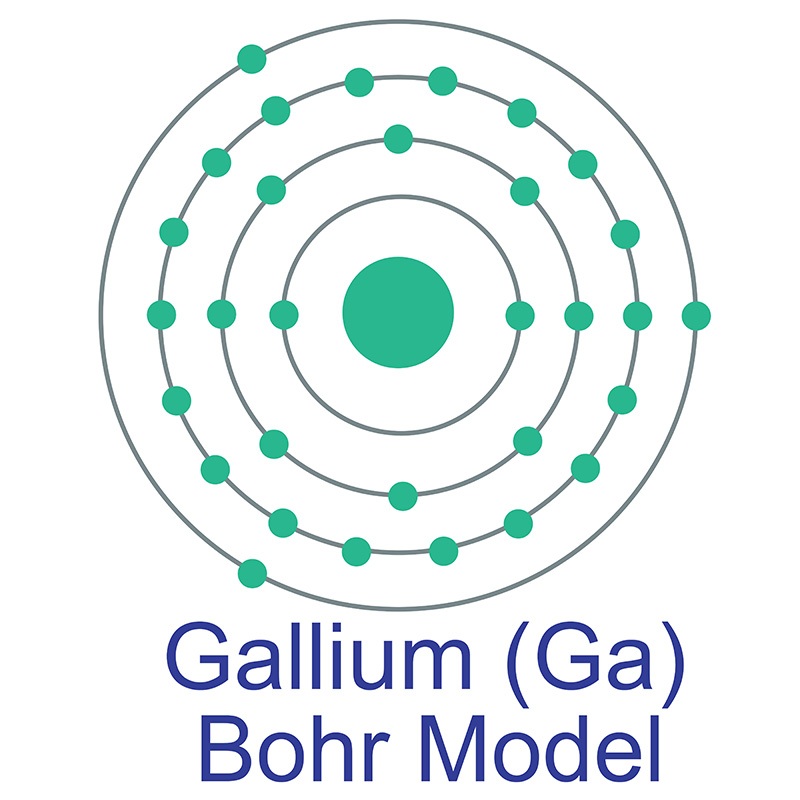
Gallium(Ga) atomic and molecular weight, atomic number and elemental symbolGallium is a Block P, Group 13, Period 4 element. The number of electrons in each of Gallium's shells is 2, 8, 18, 3 and its electronic configuration is [Ar] 3d10 4s2 4p1. In its elemental form gallium's CAS number is 7440-55-3. The gallium atom has a radius of 122.1.pm and it's Van der Waals radius is 187.pm. Gallium is not toxic. Gallium is one of three elements that naturally occur as a liquid at room temperature. The other two are mercury and cesium. The application of gallium that has received the most attention is the production of semiconducting compounds. Of these, the Gallium Bohr Modelmost Elemental Gallium important are the compounds of gallium with antimony, arsenic or phosphor. Nowadays gallium arsenide (Ga-As) is undoubtedly the most used. This compound is used in the production of several electronic parts such as diodes and transistors, made for voltage rectification, signal amplification, etc. Other gallium arsenide applications are the semiconductor "lasing" and microwave generation and also in sensors to measure temperature, light or magnetic field. Researchers at Northwestern University's Center for Quantum Devices recently developed a Gallium based semiconductor material that will advance infrared camera technology. Gallium does not exist by itself in nature and is sourced commercially from bauxite and sphalerite. Gallium was first discovered by Hans Christian Oersted in 1825. See Gallium research below.

HEALTH, SAFETY & TRANSPORTATION INFORMATION
Material Safety Data Sheet MSDS
Signal Word Warning
Hazard Statements H302-H312-H315-H319-H332-H335-H351
Hazard Codes Xn
Risk Codes 20/21/22-36/37/38-40
Safety Precautions 26-36/37/39
RTECS Number N/A
Transport Information N/A
WGK Germany 3
Globally Harmonized System of
Classification and Labelling (GHS)
Exclamation Mark-Acute Toxicity Health Hazard      

GALLIUM ACETYLACETONATE SYNONYMS
Gallium(III) acetylacetonate; 3-penten-2-one, 4-hydroxy-, gallium salt, (3Z)- (3:1); tris(pentane-2,4-dionato-O,O')gallium; Ga(acac)3; Gallium tris[(2Z)-4-oxopent-2-en-2-olate]; Gallium(III) 2,4-pentanedionate; Gallium(III) 2,4-pentanedionate

CUSTOMERS FOR GALLIUM ACETYLACETONATE HAVE ALSO LOOKED AT
Gallium Acetylacetonate Gallium Acetate Gallium Fluoride Gallium Sputtering Target Gallium Chloride
Gallium Rod Gallium Oxide Pellets Gallium Oxide Nanopowder Gallium Oxide Powder Gallium Pellets
Gadolinium Gallium Garnet-GGG Copper Gallium Sputtering Target Gallium Metal Gallium Foil Gallium Oxide
Show Me MORE Forms of Gallium

PACKAGING SPECIFICATIONS FOR BULK & RESEARCH QUANTITIES
Typical bulk packaging includes palletized plastic 5 gallon/25 kg. pails, fiber and steel drums to 1 ton super sacks in full container (FCL) or truck load (T/L) quantities. Research and sample quantities and hygroscopic, oxidizing or other air sensitive materials may be packaged under argon or vacuum. Shipping documentation includes a Certificate of Analysis and Material Safety Data Sheet (MSDS). Solutions are packaged in polypropylene, plastic or glass jars up to palletized 440 gallon liquid totes.


Have a Question? Ask a Chemical Engineer or Material Scientist
Request an MSDS or Certificate of Analysis


German   Korean   French   Japanese   Spanish   Chinese (Simplified)   Portuguese   Russian   Chinese (Taiwan)  Italian   Turkish   Polish   Dutch   Czech   Swedish   Hungarian   Danish   Hebrew

Production Catalog Available in 36 Countries & Languages


Recent Research & Development for Gallium

  • First-principles melting of gallium clusters down to nine atoms: structural and electronic contributions to melting. Steenbergen KG, Gaston N. Phys Chem Chem Phys. 2013 Jun 14. [Epub ahead of print]
  • Metallomics for drug development: Serum protein binding and analysis of an anticancer tris(8-quinolinolato)gallium(III) drug using inductively coupled plasma mass spectrometry. Ossipov K, Foteeva LS, Seregina IF, Perevalov SA, Timerbaev AR, Bolshov MA. Anal Chim Acta. 2013 Jun 27;785:22-6. doi: 10.1016/j.aca.2013.05.004. Epub 2013 May 13.
  • The Effect of Erbium, Chromium:Yttrium-Scandium-Gallium-Garnet (Er,Cr:YSGG) Laser Therapy on Pain During Cavity Preparation in Paediatric Dental Patients: A Pilot Study. Eren F, Altinok B, Ertugral F, Tanboga I. Oral Health Dent Manag. 2013 Jun;12(2):80-4.
  • Cell Behavior on Gallium Nitride Surfaces: Peptide Affinity Attachment Vs. Covalent Functionalization. Foster C, Collazo R, Sitar Z, Ivanisevic A. Langmuir. 2013 Jun 7. [Epub ahead of print]
  • Chemical Stability and Electrical Performance of Dual-Active-Layered Zinc-Tin-Oxide/Indium-Gallium-Zinc-Oxide Thin-Film Transistors Using a Solution Process. Kim CH, Rim YS, Kim HJ. ACS Appl Mater Interfaces. 2013 Jun 5. [Epub ahead of print]
  • Lacrimal Gland Uptake of 67Ga-gallium Citrate Correlates with Biopsy Results in Patients with Suspected Sarcoidosis. Tannen BL, Kolomeyer AM, Turbin RE, Frohman L, Langer PD, Oh C, Ghesani NV, Zuckier LS, Chu DS. Ocul Immunol Inflamm. 2013 Jun 3. [Epub ahead of print]
  • Gallium-containing phosphosilicate glasses: Functionalization and in-vitro bioactivity. Lusvardi G, Malavasi G, Menabue L, Shruti S. Mater Sci Eng C Mater Biol Appl. 2013 Aug 1;33(6):3190-6. doi: 10.1016/j.msec.2013.03.046. Epub 2013 Apr 6.
  • Evaluation of the carcinogenicity of gallium arsenide. Bomhard EM, Gelbke HP, Schenk H, Williams GM, Cohen SM. Crit Rev Toxicol. 2013 May;43(5):436-66. doi: 10.3109/10408444.2013.792329.
  • Influence of gallium-doped zinc-oxide thickness on polymer light-emitting diode luminescence efficiency. Chen SH, Chen WC, Yu CF, Lin CF, Kao PC. Microsc Res Tech. 2013 May 16. doi: 10.1002/jemt.22229. [Epub ahead of print]
  • Protective effects of gallium, germanium, and strontium against ovariectomized osteoporosis in rats. Qin DW, Gu Z, Dai L, Ji C. Biol Trace Elem Res. 2013 Jun;153(1-3):350-4. doi: 10.1007/s12011-013-9694-8. Epub 2013 May 12.
  • Liquid-phase gallium-indium alloy electronics with microcontact printing. Tabatabai A, Fassler A, Usiak C, Majidi C. Langmuir. 2013 May 21;29(20):6194-200. doi: 10.1021/la401245d. Epub 2013 May 9.
  • Ultraviolet nanoplasmonics: a demonstration of surface-enhanced Raman spectroscopy, fluorescence, and photodegradation using gallium nanoparticles. Yang Y, Callahan JM, Kim TH, Brown AS, Everitt HO. Nano Lett. 2013 Jun 12;13(6):2837-41. doi: 10.1021/nl401145j. Epub 2013 May 13.
  • Less May Be as Good as More: Feasible and Effective Method to Differentiate Gastric Uptake Solely on Planar Gallium Scan in the Era of SPECT/CT. Chen YR, Wu YC, Kao CH, Hsieh TC, Sun SS. Clin Nucl Med. 2013 Jul;38(7):557-9. doi: 10.1097/RLU.0b013e318292ee82.
  • Unprecedented gallium-nitrogen anions: synthesis and characterization of [(Cl3Ga)3N](3-) and [(Cl3Ga)2NSnMe3](2-). Wilson RJ, Jones JR, Bennett MV. Chem Commun (Camb). 2013 Jun 4;49(44):5049-51. doi: 10.1039/c3cc41897a. Epub 2013 Apr 26.
  • Catalysis of Alkene Epoxidation by a Series of Gallium(III) Complexes with Neutral N-Donor Ligands. Jiang W, Gorden JD, Goldsmith CR. Inorg Chem. 2013 May 20;52(10):5814-23. doi: 10.1021/ic400570h. Epub 2013 Apr 26.
  • Gallium-68 DOTANOC imaging in paraganglioma/pheochromocytoma: presentation of sample cases and review of the literature. Lopci E, Zanoni L, Fanti S, Ambrosini V, Castellani MR, Aktolun C, Chiti A. Q J Nucl Med Mol Imaging. 2013 Apr 18. [Epub ahead of print]
  • Pre-treatment with EDTA-gallium prevents the formation of biofilms on surfaces. Zhu Y, Jin F, Yang S, Li J, Hu D, Liao L. Exp Ther Med. 2013 Apr;5(4):1001-1004. Epub 2013 Feb 5.
  • New Alkali-Metal Gallium Selenites, AGa(SeO3)2 (A = Li, Na, K, and Cs): Effect of Cation Size on the Framework Structures and Macroscopic Centricities. Lee DW, Ok KM. Inorg Chem. 2013 May 6;52(9):5176-84. doi: 10.1021/ic400458a. Epub 2013 Apr 16.
  • Repeatability of Gallium-68 DOTATOC Positron Emission Tomographic Imaging in Neuroendocrine Tumors. Menda Y, Ponto LL, Schultz MK, Zamba GK, Watkins GL, Bushnell DL, Madsen MT, Sunderland JJ, Graham MM, O'Dorisio TM, O'Dorisio MS. Pancreas. 2013 Apr 12. [Epub ahead of print]
  • Reply to Reske et al.: PET imaging with a [(68)Ga]gallium-labelled PSMA ligand for the diagnosis of prostate cancer: biodistribution in humans and first evaluation of tumour lesions. Afshar-Oromieh A, Malcher A, Eder M, Eisenhut M, Linhart HG, Hadaschik BA, Holland-Letz T, Giesel FL, Kratochwil C, Haufe S, Haberkorn U, Zechmann CM. Eur J Nucl Med Mol Imaging. 2013 Jun;40(6):971-2. doi: 10.1007/s00259-013-2386-y. Epub 2013 Apr 5. No abstract available.

Recent Research & Development for Acetylacetonates

  • Single-Molecule Magnetism in Three Related {CoIII2DyIII2}-Acetylacetonate Complexes with Multiple Relaxation Mechanisms. Langley SK, Chilton NF, Moubaraki B, Murray KS. Inorg Chem. 2013 May 29.
  • Oxidatively Induced P-O Bond Formation through Reductive Coupling between Phosphido and Acetylacetonate, 8-Hydroxyquinolinate, and Picolinate Groups. Arias A, Forniés J, Fortuño C, Martín A, Mastrorilli P, Todisco S, Latronico M, Gallo V. Inorg Chem. 2013 May 6;52(9):5493-506. doi: 10.1021/ic4004005. 2013 Apr 18.
  • Growth mechanisms and size control of FePt nanoparticles synthesized using Fe(CO)x (x < 5)-oleylamine and platinum(ii) acetylacetonate. Bian B, Xia W, Du J, Zhang J, Liu JP, Guo Z, Yan A. Nanoscale. 2013 Mar 21;5(6):2454-9. doi: 10.1039/c3nr33602f.
  • Intratumoral administration of holmium-166 acetylacetonate microspheres: antitumor efficacy and feasibility of multimodality imaging in renal cancer. Bult W, Kroeze SG, Elschot M, Seevinck PR, Beekman FJ, de Jong HW, Uges DR, Kosterink JG, Luijten PR, Hennink WE, van het Schip AD, Bosch JL, Nijsen JF, Jans JJ. PLoS One. 2013;8(1):e52178. doi: 10.1371/journal.pone.0052178. 2013 Jan 8.
  • Effect of magnesium acetylacetonate on the signal of organic forms of vanadium in graphite furnace atomic absorption spectrometry. Kowalewska Z, Welz B, Castilho IN, Carasek E. Talanta. 2013 Jan 15;103:66-74. doi: 10.1016/j.talanta.2012.10.007. 2012 Oct 11.
  • Monodentate and bridging behaviour of the sulfur-containing ligand 4'-[4-(methylsulfanyl)phenyl]-4,2':6',4''-terpyridine in two discrete zinc(II) complexes with acetylacetonate. Granifo J, Gaviño R, Freire E, Baggio R. Acta Crystallogr C. 2012 Oct;68(Pt 10):m269-74. 2012 Sep 1.
  • Microbrachytherapy using holmium-166 acetylacetonate microspheres: a pilot study in a spontaneous cancer animal model. Bult W, Vente MA, Vandermeulen E, Gielen I, Seevinck PR, Saunders J, van Het Schip AD, Bakker CJ, Krijger GC, Peremans K, Nijsen JF. Brachytherapy. 2013 Mar-Apr;12(2):171-7. doi: 10.1016/j.brachy.2012.08.001. 2012 Sep 19.
  • Revisiting the molecular roots of a ubiquitously successful synthesis: nickel(0) nanoparticles by reduction of [Ni(acetylacetonate)2]. Carenco S, Labouille S, Bouchonnet S, Boissière C, Le Goff XF, Sanchez C, Mézailles N. Chemistry. 2012 Oct 29;18(44):14165-73. doi: 10.1002/chem.201201071. 2012 Sep 20.
  • Shedding light on unusual photophysical properties of bis-cyclometalated iridium(III) complexes containing 2,5-diaryl-1,3,4-oxadiazole-based and acetylacetonate ligands. Godefroid G, Su J, Qu X, Liu Y, Si Y, Shang X, Wu Z. Dalton Trans. 2012 Sep 14;41(34):10228-37. doi: 10.1039/c2dt30792h. 2012 Jul 10.
  • Binding modes of carboxylate- and acetylacetonate-linked chromophores to homodisperse polyoxotitanate nanoclusters. Sokolow JD, Trzop E, Chen Y, Tang J, Allen LJ, Crabtree RH, Benedict JB, Coppens P. J Am Chem Soc. 2012 Jul 18;134(28):11695-700. doi: 10.1021/ja303692r. 2012 Jul 6.
  • Synthesis and X-ray structure of ruthenium bis(acetylacetonate)(N,N,N',N'-tetramethylethylenediamine). Halbach RL, Nocton G, Andersen RA. Dalton Trans. 2012 Aug 7;41(29):8809-12. doi: 10.1039/c2dt30810j. 2012 Jun 15.
  • Dinuclear Cu(II) complexes of isomeric bis-(3-acetylacetonate)benzene ligands: synthesis, structure, and magnetic properties. Rancan M, Dolmella A, Seraglia R, Orlandi S, Quici S, Sorace L, Gatteschi D, Armelao L. Inorg Chem. 2012 May 7;51(9):5409-16. doi: 10.1021/ic3003806. 2012 Apr 19.
  • Voltammetric sensing of phosphoproteins using a gallium(III) acetylacetonate-modified carbon paste electrode. Sugawara K, Yugami A, Kadoya T. Anal Sci. 2012;28(3):251-5.
  • The gas-phase ligand exchange reactions of cobalt and zinc acetylacetonate, hexafluoroacetylacetonate, and trifluorotrimethylacetylacetonate complexes. Hunter GO, Leskiw BD. Rapid Commun Mass Spectrom. 2012 Feb 15;26(3):369-76. doi: 10.1002/rcm.5341.
  • On the effects of electric fields in aerosol assisted chemical vapour deposition reactions of vanadyl acetylacetonate solutions in ethanol. Warwick ME, Binions R. J Nanosci Nanotechnol. 2011 Sep;11(9):8126-31.
  • Radioactive holmium acetylacetonate microspheres for interstitial microbrachytherapy: an in vitro and in vivo stability study. Bult W, de Leeuw H, Steinebach OM, van der Bom MJ, Wolterbeek HT, Heeren RM, Bakker CJ, van Het Schip AD, Hennink WE, Nijsen JF. Pharm Res. 2012 Mar;29(3):827-36. doi: 10.1007/s11095-011-0610-7. 2011 Nov 9.
  • Mutagenic Tests Confirm That New Acetylacetonate Pt(II) Complexes Induce Apoptosis in Cancer Cells Interacting with Nongenomic Biological Targets. De Pascali SA, Lugoli F, De Donno A, Fanizzi FP. Met Based Drugs. 2011;2011:763436. doi: 10.1155/2011/763436. 2011 Apr 10.
  • Visible-light-driven copper acetylacetonate decomposition by BiVO4. Naya S, Tanaka M, Kimura K, Tada H. Langmuir. 2011 Aug 16;27(16):10334-9. doi: 10.1021/la2016935. 2011 Jul 21.
  • Spin ground state and magnetic properties of cobalt(II): relativistic DFT calculations guided by EPR measurements of bis(2,4-acetylacetonate)cobalt(II)-based complexes. Pietrzyk P, Srebro M, Radon M, Sojka Z, Michalak A. J Phys Chem A. 2011 Mar 24;115(11):2316-24. doi: 10.1021/jp109524t. 2011 Feb 25.
  • Theoretical Study of Specific Solvent Effects on the Optical and Magnetic Properties of Copper(II) Acetylacetonate. de Almeida KJ, Ramalho TC, Rinkevicius Z, Vahtras O, Agren H, Cesar A. J Phys Chem A. 2011 Feb 4.