See safety data and research below and pricing/lead time above. American Elements specializes in producing high purity Gadolinium Erbium Silicon Sputtering Targets with the highest possible density and smallest possible average grain sizes for use in semiconductor, chemical vapor deposition (CVD) and physical vapor deposition (PVD) display and optical applications. Our standard Sputtering Targets for thin film are available monoblock or bonded with dimensions and configurations up to 820 mm with hole drill locations and threading, beveling, grooves and backing designed to work with both older sputtering devises as well as the latest process equipment, such as large area coating for solar energy or fuel cells and flip-chip applications. Research sized targets are also produced as well as custom sizes and alloys. All targets are analyzed using best demonstrated techniques including X-Ray Fluorescence (XRF), Glow Discharge Mass Spectrometry (GDMS), and Inductively Coupled Plasma (ICP). "Sputtering" allows for thin film deposition of an ultra high purity sputtering metallic or oxide material onto another solid substrate by the controlled removal and conversion of the target material into a directed gaseous/plasma phase through ionic bombardment. We can also provide targets outside this range in addition to just about any size rectangular, annular, or oval target. Materials are produced using crystallization, solid state and other ultra high purification processes such as sublimation. American Elements specializes in producing custom compositions for commercial and research applications and for new proprietary technologies. American Elements also casts any of the rare earth metals and most other advanced materials into rod, bar or plate form, as well as other machined shapes and through other processes such as nanoparticles (See also application discussion at Nanotechnology Information and at Quantum Dots) and in the form of solutions and organometallics. We also produce Gadolinium as rods, powder and plates. Other shapes are available by request.
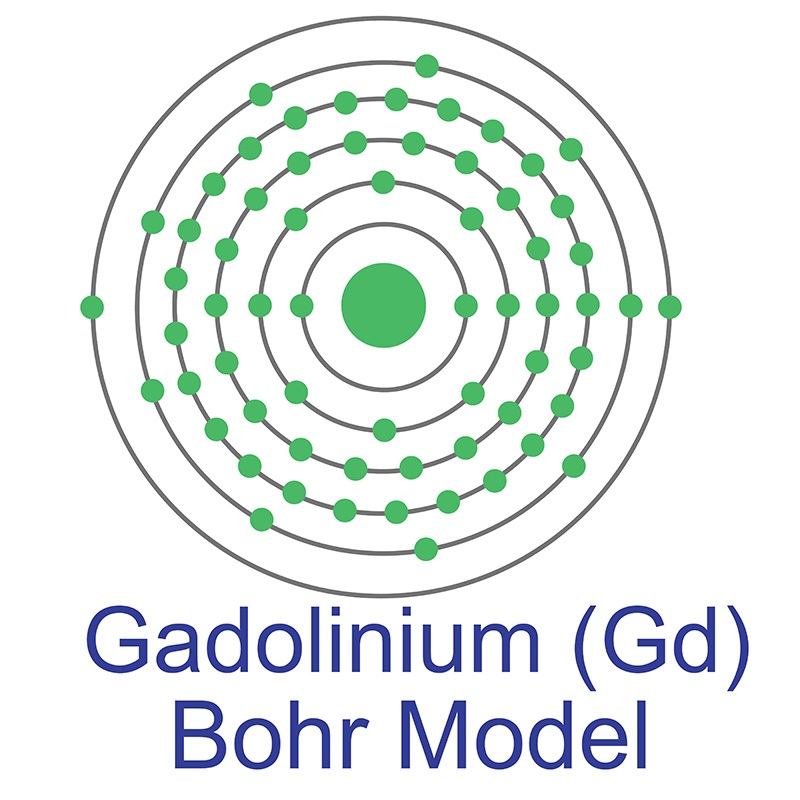
Gadolinium is a Block F, Group 3, Period 6 element. The number of electrons in each of Gadolinium's shells is 2, 8, 18, 25, 9, 2 and its electronic configuration is [Xe] 4f7 5d1 6s2. In its elemental form gadolinium's CAS number is 7440-54-2. The gadolinium atom has a radius of 178.7.pm and it's Van der Waals radius is unknown. Gadolinium is very toxic. Gadolinium is utilized for both its high magnetic moment (7.94µB) and in phosphors and scintillator material. When complexed with EDTA ligands, it is used as an injectable contrast agent for patients undergoing magnetic resonance imaging. Gadolinium is available as metal and compounds with purities from 99% to 99.999% (ACS grade to ultra-high purity); metals in the form of foil, sputtering target, and rod, and compounds as submicron and nanopowder. Gadolinium was first discovered by Jean de Marignac in 1880. The element is named after the Finnish chemist and geologist Johan Gadolin. See Gadolinium research below.
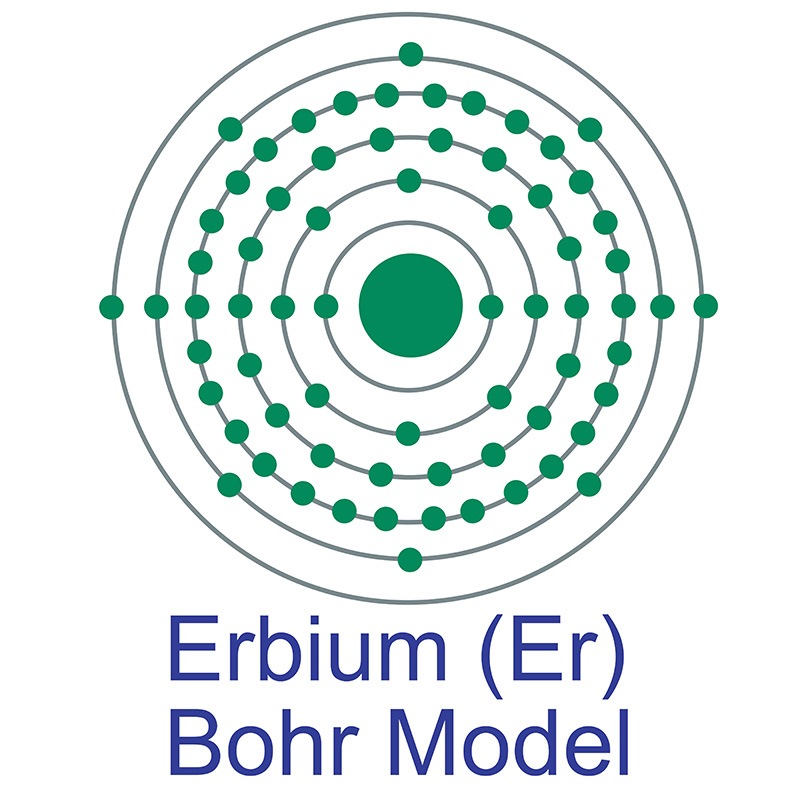
Erbium is a Block F, Group 3, Period 6 element. The number of electrons in each of Erbium's shells is 2, 8, 18, 30, 8, 2 and its electronic configuration is [Xe]4f12 6s2. In its elemental form erbium's CAS number is 7440-52-0. The erbium atom has a radius of 173.4.pm and it's Van der Waals radius is unknown. Erbium is moderately toxic. Erbium has application in glass coloring, as an amplifier in fiber optics, and in lasers for medical and dental use. Erbium is available as metal and compounds with purities from 99% to 99.999% (ACS grade to ultra-high purity); metals in the form of foil, sputtering target, and rod, and compounds as submicron and nanopowder. The ion has a very narrow absorption band coloring erbium salts pink. It is therefore used in eyeware and decorative glassware. It can neutralize discoloring impurities such as ferric ions and produce a neutral gray shade. It is used in a variety of glass products for this purpose. It is particularly useful as an amplifier for fiber optic data transfer. Erbium was first discovered by Carl Mosander in 1843. Erbium is named after the Swedish town, Ytterby. See Erbium research below.
Silicon is a Block P, Group 14, Period 3 element. The number of electrons in each of Silicon's shells is 2, 8, 4 and its electronic configuration is [Ne] 3s2 3p2. In its elemental form silicon's CAS number is 7440-21-3. The silicon atom has a radius of 117.6.pm and it's Van der Waals radius is 210.pm. Silicon is not toxic but can cause chronic respiratory problems if inhaled as a fine silica or silicate dust. Asbestos silicates are carcinogenic. Silicon is one of man's most useful elements. It makes up 25.7% of the earth's crust, by weight, and is the second most abundant element, being exceeded only by oxygen. The Czochralski process is commonly used to produce single crystals of silicon used for solid-state or semiconductor devices. Silica, as sand, is a principal ingredient of glass, one of the most inexpensive of materials with excellent mechanical, optical, thermal, and electrical properties. Silicon is available as metal and compounds with purities from 99% to 99.9999% (ACS grade to ultra-high purity); metals in the form of foil, sputtering target, and rod, and compounds as submicron and nanopowder. Ultra high purity silicon can be doped with boron, gallium, phosphorus , or arsenic to produce silicon for use in transistors, solar cells, rectifiers, and other solid-state devices which are used extensively in the electronics and space-age industries. Hydrogenated amorphous silicon has shown promise in producing economical cells for converting solar energy into electricity. Silcones are important products of silicon. They range from liquids to hard, glasslike solids with many useful properties. Silicon was first discovered by Jons Berzelius in 1823. The name Silicon originates from the Latin word "silex" which means flint or hard stone. See Silicon research below.
|
PACKAGING SPECIFICATIONS FOR BULK & RESEARCH QUANTITIES |
Typical bulk packaging includes palletized plastic 5 gallon/25 kg. pails, fiber and steel drums to 1 ton super sacks in full container (FCL) or truck load (T/L) quantities. Research and sample quantities and hygroscopic, oxidizing or other air sensitive materials may be packaged under argon or vacuum. Shipping documentation includes a Certificate of Analysis and Material Safety Data Sheet (MSDS). Solutions are packaged in polypropylene, plastic or glass jars up to palletized 440 gallon liquid totes.
|
|
| |
Customers for this product have also looked at: |
Recent Research & Development for Gadolinium
- Feasibility of Using MR Enterography (MRE) for the Assessment of Terminal Ileitis and Inflammatory Activity in Children with Crohn's Disease (CD).
Silverstein J, Grand D, Kawatu D, Shah SA, Steinkeler J, Leleiko N.
J Pediatr Gastroenterol Nutr. 2012 Jan 10. [Epub ahead of print]
PMID:
22241511
[PubMed - as supplied by publisher]
- [Pleomorphic adenoma of parotid gland: MR imaging findings].
Zhang B, Shi HM.
Shanghai Kou Qiang Yi Xue. 2011 Dec;20(6):648-52. Chinese.
PMID:
22241320
[PubMed - in process]
- CMR With Late Gadolinium Enhancement in Genotype Positive-Phenotype Negative Hypertrophic Cardiomyopathy.
Rowin EJ, Maron MS, Lesser JR, Maron BJ.
JACC Cardiovasc Imaging. 2012 Jan;5(1):119-22. No abstract available.
PMID:
22239901
[PubMed - in process]
- Peptide-mediated nanoengineering of inorganic particle sur-faces: A general route toward surface functionalization via peptide adhesion domains.
Schwemmer T, Baumgartner J, Faivre D, Boerner HG.
J Am Chem Soc. 2011 Dec 23. [Epub ahead of print]
PMID:
22239472
[PubMed - as supplied by publisher]
- Aqueductal developmental venous anomaly as an unusual cause of congenital hydrocephalus: a case report and review of the literature.
Paulson D, Hwang SW, Whitehead WE, Curry DJ, Luerssen TG, Jea A.
J Med Case Reports. 2012 Jan 11;6(1):7. [Epub ahead of print]
PMID:
22236945
[PubMed - as supplied by publisher]
- MR Imaging and CT Evaluation of Congenital Pulmonary Vein Abnormalities in Neonates and Infants.
Vyas HV, Greenberg SB, Krishnamurthy R.
Radiographics. 2012 Jan;32(1):87-98.
PMID:
22236895
[PubMed - in process]
- In vivo MRI Characterization of Progressive Cardiac Dysfunction in the mdx Mouse Model of Muscular Dystrophy.
Stuckey DJ, Carr CA, Camelliti P, Tyler DJ, Davies KE, Clarke K.
PLoS One. 2012;7(1):e28569. Epub 2012 Jan 3.
PMID:
22235247
[PubMed - in process]
- Impact of inflammation on brain volume in multiple sclerosis.
Cheriyan J, Kim S, Wolansky LJ, Cook SD, Cadavid D.
Arch Neurol. 2012 Jan;69(1):82-8.
PMID:
22232347
[PubMed - in process]
- A calcium-permeable non-selective cation channel in the thick ascending limb apical membrane of the mouse kidney.
Guinamard R, Paulais M, Lourdel S, Teulon J.
Biochim Biophys Acta. 2011 Dec 31. [Epub ahead of print]
PMID:
22230350
[PubMed - as supplied by publisher]
- Ultrasonography, computed tomography and magnetic resonance imaging of hepatocellular carcinoma: toward improved treatment decisions.
Murakami T, Imai Y, Okada M, Hyodo T, Lee WJ, Kim MJ, Kim T, Choi BI.
Oncology. 2011;81 Suppl 1:86-99. Epub 2011 Dec 22.
PMID:
22212941
[PubMed - in process]
- Diagnostic imaging of hepatocellular carcinoma: recent progress.
Kudo M.
Oncology. 2011;81 Suppl 1:73-85. Epub 2011 Dec 22.
PMID:
22212940
[PubMed - in process]
- Usefulness of combination of imaging modalities in the diagnosis of hepatocellular carcinoma using sonazoid®-enhanced ultrasound, gadolinium diethylene-triamine-pentaacetic Acid-enhanced magnetic resonance imaging, and contrast-enhanced computed tomography.
Alaboudy A, Inoue T, Hatanaka K, Chung H, Hyodo T, Kumano S, Murakami T, Moustafa EF, Kudo M.
Oncology. 2011;81 Suppl 1:66-72. Epub 2011 Dec 22.
PMID:
22212939
[PubMed - in process]
- Gd(2)O(3) nanoparticles in hematopoietic cells for MRI contrast enhancement.
Hedlund A, Ahrén M, Gustafsson H, Abrikossova N, Warntjes M, Jönsson JI, Uvdal K, Engström M.
Int J Nanomedicine. 2011;6:3233-40. Epub 2011 Dec 9.
PMID:
22228991
[PubMed - in process]
- Hepatic Uptake of Tc-99m DPD on Bone Scintigraphy: The Influence of the Interval With Gadolinium-Containing Contrast of MRI.
Pak K, Kim SJ, Kim IJ, Suh KT.
Clin Nucl Med. 2012 Feb;37(2):134-6.
PMID:
22228334
[PubMed - in process]
- Hepatic parenchymal enhancement at Gd-EOB-DTPA-enhanced MR imaging: correlation with morphological grading of severity in cirrhosis and chronic hepatitis.
Kanki A, Tamada T, Higaki A, Noda Y, Tanimoto D, Sato T, Higashi H, Ito K.
Magn Reson Imaging. 2012 Jan 5. [Epub ahead of print]
PMID:
22227353
[PubMed - as supplied by publisher]
- A simple way to acquire T(1)-weighted MR images of rat liver with respiratory triggering.
Morikawa S, Murayama H, Fujimoto S, Shiino A, Inubushi T.
Magn Reson Imaging. 2012 Jan 5. [Epub ahead of print]
PMID:
22227350
[PubMed - as supplied by publisher]
- Firategrast for relapsing remitting multiple sclerosis: a phase 2, randomised, double-blind, placebo-controlled trial.
Miller DH, Weber T, Grove R, Wardell C, Horrigan J, Graff O, Atkinson G, Dua P, Yousry T, Macmanus D, Montalban X.
Lancet Neurol. 2012 Jan 5. [Epub ahead of print]
PMID:
22226929
[PubMed - as supplied by publisher]
- Potential of the gastric motility drug lorglumide in prostate cancer imaging.
Sturzu A, Sheikh S, Klose U, Echner H, Kalbacher H, Deeg M, Nägele T, Horger M, Schwentner C, Ernemann U, Heckl S.
Eur J Pharm Sci. 2011 Dec 30. [Epub ahead of print]
PMID:
22226647
[PubMed - as supplied by publisher]
- Assessment of Distribution and Evolution of Mechanical Dyssynchrony in a Porcine Model of Myocardial Infarction by Cardiovascular Magnetic Resonance.
Abd-Elmoniem KZ, Santaularia Tomas M, Sasano T, Soleimanifard S, Vonken EJ, Youssef A, Agarwal H, Dimaano VL, Calkins H, Stuber M, Prince JL, Abraham TP, Abraham MR.
J Cardiovasc Magn Reson. 2012 Jan 6;14(1):1. [Epub ahead of print]
PMID:
22226320
[PubMed - as supplied by publisher]
- Hyperpolarized 13C spectroscopy detects early changes in tumor vasculature and metabolism after VEGF neutralization.
Bohndiek SE, Kettunen MI, Hu DE, Brindle KM.
Cancer Res. 2012 Jan 5. [Epub ahead of print]
PMID:
22223844
[PubMed - as supplied by publisher]
|
Recent Research & Development for Erbium
- Removal of Sea Urchin Spines Using Erbium-Doped Yttrium Aluminum Garnet Ablation.
Gungor S, Tarikçi N, Gokdemir G.
Dermatol Surg. 2011 Dec 30. doi: 10.1111/j.1524-4725.2011.02259.x. [Epub ahead of print] No abstract available.
PMID:
22211378
[PubMed - as supplied by publisher]
- Laser and intense pulsed light management of couperose and rosacea.
Dahan S.
Ann Dermatol Venereol. 2011 Nov;138 Suppl 3:S219-22.
PMID:
22183103
[PubMed - in process]
- In Solution Sensitization of Er(III) Luminescence by the 4-Tetrathiafulvalene-2,6-pyridinedicarboxylic Acid Dimethyl Antenna Ligand.
Pointillart F, Bourdolle A, Cauchy T, Maury O, Le Gal Y, Golhen S, Cador O, Ouahab L.
Inorg Chem. 2011 Dec 30. [Epub ahead of print]
PMID:
22208478
[PubMed - as supplied by publisher]
- Selected Trace Elements in the Sacramento River, California: Occurrence and Distribution.
Taylor HE, Antweiler RC, Roth DA, Alpers CN, Dileanis P.
Arch Environ Contam Toxicol. 2011 Dec 23. [Epub ahead of print]
PMID:
22193863
[PubMed - as supplied by publisher]
- Study about the effects of dental noises on the emotional experiences of children aged 6 to 10 years. A pilot study.
Birardi V, Pasini F.
Eur J Paediatr Dent. 2011 Dec;12(4):236-8.
PMID:
22185247
[PubMed - in process]
- High-power polycrystalline Er:YAG ceramic laser at 1617 nm.
Zhang C, Shen DY, Wang Y, Qian LJ, Zhang J, Qin XP, Tang DY, Yang XF, Zhao T.
Opt Lett. 2011 Dec 15;36(24):4767-9. doi: 10.1364/OL.36.004767.
PMID:
22179877
[PubMed - in process]
- Uranyl Sensitization of Samarium(III) Luminescence in a Two-Dimensional Coordination Polymer.
Knope KE, de Lill DT, Rowland CE, Cantos PM, de Bettencourt-Dias A, Cahill CL.
Inorg Chem. 2012 Jan 2;51(1):201-6. Epub 2011 Dec 15.
PMID:
22171660
[PubMed - in process]
- Core/shell structured NaYF(4):Yb(3+)/Er(3+)/Gd(+3) nanorods with Au nanoparticles or shells for flexible amorphous silicon solar cells.
Li ZQ, Li XD, Liu QQ, Chen XH, Sun Z, Liu C, Ye XJ, Huang SM.
Nanotechnology. 2011 Dec 14;23(2):025402. [Epub ahead of print]
PMID:
22166792
[PubMed - as supplied by publisher]
- Side effects and complications of fractional 1550-nm erbium fiber laser treatment among Asians.
Vaiyavatjamai P, Wattanakrai P.
J Cosmet Dermatol. 2011 Dec;10(4):313-6. doi: 10.1111/j.1473-2165.2011.00585.x.
PMID:
22151942
[PubMed - in process]
- Skin characteristics after fractional photothermolysis.
Oh BH, Hwang YJ, Lee YW, Choe YB, Ahn KJ.
Ann Dermatol. 2011 Nov;23(4):448-54. Epub 2011 Nov 3.
PMID:
22148011
[PubMed - in process]
- Novel heterometal-organic complexes as first single source precursors for up-converting NaY(Ln)F(4) (Ln = Yb, Er, Tm) nanomaterials.
Mishra S, Ledoux G, Jeanneau E, Daniele S, Joubert MF.
Dalton Trans. 2011 Dec 2. [Epub ahead of print]
PMID:
22134711
[PubMed - as supplied by publisher]
- The Efficacy of Er,Cr:YSGG Laser in Reconditioning of Metallic Orthodontic Brackets.
Ahrari F, Basafa M, Fekrazad R, Mokarram M, Akbari M.
Photomed Laser Surg. 2012 Jan;30(1):41-6. Epub 2011 Dec 1.
PMID:
22133152
[PubMed - in process]
- Electrically pumped silicon waveguide light sources.
Jayatilleka H, Nasrollahy-Shiraz A, Kenyon AJ.
Opt Express. 2011 Nov 21;19(24):24569-76. doi: 10.1364/OE.19.024569.
PMID:
22109485
[PubMed - in process]
- Broadly tunable L-band multiwavelength BEFL utilizing nonlinear amplified loop mirror filter.
Al-Mansoori MH, Mahdi MA.
Opt Express. 2011 Nov 21;19(24):23981-8. doi: 10.1364/OE.19.023981.
PMID:
22109422
[PubMed - in process]
- Characteristics of rational harmonic mode-locked short-cavity fiber ring laser using a bismuth-oxide-based erbium-doped fiber and a bismuth-oxide-based highly nonlinear fiber.
Fukuchi Y, Maeda J.
Opt Express. 2011 Nov 7;19(23):22502-9. doi: 10.1364/OE.19.022502.
PMID:
22109128
[PubMed - in process]
- Generation of 120-fs laser pulses at 1-GHz repetition rate derived from continuous wave laser diode.
Ishizawa A, Nishikawa T, Mizutori A, Takara H, Nakano H, Sogawa T, Takada A, Koga M.
Opt Express. 2011 Nov 7;19(23):22402-9. doi: 10.1364/OE.19.022402.
PMID:
22109116
[PubMed - in process]
- Multiwavelength Brillouin fiber laser with enhanced reverse-S-shaped feedback coupling assisted by out-of-cavity optical amplifier.
Rahman ZA, Hitam S, Al-Mansoori MH, Abas AF, Mahdi MA.
Opt Express. 2011 Oct 24;19(22):21238-45. doi: 10.1364/OE.19.021238.
PMID:
22108976
[PubMed - in process]
- Effects of Dentin Surface Modifications Treated with Er:YAG and Nd:YAG Laser Irradiation on Fibroblast Cell Adhesion.
Bolortuya G, Ebihara A, Ichinose S, Watanabe S, Anjo T, Kokuzawa C, Saegusa H, Kawashima N, Suda H.
Photomed Laser Surg. 2011 Nov 22. [Epub ahead of print]
PMID:
22107609
[PubMed - as supplied by publisher]
- Treatment of Melasma Using a Novel 1,927-nm Fractional Thulium Fiber Laser: A Pilot Study.
Polder KD, Bruce S.
Dermatol Surg. 2011 Oct 10. doi: 10.1111/j.1524-4725.2011.02178.x. [Epub ahead of print]
PMID:
22093448
[PubMed - as supplied by publisher]
- Letter: successful treatment of multiple miliary osteomas of the face using an erbium-doped yttrium aluminum garnet laser.
Ortiz AE, Ross EV.
Dermatol Surg. 2011 Oct;37(10):1548-50. doi: 10.1111/j.1524-4725.2011.02112.x. No abstract available.
PMID:
22092945
[PubMed - indexed for MEDLINE]
|
Customers for this product have also looked at: |
Recent Research & Development for Silicon
- Desymmetrization of 7-dimethylphenylsilylcycloheptatriene. Towards the synthesis of new aminocycloheptitols.
Girard E, Desvergnes V, Tarnus C, Landais Y.
Org Biomol Chem. 2010 Oct 13. [Epub ahead of print]PMID: 20941452 [PubMed - as supplied by publisher]Related citations
- Enzyme-functionalized polymer brush films on the inner wall of silicon-glass microreactors with tunable biocatalytic activity.
Costantini F, Benetti EM, Reinhoudt DN, Huskens J, Vancso GJ, Verboom W.
Lab Chip. 2010 Oct 13. [Epub ahead of print]PMID: 20941436 [PubMed - as supplied by publisher]Related citations
- Wavelength-tunable excited-state absorption and optical limiting effects in the Q band region based on silicon phthalocyanine oligomers.
Ishii K, Sakai N.
Phys Chem Chem Phys. 2010 Oct 13. [Epub ahead of print]PMID: 20941425 [PubMed - as supplied by publisher]Related citations
- Role of near-field enhancement in plasmonic laser nanoablation using gold nanorods on a silicon substrate.
Harrison RK, Ben-Yakar A.
Opt Express. 2010 Oct 11;18(21):22556-71. doi: 10.1364/OE.18.022556.PMID: 20941153 [PubMed - in process]Related citations
- Ultrafast all-optical modulator with femtojoule absorbed switching energy in silicon-on-insulator.
Schönenberger S, Stöferle T, Moll N, Mahrt RF, Dahlem MS, Wahlbrink T, Bolten J, Mollenhauer T, Kurz H, Offrein BJ.
Opt Express. 2010 Oct 11;18(21):22485-96. doi: 10.1364/OE.18.022485.PMID: 20941147 [PubMed - in process]Related citations
- The observation of super-long range surface plasmon polaritons modes and its application as sensory devices.
Zhang XL, Song JF, Lo GQ, Kwong DL.
Opt Express. 2010 Oct 11;18(21):22462-70. doi: 10.1364/OE.18.022462.PMID: 20941145 [PubMed - in process]Related citations
- Silicon photonic temperature sensor?employing a ring resonator manufactured?using a standard CMOS process.
Kim GD, Lee HS, Park CH, Lee SS, Lim BT, Bae HK, Lee WG.
Opt Express. 2010 Oct 11;18(21):22215-21. doi: 10.1364/OE.18.022215.PMID: 20941123 [PubMed - in process]Related citations
- Highly efficient nonlinearity reduction in silicon-on-insulator waveguides using vertical slots.
Yue Y, Zhang L, Wang J, Beausoleil RG, Willner AE.
Opt Express. 2010 Oct 11;18(21):22061-6. doi: 10.1364/OE.18.022061.PMID: 20941107 [PubMed - in process]Related citations
- Quantitative evaluation of boron-induced disorder in multilayers containing silicon nanocrystals in an oxide matrix designed for photovoltaic applications.
Zatryb G, Podhorodecki A, Hao XJ, Misiewicz J, Shen YS, Green MA.
Opt Express. 2010 Oct 11;18(21):22004-9. doi: 10.1364/OE.18.022004.PMID: 20941101 [PubMed - in process]Related citations
- Discrete parametric band conversion in silicon for mid-infrared applications.
Tien EK, Huang Y, Gao S, Song Q, Qian F, Kalyoncu SK, Boyraz O.
Opt Express. 2010 Oct 11;18(21):21981-9. doi: 10.1364/OE.18.021981.PMID: 20941099 [PubMed - in process]Related citations
- Split of surface plasmon resonance of gold nanoparticles on silicon substrate: a study of dielectric functions.
Zhu S, Chen TP, Cen ZH, Goh ES, Yu SF, Liu YC, Liu Y.
Opt Express. 2010 Oct 11;18(21):21926-31. doi: 10.1364/OE.18.021926.PMID: 20941092 [PubMed - in process]Related citations
- Solution-processed photodetectors from colloidal silicon nano/micro particle composite.
Tu CC, Tang L, Huang J, Voutsas A, Lin LY.
Opt Express. 2010 Oct 11;18(21):21622-7. doi: 10.1364/OE.18.021622.PMID: 20941060 [PubMed - in process]Related citations
- FDTD modeling of anisotropic nonlinear optical phenomena in silicon waveguides.
Dissanayake CM, Premaratne M, Rukhlenko ID, Agrawal GP.
Opt Express. 2010 Sep 27;18(20):21427-48. doi: 10.1364/OE.18.021427.PMID: 20941040 [PubMed - in process]Related citations
- Multi-channel WDM RZ-to-NRZ format conversion at 50 Gbit/s based on single silicon microring resonator.
Ding Y, Peucheret C, Pu M, Zsigri B, Seoane J, Liu L, Xu J, Ou H, Zhang X, Huang D.
Opt Express. 2010 Sep 27;18(20):21121-30. doi: 10.1364/OE.18.021121.PMID: 20941008 [PubMed - in process]Related citations
- Hybrid plasmon/dielectric waveguide for integrated silicon-on-insulator optical elements.
Flammer PD, Banks JM, Furtak TE, Durfee CG, Hollingsworth RE, Collins RT.
Opt Express. 2010 Sep 27;18(20):21013-23. doi: 10.1364/OE.18.021013.PMID: 20940996 [PubMed - in process]Related citations
- Tunable photonic crystal based on?capillary attraction and repulsion.
Chan CT, Yeh JA.
Opt Express. 2010 Sep 27;18(20):20894-9. doi: 10.1364/OE.18.020894.PMID: 20940984 [PubMed - in process]Related citations
- Tailoring the dispersion behavior of silicon nanophotonic slot waveguides.
Mas S, Caraquitena J, Galán JV, Sanchis P, Martí J.
Opt Express. 2010 Sep 27;18(20):20839-44. doi: 10.1364/OE.18.020839.PMID: 20940978 [PubMed - in process]Related citations
- High performance nanophotonic circuits based on partially buried horizontal slot waveguides.
Xiong C, Pernice WH, Li M, Tang HX.
Opt Express. 2010 Sep 27;18(20):20690-8. doi: 10.1364/OE.18.020690.PMID: 20940965 [PubMed - in process]Related citations
- Label-free optical biosensing using a horizontal air-slot SiN(x) microdisk resonator.
Lee S, Eom SC, Chang JS, Huh C, Sung GY, Shin JH.
Opt Express. 2010 Sep 27;18(20):20638-44. doi: 10.1364/OE.18.020638.PMID: 20940958 [PubMed - in process]Related citations
- Flattened dispersion in silicon slot waveguides.
Zhang L, Yue Y, Beausoleil RG, Willner AE.
Opt Express. 2010 Sep 13;18(19):20529-34. doi: 10.1364/OE.18.020529.PMID: 20940946 [PubMed - in process]Related citations
|
Material Safety Data Sheet |
|
1 Identification of substance
- Product details
- Trade name Gadolinium metal
|
2 Composition/Data on components:
- Chemical characterization:
Designation: (CAS#)
Gadolinium (CAS# 7440-54-2), 100%
- Identification number(s):
- EINECS Number: 231-160-1
|
3 Hazards identification
- Hazard designation: F Highly flammable
- Information pertaining to particular dangers for man and environment
R 11 Highly flammable.
R 15 Contact with water liberates extremely flammable gases.
|
4 First aid measures
- After inhalation
Supply fresh air. If required, provide artificial respiration. Keep patient warm. Consult doctor if symptoms persist.
Seek immediate medical advice.
- After skin contact
Instantly wash with water and soap and rinse thoroughly.
Seek immediate medical advice.
- After eye contact
Rinse opened eye for several minutes under running water. Then consult doctor.
- After swallowing Seek immediate medical advice.
|
5 Fire fighting measures
- Suitable extinguishing agents Extinguishing powder. Do not use water.
- For safety reasons unsuitable extinguishing agents
Water.
Halocarbon extinguisher
- Special hazards caused by the material, its products of combustion or
flue gases:
Contact with water releases hydrogen (explosive).
- Protective equipment:
Wear self-contained breathing apparatus.
Wear full protective suit.
|
6 Accidental release measures
- Person-related safety precautions:
Wear protective equipment. Keep unprotected persons away.
Ensure adequate ventilation
Keep away from ignition sources
- Measures for environmental protection:
Do not allow material to be released to the environment without proper governmental permits.
- Measures for cleaning/collecting:
Ensure adequate ventilation.
Do not flush with water or aqueous cleansing agents
Keep away from ignition sources.
- Additional information:
See Section 7 for information on safe handling
See section 8 for information on personal protection equipment.
See Section 13 for information on disposal.
|
7 Handling and storage
- Handling
- Information for safe handling:
Keep containers tightly sealed.
Store in cool, dry place in tightly closed containers.
Ensure good ventilation/exhaustion at the workplace.
Open and handle container with care.
- Information about protection against explosions and fires:
Keep ignition sources away - Do not smoke.
Protect against electrostatic charges.
Fumes can combine with air to form an explosive mixture.
- Storage
- Requirements to be met by storerooms and containers:
Store in cool location.
- Information about storage in one common storage facility:
Store away from water.
Do not store together with oxidizing and acidic materials.
Store away from halogens.
- Further information about storage conditions:
Store in petroleum or under dry argon.
Protect from humidity and keep away from water.
Keep container tightly sealed.
Store in cool, dry conditions in well sealed containers.
|
8 Exposure controls and personal protection
- Additional information about design of technical systems:
Properly operating chemical fume hood designed for hazardous chemicals and having an average face velocity of at least 100 feet per minute.
- Components with critical values that require monitoring at the
workplace:
Not required.
- Additional information: No data
- Personal protective equipment
- General protective and hygienic measures
The usual precautionary measures should be adhered to in handling the chemicals.
Keep away from foodstuffs, beverages and food.
Instantly remove any soiled and impregnated garments.
Wash hands during breaks and at the end of the work.
- Breathing equipment: Use breathing protection with high concentrations.
- Protection of hands: Impervious gloves
- Eye protection:
Safety glasses
Full face protection
Face protection
- Body protection: Protective work clothing.
|
9 Physical and chemical properties:
- General Information
- Form: Chunks
- Colour: Silver-coloured
- Smell: Odourless
- Value/Range Unit Method
- Change in condition
- Melting point/Melting range: 1312 ° C
- Boiling point/Boiling range: 3000 ° C
- Sublimation temperature / start: Not determined
- Flash point: Not applicable
- Inflammability (solid, gaseous) Highly flammable.
Contact with water liberates extremely flammable gases.
- Ignition temperature: Not determined
- Decomposition temperature: Not determined
- Critical values for explosion:
- Lower: Not determined
- Upper: Not determined
- Steam pressure: Not determined
- Density at 20 ° C 7.89 g/cm³
- Solubility in / Miscibility with
- Water: Not determined
|
10 Stability and reactivity
- Thermal decomposition / conditions to be avoided:
No decomposition if used and stored according to specifications.
- Materials to be avoided:
Oxidizing agents
Water/moisture
Acids
Halogens
Air
- Dangerous reactions: Contact with water releases flammable gases
- Dangerous products of decomposition: Hydrogen
|
11 Toxicological information
- Acute toxicity:
- Primary irritant effect:
- on the skin: Irritant for skin and mucous membranes.
- on the eye: Irritant effect.
- Sensitization: No sensitizing effect known.
- Additional toxicological information:
To the best of our knowledge the acute and chronic toxicity of this substance is not fully known.
No classification data on carcinogenic properties of this material is available from the EPA, IARC, NTP, OSHA or ACGIH.
|
12 Ecological information:
- General notes:
Do not allow material to be released to the environment without proper governmental permits.
Water hazard class 1 (Self-assessment): slightly hazardous for water.
Do not allow undiluted product or large quantities of it to reach ground water, water bodies or sewage system.
|
13 Disposal considerations
- Product:
- Recommendation
Consult state, local or national regulations for proper disposal.
Hand over to disposers of hazardous waste.
Must be specially treated under adherence to official regulations.
- Uncleaned packagings:
- Recommendation:
Disposal must be made according to official regulations.
|
14 Transport information
- Land transport ADR/RID and GGVS/GGVE (cross-border/domestic)
- ADR/RID-GGVS/E Class: 4.1 (F3) Flammable solids.
- Kemler Number: 40
- UN-Number: 3178
- Packaging group: III
- Label 4.1
- Designation of goods: 3178 FLAMMABLE SOLID, INORGANIC, N.O.S.
(gadolinium)
- Maritime transport IMDG/GGVSea:
- IMDG/GGVSea Class: 4.1
- UN Number: 3178
- Label 4.1
- Packaging group: III
- Correct technical name: FLAMMABLE SOLID, INORGANIC, N.O.S.
(gadolinium)
- Air transport ICAO-TI and IATA-DGR:
- ICAO/IATA Class: 4.1
- UN/ID Number: 3178
- Label 4.1
- Packaging group: III
- Correct technical name: FLAMMABLE SOLID, INORGANIC, N.O.S.
(gadolinium)
|
15 Regulatory information
- Designation according to EC guidelines:
- Code letter and hazard designation of product: F Highly flammable
- Risk phrases:
11 Highly flammable.
15 Contact with water liberates extremely flammable gases.
- National regulations
- Information about limitation of use:
For use only by technically qualified individuals.
Employment restrictions concerning young persons must be observed.
- Water hazard class:
Water hazard class 1 (Self-assessment): slightly hazardous for water.
|
16 Other information:
Employers should use this information only as a supplement to other information gathered by them, and should make independent judgement of suitability of this information to ensure proper use and protect the health and safety of employees. This information is furnished without warranty, and any use of the product not in conformance with this Material Safety Data Sheet, or in combination with any other product or process, is the responsibility of the user.
|
|
| American Elements is a copyrighted U.S. Trademark. All rights reserved. |
| |