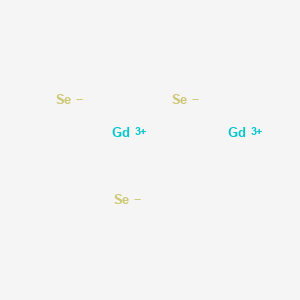
American Elements produces to many standard grades when applicable, including Mil Spec (military grade); ACS, Reagent and Technical Grade; Food, Agricultural and Pharmaceutical Grade; Optical Grade, USP and EP/BP (European Pharmacopeia/British Pharmacopeia) and follows applicable ASTM testing standards.See safety data and research below and pricing/lead time above. American Elements specializes in producing high purity Gadolinium Selenide Sputtering Targets with the highest possible density and smallest possible average grain sizes for use in semiconductor, chemical vapor deposition (CVD) and physical vapor deposition (PVD) display and optical applications. Our standard Sputtering Targets for thin film are available monoblock or bonded with dimensions and configurations up to 820 mm with hole drill locations and threading, beveling, grooves and backing designed to work with both older sputtering devises as well as the latest process equipment, such as large area coating for solar energy or fuel cells and flip-chip applications. Research sized targets are also produced as well as custom sizes and alloys. All targets are analyzed using best demonstrated techniques including X-Ray Fluorescence (XRF), Glow Discharge Mass Spectrometry (GDMS), and Inductively Coupled Plasma (ICP). "Sputtering" allows for thin film deposition of an ultra high purity sputtering metallic or oxide material onto another solid substrate by the controlled removal and conversion of the target material into a directed gaseous/plasma phase through ionic bombardment. "Sputtering" allows for thin film deposition of an ultra high purity sputtering metallic or oxide material onto another solid substrate by the controlled removal and conversion of the target material into a directed gaseous/plasma phase through ionic bombardment. We can also provide targets outside this range in addition to just about any size rectangular, annular, or oval target. Materials are produced using crystallization, solid state and other ultra high purification processes such as sublimation. American Elements specializes in producing custom compositions for commercial and research applications and for new proprietary technologies. American Elements also casts any of the rare earth metals and most other advanced materials into rod, bar or plate form, as well as other machined shapes and through other processes nanoparticles. We also produce Gadolinium as disc, granules, ingot, pellets, pieces, powder, and rod. Other shapes are available by request.
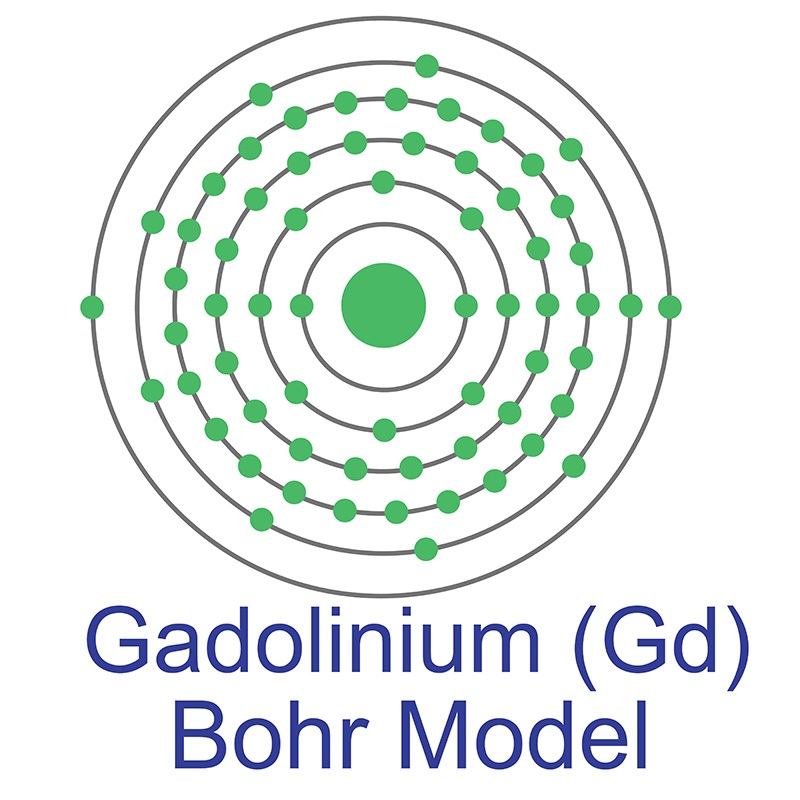
Gadolinium is a Block F, Group 3, Period 6 element. The number of electrons in each of Gadolinium's shells is 2, 8, 18, 25, 9, 2 and its electronic configuration is [Xe] 4f7 5d1 6s2. In its elemental form gadolinium's CAS number is 7440-54-2. The gadolinium atom has a radius of 178.7.pm and it's Van der Waals radius is unknown. Gadolinium is very toxic. Gadolinium is utilized for both its high magnetic moment (7.94µB) and in phosphors and scintillator material. When complexed with EDTA ligands, it is used as an injectable contrast agent for patients undergoing magnetic resonance imaging. With its high magnetic moment, gadolinium can reduce relaxation times and thereby enhance signal intensity. The extra stable half-full 4f electron shell with no low lying energy levels creates applications as an inert phosphor host. Gadolinium can therefore act as hosts for x-ray cassettes and in scintillator materials for computer tomography. Gadolinium is available as metal and compounds with purities from 99% to 99.999% (ACS grade to ultra-high purity); metals in the form of foil, sputtering target, and rod, and compounds as submicron and nanopowder. Gadolinium was first discovered by Jean de Marignac in 1880. The element is named after the Finnish chemist and geologist Johan Gadolin. See Gadolinium research below. With its high magnetic moment, gadolinium can reduce relaxation times and thereby enhance signal intensity. The extra stable half-full 4f electron shell with no low lying energy levels creates applications as an inert phosphor host. Gadolinium can therefore act as hosts for x-ray cassettes and in scintillator materials for computer tomography.
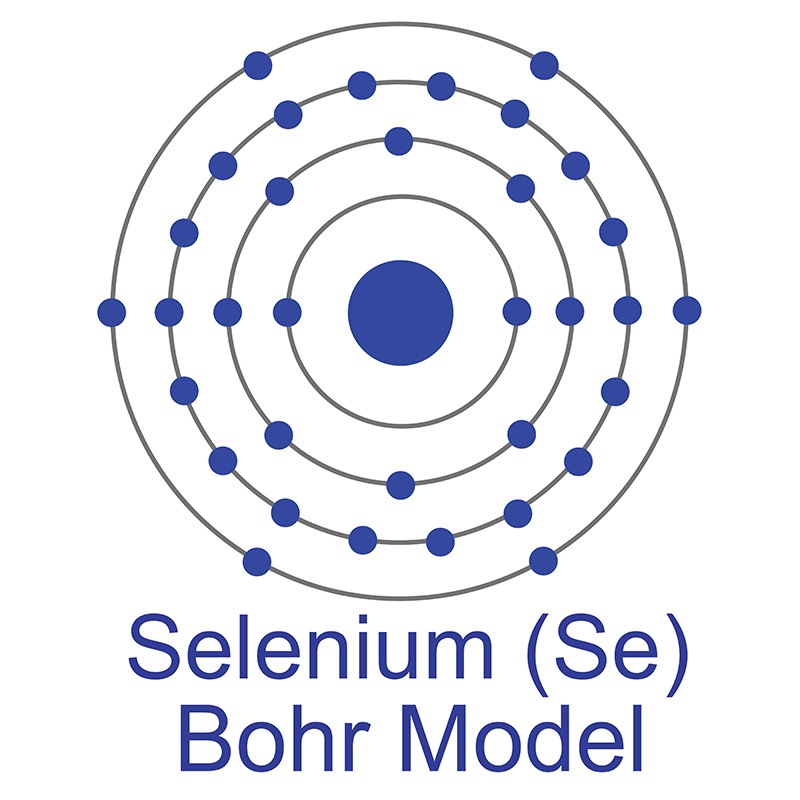
Selenium is a Block P, Group 16, Period 4 element. The number of electrons in each of Selenium's shells is 2, 8, 18, 6 and its electronic configuration is [Ar] 3d10 4s2 4p4. In its elemental form selenium's CAS number is 7782-49-2. The selenium atom has a radius of 116.pm and it's Van der Waals radius is 190.pm. The EPA does not classify selenium as carcinogenic, although selenium sulfide is a probable carcinogen. Selenates and selenites which are compounds of selenium, are highly toxic. Hydrogen selenide gas (SeH2) is the most acutely toxic compound of selenium. Selenium exhibits both photovoltaic action, where light is converted directly into electricity, and photoconductive action, where the electrical resistance decreases with increased illumination. of photocells and exposure meters for photographic use, as well as solar cells. Below its melting point, selenium is a p-type semiconductor and has many uses in electronic and solid-state applications. Selenium is available as metal and compounds with purities from 99% to 99.9999% (ACS grade to ultra-high purity); metals in the form of foil, sputtering target, and rod, and compounds as submicron and nanopowder. Selenium was first discovered by Jons Berzelius in 1817. The origin of the name Selenium comes from the Greek word "Selênê" meaning moon. See selenium research below.
T(1) assessment of hip joint cartilage following intra-articular
gadolinium injection: A pilot study. Bittersohl B, Hosalkar HS, Kim YJ, Werlen S, Trattnig S, Siebenrock KA,
Mamisch TC. Magn Reson Med. 2010 Oct;64(4):1200-7.
PubMed PMID: 20872764.
The
time window of MRI of murine atherosclerotic plaques after administration of CB2
receptor targeted micelles: inter-scan variability and relation between plaque
signal intensity increase and gadolinium content of inversion recovery prepared
versus non-prepared fast spin echo. Te Boekhorst BC, Bovens SM, van de Kolk CW, Cramer MJ, Doevendans PA, Ten Hove
M, van der Weerd L, Poelmann R, Strijkers GJ, Pasterkamp G, van Echteld CJ. NMR Biomed. 2010 Oct;23(8):939-51. PubMed
PMID: 20878972.
Coordination chemistry of amide-functionalised
tetraazamacrocycles: structural, relaxometric and cytotoxicity studies. Martinelli J, Balali-Mood B, Panizzo R, Lythgoe MF, White AJ, Ferretti P,
Steinke JH, Vilar R. Dalton
Trans. 2010 Sep 28. [Epub ahead of print] PubMed PMID: 20877892.
Gadolinium released from MR contrast
agents is deposited in brain tumors: in situ demonstration using scanning
electron microscopy with energy dispersive X-ray spectroscopy. Xia D, Davis RL, Crawford JA, Abraham JL. Acta Radiol. 2010
Sep 26. [Epub ahead of print] PubMed PMID: 20868305.
Midregional
pro-atrial natriuretic peptide: a novel marker of myocardial fibrosis in patients
with hypertrophic cardiomyopathy. Elmas E, Doesch C, Fluechter S, Freundt M, Weiss C, Lang S, Kälsch T, Haghi D,
Papassotiriou J, Kunde J, Schoenberg SO, Borggrefe M, Papavassiliu T. Int J Cardiovasc Imaging. 2010 Sep 26. [Epub
ahead of print] PubMed PMID: 20872251.
Translocator Protein PET
Imaging for Glial Activation in Multiple Sclerosis. Oh U, Fujita M, Ikonomidou VN, Evangelou IE, Matsuura E, Harberts E, Ohayon J,
Pike VW, Zhang Y, Zoghbi SS, Innis RB, Jacobson S. J Neuroimmune Pharmacol. 2010
Sep 25. [Epub ahead of print] PubMed PMID: 20872081.
Influence of small caliber coronary arteries on the diagnostic accuracy of
adenosine stress cardiac magnetic resonance imaging. Pilz G, Heer T, Graw M, Ali E, Klos M, Scheck R, Zeymer U, Höfling B. Clin Res Cardiol. 2010 Sep
24. [Epub ahead of print] PubMed PMID: 20862587.
Reference region-based pharmacokinetic modeling in quantitative dynamic
contract-enhanced MRI allows robust treatment monitoring in a rat liver tumor
model despite cardiovascular changes. Steingoetter A, Svensson J, Kosanke Y, Botnar RM, Schwaiger M, Rummeny E,
Braren R. Magn Reson Med. 2010 Sep 24. [Epub ahead of
print] PubMed PMID: 20872863.
Comparison of half-dose and full-dose
gadolinium MR contrast on the enhancement of bone and soft tissue tumors.
Costelloe CM, Murphy WA Jr, Haygood TM, Kumar R, McEnery KW, Stafford RJ, Roy
A, Bassett RL Jr, Harrell RK, Madewell JE. Skeletal Radiol. 2010 Sep 24. [Epub ahead of print] PubMed PMID: 20862469.
Gd-EOB-DTPA enhanced MR
imaging: Evaluation of biliary and renal excretion in normal and cirrhotic
livers. Tamada T, Ito K, Sone T, Kanki A, Sato T, Higashi H. Eur J Radiol. 2010 Sep 23. [Epub ahead of print] PubMed PMID: 20869827.
Increases
in the number of brain metastases detected at frame-fixed, thin-slice MRI for
gamma knife surgery planning. Nagai A, Shibamoto Y, Mori Y, Hashizume C, Hagiwara M, Kobayashi T. Neuro Oncol. 2010 Sep 23. [Epub ahead of print]
PubMed PMID: 20864500.
BOLD
cardiovascular magnetic resonance at 3.0 tesla in myocardial ischemia. Manka R, Paetsch I, Schnackenburg B, Gebker R, Fleck E, Jahnke C. J
Cardiovasc Magn Reson. 2010 Sep 22;12(1):54. [Epub ahead of print] PubMed PMID:
20860792.
Revisiting an old friend: manganese-based MRI contrast agents. Pan D, Caruthers SD, Senpan A, Schmieder AH, Wickline SA, Lanza GM. Wiley Interdiscip
Rev Nanomed Nanobiotechnol. 2010 Sep 21. [Epub ahead of print] PubMed PMID:
20860051.
Childhood cholesteatoma. Nevoux J, Lenoir M, Roger G, Denoyelle F, Ducou Le Pointe H, Garabédian EN.Eur Ann Otorhinolaryngol Head Neck Dis. 2010
Sep;127(4):143-50. Epub 2010 Aug 11. PubMed PMID: 20860924.
Comparison of portal venous and delayed phases of
gadolinium-enhanced magnetic resonance imaging study of cirrhotic liver for the
detection of contrast washout of hypervascular hepatocellular carcinoma. Cereser L, Furlan A, Bagatto D, Girometti R, Como G, Avellini C, Orsaria M,
Zuiani C, Bazzocchi M. J Comput
Assist Tomogr. 2010 Sep-Oct;34(5):706-11. PubMed PMID: 20861773.
Three-dimensional multiphase time-resolved low-dose
contrast-enhanced magnetic resonance angiography using TWIST on a 32-channel coil
at 3 T: a quantitative and qualitative comparison of a conventional gadolinium
chelate with a high-relaxivity agent. Giesel FL, Runge V, Kirchin M, Mehndiratta A, Gerigk L, Corell B, von Gall C,
Kauczor HU, Essig M. J Comput Assist Tomogr. 2010
Sep-Oct;34(5):678-83. PubMed PMID: 20861769.
[Accessory nerve schwannoma
of the intracisternal type: a case report.]. Sadatomo T, Yuki K, Migita K, Hidaka T, Kurisu K. No Shinkei Geka. 2010
Sep;38(9):831-7. Japanese. PubMed PMID: 20864772.
Use of cardiac magnetic resonance imaging to evaluate cardiac
structure, function and fibrosis in children with infantile Pompe disease on
enzyme replacement therapy. Barker PC, Pasquali SK, Darty S, Ing RJ, Li JS, Kim RJ, Dearmey S, Kishnani
PS, Campbell MJ. Mol Genet Metab. 2010 Jul 23. [Epub ahead of print]
PubMed PMID: 20875764.
Differential diagnosis and
prognosis of T1-weighted post-gadolinium intralabyrinthine hyperintensities. Dubrulle F, Kohler R, Vincent C, Puech P, Ernst O. Eur
Radiol. 2010 Jun 10. [Epub ahead of print] PubMed PMID: 20862477.
Selenoprotein K binds multi-protein complexes and is involved in the regulation of ER homeostasis.
Shchedrina VA, Everley RA, Zhang Y, Gygi SP, Hatfield DL, Gladyshev VN.
J Biol Chem. 2011 Oct 20. [Epub ahead of print]
PMID:
22016385
[PubMed - as supplied by publisher]
Catalytic activity of selenomethionine in removing amino acid, peptide, and protein hydroperoxides.
Suryo Rahmanto A, Davies MJ.
Free Radic Biol Med. 2011 Oct 1. [Epub ahead of print]
PMID:
22015433
[PubMed - as supplied by publisher]
Combination of chemometrically assisted voltammetry, calorimetry, and circular dichroism as a new method for the study of bioinorganic substances: application to selenocystine metal complexes.
Gusmão R, Prohens R, Díaz-Cruz JM, Ariño C, Esteban M.
J Biol Inorg Chem. 2011 Oct 21. [Epub ahead of print]
PMID:
22015398
[PubMed - as supplied by publisher]
Marine and farmed fish on the Polish market: Comparison of the nutritive value and human exposure to PCDD/Fs and other contaminants.
Szlinder-Richert J, Usydus Z, Malesa-Ciecwierz M, Polak-Juszczak L, Ruczynska W.
Chemosphere. 2011 Oct 17. [Epub ahead of print]
PMID:
22014661
[PubMed - as supplied by publisher]
Dietary selenium reduces retention of methyl mercury in freshwater fish.
Bjerregaard P, Fjordside S, Hansen MG, Petrova MB.
Environ Sci Technol. 2011 Oct 20. [Epub ahead of print]
PMID:
22014184
[PubMed - as supplied by publisher]
Plant and fungal food components with potential activity on the development of microbial oral diseases.
Daglia M, Papetti A, Mascherpa D, Grisoli P, Giusto G, Lingström P, Pratten J, Signoretto C, Spratt DA, Wilson M, Zaura E, Gazzani G.
J Biomed Biotechnol. 2011;2011:274578. Epub 2011 Oct 17.
PMID:
22013381
[PubMed - in process]
Selenium, selenoproteins and the thyroid gland: interactions in health and disease.
Schomburg L.
Nat Rev Endocrinol. 2011 Oct 18. doi: 10.1038/nrendo.2011.174. [Epub ahead of print]
PMID:
22009156
[PubMed - as supplied by publisher]
Selenium inhibits migration of murine melanoma cells via down-modulation of IL-18 expression.
Song H, Kim J, Lee HK, Park HJ, Nam J, Park GB, Kim YS, Cho D, Hur DY.
Int Immunopharmacol. 2011 Oct 15. [Epub ahead of print]
PMID:
22008306
[PubMed - as supplied by publisher]
Detection, Identification, and Quantification of Selenoproteins in a Candidate Human Plasma Standard Reference Material.
Ballihaut G, Kilpatrick LE, Davis WC.
Anal Chem. 2011 Oct 18. [Epub ahead of print]
PMID:
22007999
[PubMed - as supplied by publisher]
Severe pre-eclampsia is associated with abnormal trace elements concentrations in maternal and fetal blood.
Katz O, Paz-Tal O, Lazer T, Aricha-Tamir B, Mazor M, Wiznitzer A, Sheiner E.
J Matern Fetal Neonatal Med. 2011 Oct 18. [Epub ahead of print]
PMID:
22007865
[PubMed - as supplied by publisher]
Effects of Selenium Supplements on Cancer Prevention: Meta-analysis of Randomized Controlled Trials.
Lee EH, Myung SK, Jeon YJ, Kim Y, Chang YJ, Ju W, Seo HG, Huh BY.
Nutr Cancer. 2011 Oct 17. [Epub ahead of print]
PMID:
22004275
[PubMed - as supplied by publisher]
Study of the correlation of serum selenium level with Behcet's disease.
Esalatmanesh K, Jamshidi A, Shahram F, Davatchi F, Masoud SA, Soleimani Z, Salesi M, Ghaffarpasand I.
Int J Rheum Dis. 2011 Oct;14(4):375-8. doi: 10.1111/j.1756-185X.2011.01649.x. Epub 2011 Sep 5.
PMID:
22004235
[PubMed - in process]
Multi-metal(loid) methylation in methanoarchaea is linked to central intermediates of methanogenesis.
Thomas F, Diaz-Bone RA, Wuerfel O, Huber B, Weidenbach K, Schmitz RA, Hensel R.
Appl Environ Microbiol. 2011 Oct 14. [Epub ahead of print]
PMID:
22003009
[PubMed - as supplied by publisher]
The Effects of Di(2-Ethylhexyl)Phthalate Exposure and Selenium Nutrition on Sertoli Cell Vimentin Structure and Germ-Cell Apoptosis in Rat Testis.
Erkekoglu P, Zeybek ND, Giray B, Asan E, Hincal F.
Arch Environ Contam Toxicol. 2011 Oct 16. [Epub ahead of print]
PMID:
22002783
[PubMed - as supplied by publisher]
A superoxide anion-scavenger, 1,3-selenazolidin-4-one suppresses serum deprivation-induced apoptosis in PC12 cells by activating MAP kinase.
Nishina A, Kimura H, Kozawa K, Sommen G, Nakamura T, Heimgartner H, Koketsu M, Furukawa S.
Toxicol Appl Pharmacol. 2011 Oct 2. [Epub ahead of print]
PMID:
22001386
[PubMed - as supplied by publisher]
Nutrition, dietary supplements and adenocarcinoma of the prostate.
Schultz C, Meier M, Schmid HP.
Maturitas. 2011 Oct 12. [Epub ahead of print]
PMID:
22001108
[PubMed - as supplied by publisher]
Interactions of Cu(I) with Selenium-Containing Amino Acids Determined by NMR, XAS, and DFT Studies.
Wang HC, Riahi M, Pothen J, Bayse CA, Riggs-Gelasco P, Brumaghim JL.
Inorg Chem. 2011 Oct 14. [Epub ahead of print]
PMID:
21999616
[PubMed - as supplied by publisher]
Effects of Basal Media and Supplements on Diethylstilbestrol-Treated Immature Mouse Primary Granulosa Cell Growth and Regulation of Steroidogenesis In Vitro.
Ding T, Luo A, Yang S, Lai Z, Wang Y, Shen W, Jiang J, Lu Y, Ma D, Wang S.
Reprod Domest Anim. 2011 Oct 15. doi: 10.1111/j.1439-0531.2011.01879.x. [Epub ahead of print]
PMID:
21999365
[PubMed - as supplied by publisher]
Demographic and lifestyle factors and selenium levels in men and women in the U.S.
Park K, Rimm E, Siscovick D, Spiegelman D, Morris JS, Mozaffarian D.
Nutr Res Pract. 2011 Aug;5(4):357-64. Epub 2011 Aug 31.
PMID:
21994531
[PubMed - in process]
New group 11 complexes with metal-selenium bonds of methyldiphenylphosphane selenide: a solid state, solution and theoretical investigation.
Pop A, Silvestru A, Gimeno MC, Laguna A, Kulcsar M, Arca M, Lippolis V, Pintus A.
Dalton Trans. 2011 Oct 13. [Epub ahead of print]
PMID:
21993712
[PubMed - as supplied by publisher]
Proud sponsors of Aeromat 2012. Please join us and our customers & co-sponsors Boeing and ATI on
June 18-20, 2012
in Charlotte, North Carolina