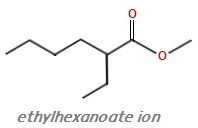
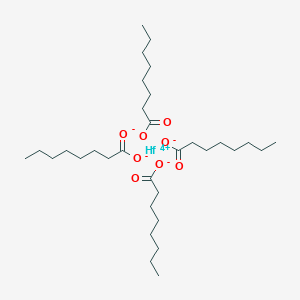
Hafnium 2 - Ethylhexanoate is a Hafnium source that is soluble in organic solvents as an organometallic compound (also known as metalorganic, organo-inorganic and metallo-organic compounds) as an organometallic compound (also known as metalorganic, organo-inorganic and metallo-organic compounds). Ethylhexanoates are carboxylates with many commercial applications They are commonly used in various catalysts for oxidation, hydrogenation and polymerization and as an adhesion promoter. It is generally immediately available in most volumes. Ultra high purity and high purity forms may be considered. Hafnium 2-Ethylhexanoate is one of numerous organo-metallic compounds (also known as metalorganic, organo-inorganic and metallo-organic compounds) sold by American Elements under the tradename AE Organo-Metallics™ for uses requiring non-aqueous solubility such as recent solar energy and water treatment applications. Similar results can sometimes also be achieved with Nanoparticles (also see Nanotechnology and Quantum Dots) and by thin film deposition. Note American Elements additionally supplies many materials as solutions. The numerous commercial applications for Silver include metallurgy, glass and glass polishing, ceramics, catalysts, and in phosphors. In steel manufacturing it is used to remove free oxygen and sulfur by forming stable oxysulfides and by tying up undesirable trace elements, such as lead and antimony. It is considered to be the most efficient glass polishing agent for precision optical polishing.American Elements produces to many standard grades when applicable, including Mil Spec (military grade); ACS, Reagent and Technical Grade; Food, Agricultural and Pharmaceutical Grade; Optical Grade, USP and EP/BP (European Pharmacopoeia/British Pharmacopoeia)and follows applicable ASTM testing standards.Typical and custom packaging is available. Additional technical, research and safety (MSDS) information is available as is a Reference Calculator for converting relevant units of measurement.
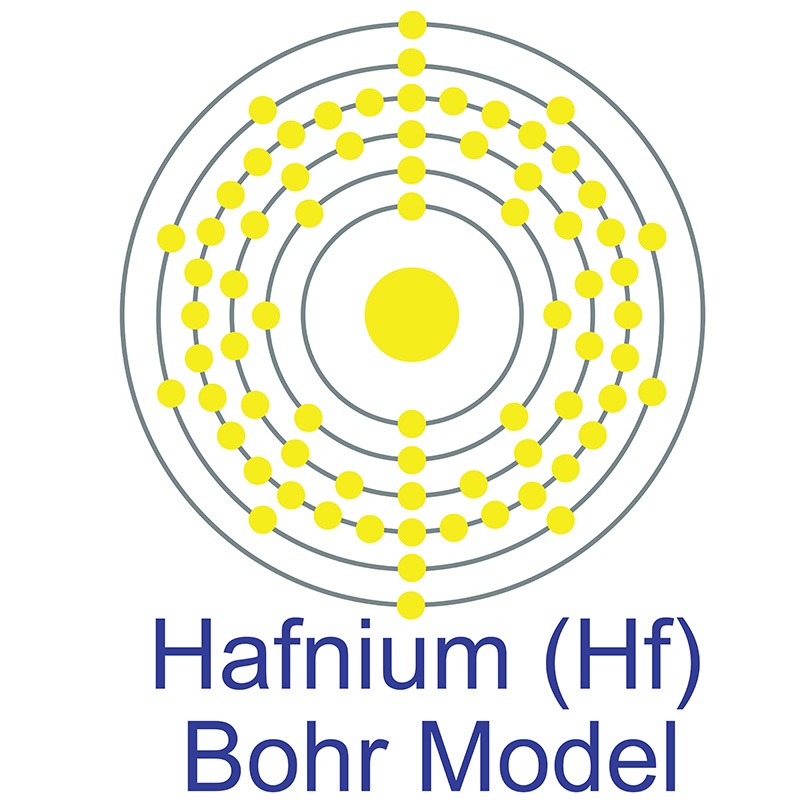
Hafnium is a Block D, Group 4, Period 6 element. The number of electrons in each of Hafnium's shells is 2, 8, 18, 32, 10, 2 and its electronic configuration is [Xe] 4f14 5d2 6s2. In its elemental form hafnium's CAS number is 7440-58-6.The hafnium atom has a radius of 156.4.pm and it's Van der Waals radius is 200.pm. Hafnium is not toxic. Hafnium is one of the Group IV transition elements that is refined from various zirconic mineral deposits. Hafnium is available as metal and compounds with purities from 99% to 99.999% (ACS grade to ultra-high purity); metals in the form of foil, sputtering target, and rod, and compounds as submicron and nanopowder. It's primary uses are due to its ability as a nuclear "getter" or absorber of neutrons. It is a primary component in nuclear control rods for this purpose. It also finds uses as a dopant in the alloy of steel and titanium. It is also used in the production of mantles for high intensity incandescent lamps. Hafnium is replacing polysilicon as the principle gate or electrode material in metaloxide semiconductor field effect transistors (MOSFETs) which are the basis for all modern semiconductors. As semiconductors have gotten smaller, the limiting factor in further size reduction has been the ability of the silicon oxide gate to perform below 10 angstroms where leakage occurs. Recent research has been devoted to the development of High-k materials which can function as a di-electric barrier or gate with lower leakage. Using hafnium based alloys as this di-electric gate has allowed for the development of MOSFET gates smaller than 10 angstroms. This allows for further size reduction, reduced switching power requirements and improved performance. Hafnium was first discovered by Dirk Coster in 1923. See Hafnium research below.
PACKAGING SPECIFICATIONS FOR BULK & RESEARCH QUANTITIES
Typical bulk packaging includes palletized plastic 5 gallon/25 kg. pails, fiber and steel drums to 1 ton super sacks in full container (FCL) or truck load (T/L) quantities. Research and sample quantities and hygroscopic, oxidizing or other air sensitive materials may be packaged under argon or vacuum. Shipping documentation includes a Certificate of Analysis and Material Safety Data Sheet (MSDS). Solutions are packaged in polypropylene, plastic or glass jars up to palletized 440 gallon liquid totes.
A younger age for ALH84001 and its geochemical link to shergottite sources in Mars.
Lapen TJ, Righter M, Brandon AD, Debaille V, Beard BL, Shafer JT, Peslier AH.
Science. 2010 Apr 16;328(5976):347-51.
PMID: 20395507 [PubMed]
Effect of deposition temperature on the characteristics of HfN(x) thin films prepared by plasma assisted cyclic chemical vapor deposition.
Kim EJ, Woo HG, Kim DH.
J Nanosci Nanotechnol. 2010 May;10(5):3463-6.
PMID: 20358979 [PubMed - in process]
Preparation and structures of enantiomeric dinuclear zirconium and hafnium complexes containing two homochiral N atoms, and their catalytic property for polymerization of rac-lactide.
Hu M, Wang M, Zhu H, Zhang L, Zhang H, Sun L.
Dalton Trans. 2010 May 14;39(18):4440-6. Epub 2010 Mar 31.
PMID: 20358041 [PubMed - in process]
Dielectric surface-controlled low-voltage organic transistors via n-alkyl phosphonic acid self-assembled monolayers on high-k metal oxide.
Acton BO, Ting GG, Shamberger PJ, Ohuchi FS, Ma H, Jen AK.
ACS Appl Mater Interfaces. 2010 Feb;2(2):511-20.
PMID: 20356199 [PubMed - in process]
In situ reaction mechanism studies on ozone-based atomic layer deposition of Al(2)O(3) and HfO(2).
Rose M, Niinistö J, Endler I, Bartha JW, Kücher P, Ritala M.
ACS Appl Mater Interfaces. 2010 Feb;2(2):347-50.
PMID: 20356179 [PubMed - in process]
Optical coatings in microscale channels by atomic layer deposition.
Gabriel NT, Talghader JJ.
Appl Opt. 2010 Mar 10;49(8):1242-8. doi: 10.1364/AO.49.001242.
PMID: 20220879 [PubMed - in process]
Improved reliability from a plasma-assisted metal-insulator-metal capacitor comprising a high-k HfO2 film on a flexible polyimide substrate.
Meena JS, Chu MC, Kuo SW, Chang FC, Ko FH.
Phys Chem Chem Phys. 2010 Mar 20;12(11):2582-9. Epub 2010 Jan 26.
PMID: 20200734 [PubMed - in process]
Synthesis and characterisation of ionic liquids based on 1-butyl-3-methylimidazolium chloride and MCl(4), M = Hf and Zr.
Campbell PS, Santini CC, Bouchu D, Fenet B, Rycerz L, Chauvin Y, Gaune-Escard M, Bessada C, Rollet AL.
Dalton Trans. 2010 Feb 7;39(5):1379-88. Epub 2009 Dec 1.
PMID: 20104366 [PubMed]
Thermal stability of precursors for atomic layer deposition of TiO2, ZrO2, and HfO2: an ab initio study of alpha-hydrogen abstraction in bis-cyclopentadienyl dimethyl complexes.
Zydor A, Elliott SD.
J Phys Chem A. 2010 Feb 4;114(4):1879-86.
PMID: 20055493 [PubMed]
Hafnium transistor process design for neural interfacing.
Parent DW, Basham EJ.
Conf Proc IEEE Eng Med Biol Soc. 2009;2009:5875-8.
PMID: 19964878 [PubMed - indexed for MEDLINE]
Effect of compositional variation on optical and structure properties of europium-doped SiO(2)-HfO(2) glasses.
Zhu C, Monteil A, Ei-Jouad M, Gaumer N, Chaussedent S.
Opt Lett. 2009 Dec 1;34(23):3749-51. doi: 10.1364/OL.34.003749.
PMID: 19953183 [PubMed]
Synthesis and characterization of hafnium oxide films for thermo and photoluminescence applications.
Mendoza JG, Frutis MA, Flores GA, Hipólito MG, Maciel Cerda A, Azorín Nieto J, Montalvo TR, Falcony C.
Appl Radiat Isot. 2010 Apr-May;68(4-5):696-9. Epub 2009 Sep 19.
PMID: 19828322 [PubMed - in process]
Zirconium and hafnium complexes of the thio(bisphenolato) ligand: synthesis, structural characterization and testing as 1-hexene polymerization catalysts.
Janas Z, Godbole D, Nerkowski T, Szczegot K.
Dalton Trans. 2009 Nov 7;(41):8846-53. Epub 2009 Aug 18.
PMID: 19826716 [PubMed]
Group 4 bis(chelate) metal complexes of monoanionic bidentate [E,O-] ligands (E = O, S): synthesis and application as alpha-olefin polymerization catalysts.
Lamberti M, Mazzeo M, Pellecchia C.
Dalton Trans. 2009 Nov 7;(41):8831-7. Epub 2009 Aug 24.
PMID: 19826714 [PubMed]
Zirconium and hafnium complexes supported by linked bis(beta-diketiminate) ligands: synthesis, characterization and catalytic application in ethylene polymerization.
Gong S, Ma H, Huang J.
Dalton Trans. 2009 Oct 21;(39):8237-47. Epub 2009 Aug 10.
PMID: 19789776 [PubMed]
Catalytic transamidation reactions compatible with tertiary amide metathesis under ambient conditions.
Stephenson NA, Zhu J, Gellman SH, Stahl SS.
J Am Chem Soc. 2009 Jul 29;131(29):10003-8.
PMID: 19621957 [PubMed - indexed for MEDLINE]
Synthesis and structure of dinuclear hafnium(IV) and zirconium(IV) complexes sandwiched between 2 mono-lacunary alpha-Keggin polyoxometalates.
Nomiya K, Saku Y, Yamada S, Takahashi W, Sekiya H, Shinohara A, Ishimaru M, Sakai Y.
Dalton Trans. 2009 Jul 28;(28):5504-11. Epub 2009 May 29.
PMID: 19587994 [PubMed]
Comparison of the synthesis of Ge nanocrystals in hafnium aluminum oxide and silicon oxide matrices.
Chew HG, Zheng F, Choi WK, Chim WK, Fitzgerald EA, Foo YL.
J Nanosci Nanotechnol. 2009 Feb;9(2):1577-81.
PMID: 19441574 [PubMed]
The controlled deposition of metal oxides onto carbon nanotubes by atomic layer deposition: examples and a case study on the application of V2O4 coated nanotubes in gas sensing.
Willinger MG, Neri G, Bonavita A, Micali G, Rauwel E, Herntrich T, Pinna N.
Phys Chem Chem Phys. 2009 May 21;11(19):3615-22. Epub 2009 Mar 30.
PMID: 19421470 [PubMed]
Atomic scale imaging and spectroscopy of individual electron trap states using force detected dynamic tunnelling.
Johnson JP, Zheng N, Williams CC.
Nanotechnology. 2009 Feb 4;20(5):055701. Epub 2009 Jan 12.
PMID: 19417360 [PubMed - indexed for MEDLINE]
Proud sponsors of Aeromat 2012. Please join us and our customers & co-sponsors Boeing and ATI on
June 18-20, 2012
in Charlotte, North Carolina