American Elements


Hafnium Phosphide Sputtering Target
High Purity HfP Sputtering Target
Product Product Code Order or Specifications
(2N) 99% Hafnium Phosphide Sputtering Target HF-P-02-ST Contact American Elements
(2N5) 99.5% Hafnium Phosphide Sputtering Target HF-P-025-ST Contact American Elements
(3N) 99.9% Hafnium Phosphide Sputtering Target HF-P-03-ST Contact American Elements
(3N5) 99.95% Hafnium Phosphide Sputtering Target HF-P-035-ST Contact American Elements
(4N) 99.99% Hafnium Phosphide Sputtering Target HF-P-04-ST Contact American Elements
(5N) 99.999% Hafnium Phosphide Sputtering Target HF-P-05-ST Contact American Elements


CHEMICAL
IDENTIFICATION
Formula CAS No. PubChem
SID
PubChem CID MDL No. EC No IUPAC Name Beilstein
Re. No.
SMILES
Identifier
InChI
Identifier
InChI
Key
HfP 12325-59-6 N/A N/A N/A 235-591-6 N/A N/A N/A N/A N/A

Compound Formula Mol. Wt. Appearance Density

Exact Mass

Monoisotopic Mass Charge MSDS
HfP 209.46 N/A 9.78 g/cm3 N/A N/A N/A Safety Data Sheet


Phosphide IonAmerican Elements produces to many standard grades when applicable, including Mil Spec (military grade); ACS, Reagent and Technical Grade; Food, Agricultural and Pharmaceutical Grade; Optical Grade, USP and EP/BP (European Pharmacopeia/British Pharmacopeia) and follows applicable ASTM testing standards.See safety data and research below and pricing/lead time above. American Elements specializes in producing high purity Hafnium Phosphide Sputtering Targets with the highest possible density High Purity (99.99%) Metallic Sputtering Targetand smallest possible average grain sizes for use in semiconductor, chemical vapor deposition (CVD) and physical vapor deposition (PVD) display and optical applications. Our standard Sputtering Targets for thin film are available monoblock or bonded with dimensions and configurations up to 820 mm with hole drill locations and threading, beveling, grooves and backing designed to work with both older sputtering devises as well as the latest process equipment, such as large area coating for solar energy or fuel cells and flip-chip applications. Research sized targets are also produced as well as custom sizes and alloys. All targets are analyzed using best demonstrated techniques including X-Ray Fluorescence (XRF), Glow Discharge Mass Spectrometry (GDMS), and Inductively Coupled Plasma (ICP). "Sputtering" allows for thin film deposition of an ultra high purity sputtering metallic or oxide material onto another solid substrate by the controlled removal and conversion of the target material into a directed gaseous/plasma phase through ionic bombardment. "Sputtering" allows for thin film deposition of an ultra high purity sputtering metallic or oxide material onto another solid substrate by the controlled removal and conversion of the target material into a directed gaseous/plasma phase through ionic bombardment. We can also provide targets outside this range in addition to just about any size rectangular, annular, or oval target. Materials are produced using crystallization, solid state and other ultra high purification processes such as sublimation. American Elements specializes in producing custom compositions for commercial and research applications and for new proprietary technologies. American Elements also casts any of the rare earth metals and most other advanced materials into rod, bar or plate form, as well as other machined shapes and through other processes nanoparticles. We also produce Hafnium as disc, granules, ingot, pellets, pieces, powder, and rod. Other shapes are available by request.

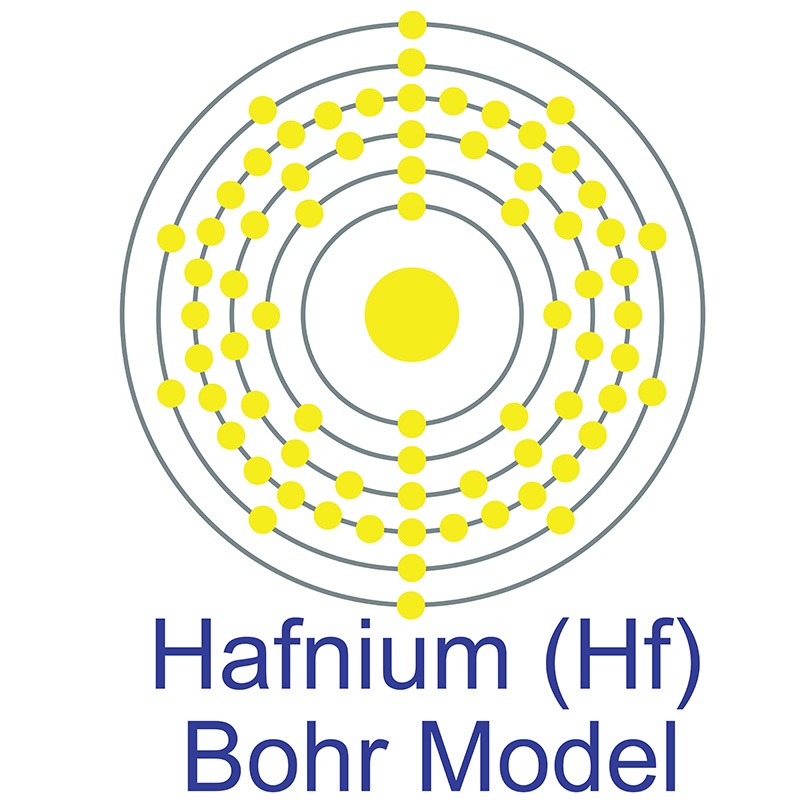
Hafnium(Hf) atomic and molecular weight, atomic number and elemental symbol Hafnium is a Block D, Group 4, Period 6 element. The number of electrons in each of Hafnium's shells is 2, 8, 18, 32, 10, 2 and its electronic configuration is [Xe] 4f14 5d2 6s2. In its elemental form hafnium's CAS number is 7440-58-6.The hafnium atom has a radius of 156.4.pm and it's Van der Waals radius is 200.pm. Hafnium is not toxic. Hafnium is one of the Group IV transition elements that is refined from various zirconic mineral deposits. Hafnium is available as metal and compounds with purities from 99% to 99.999% (ACS grade to ultra-high purity); metals in the form of foil, sputtering target, and rod, and compounds as submicron and nanopowder. It's primary uses are due to its ability as a nuclear "getter" or absorber of neutrons. It is a primary component in nuclear control rods for this purpose. It also finds uses as a dopant in the alloy of Elemental Hafniumsteel and Hafnium Bohr Modeltitanium. It is also used in the production of mantles for high intensity incandescent lamps. Hafnium is replacing polysilicon as the principle gate or electrode material in metal oxide semiconductor field effect transistors (MOSFETs) which are the basis for all modern semiconductors. As semiconductors have gotten smaller, the limiting factor in further size reduction has been the ability of the silicon oxide gate to perform below 10 angstroms where leakage occurs. Recent research has been devoted to the development of High-k materials which can function as a di-electric barrier or gate with lower leakage. Using hafnium based alloys as this di-electric gate has allowed for the development of MOSFET gates smaller than 10 angstroms. This allows for further size reduction, reduced switching power requirements and improved performance. Hafnium was first discovered by Dirk Coster in 1923. See Hafnium research below.

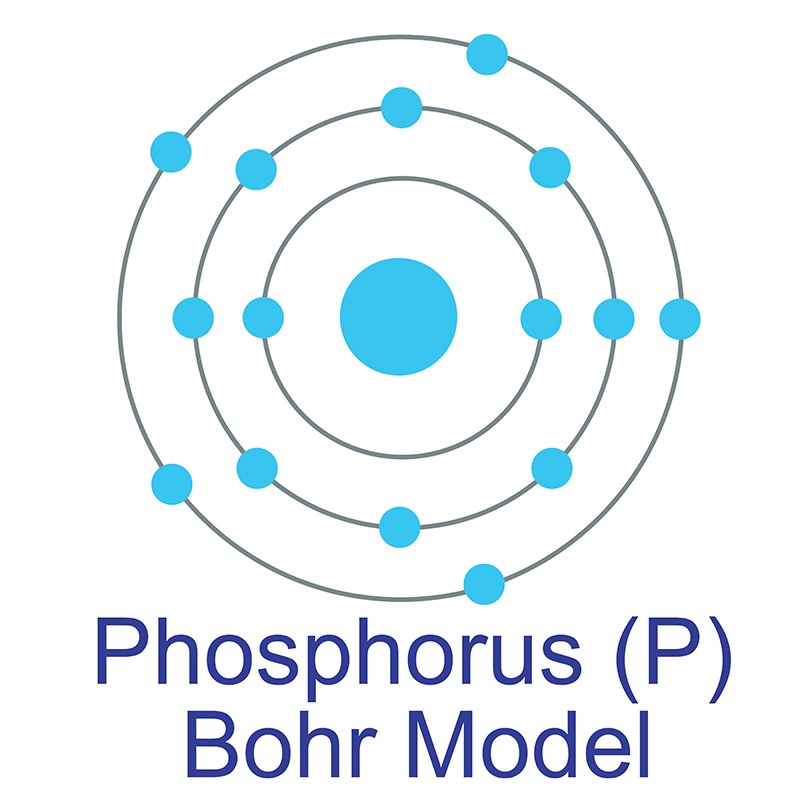
Phosphorus(P) atomic and molecular weight, atomic number and elemental symbolPhosphorus Bohr ModelPhosphorus is a Block P, Group 15, Period 3 element. The number of electrons in each of Phosphorus's shells is 2, 8, 5 and its electronic configuration is [Ne] 3s2 3p3. In its elemental form Phosphorus's CAS number is 7723-14-0. The Phosphorus atom has a radius of 110.5.pm and it's Van der Waals radius is 180.pm. Although white phosphorus is very toxic, red phosphorus is not considered toxic. Phosphorus information, including Technical Data, Safety Data and its High Purity properties, research, applications and other useful facts are discussed below. Scientific facts such as the atomic structure, ionization energy, abundance on Earth, conductivity and thermal properties are included.

Have a Question? Ask a Chemical Engineer or Material Scientist   Request an MSDS or Certificate of Analysis

 
Toxicity
Safety & Handling
 
Signal Word Hazard Statements Hazard Codes Risk Codes Safety Precautions RTECS No. Transport Information WGK Germany
N/A N/A N/A N/A N/A N/A N/A N/A

PACKAGING SPECIFICATIONS FOR BULK & RESEARCH QUANTITIES


Typical bulk packaging includes palletized plastic 5 gallon/25 kg. pails, fiber and steel drums to 1 ton super sacks in full container (FCL) or truck load (T/L) quantities. Research and sample quantities and hygroscopic, oxidizing or other air sensitive materials may be packaged under argon or vacuum. Shipping documentation includes a Certificate of Analysis and Material Safety Data Sheet (MSDS). Solutions are packaged in polypropylene, plastic or glass jars up to palletized 440 gallon liquid totes.


Show me more hafnium
 
Customers for this product have also looked at:
Hafnium Sputtering Target Hafnium Oxide Nanopowder Hafnium Wire Hafnium Oxide Hafnium Powder
Hafnium Acetate Solution Cobalt Hafnium Niobium Hafnium Acetylacetonate Tantalum Hafnium Carbide Hafnium Chloride
Hafnium Rod Hafnium Foil Hafnium Pellets Hafnium Metal Hafnium Oxide Pellets


Search by Material, Product Name, Product Code, CAS Number, Formula, Element, Anion, Form, EC Number, MDL Number or PubChem ID.


German   Korean   French   Japanese   Spanish   Chinese (Simplified)   Portuguese   Russian   Chinese (Taiwan)   Italian   Turkish   Polish   Dutch   Czech   Swedish   Hungarian   Danish   Hebrew

Production Catalog Available in 36 Countries & Languages

Recent Research & Development for Hafnium

  • N(2) Activation by a Hafnium Complex: A DFT Study on CO-Assisted Dinitrogen Cleavage and Functionalization. Zhang X, Butschke B, Schwarz H. Chemistry. 2010 Sep 28. [Epub ahead of print] PubMed PMID: 20878807.

  • Effective enrichment and mass spectrometry analysis of phosphopeptides using mesoporous metal oxide nanomaterials. Nelson CA, Szczech JR, Dooley CJ, Xu Q, Lawrence MJ, Zhu H, Jin S, Ge Y. Anal Chem. 2010 Sep 1;82(17):7193-201. PubMed PMID: 20704311; PubMed Central PMCID: PMC2936271.

  • Synthesis, characterization and biological study on Cr(3+), ZrO(2+), HfO(2+) and UO(2)(2+) complexes of oxalohydrazide and bis(3-hydroxyimino)butan-2-ylidene)-oxalohydrazide. El-Asmy AA, El-Gammal OA, Radwan HA. Spectrochim Acta A Mol Biomol Spectrosc. 2010 Sep 1;76(5):496-501. Epub 2010 Apr 21. PubMed PMID: 20451440.

  • Intramolecular sigma-bond metathesis/protonolysis on zirconium(IV) and hafnium(IV) pyridylamido olefin polymerization catalyst precursors: exploring unexpected reactivity paths. Luconi L, Giambastiani G, Rossin A, Bianchini C, Lledós A. Inorg Chem. 2010 Aug 2;49(15):6811-3. PubMed PMID: 20583749.

  • Guided-mode resonant wave plates. Magnusson R, Shokooh-Saremi M, Johnson EG. Opt Lett. 2010 Jul 15;35(14):2472-4. doi: 10.1364/OL.35.002472. PubMed PMID: 20634867.

  • Initiation of a passivated interface between hafnium oxide and In(Ga)As(0 0 1)-(4x2). Clemens JB, Bishop SR, Lee JS, Kummel AC, Droopad R. J Chem Phys. 2010 Jun 28;132(24):244701. PubMed PMID: 20590208.

  • Zirconium(IV)- and hafnium(IV)-catalyzed highly enantioselective epoxidation of homoallylic and bishomoallylic alcohols. Li Z, Yamamoto H. J Am Chem Soc. 2010 Jun 16;132(23):7878-80. PubMed PMID: 20481541; PubMed Central PMCID: PMC2886809.

  • Combined U-Pb and Lu-Hf isotope analyses by laser ablation MC-ICP-MS: methodology and applications. Matteini M, Dantas EL, Pimentel MM, Bühn B. An Acad Bras Cienc. 2010 Jun;82(2):479-91. PubMed PMID: 20563428.

  • Preparation and structures of enantiomeric dinuclear zirconium and hafnium complexes containing two homochiral N atoms, and their catalytic property for polymerization of rac-lactide. Hu M, Wang M, Zhu H, Zhang L, Zhang H, Sun L. Dalton Trans. 2010 May 14;39(18):4440-6. Epub 2010 Mar 31. PubMed PMID: 20358041.

  • Effect of deposition temperature on the characteristics of HfN(x) thin films prepared by plasma assisted cyclic chemical vapor deposition. Kim EJ, Woo HG, Kim DH. J Nanosci Nanotechnol. 2010 May;10(5):3463-6. PubMed PMID: 20358979.

  • A younger age for ALH84001 and its geochemical link to shergottite sources in Mars. Lapen TJ, Righter M, Brandon AD, Debaille V, Beard BL, Shafer JT, Peslier AH. Science. 2010 Apr 16;328(5976):347-51. PubMed PMID: 20395507.

  • Improved reliability from a plasma-assisted metal-insulator-metal capacitor comprising a high-k HfO2 film on a flexible polyimide substrate. Meena JS, Chu MC, Kuo SW, Chang FC, Ko FH. Phys Chem Chem Phys. 2010 Mar 20;12(11):2582-9. Epub 2010 Jan 26. PubMed PMID: 20200734.

  • Optical coatings in microscale channels by atomic layer deposition. Gabriel NT, Talghader JJ. Appl Opt. 2010 Mar 10;49(8):1242-8. doi: 10.1364/AO.49.001242. PubMed PMID: 20220879.

  • Effect of TiF4, ZrF4, HfF4 and AmF on erosion and erosion/abrasion of enamel and dentin in situ. Wiegand A, Hiestand B, Sener B, Magalhães AC, Roos M, Attin T. Arch Oral Biol. 2010 Mar;55(3):223-8. Epub 2010 Jan 18. PubMed PMID: 20083245.

  • Hydrolysis of bis(p-nitrophenyl)phosphate by tetravalent metal complexes with Klaui's oxygen tripodal ligand. Yi XY, Lam TC, Williams ID, Leung WH. Inorg Chem. 2010 Mar 1;49(5):2232-8. PubMed PMID: 20131806.

  • Synthesis of nested coaxial multiple-walled nanotubes by atomic layer deposition. Gu D, Baumgart H, Abdel-Fattah TM, Namkoong G. ACS Nano. 2010 Feb 23;4(2):753-8. Erratum in: ACS Nano. 2010 Jul 27;4(7):4331. PubMed PMID: 20085347.

  • Synthesis and characterisation of ionic liquids based on 1-butyl-3-methylimidazolium chloride and MCl(4), M = Hf and Zr. Campbell PS, Santini CC, Bouchu D, Fenet B, Rycerz L, Chauvin Y, Gaune-Escard M, Bessada C, Rollet AL. Dalton Trans. 2010 Feb 7;39(5):1379-88. Epub 2009 Dec 1. PubMed PMID: 20104366.

  • Dielectric surface-controlled low-voltage organic transistors via n-alkyl phosphonic acid self-assembled monolayers on high-k metal oxide. Acton BO, Ting GG, Shamberger PJ, Ohuchi FS, Ma H, Jen AK. ACS Appl Mater Interfaces. 2010 Feb;2(2):511-20. PubMed PMID: 20356199.

  • In situ reaction mechanism studies on ozone-based atomic layer deposition of Al(2)O(3) and HfO(2). Rose M, Niinistö J, Endler I, Bartha JW, Kücher P, Ritala M. ACS Appl Mater Interfaces. 2010 Feb;2(2):347-50. PubMed PMID: 20356179.

  • Is titanium tetrafluoride (TiF4) effective to prevent carious and erosive lesions? A review of the literature. Wiegand A, Magalhães AC, Attin T. Oral Health Prev Dent. 2010;8(2):159-64. Review. PubMed PMID: 20589250.

Recent Research & Development for Phosphorus

  • Consumption of whole grains is associated with improved diet quality and nutrient intake in children and adolescents: the National Health and Nutrition Examination Survey 1999-2004. O'Neil CE, Nicklas TA, Zanovec M, Cho SS, Kleinman R. Public Health Nutr. 2010 Oct 6:1-9. [Epub ahead of print] PubMed PMID: 20923597.

  • Chemical and microbiological changes during vermicomposting of coffee pulp using exotic (Eudrilus eugeniae) and native earthworm (Perionyx ceylanesis) species. Raphael K, Velmourougane K. Biodegradation. 2010 Oct 5. [Epub ahead of print] PubMed PMID: 20922463.

  • Synthesis, structure, and reductive elimination in the series Tp'Rh(PR(3))(Ar(F))H; Determination of rhodium-carbon bond energies of fluoroaryl substituents. Tanabe T, Brennessel WW, Clot E, Eisenstein O, Jones WD. Dalton Trans. 2010 Oct 5. [Epub ahead of print] PubMed PMID: 20924525.

  • Nutrient concentrations in Maryland non-tidal streams. Morgan RP 2nd, Kline KM. Environ Monit Assess. 2010 Oct 5. [Epub ahead of print] PubMed PMID: 20890788.

  • Hereditary disorders of renal phosphate wasting. Alizadeh Naderi AS, Reilly RF; Medscape. Nat Rev Nephrol. 2010 Oct 5. [Epub ahead of print] PubMed PMID: 20924400.

  • New Synthesis of 3-Trifluoromethylpyrroles by Condensation of Mesoionic 4-Trifluoroacetyl-1,3-oxazolium-5-olates with Phosphorus Ylides. Saijo R, Hagimoto Y, Kawase M. Org Lett. 2010 Oct 5. [Epub ahead of print] PubMed PMID: 20923166.

  • Structural and electronic properties of luminescent copper(i) halide complexes of bis[2-(diphenylphosphano)phenyl] ether (DPEphos). Crystal structure of [CuCl(DPEphos)(dmpymtH]. Aslanidis P, Cox PJ, Tsipis AC. Dalton Trans. 2010 Oct 4. [Epub ahead of print] PubMed PMID: 20922239.

  • Changes in Microbial Community Structure and Function of Drinking Water Treatment Bioreactors Upon Phosphorus Addition. Li X, Upadhyaya G, Yuen W, Brown J, Morgenroth E, Raskin L. Appl Environ Microbiol. 2010 Oct 1. [Epub ahead of print] PubMed PMID: 20889793.

  • Determination of a set of surrogate parameters to assess urban stormwater quality. Miguntanna NS, Egodawatta P, Kokot S, Goonetilleke A. Sci Total Environ. 2010 Oct 1. [Epub ahead of print] PubMed PMID: 20888615.

  • A review on the effects of environmental conditions on growth and toxin production of Ostreopsis ovata. Pistocchi R, Pezzolesi L, Guerrini F, Vanucci S, Dell'aversano C, Fattorusso E. Toxicon. 2010 Oct 1. [Epub ahead of print] PubMed PMID: 20920514.

  • Tenofovir-associated severe bone pain: I cannot walk! Jhaveri MA, Mawad HW, Thornton AC, Mullen NW, Greenberg RN. J Int Assoc Physicians AIDS Care (Chic Ill). 2010 Sep-Oct;9(5):328-34. PubMed PMID: 20923957.

  • Characteristics of contaminants in water and sediment of a constructed wetland treating piggery wastewater effluent. Lee S, Maniquiz MC, Kim LH. J Environ Sci (China). 2010;22(6):940-5. PubMed PMID: 20923110.

  • Effect of a seasonal diffuse pollution migration on natural organic matter behavior in a stratified dam reservoir. Yu SJ, Lee JY, Ha SR. J Environ Sci (China). 2010;22(6):908-14. PubMed PMID: 20923105.

  • Water-saving irrigation of paddy field to reduce nutrient runoff. Hitomi T, Iwamoto Y, Miura A, Hamada K, Takaki K, Shiratani E. J Environ Sci (China). 2010;22(6):885-91. PubMed PMID: 20923101.

  • Scenario analysis for reduction of pollutant load discharged from a watershed by recycling of treated water for irrigation. Shiratani E, Munakata Y, Yoshinaga I, Kubota T, Hamada K, Hitomi T. J Environ Sci (China). 2010;22(6):878-84. PubMed PMID: 20923100.

  • Modeling the effects of constructed wetland on nonpoint source pollution control and reservoir water quality improvement. Ham J, Yoon CG, Kim HJ, Kim HC. J Environ Sci (China). 2010;22(6):834-9. PubMed PMID: 20923093.

  • Evaluation of non-point source pollution reduction by applying best management practices using a SWAT model and QuickBird high resolution satellite imagery. Lee M, Park G, Park M, Park J, Lee J, Kim S. J Environ Sci (China). 2010;22(6):826-33. PubMed PMID: 20923092.

  • Understanding nutrient build-up on urban road surfaces. Miguntanna NP, Goonetilleke A, Egodowatta P, Kokot S. J Environ Sci (China). 2010;22(6):806-12. PubMed PMID: 20923089.

  • Monitoring of non-point source pollutants load from a mixed forest land use. Yoon SW, Chung SW, Oh DG, Lee JW. J Environ Sci (China). 2010;22(6):801-5. PubMed PMID: 20923088.

  • [Primary hyperparathyroidism: Postoperative long-term evolution.]. Spivacow FR, Martínez C, Polonsky A. Medicina (B Aires). 2010;70(5):408-14. Spanish. PubMed PMID: 20920956.


Aeromat 2012 Sponsor
Proud sponsors of Aeromat 2012. Please join us and our customers & co-sponsors Boeing and ATI on June 18-20, 2012
in Charlotte, North Carolina

PRODUCT CATALOG News Foil Submicron & Nanopowder Tolling Ultra High Purity Sputtering Target Crystal Growth Rod, Plate, Powder, etc. Home

  Print this Page
Periodic table of the elements science and academic information, elements and advanced materials data, scientific presentations and all pages, designs, concepts, logos, and color schemes herein are the copyrighted proprietary rights and intellectual property of American Elements. American Elements is a U.S. Registered Trademark. © 1998-2012. American Elements. All rights reserved.
Learn Six Sigma


American Elements is a copyrighted U.S. Trademark. All rights reserved.