American Elements Logo and U.S. Registered Trademark

Molybdenum 94 Trioxide Isotope

94MoO3

Product
Product Code
Order or Specifications
Molybdenum 94 Trioxide
MO-OX-94-ISO
Contact American Elements
Molybdenum 94 Trioxide (Molybdenum-94) is a stable (non-radioactive) isotope of Molybdenum. See below table for ENSDF Citation and Half Life. It is both naturally occurring and produced by fission. Molybdenum 94 Trioxide is one of over 250 stable isotopes produced by American Elements for biological and biomedical labeling, as target materials and other applications. Molybdenum Trioxide is also available in ultra high purity and as nanoparticles. For thin film applications it is available as rod, pellets, pieces, granules and sputtering targets and as either an ingot or powder. Molybdenum Trioxide 94 isotopic material is generally immediately available. Additional technical, research and safety (MSDS) information is available as is a Reference Calculator for converting relevant units of measurement.

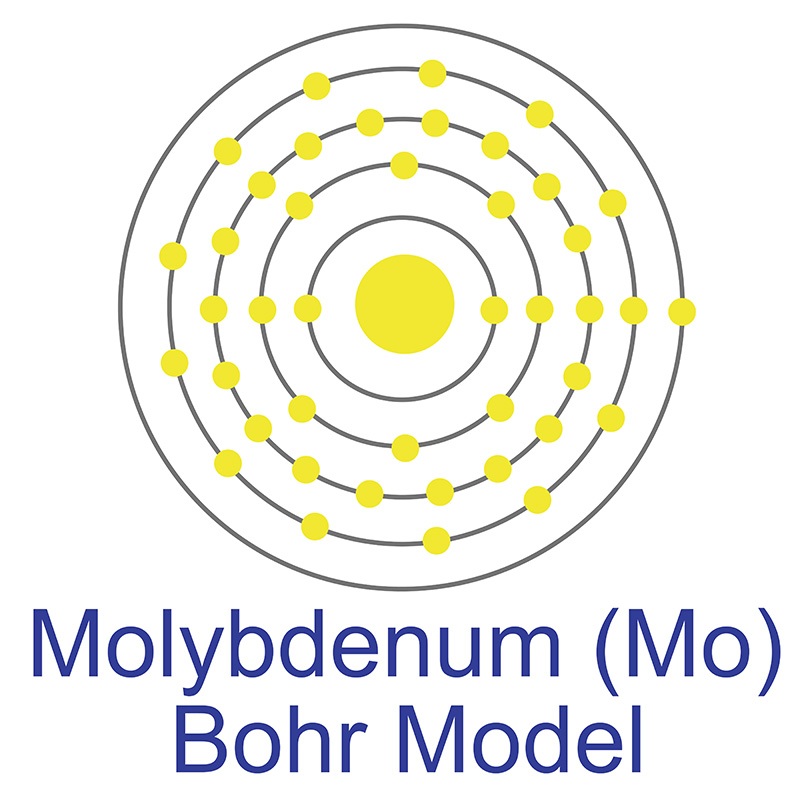
Molybdenum is a Block D, Group 6, Period 5 element. The electronic configuration is [Kr] 4d5 5s1. In its elemental form molybdenum's CAS number is 7439-98-7. The molybdenum atom has a radius of 136.3.pm and it's Van der Waals radius is 200.pm. Molybdenum has the third highest melting point of any element, exceeded only by tungsten and tantalum. Molybdenum is a catalyst in the oil refining. It has many other applications, including in catalysts, pigments, corrosion inhibitors and lubricants. It has a very high elastic modulus. Molybdenum is available as metal and compounds with purities from 99% to 99.999% (ACS grade to ultra-high purity); metals in the form of foil, sputtering target, and rod, and compounds as submicron and nanopowder. It is used in steel alloys to add hardness and raise melting points. It is a component in Hastelloys brand steel. Molybdenum is used in nuclear reactors and aerospace components.

Formula N ENSDF Citation Half Life Jp Sn (keV) Sp (keV) Abundance
94MoO3              
ISOTOPES Submicron & Nanopowder Tolling Ultra High Purity Sputtering Target Crystal Growth Rod, Plate, Powder, etc.
German   Korean   French   Japanese   Spanish   Chinese (Simplified)   Portuguese   Russian   Chinese (Taiwan)   Italian   Turkish   Polish   Dutch   Czech   Swedish   Hungarian   Danish   Hebrew

Production Catalog Available in 32 Countries
 
Periodic table of the elements science and academic information, elements and advanced materials data, scientific presentations and all pages, designs, concepts, logos, and color schemes herein are the copyrighted proprietary rights and intellectual property of American Elements. American Elements is a U.S. Registered Trademark. © 2001-2009. American Elements. All rights reserved.


Recent Research & Development for Molybdenum

  • Atomic-Scale Analysis on the Role of Molybdenum in Iron-Catalyzed Carbon Nanotube Growth. Yoshida H, Shimizu T, Uchiyama T, Kohno H, Homma Y, Takeda S. Nano Lett. 2009 Sep 4. [Epub ahead of print] PMID: 19731921 [PubMed - as supplied by publisher]

  • Plasma Levels of Trace Elements Have an Implication on Interferon Treatment of Children with Chronic Hepatitis B Infection. Balamtekin N, Kurekci AE, Atay A, Kalman S, Okutan V, Gokcay E, Aydin A, Sener K, Safali M, Ozcan O. Biol Trace Elem Res. 2009 Sep 2. [Epub ahead of print] PMID: 19727570 [PubMed - as supplied by publisher]

  • Determination of X-ray mass attenuation coefficients using HPGe detector. Sharanabasappa, Kerur BR, Anilkumar S, Hanumaiah B. Appl Radiat Isot. 2009 Aug 19. [Epub ahead of print] PMID: 19726203 [PubMed - as supplied by publisher]

  • L: -Ribose from L: -arabinose by epimerization and its purification by 3-zone simulated moving bed chromatography. Jeon YJ, Park MB, Kim IH. Bioprocess Biosyst Eng. 2009 Aug 28. [Epub ahead of print] PMID: 19714365 [PubMed - as supplied by publisher]

  • An allelic mutant series of ATM3 reveals its key role in the biogenesis of cytosolic iron-sulfur proteins in Arabidopsis. Bernard DG, Cheng Y, Zhao Y, Balk J. Plant Physiol. 2009 Aug 26. [Epub ahead of print] PMID: 19710232 [PubMed - as supplied by publisher]

  • Macroion clustering in solutions and suspensions: the roles of microions and solvent. Schmitz KS. J Phys Chem B. 2009 Mar 5;113(9):2624-38. PMID: 19708104 [PubMed - in process]

  • Molybdenum(0)-Promoted Carbonylative Cyclization of o-Haloaryl- and beta-Haloalkenylimine Derivatives by Oxidative Addition of a Carbon(sp(2))--Halogen Bond: Preparation of Two Types of gamma-Lactams. Takaya J, Sangu K, Iwasawa N. Angew Chem Int Ed Engl. 2009 Sep 7;48(38):7090-7093. No abstract available. PMID: 19705391 [PubMed - as supplied by publisher]

  • Catalytic epoxidation of a technical mixture of methyl oleate and methyl linoleate in ionic liquids using MoO(O2)2.2QOH (QOH = 8-quinilinol) as catalyst and NaHCO3 as co-catalyst. Cai SF, Wang LS, Fan CL. Molecules. 2009 Aug 10;14(8):2935-46. PMID: 19701136 [PubMed - in process]

  • Isolation and characterization of a new Cu-Fe protein from Desulfovibrio aminophilus DSM12254. Rivas MG, Mota CS, Pauleta SR, Carepo MS, Folgosa F, Andrade SL, Fauque G, Pereira AS, Tavares P, Calvete JJ, Moura I, Moura JJ. J Inorg Biochem. 2009 May 7. [Epub ahead of print] PMID: 19699535 [PubMed - as supplied by publisher]

  • Sequential Construction of One, Two, or Three Dithiolene Ligands from Alkynes and Sulfur in Dinuclear Cyclopentadienyl Molybdenum Complexes. Adams H, Bancroft MN, Morris MJ, Riddiough AE. Inorg Chem. 2009 Aug 21. [Epub ahead of print] PMID: 19697947 [PubMed - as supplied by publisher]

  • Use of a high electron-affinity molybdenum dithiolene complex to p-dope hole-transport layers. Qi Y, Sajoto T, Barlow S, Kim EG, Brédas JL, Marder SR, Kahn A. J Am Chem Soc. 2009 Sep 9;131(35):12530-1. PMID: 19678703 [PubMed - in process]

  • Molybdenum cofactors, enzymes and pathways. Schwarz G, Mendel RR, Ribbe MW. Nature. 2009 Aug 13;460(7257):839-47. PMID: 19675644 [PubMed - in process]

  • Synthesis, characterization and structure of a low coordinate desoxomolybdenum cluster stabilized by a dithione ligand. Perera E, Basu P. Dalton Trans. 2009 Jul 7;(25):5023-8. Epub 2009 May 27. PMID: 19662295 [PubMed - in process]

  • Nucleation and growth mechanism for flame synthesis of MoO2 hollow microchannels with nanometer wall thickness. Merchan-Merchan W, Saveliev AV, Taylor AM. Micron. 2009 Dec;40(8):821-6. Epub 2009 Jul 25. PMID: 19660960 [PubMed - in process]

  • Structures of Mo(x)W(3-x)O(6) (x = 0-3) anion and neutral clusters determined by anion photoelectron spectroscopy and density functional theory calculations. Rothgeb DW, Hossain E, Kuo AT, Troyer JL, Jarrold CC. J Chem Phys. 2009 Jul 28;131(4):044310. PMID: 19655870 [PubMed - in process]

  • Synthesis, electronic and crystal structures, and physical studies of the superconductor Cs(~1)Mo12S14, final step of the condensation of the Mo6L8(i)L6(a) unit. Gougeon P, Salloum D, Cuny J, Le Pollès L, Le Floch M, Gautier R, Potel M. Inorg Chem. 2009 Sep 7;48(17):8337-41. PMID: 19645498 [PubMed - in process]

  • Nutrient composition of plants consumed by black and white ruffed lemurs, Varecia variegata, in the Betampona Natural Reserve, Madagascar. Schmidt DA, Iambana RB, Britt A, Junge RE, Welch CR, Porton IJ, Kerley MS. Zoo Biol. 2009 Jul 30. [Epub ahead of print] PMID: 19645044 [PubMed - as supplied by publisher]

  • Molybdenum supplies and nuclear medicine services. Perkins AC, Vivian G. Nucl Med Commun. 2009 Sep;30(9):657-9. No abstract available. PMID: 19644241 [PubMed - in process]

  • Reactivity of neutral Mo(S2C6H4)3 in aqueous media: an alternative functional model of sulfite oxidase. Pérez Pla F, Cervilla A, Piles M, Llopis E. Inorg Chem. 2009 Sep 7;48(17):8559-68. PMID: 19642629 [PubMed - in process]

  • Molybdenum triamidoamine systems. Reactions involving dihydrogen relevant to catalytic reduction of dinitrogen. Hetterscheid DG, Hanna BS, Schrock RR. Inorg Chem. 2009 Sep 7;48(17):8569-77. PMID: 19639973 [PubMed - in process]


American Elements Products can also be sourced at these sites:


electronics-ee.com