SECTION 1. IDENTIFICATION
Product Name: Molybdenum Telluride Sputtering Target
Product Number: All applicable American Elements product codes, e.g. MO-TE-02-ST
, MO-TE-025-ST
, MO-TE-03-ST
, MO-TE-035-ST
, MO-TE-04-ST
, MO-TE-05-ST
CAS #: 12058-20-7
Relevant identified uses of the substance: Scientific research and development
Supplier details:
American Elements
10884 Weyburn Ave.
Los Angeles, CA 90024
Tel: +1 310-208-0551
Fax: +1 310-208-0351
Emergency telephone number:
Domestic, North America: +1 800-424-9300
International: +1 703-527-3887
SECTION 2. HAZARDS IDENTIFICATION
Classification of the substance or mixture
Classification according to Regulation (EC) No 1272/2008
GHS07
Acute Tox. 4 H302 Harmful if swallowed.
Acute Tox. 4 H312 Harmful in contact with skin.
Acute Tox. 4 H332 Harmful if inhaled.
Classification according to Directive 67/548/EEC or Directive 1999/45/EC
Xn; Harmful
R20/21/22: Harmful by inhalation, in contact with skin and if swallowed.
N; Dangerous for the environment
R50/53: Very toxic to aquatic organisms, may cause long-term adverse effects in the aquatic environment.
Information concerning particular hazards for human and environment:
N/A
Hazards not otherwise classified
No data available
Label elements
Labelling according to Regulation (EC) No 1272/2008
The substance is classified and labeled according to the CLP regulation.
Hazard pictogram

GHS07
Signal word
Warning
Hazard statements
H302+H312+H332 Harmful if swallowed, in contact with skin or if inhaled.
Precautionary statements
P261 Avoid breathing dust/fume/gas/mist/vapors/spray.
P280 Wear protective gloves/protective clothing/eye protection/face protection.
P304+P340 IF INHALED: Remove person to fresh air and keep comfortable for breathing.
P301+P312 IF SWALLOWED: Call a POISON CENTER/doctor/.../if you feel unwell.
P312 Call a POISON CENTER/doctor/.../if you feel unwell.
P501 Dispose of contents/container in accordance with local/regional/
national/international regulations.
WHMIS classification
D2A - Very toxic material causing other toxic effects
Classification system
HMIS ratings (scale 0-4)
(Hazardous Materials Identification System)
HEALTH
FIRE
REACTIVITY
2
0
1
Health (acute effects) = 2
Flammability = 0
Physical Hazard = 1
Other hazards
Results of PBT and vPvB assessment
PBT:
N/A
vPvB:
N/A
SECTION 3. COMPOSITION/INFORMATION ON INGREDIENTS
MOLYBDENUM TELLURIDE
Cas Number: 12058-20-7
SECTION 4. FIRST AID MEASURES
General advice: In the case of accident or if you feel unwell, seek medical advice immediately (show the label where possible).
Inhalation: Move to fresh air. Call a physician immediately.
Skin contact: Rinse immediately with plenty of water and seek medical advice
Ingestion: Do not induce vomiting without medical advice.
Eye contact: In the case of contact with eyes, rinse immediately with plenty of water and seek medical advice.
Protection of first-aiders: No data available
Medical conditions aggravated by exposure: None known
SECTION 5. FIREFIGHTING MEASURES
Suitable extinguishing media:
Use dry chemical, CO2, water spray or "alcohol" foam
Specific hazards:
Burning produces irritant fumes.
Unusual hazards:
None known
Special protective equipment for firefighters:
As in any fire, wear self-contained breathing apparatus pressure-demand, MSHA/NIOSH (approved or equivalent) and full protective gear
Specific methods:
Water mist may be used to cool closed containers.
Flash point:
No data available
Autoignition temperature:
No data available
NFPA rating:
NFPA Health: 4
NFPA Flammability: 0
NFPA Reactivity: 0
SECTION 6. ACCIDENTAL RELEASE MEASURES
Personal precautions:
Use personal protective equipment.
Environmental precautions:
Prevent product from entering drains.
Methods for cleaning up:
Sweep up and shovel into suitable containers for disposal.
SECTION 7. HANDLING AND STORAGE
Storage:
ROOM TEMPERATURE
Handling:
Use only in area provided with appropriate exhaust ventilation.
Safe handling advice:
Wear personal protective equipment.
Incompatible products:
Oxidising and spontaneously flammable products
SECTION 8. EXPOSURE CONTROLS/PERSONAL PROTECTION
Engineering measures:
Ensure adequate ventilation.
PERSONAL PROTECTIVE EQUIPMENT
Respiratory protection:
Breathing apparatus only if aerosol or dust is formed.
Hand protection:
Pvc or other plastic material gloves
Skin and body protection:
Usual safety precautions while handling the product will provide adequate protection against
this potential effect.
Eye protection:
Safety glasses with side-shields
Hygiene measures:
Handle in accordance with good industrial hygiene and safety practice.
SECTION 9. PHYSICAL AND CHEMICAL PROPERTIES
Physical state: Solid
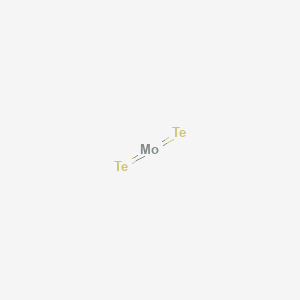
Formula: MoTe2
Molecular weight: 351.14
Melting point/range: No data available at this time.
Boiling point/range: No Data available at this time.
Density: No data available
Vapor pressure: No data available
Evaporation rate: No data available
Vapor density: No data available
Solubility (in water): No data available
Flash point: No data available
Autoignition temperature: No data available
SECTION 10. STABILITY AND REACTIVITY
Stability:
Stable under recommended storage conditions.
Polymerization:
None under normal processing.
Hazardous decomposition products:
Tellurium (Te)
Materials to avoid:
Hazards vary depending upon specific compound. (as Te)
Conditions to avoid:
Exposure to air or moisture over prolonged periods.
SECTION 11. TOXICOLOGICAL INFORMATION
Product Information
Acute toxicity
Components
RTECS Number: Selected LD50s and LC50s
MOLYBDENUM TELLURIDE
Not Available Inhalation LC50 Rat : >2420 mg/m3/4H
Oral LD50 Rat : >5 gm/kg
Oral LD50 Mouse : >5 gm/kg
Chronic toxicity:
Chronic exposure may cause nausea and vomiting, higher exposure causes unconsciousness.
Local effects:
Symptoms of overexposure may be headache, dizziness, tiredness, nausea and
vomiting.
Specific effects:
May include moderate to severe erythema (redness) and moderate edema (raised skin), nausea, vomiting, headache.
Primary irritation:
No data is available on the product itself.
Carcinogenic effects:
No data is available on the product itself.
Mutagenic effects:
No data is available on the product itself.
Reproductive toxicity:
No data is available on the product itself.
Components
NIOSH - Health Effects
MOLYBDENUM TELLURIDE
Malaise; CNS and red blood cell effects in animals
NIOSH - Target Organs
skin, CNS, blood
SECTION 12. ECOLOGICAL INFORMATION
Toxicity
Aquatic toxicity:
No data available
Persistence and degradability
No data available
Bioaccumulative potential
No data available
Mobility in soil
No data available
Ecotoxical effects:
Remark:
Very toxic for aquatic organisms
Additional ecological information:
Do not allow material to be released to the environment without official permits.
Do not allow product to reach groundwater, water courses, or sewage systems, even in small quantities.
Danger to drinking water if even extremely small quantities leak into the ground.
Also poisonous for fish and plankton in water bodies.
May cause long lasting harmful effects to aquatic life.
Avoid transfer into the environment.
Very toxic for aquatic organisms
Results of PBT and vPvB assessment
PBT:
N/A
vPvB:
N/A
Other adverse effects
No data available
SECTION 13. DISPOSAL CONSIDERATIONS
Waste treatment methods
Recommendation
Consult official regulations to ensure proper disposal.
Uncleaned packagings:
Recommendation:
Disposal must be made according to official regulations.
SECTION 14. EXPOSURE CONTROLS/PERSONAL PROTECTION
UN-Number
DOT, IMDG, IATA
UN3077
UN proper shipping name
DOT
Environmentally hazardous substances, solid, n.o.s. (Molybdenum telluride)
IMDG, IATA
ENVIRONMENTALLY HAZARDOUS SUBSTANCE, SOLID, N.O.S. (Molybdenum telluride)
Transport hazard class(es)
DOT, IMDG
Class
9 Miscellaneous dangerous substances and articles.
Label
9
Class
9 (M7) Miscellaneous dangerous substances and articles
Label
9
IATA
Class
9 Miscellaneous dangerous substances and articles.
Label
9
Packing group
DOT, IMDG, IATA
III
Environmental hazards: Special marking (ADR):
Symbol (fish and tree)
Special marking (IATA):
Symbol (fish and tree)
Special precautions for user
Warning: Miscellaneous dangerous substances and articles
Transport in bulk according to Annex II of MARPOL73/78 and the IBC Code
N/A
Transport/Additional information: DOT
Marine Pollutant (DOT): No
UN "Model Regulation":
UN3077, Environmentally hazardous substances, solid, n.o.s. (Molybdenum telluride),
9, III
SECTION 15. REGULATORY INFORMATION
Safety, health and environmental regulations/legislation specific for the substance or mixture
National regulations
All components of this product are listed in the U.S. Environmental Protection Agency Toxic Substances Control Act Chemical substance Inventory.
All components of this product are listed on the Canadian Non-Domestic Substances List (NDSL).
SARA Section 313 (specific toxic chemical listings)
Substance is not listed.
California Proposition 65
Prop 65 - Chemicals known to cause cancer
Substance is not listed.
Prop 65 - Developmental toxicity
Substance is not listed.
Prop 65 - Developmental toxicity, female
Substance is not listed.
Prop 65 - Developmental toxicity, male
Substance is not listed.
Information about limitation of use:
For use only by technically qualified individuals.
Other regulations, limitations and prohibitive regulations
Substance of Very High Concern (SVHC) according to the REACH Regulations (EC) No. 1907/2006.
Substance is not listed.
The conditions of restrictions according to Article 67 and Annex XVII of the Regulation (EC) No 1907/2006 (REACH) for the manufacturing, placing on the market and use must be observed.
Substance is not listed.
Annex XIV of the REACH Regulations (requiring Authorisation for use)
Substance is not listed.
REACH - Pre-registered substances
Substance is listed.
Chemical safety assessment:
A Chemical Safety Assessment has not been carried out.
SECTION 16. OTHER INFORMATION
Safety Data Sheet according to Regulation (EC) No. 1907/2006 (REACH). The above information is believed to be correct but does not purport to be all inclusive and shall be used only as a guide. The information in this document is based on the present state of our knowledge and is applicable to the product with regard to appropriate safety precautions. It does not represent any guarantee of the properties of the product. American Elements shall not be held liable for any damage resulting from handling or from contact with the above product. See reverse side of invoice or packing slip for additional terms and conditions of sale. COPYRIGHT 1997-2022 AMERICAN ELEMENTS. LICENSED GRANTED TO MAKE UNLIMITED PAPER COPIES FOR INTERNAL USE ONLY.

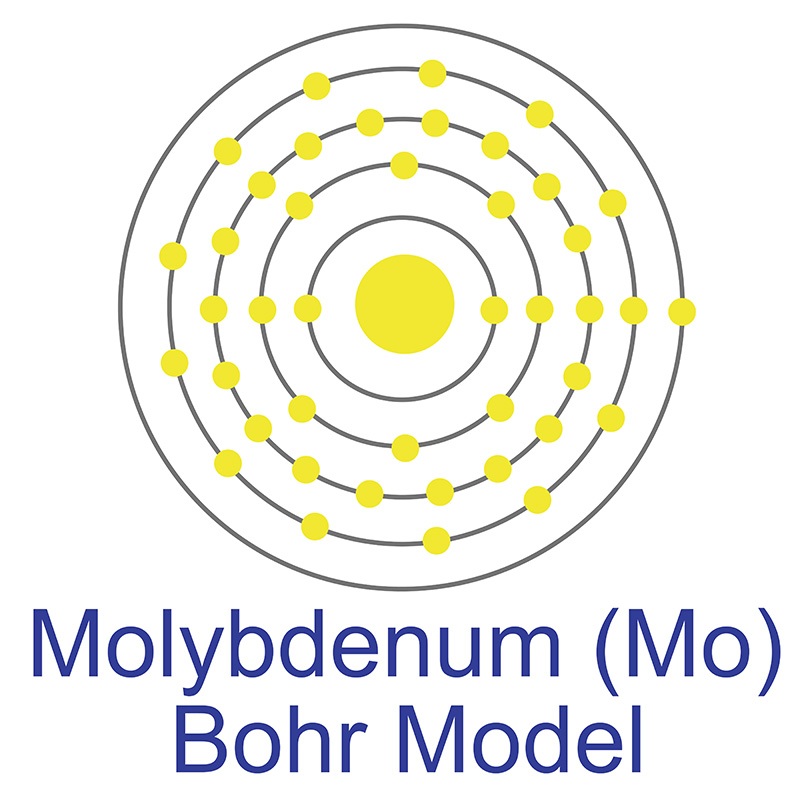 The number of electrons in each of molybdenum's shells is [2, 8, 18, 13, 1] and its electron configuration is [Kr] 4d5 5s1. The molybdenum atom has a radius of 139 pm and a Van der Waals radius of 209 pm. In its elemental form, molybdenum has a gray metallic appearance. Molybdenum was discovered by Carl Wilhelm in 1778 and first isolated by Peter Jacob Hjelm in 1781. Molybdenum is the 54th most abundant element in the earth's crust.
  It has the third highest melting point of any element, exceeded only by tungsten and tantalum. Molybdenum does not occur naturally as a free metal, it is found in various oxidation states in minerals. The primary commercial source of molybdenum is molybdenite, although it is also recovered as a byproduct of copper and tungsten mining. The origin of the name Molybdenum comes from the Greek word molubdos meaning lead.
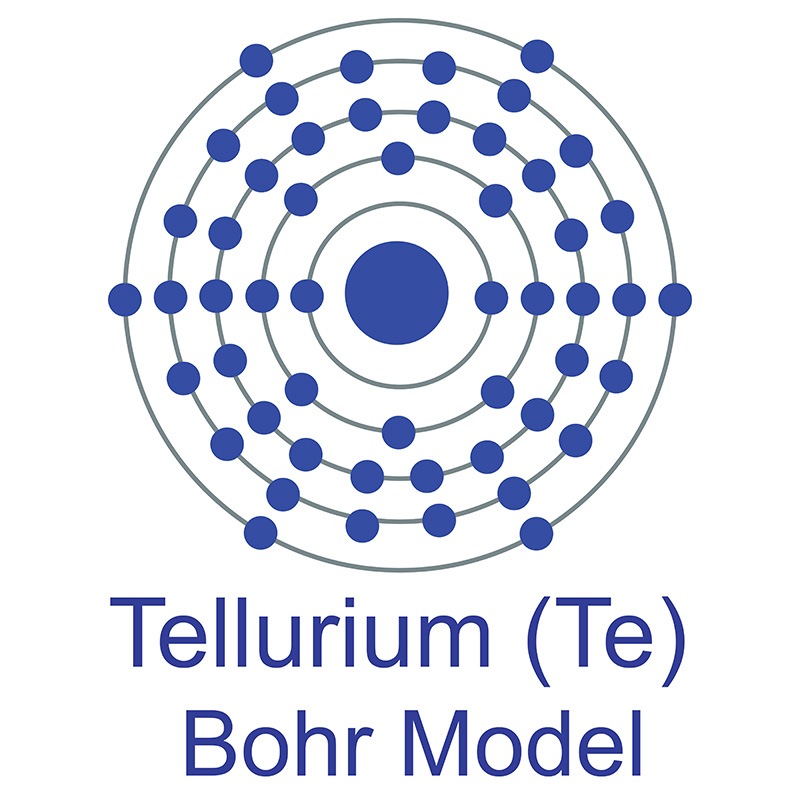 The number of electrons in each of tellurium's shells is 2, 8, 18, 18, 6 and its electron configuration is [Kr] 4d10 5s2 5p4. Tellurium was discovered by Franz Muller von Reichenstein in 1782 and first isolated by Martin Heinrich Klaproth in 1798. In its elemental form, tellurium has a silvery lustrous gray appearance. The tellurium atom has a radius of 140 pm and a Van der Waals radius of 206 pm.
  Tellurium is most commonly sourced from the anode sludges produced as a byproduct of copper refining. The name Tellurium originates from the Greek word Tellus, meaning Earth.