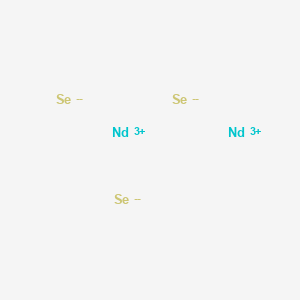
American Elements produces to many standard grades when applicable, including Mil Spec (military grade); ACS, Reagent and Technical Grade; Food, Agricultural and Pharmaceutical Grade; Optical Grade, USP and EP/BP (European Pharmacopeia/British Pharmacopeia) and follows applicable ASTM testing standards.See safety data and research below and pricing/lead time above. American Elements specializes in producing high purity Neodymium Selenide Sputtering targets with the highest possible density and smallest possible average grain sizes for use in semiconductor, chemical vapor deposition (CVD) and physical vapor deposition (PVD) display and optical applications. Our standard Sputtering Targets for thin film are available monoblock or bonded with dimensions and configurations up to 820 mm with hole drill locations and threading, beveling, grooves and backing designed to work with both older sputtering devises as well as the latest process equipment, such as large area coating for solar energy or fuel cells and flip-chip applications. Research sized targets are also produced as well as custom sizes and alloys. All targets are analyzed using best demonstrated techniques including X-Ray Fluorescence (XRF), Glow Discharge Mass Spectrometry (GDMS), and Inductively Coupled Plasma (ICP). "Sputtering" allows for thin film deposition of an ultra high purity sputtering metallic or oxide material onto another solid substrate by the controlled removal and conversion of the target material into a directed gaseous/plasma phase through ionic bombardment. "Sputtering" allows for thin film deposition of an ultra high purity sputtering metallic or oxide material onto another solid substrate by the controlled removal and conversion of the target material into a directed gaseous/plasma phase through ionic bombardment. We can also provide targets outside this range in addition to just about any size rectangular, annular, or oval target. Materials are produced using crystallization, solid state and other ultra high purification processes such as sublimation. American Elements specializes in producing custom compositions for commercial and research applications and for new proprietary technologies. American Elements also casts any of the rare earth metals and most other advanced materials into rod, bar or plate form, as well as other machined shapes and through other processes nanoparticles. We also produce Neodymium as disc, granules, ingot, pellets, pieces, powder, and rod. Other shapes are available by request.
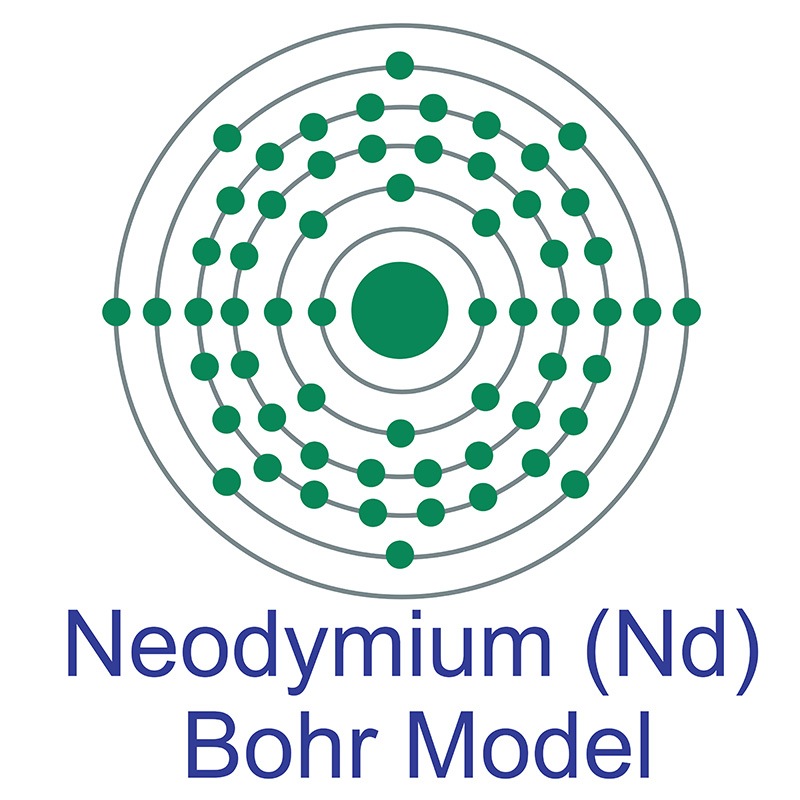
Neodymium is a Block F, Group 3, Period 6 element. The number of electrons in each of Neodymium's shells is 2, 8, 18, 22, 8, 2 and its electronic configuration is [Xe] 4f4 6s2. In its elemental form neodymium's CAS number is 7440-00-8. The neodymium atom has a radius of 181.4.pm and it's Van der Waals radius is 181.pm. Neodymium is the most abundant of the rare earths after cerium and lanthanum. Neodymium is available as metal and compounds with purities from 99% to 99.999% (ACS grade to ultra-high purity); metals in the form of foil, sputtering target, and rod, and compounds as submicron and nanopowder. Primary applications include lasers, glass coloring and tinting, dielectrics and, most importantly, as the fundamental basis for neodymium-iron-boron permanent magnets. Neodymium has a strong absorption band centered at 580 nm, which is very close to the human eye's maximum level of sensitivity making it useful in protective lenses for welding goggles. It is also used in CRT displays to enhance contrast between reds and greens and highly valued in glass manufacturing for its attractive purple coloring. Neodymium is included in many formulations of barium titanate, used as dielectric coatings and in multi-layer capacitors essential to electronic equipment. Neodymium was first discovered by Carl Aer von Welsbach in 1885. The name originates from the Greek words 'neos didymos', meaning new twin. See Neodymium research below.
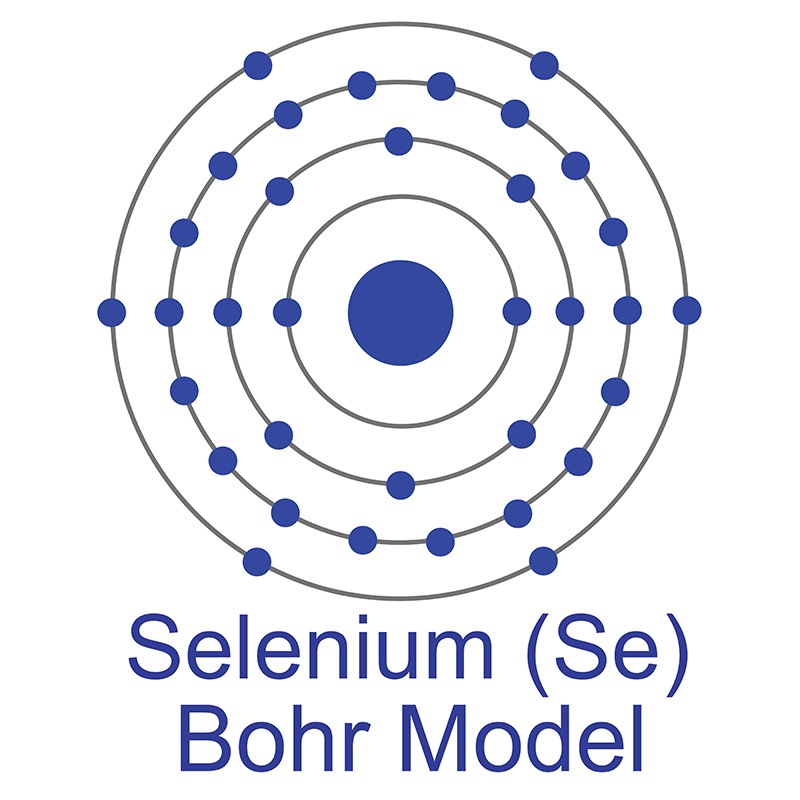
Selenium is a Block P, Group 16, Period 4 element. The number of electrons in each of Selenium's shells is 2, 8, 18, 6 and its electronic configuration is [Ar] 3d10 4s2 4p4. In its elemental form selenium's CAS number is 7782-49-2. The selenium atom has a radius of 116.pm and it's Van der Waals radius is 190.pm. The EPA does not classify selenium as carcinogenic, although selenium sulfide is a probable carcinogen. Selenates and selenites which are compounds of selenium, are highly toxic. Hydrogen selenide gas (SeH2) is the most acutely toxic compound of selenium. Selenium exhibits both photovoltaic action, where light is converted directly into electricity, and photoconductive action, where the electrical resistance decreases with increased illumination. of photocells and exposure meters for photographic use, as well as solar cells. Below its melting point, selenium is a p-type semiconductor and has many uses in electronic and solid-state applications. Selenium is available as metal and compounds with purities from 99% to 99.9999% (ACS grade to ultra-high purity); metals in the form of foil, sputtering target, and rod, and compounds as submicron and nanopowder. Selenium was first discovered by Jons Berzelius in 1817. The origin of the name Selenium comes from the Greek word "Selênê" meaning moon. See selenium research below.
PACKAGING SPECIFICATIONS FOR BULK & RESEARCH QUANTITIES
Typical bulk packaging includes palletized plastic 5 gallon/25 kg. pails, fiber and steel drums to 1 ton super sacks in full container (FCL) or truck load (T/L) quantities. Research and sample quantities and hygroscopic, oxidizing or other air sensitive materials may be packaged under argon or vacuum. Shipping documentation includes a Certificate of Analysis and Material Safety Data Sheet (MSDS). Solutions are packaged in polypropylene, plastic or glass jars up to palletized 440 gallon liquid totes.
Laser treatment of dark skin: an updated review. Shah S, Alster TS. Am J Clin
Dermatol. 2010 Dec 1;11(6):389-97. doi: 10.2165/11538940-000000000-00000. PubMed
PMID: 20866114.
Synthesis and characterization of anionic
rare-earth metal amides stabilized by phenoxy-amido ligands and their catalytic
behavior for the polymerization of lactide. Lu M, Yao Y, Zhang Y, Shen Q. Dalton Trans. 2010 Oct
28;39(40):9530-7. Epub 2010 Sep 3. PubMed PMID: 20820599.
Bimatoprost 0.03% Versus Brimonidine 0.2% in the Prevention of Intraocular
Pressure Spike Following Neodymium:Yttrium–Aluminum–Garnet Laser Posterior
Capsulotomy. Artunay O, Yuzbasioglu E, Unal M, Rasier R, Sengul A, Bahcecioglu H. J Ocul Pharmacol Ther. 2010 Sep 28. [Epub ahead of print] PubMed
PMID: 20874499.
Quantification of C-H
Quenching in Near-IR Luminescent Ytterbium and Neodymium Cryptates. Bischof C, Wahsner J, Scholten J, Trosien S, Seitz M. J Am Chem
Soc. 2010 Sep 24. [Epub ahead of print] PubMed PMID: 20866054.
Reiterative membranous proliferation with giant-cell
deposits on hydrophobic acrylic intraocular lenses after triple procedures in
eyes with cataracts and uveitis. Iwase T, Tanaka N. Cutan Ocul Toxicol. 2010 Sep 20. [Epub ahead of
print] PubMed PMID: 20854015.
Comparison of Two
Q-Switched Lasers and a Short-Pulse Erbium-Doped Yttrium Aluminum Garnet Laser
for Treatment of Cosmetic Tattoos Containing Titanium and Iron in an Animal
Model. Wang CC, Huang CL, Yang AH, Chen CK, Lee SC, Leu FJ. Dermatol Surg. 2010 Sep 14. doi: 10.1111/j.1524-4725.2010.01714.x. [Epub
ahead of print] PubMed PMID: 20840495.
Non-classical divalent lanthanide complexes. Nief F. Dalton Trans. 2010 Aug
7;39(29):6589-98. Epub 2010 Mar 25. PubMed PMID: 20631944.
Four-year experience with a
silicone refractive multifocal intraocular lens. Fujimoto K, Honda K, Wada YR, Tanaka M, Irie T. J Cataract Refract Surg. 2010
Aug;36(8):1330-5. PubMed PMID: 20656156.
Phacoemulsification
with intraocular lens implantation in patients with uveitis. Ram J, Gupta A, Kumar S, Kaushik S, Gupta N, Severia S. J Cataract Refract
Surg. 2010 Aug;36(8):1283-8. PubMed PMID: 20656149.
Photocatalytic treatment of municipal wastewater using modified neodymium
doped TiO(2) hybrid nanoparticles. Shahmoradi B, Ibrahim IA, Sakamoto N, Ananda S, Somashekar R, Row TN, Byrappa
K. J Environ Sci Health A Tox Hazard Subst
Environ Eng. 2010 Aug;45(10):1248-55. PubMed PMID: 20623404.
Low pulse energy Nd:YAG laser irradiation exerts a
biostimulative effect on different cells of the oral microenvironment: "an in
vitro study". Chellini F, Sassoli C, Nosi D, Deledda C, Tonelli P, Zecchi-Orlandini S,
Formigli L, Giannelli M. Lasers Surg Med. 2010 Aug;42(6):527-39. PubMed PMID: 20662029.
Clinical comparison of potassium-titanyl-phosphate (KTP) versus neodymium:YAG
(Nd:YAG) laser treatment for lower extremity telangiectases. Ozden MG, Bahçivan M, Aydin F, Sentürk N, Bek Y, Cantürk T, Turanli AY. J Dermatolog Treat.
2010 Jul 28. [Epub ahead of print] PubMed PMID: 20666669.
Treatment of Facial Postinflammatory Hyperpigmentation with
Facial Acne in Asian Patients Using a Q-Switched Neodymium-Doped Yttrium Aluminum
Garnet Laser. Kim S, Cho KH. Dermatol Surg. 2010 Jul 9. [Epub ahead of print] PubMed PMID:
20629693.
Treatment of Facial Postinflammatory Hyperpigmentation with
Facial Acne in Asian Patients Using a Novel Q-Switched Neodymium-Doped Yttrium
Aluminum Garnet Laser. Metelitsa AI. Dermatol Surg. 2010 Jul 9. [Epub ahead of print] PubMed
PMID: 20629692.
Modification of
neodymium-doped ZnO hybrid nanoparticles under mild hydrothermal conditions.
Shahmoradi B, Soga K, Ananda S, Somashekar R, Byrappa K. Nanoscale. 2010 Jul 7;2(7):1160-4. Epub 2010 May 25. PubMed PMID: 20648343.
Stoichiometric analysis of compositionally graded combinatorial amorphous
thin film oxides using laser-induced breakdown spectroscopy. Widjonarko NE, Perkins JD, Leisch JE, Parilla PA, Curtis CJ, Ginley DS, Berry
JJ. Rev Sci Instrum.
2010 Jul;81(7):073103. PubMed PMID: 20687701.
[Enhancing effect of sample
additive on laser-induced plasma radiation]. Zhang LJ, Chen JZ, Yang SP, Wei YH, Guo QL. Guang Pu Xue Yu Guang Pu Fen Xi.
2010 May;30(5):1175-8. Chinese. PubMed PMID: 20672595.
High-energy neodymium laser radiation for
the treatment of face cutaneous melanoma. Moskalik KG, Kozlov AP, Demin EV. J BUON. 2010 Apr-Jun;15(2):389-91.
PubMed PMID: 20658741.
[Laser therapy for
endobronchial malignancies]. Ohtani K, Usuda J, Shimada Y, Soma T, Ikeda N. Kyobu Geka. 2009 Jul;62(8 Suppl):739-43. Review.
Japanese. PubMed PMID: 20715702.
Recent Research & Development for Selenium
Selenoprotein K binds multi-protein complexes and is involved in the regulation of ER homeostasis.
Shchedrina VA, Everley RA, Zhang Y, Gygi SP, Hatfield DL, Gladyshev VN.
J Biol Chem. 2011 Oct 20. [Epub ahead of print]
PMID:
22016385
[PubMed - as supplied by publisher]
Catalytic activity of selenomethionine in removing amino acid, peptide, and protein hydroperoxides.
Suryo Rahmanto A, Davies MJ.
Free Radic Biol Med. 2011 Oct 1. [Epub ahead of print]
PMID:
22015433
[PubMed - as supplied by publisher]
Combination of chemometrically assisted voltammetry, calorimetry, and circular dichroism as a new method for the study of bioinorganic substances: application to selenocystine metal complexes.
Gusmão R, Prohens R, Díaz-Cruz JM, Ariño C, Esteban M.
J Biol Inorg Chem. 2011 Oct 21. [Epub ahead of print]
PMID:
22015398
[PubMed - as supplied by publisher]
Marine and farmed fish on the Polish market: Comparison of the nutritive value and human exposure to PCDD/Fs and other contaminants.
Szlinder-Richert J, Usydus Z, Malesa-Ciecwierz M, Polak-Juszczak L, Ruczynska W.
Chemosphere. 2011 Oct 17. [Epub ahead of print]
PMID:
22014661
[PubMed - as supplied by publisher]
Dietary selenium reduces retention of methyl mercury in freshwater fish.
Bjerregaard P, Fjordside S, Hansen MG, Petrova MB.
Environ Sci Technol. 2011 Oct 20. [Epub ahead of print]
PMID:
22014184
[PubMed - as supplied by publisher]
Plant and fungal food components with potential activity on the development of microbial oral diseases.
Daglia M, Papetti A, Mascherpa D, Grisoli P, Giusto G, Lingström P, Pratten J, Signoretto C, Spratt DA, Wilson M, Zaura E, Gazzani G.
J Biomed Biotechnol. 2011;2011:274578. Epub 2011 Oct 17.
PMID:
22013381
[PubMed - in process]
Selenium, selenoproteins and the thyroid gland: interactions in health and disease.
Schomburg L.
Nat Rev Endocrinol. 2011 Oct 18. doi: 10.1038/nrendo.2011.174. [Epub ahead of print]
PMID:
22009156
[PubMed - as supplied by publisher]
Selenium inhibits migration of murine melanoma cells via down-modulation of IL-18 expression.
Song H, Kim J, Lee HK, Park HJ, Nam J, Park GB, Kim YS, Cho D, Hur DY.
Int Immunopharmacol. 2011 Oct 15. [Epub ahead of print]
PMID:
22008306
[PubMed - as supplied by publisher]
Detection, Identification, and Quantification of Selenoproteins in a Candidate Human Plasma Standard Reference Material.
Ballihaut G, Kilpatrick LE, Davis WC.
Anal Chem. 2011 Oct 18. [Epub ahead of print]
PMID:
22007999
[PubMed - as supplied by publisher]
Severe pre-eclampsia is associated with abnormal trace elements concentrations in maternal and fetal blood.
Katz O, Paz-Tal O, Lazer T, Aricha-Tamir B, Mazor M, Wiznitzer A, Sheiner E.
J Matern Fetal Neonatal Med. 2011 Oct 18. [Epub ahead of print]
PMID:
22007865
[PubMed - as supplied by publisher]
Effects of Selenium Supplements on Cancer Prevention: Meta-analysis of Randomized Controlled Trials.
Lee EH, Myung SK, Jeon YJ, Kim Y, Chang YJ, Ju W, Seo HG, Huh BY.
Nutr Cancer. 2011 Oct 17. [Epub ahead of print]
PMID:
22004275
[PubMed - as supplied by publisher]
Study of the correlation of serum selenium level with Behcet's disease.
Esalatmanesh K, Jamshidi A, Shahram F, Davatchi F, Masoud SA, Soleimani Z, Salesi M, Ghaffarpasand I.
Int J Rheum Dis. 2011 Oct;14(4):375-8. doi: 10.1111/j.1756-185X.2011.01649.x. Epub 2011 Sep 5.
PMID:
22004235
[PubMed - in process]
Multi-metal(loid) methylation in methanoarchaea is linked to central intermediates of methanogenesis.
Thomas F, Diaz-Bone RA, Wuerfel O, Huber B, Weidenbach K, Schmitz RA, Hensel R.
Appl Environ Microbiol. 2011 Oct 14. [Epub ahead of print]
PMID:
22003009
[PubMed - as supplied by publisher]
The Effects of Di(2-Ethylhexyl)Phthalate Exposure and Selenium Nutrition on Sertoli Cell Vimentin Structure and Germ-Cell Apoptosis in Rat Testis.
Erkekoglu P, Zeybek ND, Giray B, Asan E, Hincal F.
Arch Environ Contam Toxicol. 2011 Oct 16. [Epub ahead of print]
PMID:
22002783
[PubMed - as supplied by publisher]
A superoxide anion-scavenger, 1,3-selenazolidin-4-one suppresses serum deprivation-induced apoptosis in PC12 cells by activating MAP kinase.
Nishina A, Kimura H, Kozawa K, Sommen G, Nakamura T, Heimgartner H, Koketsu M, Furukawa S.
Toxicol Appl Pharmacol. 2011 Oct 2. [Epub ahead of print]
PMID:
22001386
[PubMed - as supplied by publisher]
Nutrition, dietary supplements and adenocarcinoma of the prostate.
Schultz C, Meier M, Schmid HP.
Maturitas. 2011 Oct 12. [Epub ahead of print]
PMID:
22001108
[PubMed - as supplied by publisher]
Interactions of Cu(I) with Selenium-Containing Amino Acids Determined by NMR, XAS, and DFT Studies.
Wang HC, Riahi M, Pothen J, Bayse CA, Riggs-Gelasco P, Brumaghim JL.
Inorg Chem. 2011 Oct 14. [Epub ahead of print]
PMID:
21999616
[PubMed - as supplied by publisher]
Effects of Basal Media and Supplements on Diethylstilbestrol-Treated Immature Mouse Primary Granulosa Cell Growth and Regulation of Steroidogenesis In Vitro.
Ding T, Luo A, Yang S, Lai Z, Wang Y, Shen W, Jiang J, Lu Y, Ma D, Wang S.
Reprod Domest Anim. 2011 Oct 15. doi: 10.1111/j.1439-0531.2011.01879.x. [Epub ahead of print]
PMID:
21999365
[PubMed - as supplied by publisher]
Demographic and lifestyle factors and selenium levels in men and women in the U.S.
Park K, Rimm E, Siscovick D, Spiegelman D, Morris JS, Mozaffarian D.
Nutr Res Pract. 2011 Aug;5(4):357-64. Epub 2011 Aug 31.
PMID:
21994531
[PubMed - in process]
New group 11 complexes with metal-selenium bonds of methyldiphenylphosphane selenide: a solid state, solution and theoretical investigation.
Pop A, Silvestru A, Gimeno MC, Laguna A, Kulcsar M, Arca M, Lippolis V, Pintus A.
Dalton Trans. 2011 Oct 13. [Epub ahead of print]
PMID:
21993712
[PubMed - as supplied by publisher]
American Elements is a copyrighted U.S. Trademark. All rights reserved.