American Elements Logo and U.S. Registered Trademark


Ammonium Fluozirconate
(NH4)2ZrF6
Product Product Code Order or Specifications
98% (1N8) Ammonium Fluozirconate NH-ZRF-018 Contact American Elements
(2N) 99% Ammonium Fluozirconate NH-ZRF-02 Contact American Elements
(3N) 99.9% Ammonium Fluozirconate NH-ZRF-03 Contact American Elements
(4N) 99.99% Ammonium Fluozirconate NH-ZRF-04 Contact American Elements
(5N) 99.999% Ammonium Fluozirconate NH-ZRF-05 Contact American Elements
Fluoride IonAmmonium Fluozirconate is a water insoluble Zirconium source for use in oxygen-sensitive applications, such as metal production. In extremely low concentrations (ppm), fluoride compounds are used in health applications. Fluoride compounds also have significant uses in synthetic organic chemistry. They are commonly also used to alloy metal and for optical deposition. Certain fluoride compounds can be produced at nanoscale and in ultra high purity forms. Ammonium Fluozirconate is generally immediately available in most volumes. Ultra high purity and high purity compositions improve both optical quality and usefulness as scientific standards. Nanoscale (See also Nanotechnology Information and Quantum Dots) elemental powders and suspensions, as alternative high surface area forms, may be considered.American Elements produces to many standard grades when applicable, including Mil Spec (military grade); ACS, Reagent and Technical Grade; Food, Agricultural and Pharmaceutical Grade; Optical Grade, USP and EP/BP (European Pharmacopoeia/British Pharmacopoeia)and follows applicable ASTM testing standards.Typical and custom packaging is available. Additional technical, research and safety (MSDS) information is available as is a Reference Calculator for converting relevant units of measurement.

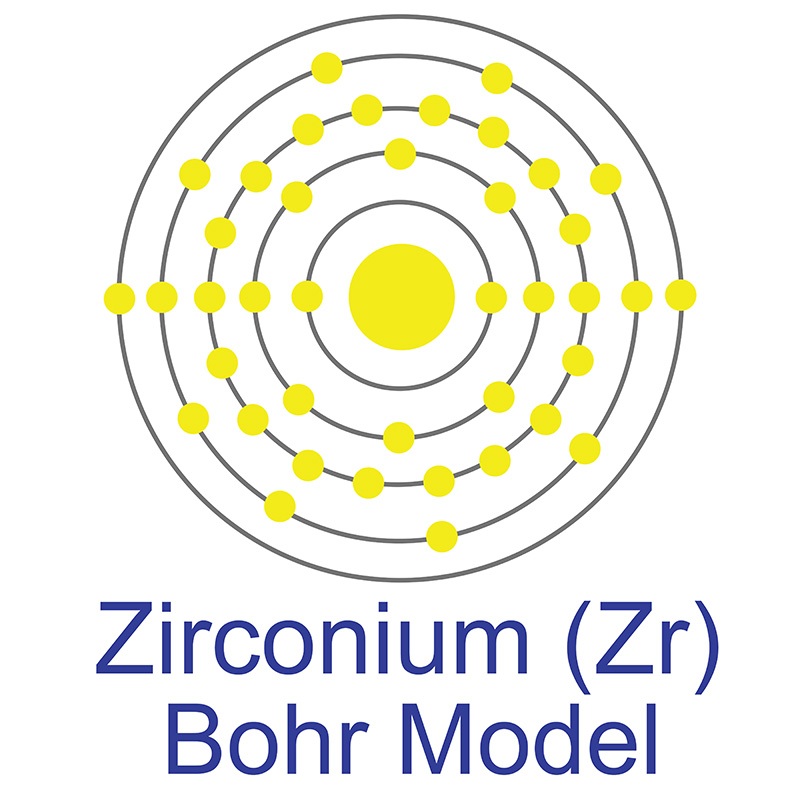
Zirconium is a Block D, Group 4, Period 5 element. The number of electrons in each of Zirconium's shells is 2, 8, 18, 10, 2 and its electronic configuration is [Kr] 4d2 5s2. In its elemental form zirconium's CAS number is 7440-67-7. The zirconium atom has a radius of 159.pm and it'sVan der Waals radius is 200.pm. Zirconium is non-toxic. Zirconium is primarily used in it's oxide or zirconia form. Zirconium dioxide has a high melting point (2,700° C) and a low thermal conductivity. Its polymorphism, however, restricts its widespread use in ceramic industry. During a heating process, zirconia will undergo a phase transformation process. The change in volume associated with this transformation makes the usage of pure zirconia in many applications impossible. Addition of some oxides, such as CaO, MgO, and Y2O3, into the zirconia structure in a certain degree results in a solid solution, which is a cubic form and has no phase transformation during heating and cooling. This solid solution material is termed as stabilized zirconia, a valuable refractory. Stabilized zirconia is used as a grinding media and engineering ceramics due to its increased hardness and high thermal shock resistivity. Stabilized zirconia is also used in applications such as oxygen sensors and solid oxide fuel cells due to its high oxygen ion conductivity.Zirconium was first discovered by William Gregor in 1791. The name Zirconium originated from the Persian word 'zargun' meaning gold color or gold-like. See Zirconium research below.

Formula CAS No. Appearance Molecular Weight
(NH4)2ZrF6 16919-31-6 White Crystal 241.29
PRODUCT CATALOG Zirconium Products Foil Submicron & Nanopowder Tolling Ultra High Purity Sputtering Target Crystal Growth Rod, Plate, Powder, etc. Home
© 2001-2009. American Elements is a U.S. Registered Trademark. All rights reserved.
This website and all pages, designs, concepts, logos, and color schemes herein are
the copyrighted proprietary rights and intellectual property of American Elements.
Customers for this product have also looked at:


Recent Research & Development for Aluminum

  • In vitro studies of the ablation mechanism of periodontopathic bacteria and decontamination effect on periodontally diseased root surfaces by erbium:yttrium-aluminum-garnet laser. Akiyama F, Aoki A, Miura-Uchiyama M, Sasaki KM, Ichinose S, Umeda M, Ishikawa I, Izumi Y. Lasers Med Sci. 2010 Mar 23. [Epub ahead of print] PMID: 20309597 [PubMed - as supplied by publisher] Related articles

  • Unusual reactivity in organoaluminium and NHC chemistry: deprotonation of AlMe(3) by an NHC moiety involving the formation of a sterically bulky NHC-AlMe(3) Lewis adduct. Schmitt AL, Schnee G, Welter R, Dagorne S. Chem Commun (Camb). 2010 Apr 14;46(14):2480-2. Epub 2010 Mar 5. PMID: 20309474 [PubMed - in process] Related articles

  • Next-generation biomedical implants using additive manufacturing of complex, cellular and functional mesh arrays. Murr LE, Gaytan SM, Medina F, Lopez H, Martinez E, Machado BI, Hernandez DH, Martinez L, Lopez MI, Wicker RB, Bracke J. Philos Transact A Math Phys Eng Sci. 2010 Apr 28;368(1917):1999-2032. PMID: 20308113 [PubMed - in process] Related articles

  • Ink-jet printout of radiographs on transparent film and glossy paper versus monitor display: an ROC analysis. Kühl S, Krummenauer F, Dagassan-Berndt D, Lambrecht TJ, d'Hoedt B, Schulze RK. Clin Oral Investig. 2010 Mar 20. [Epub ahead of print] PMID: 20306098 [PubMed - as supplied by publisher] Related articles

  • The bioceramic implant: evaluation of implant exposures in 419 implants. Jordan DR, Klapper SR, Gilberg SM, Dutton JJ, Wong A, Mawn L. Ophthal Plast Reconstr Surg. 2010 Mar-Apr;26(2):80-2. PMID: 20305504 [PubMed - in process] Related articles

  • Inorganic structures in space group P31m; coordinate analysis and systematic prediction of new ferroelectrics. Abrahams SC. Acta Crystallogr B. 2010 Apr;66(Pt 2):173-83. Epub 2010 Mar 16. PMID: 20305351 [PubMed - in process] Related articles

  • Mullite-type Ga(4)B(2)O(9): structure and order-disorder phenomenon. Cong R, Yang T, Li K, Li H, You L, Liao F, Wang Y, Lin J. Acta Crystallogr B. 2010 Apr;66(Pt 2):141-50. Epub 2010 Feb 26. PMID: 20305347 [PubMed - in process] Related articles

  • Effect of 5-aminosalicylate on allergic rhinitis model in mice. Kuyama S, Yamamoto A, Sugiyama M, Kakuta H, Sugimoto Y. Int Immunopharmacol. 2010 Mar 18. [Epub ahead of print] PMID: 20304104 [PubMed - as supplied by publisher] Related articles

  • Experimental design approach applied to the elimination of crystal violet in water by electrocoagulation with Fe or Al electrodes. Durango-Usuga P, Guzmán-Duque F, Mosteo R, Vazquez MV, Peñuela G, Torres-Palma RA. J Hazard Mater. 2010 Mar 1. [Epub ahead of print] PMID: 20303653 [PubMed - as supplied by publisher] Related articles

  • Study of organic matter during coagulation and electrocoagulation processes: Application to a stabilized landfill leachate. Labanowski J, Pallier V, Feuillade-Cathalifaud G. J Hazard Mater. 2010 Mar 1. [Epub ahead of print] PMID: 20303652 [PubMed - as supplied by publisher] Related articles

  • Abiotic hydrogen production in fresh and altered MSWI-residues: Texture and microstructure investigation. Heuss-Aßbichler S, Magel G, Fehr KT. Waste Manag. 2010 Mar 17. [Epub ahead of print] PMID: 20303250 [PubMed - as supplied by publisher] Related articles

  • Computational Study on Nitronium and Nitrosonium Oxalate: Potential Oxidizers for Solid Rocket Propulsion? (dagger). Go¨kc¸inar E, Klapo¨tke TM, Kramer MP. J Phys Chem A. 2010 Mar 19. [Epub ahead of print] PMID: 20302312 [PubMed - as supplied by publisher] Related articles

  • .[Optical and spectral parameters in Ce3+ -doped gadolinium gallium aluminum garnet glass-ceramics] Gong H, Zhao X, Yu XB, Setsuhisa T, Lin H. Guang Pu Xue Yu Guang Pu Fen Xi. 2010 Jan;30(1):128-32. Chinese. PMID: 20302098 [PubMed - in process] Related articles

  • Combination of ionic liquid-based dispersive liquid-liquid micro-extraction with stopped-flow spectrofluorometry for the pre-concentration and determination of aluminum in natural waters, fruit juice and food samples. Abdolmohammad-Zadeh H, Sadeghi GH. Talanta. 2010 May 15;81(3):778-785. Epub 2010 Jan 18. PMID: 20298853 [PubMed - as supplied by publisher] Related articles

  • The development and preliminary evaluation of a new Mycobacterium tuberculosis vaccine comprising Ag85b, HspX and CFP-10:ESAT-6 fusion protein with CpG DNA and aluminum hydroxide adjuvants. Chen L, Xu M, Wang ZY, Chen BW, Du WX, Su C, Shen XB, Zhao AH, Dong N, Wang YJ, Wang GZ. FEMS Immunol Med Microbiol. 2010 Feb 17. [Epub ahead of print] PMID: 20298499 [PubMed - as supplied by publisher] Related articles

  • Low-Fluence Q-Switched Neodymium-Doped Yttrium Aluminum Garnet (1,064 nm) Laser for the Treatment of Facial Melasma in Asians. Wattanakrai P, Mornchan R, Eimpunth S. Dermatol Surg. 2010 Jan;36(1):76-87. PMID: 20298254 [PubMed - in process] Related articles

  • Physicochemical Characterization and Surface Acid Properties of Mesoporous [Al]-SBA-15 Obtained by Direct Synthesis. Gallo JM, Bisio C, Gatti G, Marchese L, Pastore HO. Langmuir. 2010 Mar 18. [Epub ahead of print] PMID: 20297832 [PubMed - as supplied by publisher] Related articles

  • Multiple Nanowire Species Synthesized on a Single Chip by Selectively Addressable Horizontal Nanochannels. Xiang Y, Keilbach A, Moreno Codinachs L, Nielsch K, Abstreiter G, Fontcuberta I Morral A, Bein T. Nano Lett. 2010 Mar 18. [Epub ahead of print] PMID: 20297808 [PubMed - as supplied by publisher] Related articles

  • Combining density functional theory (DFT) and pair distribution function (PDF) analysis to solve the structure of metastable materials: the case of metakaolin. White CE, Provis JL, Proffen T, Riley DP, van Deventer JS. Phys Chem Chem Phys. 2010 Apr 7;12(13):3239-45. Epub 2010 Feb 22. PMID: 20237714 [PubMed - in process] Related articles

  • Transcriptomic analysis reveals differential gene expression in response to aluminium in common bean (Phaseolus vulgaris) genotypes. Eticha D, Zahn M, Bremer M, Yang Z, Rangel AF, Rao IM, Horst WJ. Ann Bot. 2010 Mar 17. [Epub ahead of print] PMID: 20237115 [PubMed - as supplied by publisher]


USA Science & Engineering FestivalSponsors of the United States Science & Engineering Festival on April 28, 2012 in Washington D.C. Please join us and our customers & co-sponsors NASA, Lockheed Martin and the Department of Defense inspiring the next generation of scientists and engineers.


  Print this Page
Periodic table of the elements science and academic information, elements and advanced materials data, scientific presentations and all pages, designs, concepts, logos, and color schemes herein are the copyrighted proprietary rights and intellectual property of American Elements. American Elements is a U.S. Registered Trademark. © 2001-2012. American Elements. All rights reserved.
Learn Six Sigma


American Elements is a copyrighted U.S. Trademark. All rights reserved.