
American Elements Logo and U.S. Registered Trademark


Praseodymium Acetylacetonate
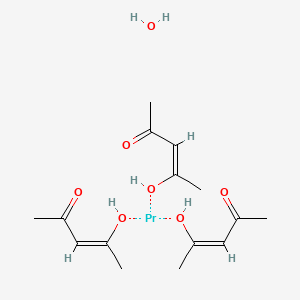
Pr(CH3COCHCOCH3)3 • x H2O
14553-09-4
Product Product Code Order or Specifications
(2N) 99% Praseodymium Acetylacetonate PR-ACAC-02 Contact American Elements
(3N) 99.9% Praseodymium Acetylacetonate PR-ACAC-03 Contact American Elements
(4N) 99.99% Praseodymium Acetylacetonate PR-ACAC-04 Contact American Elements
(5N) 99.999% Praseodymium Acetylacetonate PR-ACAC-05 Contact American Elements


CHEMICAL
IDENTIFICATION
Formula CAS No. PubChem
SID
PubChem CID MDL No. EC No IUPAC Name Beilstein
Re. No.
SMILES
Identifier
InChI
Identifier
InChI
Key
Pr(CH3COCHCOCH3)3 • xH2O 14553-09-4 24873965 16213769 MFCD08272322 N/A praseodymium 741937 [Pr+3].O=C(/C=C(\[O-])C)C.[O-]\C(=C/C(=O)C)C.[O-]\C(=C/C(=O)C)C InChI=1S/3C5H8O2.Pr/c3*1-4(6)3-5(2)7;/h3*3,6H,1-2H3;/q;;;+3/p-3/b3*4-3-; NOXQKISUYACYGB-LNTINUHCSA-K

Compound Formula Mol. Wt. Appearance Density

Exact Mass

Monoisotopic Mass Charge MSDS
C15H21O6 Pr 438.23 Pale Green 6.71 g/cm3 N/A N/A N/A Safety Data Sheet


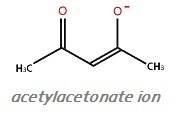
Acetylaceton Formula Diagram (C5H8O2)Praseodymium Acetylacetonate is a Praseodymium source that is soluble in organic solvents. The high purity acetylacetonate anion complexes by bonding each oxygen atom to the Acetylacetonate Packaging, Lab Quantitymetallic cation to form a chelate ring.Because of this property, Praseodymium Acetylacetonate is commonly used in various catalysts and catalytic reagents for organic synthesis. It is generally immediately available in most volumes. Ultra high purity and high purity forms may be considered. Praseodymium Acetylacetonate is one of numerous organo-metallic compounds sold by American Elements under the tradename AE Organo-Metallics™ for uses requiring non-aqueous solubility such as recent solar energy and water treatment applications. Similar results can sometimes also be achieved with Nanoparticles (also see Nanotechnology and Quantum Dots) and by thin film deposition. Note American Elements additionally supplies many materials as solutions. The numerous commercial applications for Praseodymium include glass and ceramic production as a bright yellow pigment because of its optimum reflectance at 560 nm. Much research is being done on its optical properties for use in amplification of telecommunication systems, including as a doping agent in fluoride fibers.American Elements produces to many standard grades when applicable, including Mil Spec (military grade); ACS, Reagent and Technical Grade; Food, Agricultural and Pharmaceutical Grade; Optical Grade, USP and EP/BP (European Pharmacopoeia/British Pharmacopoeia)and follows applicable ASTM testing standards.Typical and custom packaging is available. Additional technical, research and safety (MSDS) information is available as is a Reference Calculator for converting relevant units of measurement.

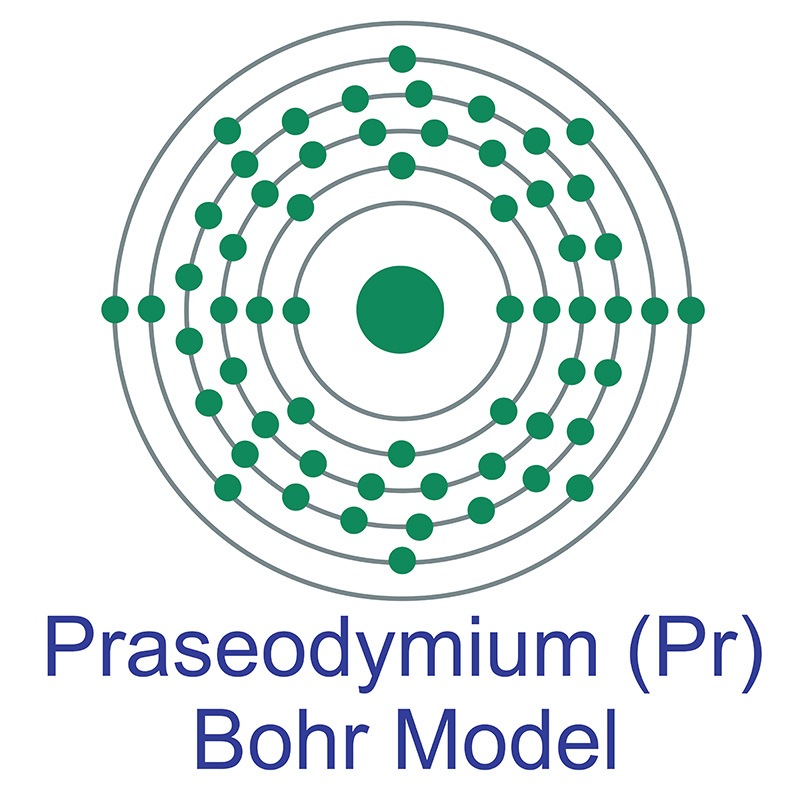
Praseodymium(Pr) atomic and molecular weight, atomic number and elemental symbol Praseodymium is a Block F, Group 3, Period 6 element. The number of electrons in each of Praseodymium's shells is 2, 8, 18, 21, 8, 2 and its electronic configuration is [Xe]4f3 6s2. In its elemental form praseodymium's CAS number is 7440-10-0. The praseodymium atom has a radius of 182.pm and it's Van der Waals radius is is unknown. Praseodymium is somewhat toxic. Praseodymium resembles the typical trivalent rare earths, however, it willPraseodymium Bohr Model exhibit a +4 state when stabilized in a zirconia host. Praseodymium is available as metal and compounds with purities from 99% to 99.999% (ACS grade to ultra-high purity); metals in the form Elemental Praseodymiumof foil, sputtering target, and rod, and compounds as submicron and nanopowder. The element is found in most all light rare earth derivatives. It is highly valued in glass and ceramic production as a bright yellow pigment because of its optimum reflectance at 560 nm. Much research is being done on its optical properties for use in amplification of telecommunication systems, including as a doping agent in fluoride fibers. The origin of the element name comes from the Greek words 'prasios didymos' meaning green twin. See Praseodymium research below.

Have a Question? Ask a Chemical Engineer or Material Scientist   Request an MSDS or Certificate of Analysis

 
Safety &
Handling
  Exclamation Mark-Acute Toxicity Health Hazard
Signal Word Hazard Statements Hazard Codes Risk Codes Safety Precautions RTECS No. Transport Information WGK Germany
Warning H302-H312-H315-H319-H335-H361 Xn 20/21/22-36/37/38-63 26-36 N/A N/A 3


Synonyms for Praseodymium Acetylacetonate Include:


Pr(acac)3
Praseodymium metal
2,4-pentanedione


PACKAGING SPECIFICATIONS FOR BULK & RESEARCH QUANTITIES


Typical bulk packaging includes palletized plastic 5 gallon/25 kg. pails, fiber and steel drums to 1 ton super sacks in full container (FCL) or truck load (T/L) quantities. Research and sample quantities and hygroscopic, oxidizing or other air sensitive materials may be packaged under argon or vacuum. Shipping documentation includes a Certificate of Analysis and Material Safety Data Sheet (MSDS). Solutions are packaged in polypropylene, plastic or glass jars up to palletized 440 gallon liquid totes.


Show me more forms of Praseodymium
 
Customers for this product have also looked at:
Praseodymium Sheet Praseodymium Telluride Praseodymium Acetate Praseodymium Foil Praseodymium Pellets
Mischmetal Nickel Alloy Praseodymium Powder Praseodymium Nanoparticles Praseodymium Chloride Praseodymium Oxide Pellets
Praseodymium Sputtering Target
Praseodymium Fluoride Praseodymium Metal Praseodymium Nitrate Praseodymium Acetylacetonate


Search by Material, Product Name, Product Code, CAS Number, Formula, Element, Anion, Form, EC Number, MDL Number or PubChem ID.


German   Korean   French   Japanese   Spanish   Chinese (Simplified)   Portuguese   Russian   Chinese (Taiwan)   Italian   Turkish   Polish   Dutch   Czech   Swedish   Hungarian   Danish   Hebrew

Production Catalog Available in 36 Countries & Languages

Recent Research & Development for Praseodymium

  • Superbroadband near-IR emission from praseodymium-doped bismuth gallate glasses. Zhou B, Pun EY. Opt Lett. 2011 Aug 1;36(15):2958-60. doi: 10.1364/OL.36.002958. PMID: 21808371 [PubMed - in process]

  • Pr(16)Mo(21)O(56). Gougeon P, Gall P. Acta Crystallogr Sect E Struct Rep Online. 2011 May 1;67(Pt 5):i34-i35. Epub 2011 Apr 29. PMID: 21754260 [PubMed]

  • Internal radiotherapy techniques using radiolanthanide praseodymium-142: a review of production routes, brachytherapy, unsealed source therapy. Bakht MK, Sadeghi M. Ann Nucl Med. 2011 Jul 1. [Epub ahead of print] PMID: 21720780 [PubMed - as supplied by publisher]

  • Fluorescence and DNA-binding properties of neodymium(III) and praseodymium(III) complexes containing 1,10-phenanthroline. Khorasani-Motlagh M, Noroozifar M, Mirkazehi-Rigi S. Spectrochim Acta A Mol Biomol Spectrosc. 2011 Sep;79(5):978-84. Epub 2011 May 7. PMID: 21669548 [PubMed - in process]

  • Praseodymium(III) sulfate hydroxide, Pr(SO(4))(OH). Wang XJ, Cheng JW. Acta Crystallogr Sect E Struct Rep Online. 2011 Jan 15;67(Pt 2):i12. PMID: 21522810 [PubMed]

  • Electrical conductivity and defect equilibria of Pr0.1Ce0.9O(2-d). Bishop SR, Stefanik TS, Tuller HL. Phys Chem Chem Phys. 2011 Jun 7;13(21):10165-73. Epub 2011 Apr 26. PMID: 21519609 [PubMed - in process]

  • Enhanced emission of 2.7 µm pumped by laser diode from Er3+/Pr(3+)-codoped germanate glasses. Xu R, Tian Y, Hu L, Zhang J. Opt Lett. 2011 Apr 1;36(7):1173-5. doi: 10.1364/OL.36.001173. PMID: 21479020 [PubMed - indexed for MEDLINE]

  • Effect of graded levels of rare earth elements in diets of fattening bulls on growing and slaughtering performance, and on nutrient digestibility of wethers. Schwabe A, Meyer U, Flachowsky G, Dänicke S. Arch Anim Nutr. 2011 Feb;65(1):55-73. PMID: 21452614 [PubMed - indexed for MEDLINE]

  • Influence of rare-earth ions on SiO2-Na2O-RE2O3 glass structure. Johnson JA, Benmore CJ, Holland D, Du J, Beuneu B, Mekki A. J Phys Condens Matter. 2011 Feb 16;23(6):065404. Epub 2011 Jan 27. PMID: 21406929 [PubMed]

  • Poly[[tetra-µ3-acetato-hexa-µ2-acetato-diaqua-µ2-oxalato-tetrapraseodymium(III)] dihydrate]. Gutkowski K, Freire E, Baggio R. Acta Crystallogr C. 2011 Mar;67(Pt 3):m77-80. Epub 2011 Feb 18. PMID: 21368405 [PubMed]

  • Metallic and insulating oxide interfaces controlled by electronic correlations. Jang HW, Felker DA, Bark CW, Wang Y, Niranjan MK, Nelson CT, Zhang Y, Su D, Folkman CM, Baek SH, Lee S, Janicka K, Zhu Y, Pan XQ, Fong DD, Tsymbal EY, Rzchowski MS, Eom CB. Science. 2011 Feb 18;331(6019):886-9. PMID: 21330538 [PubMed]

  • Decrease of liposomal size and retarding effect on fluconazole skin permeation by lysine derivatives. Schwarz JC, Kählig H, Matsko NB, Kratzel M, Husa M, Valenta C. J Pharm Sci. 2011 Jul;100(7):2911-9. doi: 10.1002/jps.22513. Epub 2011 Feb 11. PMID: 21319163 [PubMed - in process]

  • Interferometric measurement of laser heating in praseodymium-doped YAG crystal. Farley CW 3rd, Reddy BR. Appl Opt. 2011 Feb 1;50(4):526-31. doi: 10.1364/AO.50.000526. PMID: 21283244 [PubMed]

  • Observation of 2.7 µm emission from diode-pumped Er3+/Pr3+-codoped fluorophosphate glass. Tian Y, Xu R, Zhang L, Hu L, Zhang J. Opt Lett. 2011 Jan 15;36(2):109-11. doi: 10.1364/OL.36.000109. PMID: 21263469 [PubMed - indexed for MEDLINE]

  • Spectroscopic studies on the interaction between Pr(III) complex of an ofloxacin derivative and bovine serum albumin or DNA. Xu M, Ma ZR, Huang L, Chen FJ, Zeng ZZ. Spectrochim Acta A Mol Biomol Spectrosc. 2011 Jan;78(1):503-11. Epub 2010 Nov 23. PMID: 21156349 [PubMed - indexed for MEDLINE]

  • Study on fluorescence and DNA-binding of praseodymium(III) complex containing 2,2'-bipyridine. Khorasani-Motlagh M, Noroozifar M, Khmmarnia S. Spectrochim Acta A Mol Biomol Spectrosc. 2011 Jan;78(1):389-95. Epub 2010 Oct 30. PMID: 21130681 [PubMed - indexed for MEDLINE]

  • The correlation between f-f absorption and sensitized visible light emission of luminescent Pr(III) complexes: role of solvents and ancillary ligands on sensitivity. Irfanullah M, Iftikhar K. J Fluoresc. 2011 Mar;21(2):673-86. Epub 2010 Nov 3. PMID: 21046438 [PubMed - in process]

  • Synthesis, characterization, antioxidant activities, and DNA-binding studies of (E)-N'-[1-(pyridin-2-yl)ethylidene]isonicotinohydrazide and its Pr(III) and Nd(III) complexes. Hao ZY, Liu QW, Xu J, Jia L, Li SB. Chem Pharm Bull (Tokyo). 2010 Oct;58(10):1306-12. PMID: 20930395 [PubMed - indexed for MEDLINE]

  • Autogenic synthesis of green- and red-emitting single-phase Pr(2)O(2)CO(3) and PrO(1.833) luminescent nanopowders. Calderon Moreno JM, Pol VG, Suh SH, Popa M. Inorg Chem. 2010 Nov 1;49(21):10067-73. PMID: 20923161 [PubMed]

  • Morphological and electrochemical properties of crystalline praseodymium oxide nanorods. Shamshi Hassan M, Shaheer Akhtar M, Shim KB, Yang OB. Nanoscale Res Lett. 2010 Feb 5;5(4):735-40. PMID: 20672103 [PubMed]


USA Science & Engineering FestivalSponsors of the United States Science & Engineering Festival on April 28, 2012 in Washington D.C. Please join us and our customers & co-sponsors NASA, Lockheed Martin and the Department of Defense inspiring the next generation of scientists and engineers.


PRODUCT CATALOG Foil Submicron & Nanopowder Tolling Ultra High Purity Sputtering Target Crystal Growth Rod, Plate, Powder, etc. Home

  Print this Page
Periodic table of the elements science and academic information, elements and advanced materials data, scientific presentations and all pages, designs, concepts, logos, and color schemes herein are the copyrighted proprietary rights and intellectual property of American Elements. American Elements is a U.S. Registered Trademark. © 2001-2012. American Elements. All rights reserved.
Learn Six Sigma


American Elements is a copyrighted U.S. Trademark. All rights reserved.