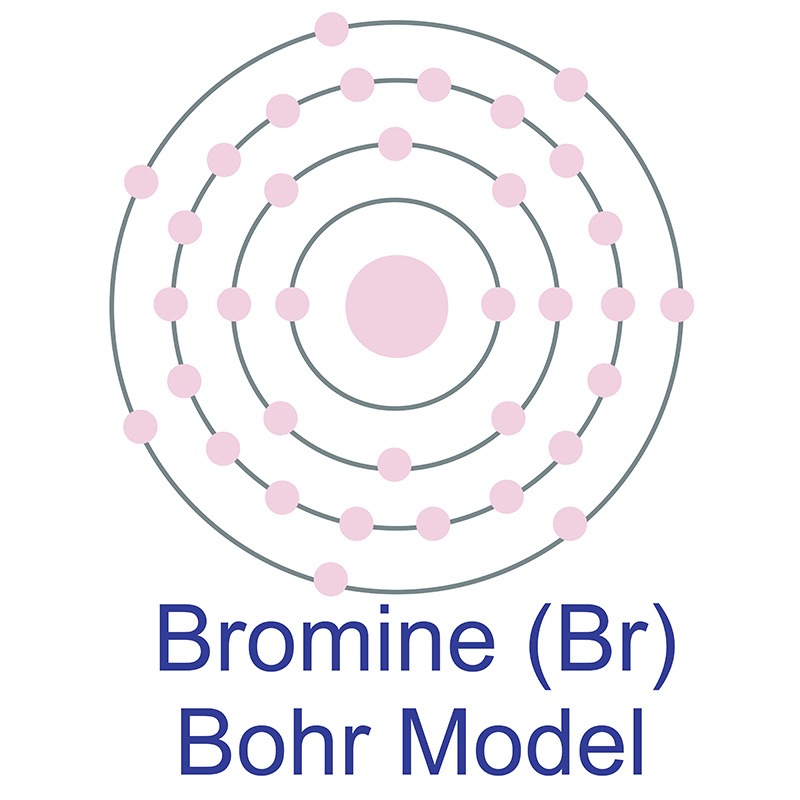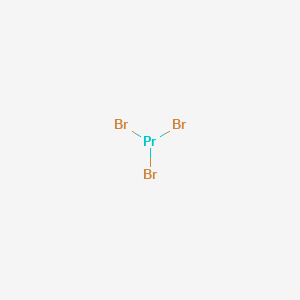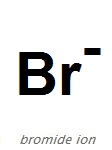
Praseodymium Bromide is a highly water soluble crystalline Praseodymium source for uses compatible with Bromides and lower (acidic) pH. Metallic Bromides are marketed under the trade name AE Bromides™. Most metal bromide compounds are water soluble for uses in water treatment, chemical analysis and in ultra high purity for certain crystal growth applications. Bromide in an aqueous solution can be detected by adding Praseodymium disulfide (CS2) and chlorine. Praseodymium Bromide is generally immediately available in most volumes. Ultra high purity and high purity compositions improve both optical quality and usefulness as scientific standards. Nanoscale (See also Nanotechnology Information and Quantum Dots) elemental powders and suspensions, as alternative high surface area forms, may be considered.American Elements produces to many standard grades when applicable, including Mil Spec (military grade); ACS, Reagent and Technical Grade; Food, Agricultural and Pharmaceutical Grade; Optical Grade, USP and EP/BP (European Pharmacopoeia/British Pharmacopoeia)and follows applicable ASTM testing standards.Typical and custom packaging is available. Additional technical, research and safety (MSDS) information is available as is a Reference Calculator for converting relevant units of measurement.
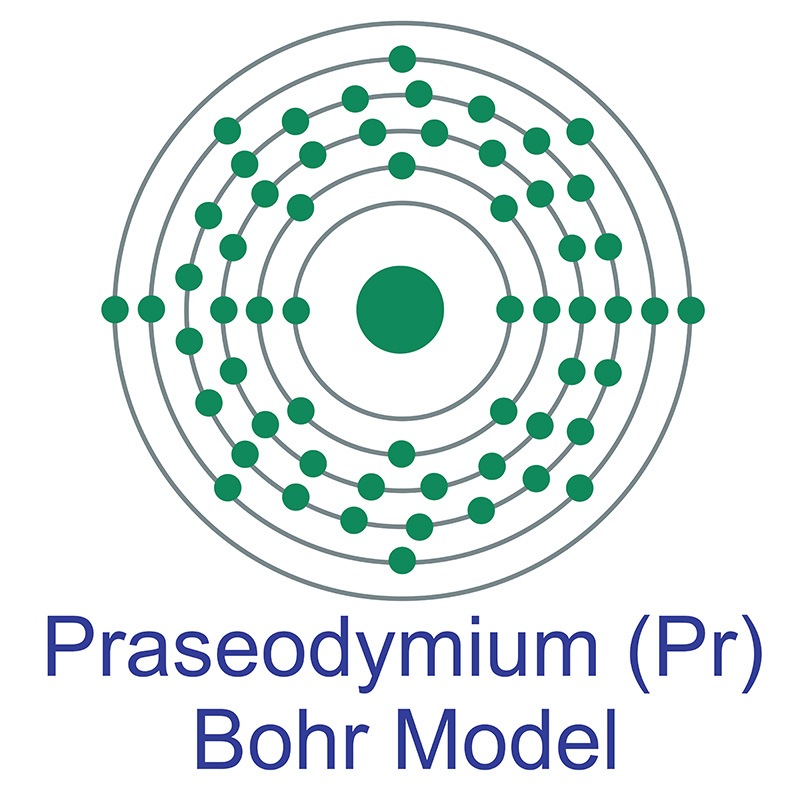
Praseodymium is a Block F, Group 3, Period 6 element. The number of electrons in each of Praseodymium's shells is 2, 8, 18, 21, 8, 2 and its electronic configuration is [Xe]4f3 6s2. In its elemental form praseodymium's CAS number is 7440-10-0. The praseodymium atom has a radius of 182.pm and it's Van der Waals radius is is unknown. Praseodymium is somewhat toxic. Praseodymium resembles the typical trivalent rare earths, however, it will exhibit a +4 state when stabilized in a zirconia host. Praseodymium is available as metal and compounds with purities from 99% to 99.999% (ACS grade to ultra-high purity); metals in the form of foil, sputtering target, and rod, and compounds as submicron and nanopowder. The element is found in most all light rare earth derivatives. It is highly valued in glass and ceramic production as a bright yellow pigment because of its optimum reflectance at 560 nm. Much research is being done on its optical properties for use in amplification of telecommunication systems, including as a doping agent in fluoride fibers. The origin of the element name comes from the Greek words 'prasios didymos' meaning green twin. See Praseodymium research below.
Autogenic Synthesis of Green- and
Red-Emitting Single-Phase Pr(2)O(2)CO(3) and PrO(1.833) Luminescent Nanopowders.
Calderon Moreno JM, Pol VG, Suh SH, Popa M. Inorg Chem. 2010 Oct 5. [Epub ahead of print] PubMed PMID: 20923161.
Cationic rare-earth-metal
methyl complexes: a new preparative access exemplified for Y and Pr. Nieland A, Mix A, Neumann B, Stammler HG, Mitzel NW. Dalton
Trans. 2010 Aug 7;39(29):6753-60. Epub 2010 May 4. PubMed PMID: 20442946.
Conversion of orange light into blue
light. Rai N, Jha Y, Kamal KP, Kumar S, Rai VK. Spectrochim Acta A Mol Biomol Spectrosc. 2010 Aug;76(3-4):311-4. Epub 2010
Mar 6. PubMed PMID: 20430692.
Efficient green
continuous-wave lasing of blue-diode-pumped solid-state lasers based on
praseodymium-doped LiYF4. Hansen NO, Bellancourt AR, Weichmann U, Huber G. Appl Opt. 2010 Jul 10;49(20):3864-8. doi:
10.1364/AO.49.003864. PubMed PMID: 20648158.
Praseodymium(III)-based
bis-metallacalix[4]arene with host-guest behaviour. Xu GF, Gamez P, Teat SJ, Tang J. Dalton Trans. 2010 May
14;39(18):4353-7. Epub 2010 Mar 24. PubMed PMID: 20422093.
Evaluation of short-term effects of rare earth and other elements used in
magnesium alloys on primary cells and cell lines. Feyerabend F, Fischer J, Holtz J, Witte F, Willumeit R, Drücker H, Vogt C,
Hort N. Acta Biomater. 2010
May;6(5):1834-42. Epub 2009 Oct 1. PubMed PMID: 19800429.
Carboxymethylated cyclodextrins and their complexes with Pr(III) and Yb(III) as
water-soluble chiral NMR solvating agents for cationic compounds. Provencher KA, Weber MA, Randall LA, Cunningham PR, Dignam CF, Wenzel TJ. Chirality. 2010
Mar;22(3):336-46. PubMed PMID: 19544350.
Crystal structure, diffusion path, and
oxygen permeability of a Pr(2)NiO(4)-based mixed conductor
(Pr(0.9)La(0.1))(2)(Ni(0.74)Cu(0.21)Ga(0.05))O(4+delta). Yashima M, Sirikanda N, Ishihara T. J Am Chem Soc. 2010 Feb
24;132(7):2385-92. PubMed PMID: 20121092.
Crystal structure and optical and magnetic properties of
Pr(2)(MoO(4))(3). Logvinovich D, Arakcheeva A, Pattison P, Eliseeva S, Tomes P, Marozau I,
Chapuis G. Inorg Chem. 2010 Feb 15;49(4):1587-94. PubMed PMID: 20067248.
Morphological and
Electrochemical Properties of Crystalline Praseodymium Oxide Nanorods. Shamshi Hassan M, Shaheer Akhtar M, Shim KB, Yang OB. Nanoscale
Res Lett. 2010 Feb 5;5(4):735-740. PubMed PMID: 20672103; PubMed Central PMCID:
PMC2894094.
Demonstration of atomic frequency
comb memory for light with spin-wave storage. Afzelius M, Usmani I, Amari A, Lauritzen B, Walther A, Simon C, Sangouard N,
Minár J, de Riedmatten H, Gisin N, Kröll S. Phys Rev Lett. 2010 Jan
29;104(4):040503. Epub 2010 Jan 27. PubMed PMID: 20366694.
Triggered instability of liposomes bound to hydrophobically modified core-shell
PNIPAM hydrogel beads. MacKinnon N, Guérin G, Liu B, Gradinaru CC, Rubinstein JL, Macdonald PM. Langmuir. 2010 Jan 19;26(2):1081-9. PubMed PMID: 19754070.
Templated assembly
of mu(5)-CO3(2-) decanuclear praseodymium and neodymium clusters through
spontaneous fixation of atmospheric carbon dioxide. Ke H, Zhao L, Xu GF, Guo YN, Tang J, Zhang XY, Zhang HJ. Dalton Trans. 2009 Dec
21;(47):10609-13. Epub 2009 Nov 2. PubMed PMID: 20023886.
Efficacy and safety of lanthanoids as X-ray contrast agents. Pietsch H, Jost G, Frenzel T, Raschke M, Walter J, Schirmer H, Hütter J,
Sieber MA. Eur J
Radiol. [Epub ahead of print] PubMed PMID: 20006455.
The permanent electric dipole moments and
magnetic g(e)-factors of praseodymium monoxide (PrO). Wang H, Linton C, Ma T, Steimle TC. J Phys Chem A. 2009 Nov
26;113(47):13372-8. PubMed PMID: 19921945.
Pr3+-doped fluoro-oxide lithium glass as
scintillator for nuclear fusion diagnostics. Arikawa Y, Yamanoi K, Nakazato T, Estacio ES, Shimizu T, Sarukura N, Nakai M,
Norimatsu T, Azechi H, Murata T, Fujino S, Yoshida H, Kamada K, Usuki Y, Suyama
T, Yoshikawa A, Sato N, Kan H. Rev Sci Instrum. 2009
Nov;80(11):113504. PubMed PMID: 19947728.
Comparative studies of
praseodymium(III) selective sensors based on newly synthesized Schiff's bases.
Gupta VK, Goyal RN, Pal MK, Sharma RA. Anal Chim Acta. 2009 Oct 27;653(2):161-6. Epub 2009 Sep 9. PubMed PMID: 19808108.
Ethanol electrooxidation on Pt/C catalysts
promoted with praseodymium oxide nanorods. Wang Y, Nguyen TS, Wang C, Wang X. Dalton Trans. 2009 Oct 7;(37):7606-9.
Epub 2009 Jul 27. PubMed PMID: 19759930.
Computation of energy interaction
parameters as well as electric dipole intensity parameters for the absorption
spectral study of the interaction of Pr(III) with l-phenylalanine, l-glycine,
l-alanine and l-aspartic acid in the presence and absence of Ca2+ in organic
solvents. Moaienla T, Singh TD, Singh NR, Devi MI. Spectrochim Acta A Mol Biomol Spectrosc. 2009 Oct 1;74(2):434-40. Epub
2009 Jun 24. PubMed PMID: 19615935.
High dielectric constant PrY(x)O(y) sensing films
electrolyte-insulator-semiconductor pH-sensor for the detection of urea. Wu MH, Lee CD, Pan TM. Anal
Chim Acta. 2009 Sep 28;651(1):36-41. Epub 2009 Aug 18. PubMed PMID: 19733732.
Synthesis of Enol Lactones via Cu(I)-Catalyzed Intramolecular O-Vinylation of Carboxylic Acids.
Sun C, Fang Y, Li S, Zhang Y, Zhao Q, Zhu S, Li C.
Org Lett. 2010 Jan 5. [Epub ahead of print]
PMID: 19689116 [PubMed - as supplied by publisher]
Formation of ArF from LPdAr(F): Catalytic Conversion of Aryl Triflates to Aryl Fluorides.
Watson DA, Su M, Teverovskiy G, Zhang Y, García-Fortanet J, Kinzel T, Buchwald SL.
Science. 2009 Aug 13. [Epub ahead of print]
PMID: 19679769 [PubMed - as supplied by publisher]
(2-Pyridyl)acetone-Promoted Cu-Catalyzed O-Arylation of Phenols with Aryl Iodides, Bromides, and Chlorides.
Zhang Q, Wang D, Wang X, Ding K.
J Org Chem. 2009 Aug 12. [Epub ahead of print]
PMID: 19673481 [PubMed - as supplied by publisher]
Ni-Catalyzed Sonogashira Coupling of Nonactivated Alkyl Halides: Orthogonal Functionalization of Alkyl Iodides, Bromides, and Chlorides.
Vechorkin O, Barmaz D, Proust V, Hu X.
J Am Chem Soc. 2009 Aug 11. [Epub ahead of print]
PMID: 19670863 [PubMed - as supplied by publisher]
Zn-mediated electrochemical allylation of aldehydes in aqueous ammonia.
Huang JM, Dong Y.
Chem Commun (Camb). 2009 Jul 14;(26):3943-5. Epub 2009 May 28.
PMID: 19662260 [PubMed - in process]
Practical Catalytic Asymmetric Synthesis of Diaryl-, Aryl Heteroaryl-, and Diheteroarylmethanols.
Salvi L, Kim JG, Walsh PJ.
J Am Chem Soc. 2009 Aug 4. [Epub ahead of print]
PMID: 19653691 [PubMed - as supplied by publisher]
Direct Palladium-Catalyzed Arylations of Aryl Bromides with 2/9-Substituted Pyrimido[5,4-b]indolizines.
Jiang M, Li T, Meng L, Yang C, Xie Y, Ding J.
J Comb Chem. 2009 Jul 31. [Epub ahead of print]
PMID: 19645499 [PubMed - as supplied by publisher]
Versatile chemoselectivity in Ni-catalyzed multiple bond carbonylations and cyclocarbonylations in CO(2)-expanded liquids.
del Moral D, Banet Osuna AM, Córdoba A, Moretó JM, Veciana J, Ricart S, Ventosa N.
Chem Commun (Camb). 2009 Aug 21;(31):4723-5. Epub 2009 Jun 29.
PMID: 19641822 [PubMed - in process]
Highly Selective Biaryl Cross-Coupling Reactions between Aryl Halides and Aryl Grignard Reagents: A New Catalyst Combination of N-Heterocyclic Carbenes and Iron, Cobalt, and Nickel Fluorides.
Hatakeyama T, Hashimoto S, Ishizuka K, Nakamura M.
J Am Chem Soc. 2009 Jul 29. [Epub ahead of print]
PMID: 19639999 [PubMed - as supplied by publisher]
Hexacationic Dendriphos Ligands in the Pd-Catalyzed Suzuki-Miyaura Cross-Coupling Reaction: Scope and Mechanistic Studies.
Snelders DJ, van Koten G, Klein Gebbink RJ.
J Am Chem Soc. 2009 Jul 29. [Epub ahead of print]
PMID: 19639941 [PubMed - as supplied by publisher]
Can One Predict Changes from S(N)1 to S(N)2 Mechanisms?
Phan TB, Nolte C, Kobayashi S, Ofial AR, Mayr H.
J Am Chem Soc. 2009 Jul 27. [Epub ahead of print]
PMID: 19634906 [PubMed - as supplied by publisher]
A General Copper-Catalyzed Coupling of Azoles with Vinyl Bromides.
Liao Q, Wang Y, Zhang L, Xi C.
J Org Chem. 2009 Jul 15. [Epub ahead of print]
PMID: 19603753 [PubMed - as supplied by publisher]
Kinetics of Bromine-Magnesium Exchange Reactions in Heteroaryl Bromides.
Shi L, Chu Y, Knochel P, Mayr H.
Org Lett. 2009 Jul 14. [Epub ahead of print]
PMID: 19601592 [PubMed - as supplied by publisher]
C5-Modified nucleosides exhibiting anticancer activity.
Lee YS, Park SM, Kim HM, Park SK, Lee K, Lee CW, Kim BH.
Bioorg Med Chem Lett. 2009 Aug 15;19(16):4688-91. Epub 2009 Jun 21.
PMID: 19596579 [PubMed - in process]
Palladium-Catalyzed Coupling of Ammonia with Aryl Chlorides, Bromides, Iodides, and Sulfonates: A General Method for the Preparation of Primary Arylamines.
Vo GD, Hartwig JF.
J Am Chem Soc. 2009 Jul 10. [Epub ahead of print]
PMID: 19591470 [PubMed - as supplied by publisher]
New One-Pot Synthesis of (E)-beta-Aryl Vinyl Halides from Styrenes.
Pawluc´ P, Hreczycho G, Szudkowska J, Kubicki M, Marciniec B.
Org Lett. 2009 Jul 2. [Epub ahead of print]
PMID: 19572730 [PubMed - as supplied by publisher]
The Scope and Limitation of Nickel-Catalyzed Aminocarbonylation of Aryl Bromides from Formamide Derivatives.
Jo Y, Ju J, Choe J, Song KH, Lee S.
J Org Chem. 2009 Jul 2. [Epub ahead of print]
PMID: 19572571 [PubMed - as supplied by publisher]
Electroencephalographic and behavioral convulsant effects of hydrobromide and hydrochloride salts of bupropion in conscious rodents.
Henshall DC, Dürmüller N, White HS, Williams R, Moser P, Dunleavy M, Silverstone PH.
Neuropsychiatr Dis Treat. 2009;5:189-206. Epub 2009 Apr 8.
PMID: 19557114 [PubMed - in process]
A facile route to C2-substituted imidazolium ionic liquids.
Ennis E, Handy ST.
Molecules. 2009 Jun 19;14(6):2235-45.
PMID: 19553895 [PubMed - in process]
Synthesis of 1,3-amino alcohol derivatives via a silicon-mediated ring-opening of substituted piperidines.
McCall WS, Comins DL.
Org Lett. 2009 Jul 2;11(13):2940-2.
PMID: 19552467 [PubMed - indexed for MEDLINE]