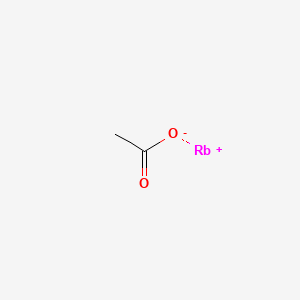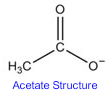
Rubidium Acetate is a moderately water soluble crystalline Rubidium source that decomposes to Rubidium oxide on heating. It is generally immediately available in most volumes. Acetates are excellent precursors for production of ultra high purity compounds and certain catalyst and nanoscale(nanoparticles and nanopowders) materials. All metallic acetates are inorganic salts of a metal cation and the acetate anion. The acetate anion is a univalent (-1 charge) polyatomic ion composed of two carbon atoms ionically bound to three hydrogen and two oxygen atoms (Symbol: CH3COO) for a total formula weight of 59.05. High purity, submicron and nanopowder forms may be considered. We also produce Rubidium Acetate Solution.American Elements produces to many standard grades when applicable, including Mil Spec (military grade); ACS, Reagent and Technical Grade; Food, Agricultural and Pharmaceutical Grade; Optical Grade, USP and EP/BP (European Pharmacopoeia/British Pharmacopoeia)and follows applicable ASTM testing standards.Typical and custom packaging is available. Additional technical, research and safety (MSDS) information is available as is a Reference Calculator for converting relevant units of measurement.
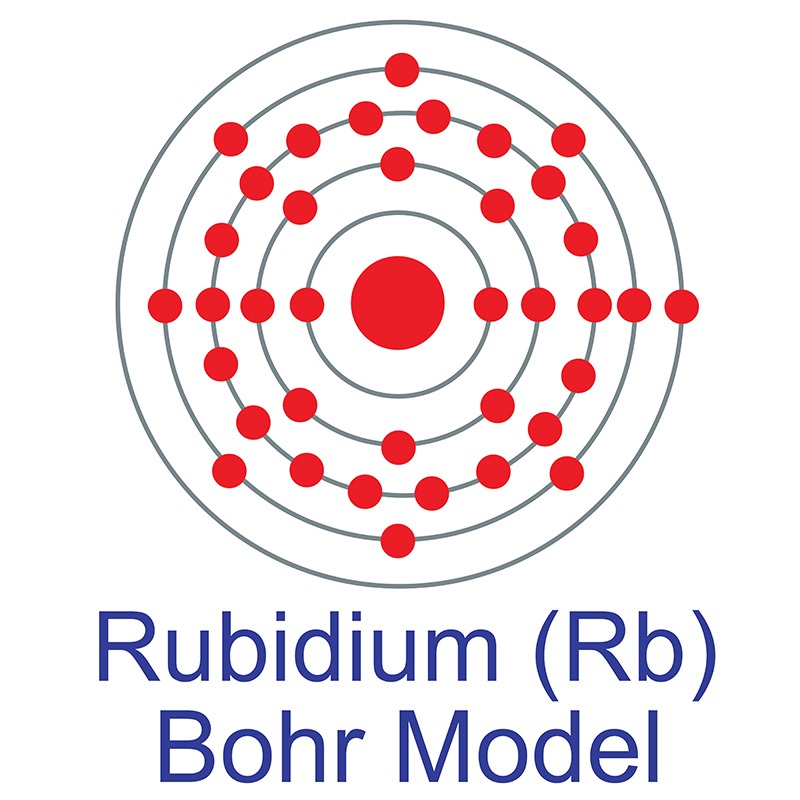
Rubidium is a Block S, Group 1, Period 5 element. The number of electrons in each of Rubidium's shells is 2, 8, 18, 8, 1 and its electronic configuration is [Kr] 5s1. In its elemental form rubidium 's CAS number is 7440-17-7. The rubidium atom has a radius of 247.5.pm and it's Van der Waals radius is 200.pm. Rubidium is not toxic. Rubidium has various applications in medicine and in photoelectronics. Rubidium is available as metal and compounds with purities from 99% to 99.999% (ACS grade to ultra-high purity); metals in the form of foil, sputtering target, and rod, and compounds as submicron and nanopowder. It is used in photo and detection cells production. It is used in photo and detection cells production. Rubidium glass compositions have the highest room temperature conductivity. It has been used as a "getter" in vacuum tubes. Rubidium was first discovered by Robert Wilhem Bunsen and Gustav Robert Kirchhoff in 1861. The name Rubidium, originates from the Latin word 'Rubidius' which means dark or deepest red. See Rubidium research below.
Acetate is an anion used as a ligand in metal complexes. The formula is CH3CO2-, C2H3O2-, or CH3COO-. Metal acetates are used in biology, printing, vinyl acetate in plastic production, volatile organic esters as solvents and cellulose acetate in photographic films and textiles. Cellulose acetate, one of the first synthetic fibers, is often called acetate.
PACKAGING SPECIFICATIONS FOR BULK & RESEARCH QUANTITIES
Typical bulk packaging includes palletized plastic 5 gallon/25 kg. pails, fiber and steel drums to 1 ton super sacks in full container (FCL) or truck load (T/L) quantities. Research and sample quantities and hygroscopic, oxidizing or other air sensitive materials may be packaged under argon or vacuum. Shipping documentation includes a Certificate of Analysis and Material Safety Data Sheet (MSDS). Solutions are packaged in polypropylene, plastic or glass jars up to palletized 440 gallon liquid totes.
Search by Material, Product Name, Product Code, CAS Number, Formula, Element, Anion, Form, EC Number, MDL Number or PubChem ID.
Quantitative relationship between the extent and morphology of coronary atherosclerotic plaque and downstream myocardial perfusion.
Naya M, Murthy VL, Blankstein R, Sitek A, Hainer J, Foster C, Gaber M, Fantony JM, Dorbala S, Di Carli MF.
J Am Coll Cardiol. 2011 Oct 18;58(17):1807-16.
PMID:
21996395
[PubMed - in process]
The fate of minor alkali elements in the chemical evolution of salt lakes.
Witherow RA, Lyons WB.
Saline Systems. 2011 Oct 12;7(1):2. [Epub ahead of print]
PMID:
21992434
[PubMed - as supplied by publisher]
A high-pressure single-crystal synchrotron diffraction study of NH(4)RbTe(4)O(9)·2H(2)O: stability of three different TeO(x) coordination polyhedra.
Friese K, Halasyamani PS, Tolkiehn M, Grzechnik A.
Acta Crystallogr C. 2011 Oct;67(Pt 10):i45-i49. Epub 2011 Sep 2.
PMID:
21979964
[PubMed - in process]
Noise reduction in spectral CT: Reducing dose and breaking the trade-off between image noise and energy bin selection.
Leng S, Yu L, Wang J, Fletcher JG, Mistretta CA, McCollough CH.
Med Phys. 2011 Sep;38(9):4946.
PMID:
21978039
[PubMed - in process]
All-optical switching in an N-type foul-level atom-cavity system.
Sheng J, Yang X, Khadka U, Xiao M.
Opt Express. 2011 Aug 29;19(18):17059-64. doi: 10.1364/OE.19.017059.
PMID:
21935066
[PubMed - in process]
Excitation of Rydberg states in rubidium with near infrared diode lasers.
Fahey DP, Noel MW.
Opt Express. 2011 Aug 29;19(18):17002-12. doi: 10.1364/OE.19.017002.
PMID:
21935060
[PubMed - in process]
Photon statistics and polarization correlations at telecommunications wavelengths from a warm atomic ensemble.
Willis RT, Becerra FE, Orozco LA, Rolston SL.
Opt Express. 2011 Jul 18;19(15):14632-41. doi: 10.1364/OE.19.014632.
PMID:
21934825
[PubMed - in process]
Urinary rubidium in breast cancers.
Su Y, Chen LJ, He JR, Yuan XJ, Cen YL, Su FX, Tang LY, Zhang AH, Chen WQ, Lin Y, Wang SM, Ren ZF.
Clin Chim Acta. 2011 Nov 20;412(23-24):2305-9. Epub 2011 Sep 2.
PMID:
21910977
[PubMed - in process]
Rydberg excitations in bose-einstein condensates in quasi-one-dimensional potentials and optical lattices.
Viteau M, Bason MG, Radogostowicz J, Malossi N, Ciampini D, Morsch O, Arimondo E.
Phys Rev Lett. 2011 Aug 5;107(6):060402. Epub 2011 Aug 2.
PMID:
21902300
[PubMed - in process]
Rubidium-82 uptake in metastases from pheochromocytoma on PET myocardial perfusion images.
Gupta A, DiFilippo FP, Brunken RC.
Clin Nucl Med. 2011 Oct;36(10):930-1. No abstract available.
PMID:
21892051
[PubMed - in process]
Methods and evaluation of frequency aging in distributed-feedback laser diodes for rubidium atomic clocks.
Matthey R, Affolderbach C, Mileti G.
Opt Lett. 2011 Sep 1;36(17):3311-3. doi: 10.1364/OL.36.003311.
PMID:
21886194
[PubMed - in process]
Incremental Diagnostic Value of Regional Myocardial Blood Flow Quantification Over Relative Perfusion Imaging With Generator-Produced Rubidium-82 PET.
Yoshinaga K, Katoh C, Manabe O, Klein R, Naya M, Sakakibara M, Yamada S, Dekemp RA, Tsutsui H, Tamaki N.
Circ J. 2011 Aug 27. [Epub ahead of print]
PMID:
21873801
[PubMed - as supplied by publisher]
Homo- and heteronuclear alkali metal trimers formed on helium nanodroplets. Part I. Vibronic spectra simulations based on ab initio calculations.
Hauser AW, Ernst WE.
Phys Chem Chem Phys. 2011 Aug 25. [Epub ahead of print]
PMID:
21869966
[PubMed - as supplied by publisher]
Relationship between chemical structure and biological activity of alkali metal o-, m- and p-anisates. FT-IR and microbiological studies.
Kalinowska M, Piekut J, Lewandowski W.
Spectrochim Acta A Mol Biomol Spectrosc. 2011 Nov;82(1):432-6. Epub 2011 Jul 28.
PMID:
21852187
[PubMed - in process]
[The evaluation of uncertainty in the results for elements rubidium, strontium, yttrium and zirconium in silicate geological samples by polarized energy dispersive X-ray fluorescence spectrometry].
Wang YY, Zhan XC, Yuan JH, Fan XT.
Guang Pu Xue Yu Guang Pu Fen Xi. 2011 Jun;31(6):1707-11. Chinese.
PMID:
21847963
[PubMed - in process]
Structure of the alkali-metal-atom + strontium molecular ions: towards photoassociation and formation of cold molecular ions.
Aymar M, Guérout R, Dulieu O.
J Chem Phys. 2011 Aug 14;135(6):064305.
PMID:
21842931
[PubMed - in process]
Poly[(µ(5)-3,5-dinitro-benzoato)rubidium].
Miao Y, Zhang X, Liu C.
Acta Crystallogr Sect E Struct Rep Online. 2011 Jul 1;67(Pt 7):m1002. Epub 2011 Jun 30.
PMID:
21836829
[PubMed - in process]
A young source for the Hawaiian plume.
Sobolev AV, Hofmann AW, Jochum KP, Kuzmin DV, Stoll B.
Nature. 2011 Aug 10;476(7361):434-7. doi: 10.1038/nature10321.
PMID:
21832996
[PubMed]
Leaving relativity behind: quantitative clinical perfusion imaging.
Bengel FM.
J Am Coll Cardiol. 2011 Aug 9;58(7):749-51. No abstract available.
PMID:
21816312
[PubMed - indexed for MEDLINE]
Impaired myocardial flow reserve on rubidium-82 positron emission tomography imaging predicts adverse outcomes in patients assessed for myocardial ischemia.
Ziadi MC, Dekemp RA, Williams KA, Guo A, Chow BJ, Renaud JM, Ruddy TD, Sarveswaran N, Tee RE, Beanlands RS.
J Am Coll Cardiol. 2011 Aug 9;58(7):740-8.
PMID:
21816311
[PubMed - indexed for MEDLINE]