American Elements Logo and U.S. Registered Trademark


Rhodium Acetate
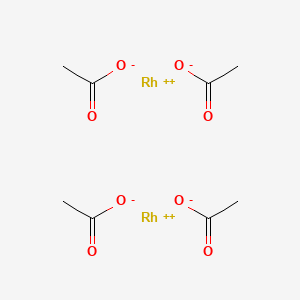
[Rh(O2CCH3)2]2
Product Product Code Order or Specifications
(2N) 99% Rhodium Acetate RH-AC-02 Contact American Elements
(3N) 99.9% Rhodium Acetate RH-AC-03 Contact American Elements
(4N) 99.99% Rhodium Acetate RH-AC-04 Contact American Elements
(5N) 99.999% Rhodium Acetate RH-AC-05 Contact American Elements


CHEMICAL
IDENTIFICATION
Formula CAS No. PubChem
SID
PubChem CID MDL No. EC No IUPAC Name Beilstein
Re. No.
SMILES
Identifier
InChI
Identifier
InChI
Key
[Rh(O2CCH3)2]2 15956-28-2 24871707 168478 MFCD00003538 240-084-8 Rhodium(+2) cation diacetate   [Rh+2].[O-]C(=O)C.[O-]C(=O)C InChI=1S/2C2H4O2.Rh/c2*1-2(3)4;/h2*1H3,(H,3,4);/q;;+2/p-2 ITDJKCJYYAQMRO-UHFFFAOYSA-L

Compound Formula Mol. Wt. Appearance Density

Exact Mass

Monoisotopic Mass Charge MSDS
C4H6O4Rh 442.00 Greenish-Black Powder 0.888g/cm3 279.945 g/mol; 220.932113 Da 0 Safety Data Sheet


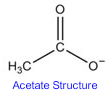
Acetate Formula StructureRhodium Acetate is a moderately water soluble crystalline Rhodium source that decomposes to Rhodium oxide on heating. It is generally immediately available in most volumes. Acetates are excellent precursors for production of ultra high purity compounds and certain catalyst and nanoscale(nanoparticles and nanopowders) materials. All metallic acetates are inorganic salts of a metal cation and the acetate anion. The acetate anion is a univalent (-1 charge) polyatomic ion composed of two carbon atoms ionically bound to three hydrogen and two oxygen atoms (Symbol: CH3COO) for a total formula weight of 59.05. High purity, submicron and nanopowder forms may be considered. We also produce Rhodium Acetate Solution.American Elements produces to many standard grades when applicable, including Mil Spec (military grade); ACS, Reagent and Technical Grade; Food, Agricultural and Pharmaceutical Grade; Optical Grade, USP and EP/BP (European Pharmacopoeia/British Pharmacopoeia)and follows applicable ASTM testing standards.Typical and custom packaging is available. Additional technical, research and safety (MSDS) information is available as is a Reference Calculator for converting relevant units of measurement.

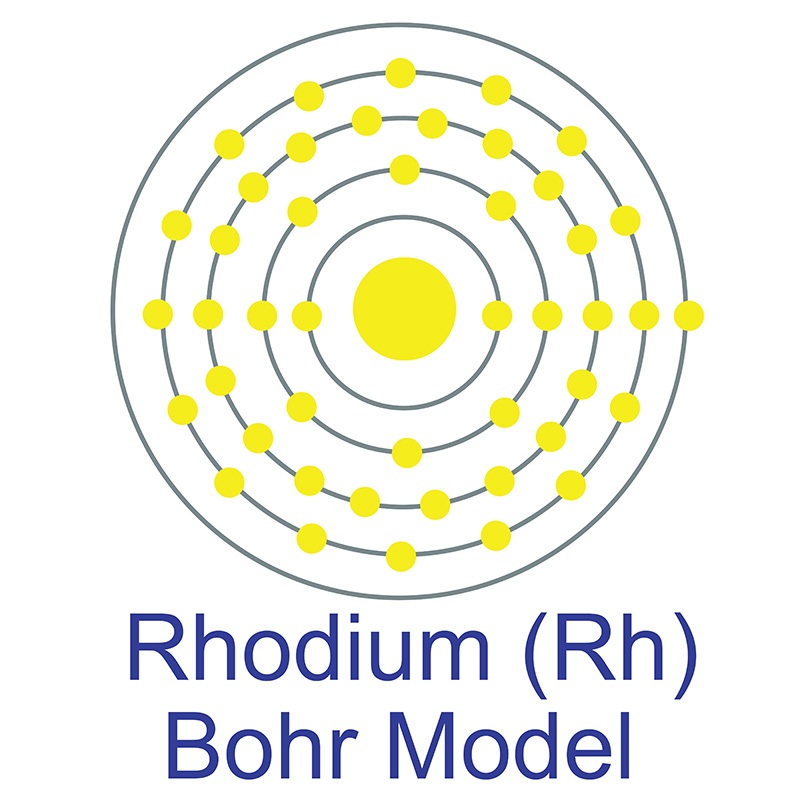
Rhodium(Rh) atomic and molecular weight, atomic number and elemental symbolRhodium is a Block D, Group 9, Period 5 element. The number of electrons in each of Rhodium's shells is 2, 8, 18, 16, 1 and its electronic configuration is [Kr] 4d8 5s1. In its elemental form rhodium's CAS number is 7440-16-6. The rhodium atom has a radius of 134.5.pm and it's Van der Waals radius is 200.pm. Rhodium is not toxic. Rhodium is a member of the platinum group of metals. It has a higher melting point than platinum, but a lower Rhodium Bohr Modeldensity. It is alloyed with platinum and palladium in electrodes for spark plugs, advanced laboratory equipment and in thermocouples. Rhodium compounds also have catalytic uses in automotive catalytic converters. Rhodium is used as a plating metal in jewelry production to enhance the whiteness of white gold. Rhodium is available as metal and compounds with purities from 99% to 99.999% (ACS grade to ultra-high purity); metals in the form of foil, sputtering target, and rod, and compounds as submicron and nanopowder. Rhodium was first discovered by William Wollaston in 1803. The name Rhodium, originates from the Greek word 'Rhodon' which means rose. See Rhodium research below.

Acetate is an anion used as a ligand in metal complexes. The formula is CH3CO2-, C2H3O2-, or CH3COO-. Metal acetates are used in biology, printing, vinyl acetate in plastic production, volatile organic esters as solvents and cellulose acetate in photographic films and textiles. Cellulose acetate, one of the first synthetic fibers, is often called acetate.

Have a Question? Ask a Chemical Engineer or Material Scientist   Request an MSDS or Certificate of Analysis

 
Safety &
Handling
 
Signal Word Hazard Statements Hazard Codes Risk Codes Safety Precautions RTECS No. Transport Information WGK Germany
N/A N/A N/A N/A N/A N/A N/A 3


Synonyms for Rhodium Acetate Include:


rhodium(2+) diacetate
Tetrakis(acetato)dirhodium(II)
Acetic acid, rhodium(2+) salt (2:1)
Dirhodium tetraacetate
Rhodium(2+) diacetate
Rhodium (II) acetate
Rhodium diacetate
Rhodium(3+) triacetate
Rhodium(+2) cation diacetate
Dirhodium tetracetate dihydrate


PACKAGING SPECIFICATIONS FOR BULK & RESEARCH QUANTITIES


Typical bulk packaging includes palletized plastic 5 gallon/25 kg. pails, fiber and steel drums to 1 ton super sacks in full container (FCL) or truck load (T/L) quantities. Research and sample quantities and hygroscopic, oxidizing or other air sensitive materials may be packaged under argon or vacuum. Shipping documentation includes a Certificate of Analysis and Material Safety Data Sheet (MSDS). Solutions are packaged in polypropylene, plastic or glass jars up to palletized 440 gallon liquid totes.


Show more forms of Rhodium
 
Customers for this product have also looked at:
Rhodium Oxide Rhodium Oxide Pellets Rhodium Acetate Rhodium Chloride Rhodium Pellets
Rhodium Rod Rhodium Metal
Rhodium Oxide Nanopowder
Iron Rhodium Rhodium Foil
Rhodium Sulfate Rhodium Sputtering Target Platinum-rhodium alloy Rhodium Acetylacetonate Rhodium Powder


Search by Material, Product Name, Product Code, CAS Number, Formula, Element, Anion, Form, EC Number, MDL Number or PubChem ID.


German   Korean   French   Japanese   Spanish   Chinese (Simplified)   Portuguese   Russian   Chinese (Taiwan)   Italian   Turkish   Polish   Dutch   Czech   Swedish   Hungarian   Danish   Hebrew

Production Catalog Available in 36 Countries & Languages


Recent Research & Development for Rhodium

  • Direct Access to Parent Amido Complexes of Rhodium and Iridium through N?H Activation of Ammonia. Mena I, Casado MA, García-Orduña P, Polo V, Lahoz FJ, Fazal A, Oro LA. Angew Chem Int Ed Engl. 2011 Oct 12. doi: 10.1002/anie.201104745. [Epub ahead of print] No abstract available. PMID: 21994125 [PubMed - as supplied by publisher]

  • Asymmetric Hydrogenation of ?- and ?-Enamido Phosphonates: Rhodium(I)/Monodentate Phosphoramidite Catalyst. Zhang J, Li Y, Wang Z, Ding K. Angew Chem Int Ed Engl. 2011 Oct 11. doi: 10.1002/anie.201104912. [Epub ahead of print] No abstract available. PMID: 21990114 [PubMed - as supplied by publisher]

  • An operando DRIFTS investigation into the resistance against CO(2) poisoning of a Rh/alumina catalyst during toluene hydrogenation. Scalbert J, Meunier FC, Daniel C, Schuurman Y. Phys Chem Chem Phys. 2011 Oct 11. [Epub ahead of print] PMID: 21989590 [PubMed - as supplied by publisher]

  • Rh(III)-Catalyzed Oxidative Olefination of N-(1-Naphthyl)sulfonamides Using Activated and Unactivated Alkenes. Li X, Gong X, Zhao M, Song G, Deng J, Li X. Org Lett. 2011 Oct 11. [Epub ahead of print] PMID: 21988638 [PubMed - as supplied by publisher]

  • Synthesis of Isochromene and Related Derivatives by Rhodium-Catalyzed Oxidative Coupling of Benzyl and Allyl Alcohols with Alkynes. Morimoto K, Hirano K, Satoh T, Miura M. J Org Chem. 2011 Oct 11. [Epub ahead of print] PMID: 21988500 [PubMed - as supplied by publisher]

  • Pyridine synthesis from oximes and alkynes via rhodium(iii) catalysis: Cp* and Cp(t) provide complementary selectivity. Hyster TK, Rovis T. Chem Commun (Camb). 2011 Oct 10. [Epub ahead of print] PMID: 21986995 [PubMed - as supplied by publisher]

  • Rhodium-catalyzed redox allylation reactions of ketones. Williams FJ, Grote RE, Jarvo ER. Chem Commun (Camb). 2011 Oct 10. [Epub ahead of print] PMID: 21984365 [PubMed - as supplied by publisher]

  • Enantioselective Rhodium(I)-Catalyzed [3+2] Annulations of Aromatic Ketimines Induced by Directed C?H Activations. Tran DN, Cramer N. Angew Chem Int Ed Engl. 2011 Oct 4. doi: 10.1002/anie.201105766. [Epub ahead of print] No abstract available. PMID: 21976453 [PubMed - as supplied by publisher]

  • Asymmetric N?H Insertion Reaction Cooperatively Catalyzed by Rhodium and Chiral Spiro Phosphoric Acids. Xu B, Zhu SF, Xie XL, Shen JJ, Zhou QL. Angew Chem Int Ed Engl. 2011 Oct 4. doi: 10.1002/anie.201105485. [Epub ahead of print] No abstract available. PMID: 21976452 [PubMed - as supplied by publisher]

  • Rhodium-Catalyzed Reaction of 1-Alkenylboronates with Aldehydes Leading to Allylation Products. Shimizu H, Igarashi T, Miura T, Murakami M. Angew Chem Int Ed Engl. 2011 Oct 4. doi: 10.1002/anie.201105148. [Epub ahead of print] No abstract available. PMID: 21976365 [PubMed - as supplied by publisher]

  • Rhodium-Catalyzed Annulation of N-Benzoylsulfonamide with Isocyanide through C?H Activation. Zhu C, Xie W, Falck JR. Chemistry. 2011 Oct 4. doi: 10.1002/chem.201102475. [Epub ahead of print] No abstract available. PMID: 21972033 [PubMed - as supplied by publisher]

  • "Cofactor"-Controlled Enantioselective Catalysis. Dydio P, Rubay C, Gadzikwa T, Lutz M, Reek JN. J Am Chem Soc. 2011 Oct 11. [Epub ahead of print] PMID: 21961536 [PubMed - as supplied by publisher]

  • Selective hydroformylation-hydrogenation tandem reaction of isoprene to 3-methylpentanal. Behr A, Reyer S, Tenhumberg N. Dalton Trans. 2011 Sep 29. [Epub ahead of print] PMID: 21960209 [PubMed - as supplied by publisher]

  • Synthesis of ?,?-Disubstituted Aryl Amines by Rhodium-Catalyzed Amination of Tertiary Allylic Trichloroacetimidates. Arnold JS, Cizio GT, Nguyen HM. Org Lett. 2011 Oct 21;13(20):5576-9. Epub 2011 Sep 29. PMID: 21958228 [PubMed - in process]

  • Unravelling the Reaction Path of Rhodium-MonoPhos-Catalysed Olefin Hydrogenation. Alberico E, Baumann W, de Vries JG, Drexler HJ, Gladiali S, Heller D, Henderickx HJ, Lefort L. Chemistry. 2011 Sep 28. doi: 10.1002/chem.201101793. [Epub ahead of print] PMID: 21956660 [PubMed - as supplied by publisher]

  • Fluorous Hydrosilylation. Carreira M, Contel M. Top Curr Chem. 2011 Sep 28. [Epub ahead of print] PMID: 21952841 [PubMed - as supplied by publisher]

  • The oxidative conversion of the N,S-bridged complexes [{RhLL'(?-X)}(2)] to [(RhLL')(3)(?-X)(2)](+) (X = mt or taz): a comparison with the oxidation of N,N-bridged analogues. Blagg RJ, López-Gómez MJ, Charmant JP, Connelly NG, Cowell JJ, Haddow MF, Hamilton A, Orpen AG, Riis-Johannessen T, Saithong S. Dalton Trans. 2011 Sep 27. [Epub ahead of print] PMID: 21952645 [PubMed - as supplied by publisher]

  • Ligand Fluorination to Optimize Preferential Oxidation (PROX) of Carbon Monoxide by Water-Soluble Rhodium Porphyrins. Biffinger JC, Uppaluri S, Sun H, Dimagno SG. ACS Catal. 2011 May 18;1(7):764-771. PMID: 21949596 [PubMed]

  • Rhodium-Catalyzed Intermolecular [2+2+2] Cross-Trimerization of Aryl Ethynyl Ethers and Carbonyl Compounds To Produce Dienyl Esters. Miyauchi Y, Kobayashi M, Tanaka K. Angew Chem Int Ed Engl. 2011 Sep 21. doi: 10.1002/anie.201105519. [Epub ahead of print] No abstract available. PMID: 21948312 [PubMed - as supplied by publisher]

  • Zinc-catalyzed allenylations of aldehydes and ketones. Fandrick DR, Saha J, Fandrick KR, Sanyal S, Ogikubo J, Lee H, Roschangar F, Song JJ, Senanayake CH. Org Lett. 2011 Oct 21;13(20):5616-9. Epub 2011 Sep 26. PMID: 21942658 [PubMed - in process]


USA Science & Engineering FestivalSponsors of the United States Science & Engineering Festival on April 28, 2012 in Washington D.C. Please join us and our customers & co-sponsors NASA, Lockheed Martin and the Department of Defense inspiring the next generation of scientists and engineers.


PRODUCT CATALOG News Foil Submicron & Nanopowder Tolling Ultra High Purity Sputtering Target Crystal Growth Rod, Plate, Powder, etc. Home

  Print this Page
Periodic table of the elements science and academic information, elements and advanced materials data, scientific presentations and all pages, designs, concepts, logos, and color schemes herein are the copyrighted proprietary rights and intellectual property of American Elements. American Elements is a U.S. Registered Trademark. © 2001-2012. American Elements. All rights reserved.
Learn Six Sigma


American Elements is a copyrighted U.S. Trademark. All rights reserved.