American Elements produces to many standard grades when applicable, including Mil Spec (military grade); ACS, Reagent and Technical Grade; Food, Agricultural and Pharmaceutical Grade; Optical Grade, USP and EP/BP (European Pharmacopeia/British Pharmacopeia) and follows applicable ASTM testing standards.See safety data and research below and pricing/lead time above. American Elements specializes in producing high purity Rhodium Phosphide Sputtering targets with the highest possible density and smallest possible average grain sizes for use in semiconductor, chemical vapor deposition (CVD) and physical vapor deposition (PVD) display and optical applications. Our standard Sputtering Targets for thin film are available monoblock or bonded with dimensions and configurations up to 820 mm with hole drill locations and threading, beveling, grooves and backing designed to work with both older sputtering devises as well as the latest process equipment, such as large area coating for solar energy or fuel cells and flip-chip applications. Research sized targets are also produced as well as custom sizes and alloys. All targets are analyzed using best demonstrated techniques including X-Ray Fluorescence (XRF), Glow Discharge Mass Spectrometry (GDMS), and Inductively Coupled Plasma (ICP). "Sputtering" allows for thin film deposition of an ultra high purity sputtering metallic or oxide material onto another solid substrate by the controlled removal and conversion of the target material into a directed gaseous/plasma phase through ionic bombardment. "Sputtering" allows for thin film deposition of an ultra high purity sputtering metallic or oxide material onto another solid substrate by the controlled removal and conversion of the target material into a directed gaseous/plasma phase through ionic bombardment. We can also provide targets outside this range in addition to just about any size rectangular, annular, or oval target. Materials are produced using crystallization, solid state and other ultra high purification processes such as sublimation. American Elements specializes in producing custom compositions for commercial and research applications and for new proprietary technologies. American Elements also casts any of the rare earth metals and most other advanced materials into rod, bar or plate form, as well as other machined shapes and through other processes nanoparticles. We also produce Rhodium as disc, granules, ingot, pellets, pieces, powder, and rod. Other shapes are available by request.
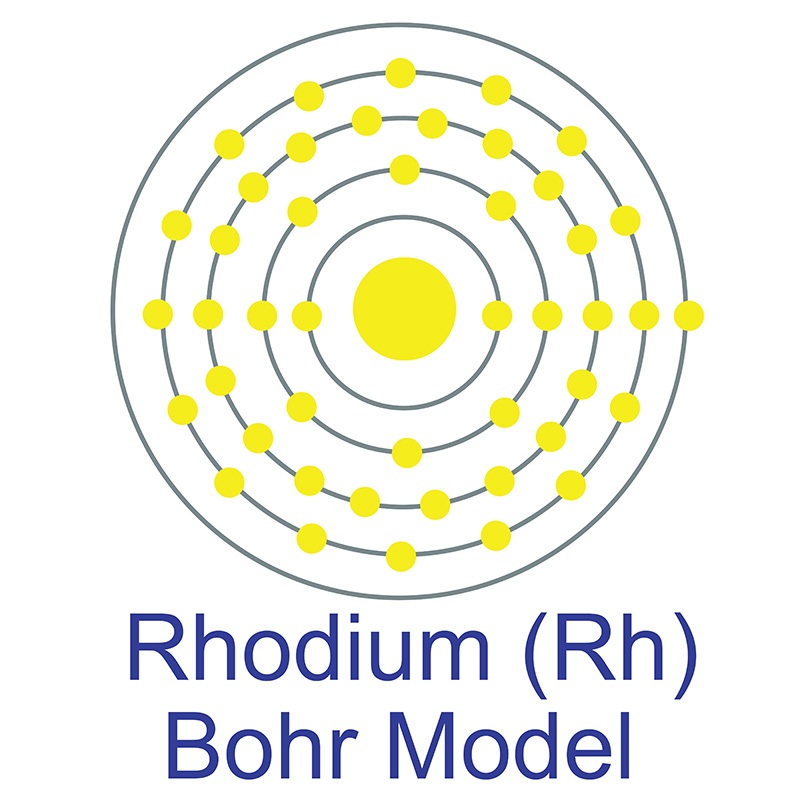
Rhodium is a Block D, Group 9, Period 5 element. The number of electrons in each of Rhodium's shells is 2, 8, 18, 16, 1 and its electronic configuration is [Kr] 4d8 5s1. In its elemental form rhodium's CAS number is 7440-16-6. The rhodium atom has a radius of 134.5.pm and it's Van der Waals radius is 200.pm. Rhodium is not toxic. Rhodium is a member of the platinum group of metals. It has a higher melting point than platinum, but a lower density.
It is alloyed with platinum and palladium in electrodes for spark plugs, advanced laboratory equipment and in thermocouples. Rhodium compounds also have catalytic uses in automotive catalytic converters. Rhodium is used as a plating metal in jewelry production to enhance the whiteness of white gold. Rhodium is available as metal and compounds with purities from 99% to 99.999% (ACS grade to ultra-high purity); metals in the form of foil, sputtering target, and rod, and compounds as submicron and nanopowder. Rhodium was first discovered by William Wollaston in 1803. The name Rhodium, originates from the Greek word 'Rhodon' which means rose. See Rhodium research below.
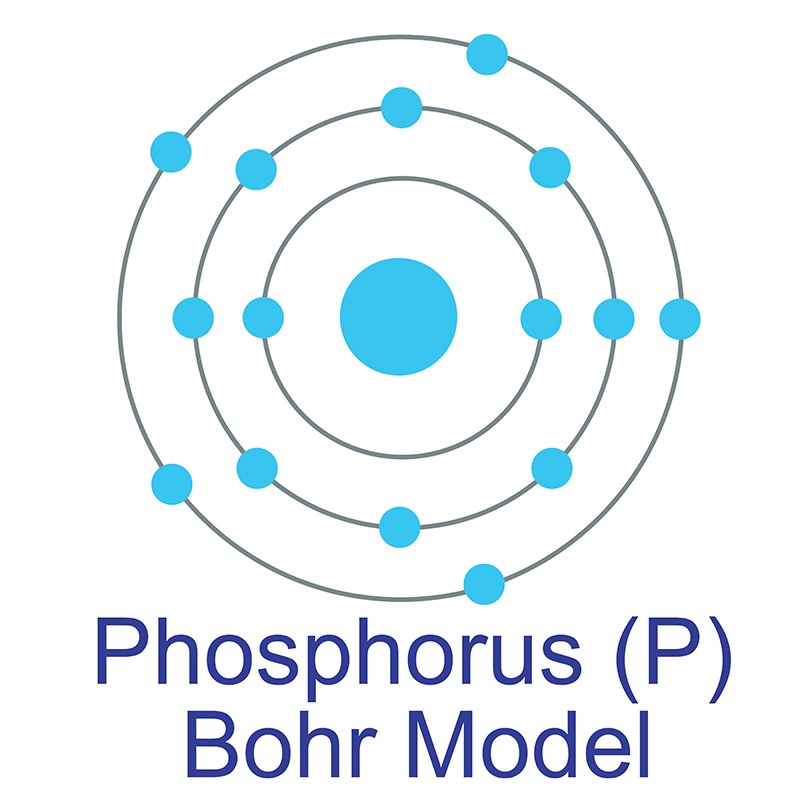
Phosphorus is a Block P, Group 15, Period 3 element. The number of electrons in each of Phosphorus's shells is 2, 8, 5 and its electronic configuration is [Ne] 3s2 3p3. In its elemental form Phosphorus's CAS number is 7723-14-0. The Phosphorus atom has a radius of 110.5.pm and it's Van der Waals radius is 180.pm. Although white phosphorus is very toxic, red phosphorus is not considered toxic.
American Elements semi conducting materials are crystal structures produced from ultra high purity starting materials synthesized by our high purity production facility which includes several large electric muffle furnaces, a tube furnace for hydrogen reduction, 50 gallon glass-lined Pfaudler reactors supported by our analytical laboratory containing X-ray diffraction, SEM, AA, BET surface area, and ICP Spectrometry for trace metals analysis. See a discussion of American Elements Ultra High Purity and Analytical capabilities. See Crystal Growth for processes used to fabricate semiconductor materials, which include:
Crystal "pulling" by the Czochaiski method for production of semiconductor materials
Flux growth and gradient freeze
Directional solidification of fluorites using both the Bridgman-Stockbarger and float zoning techniques
Preparation of Rhodium Nanoparticles in Carbon Dioxide Induced Ionic Liquids and their Application to Selective Hydrogenation.
Cimpeanu V, Kocevar M, Parvulescu VI, Leitner W.
Angew Chem Int Ed Engl. 2008 Dec 30. [Epub ahead of print] No abstract available.
PMID: 19116999 [PubMed - as supplied by publisher]
Stereoselective Hydrogenation of Olefins Using Rhodium-Substituted Carbonic Anhydrase-A New Reductase.
Jing Q, Okrasa K, Kazlauskas RJ.
Chemistry. 2008 Dec 29. [Epub ahead of print]
PMID: 19115310 [PubMed - as supplied by publisher]
Chelation-Assisted Carbon-Halogen Bond Activation by a Rhodium(I) Complex.
Chen S, Li Y, Zhao J, Li X.
Inorg Chem. 2008 Dec 23. [Epub ahead of print]
PMID: 19105736 [PubMed - as supplied by publisher]
Catalytic Carbon-Carbon sigma Bond Activation: An Intramolecular Carbo-Acylation Reaction with Acylquinolines.
Dreis AM, Douglas CJ.
J Am Chem Soc. 2008 Dec 23. [Epub ahead of print]
PMID: 19105696 [PubMed - as supplied by publisher]
Cytotoxic Rhodium(III) and Iridium(III) Polypyridyl Complexes: Structure-Activity Relationships, Antileukemic Activity, and Apoptosis Induction.
Dobroschke M, Geldmacher Y, Ott I, Harlos M, Kater L, Wagner L, Gust R, Sheldrick WS, Prokop A.
ChemMedChem. 2008 Dec 19. [Epub ahead of print]
PMID: 19101960 [PubMed - as supplied by publisher]
Transition-Metal-Catalyzed Enantioselective [2+2+2] Cycloadditions for the Synthesis of Axially Chiral Biaryls.
Tanaka K.
Chem Asian J. 2008 Dec 19. [Epub ahead of print]
PMID: 19101940 [PubMed - as supplied by publisher]
Dendrimer-rhodium nanoparticle modified glassy carbon electrode for amperometric detection of hydrogen peroxide.
Chandra S, Lokesh KS, Nicolai A, Lang H.
Anal Chim Acta. 2009 Jan 19;632(1):63-8. Epub 2008 Nov 5.
PMID: 19100883 [PubMed - in process]
Rhodium-Catalyzed Direct Oxidative Carbonylation of Aromatic C-H Bond with CO and Alcohols.
Guan ZH, Ren ZH, Spinella SM, Yu S, Liang YM, Zhang X.
J Am Chem Soc. 2008 Dec 19. [Epub ahead of print]
PMID: 19099479 [PubMed - as supplied by publisher]
Alkyl dehydrogenation in a Rh(i) complex via an isolated agostic intermediate.
Chaplin AB, Poblador-Bahamonde AI, Sparkes HA, Howard JA, Macgregor SA, Weller AS.
Chem Commun (Camb). 2009 Jan 14;(2):244-6. Epub 2008 Nov 19.
PMID: 19099083 [PubMed - in process]
Towards [Cp( *)Rh(bpy)(H(2)O)](2+)-promoted P450 catalysis: Direct regeneration of CytC.
Hollmann F, Schmid A.
J Inorg Biochem. 2008 Nov 20. [Epub ahead of print]
PMID: 19087893 [PubMed - as supplied by publisher]
Elevated metallothionein-bound cadmium concentrations in urine from bladder carcinoma patients, investigated by size exclusion chromatography-inductively coupled plasma mass spectrometry.
Wolf C, Strenziok R, Kyriakopoulos A.
Anal Chim Acta. 2009 Jan 12;631(2):218-22. Epub 2008 Nov 1.
PMID: 19084629 [PubMed - in process]
Diastereoisomeric bisphosphite ligands in the hydroformylation of octenes: rhodium catalysis and HP-NMR investigations.
Selent D, Baumann W, Wiese KD, Börner A.
Chem Commun (Camb). 2008 Dec 14;(46):6203-5. Epub 2008 Oct 31.
PMID: 19082120 [PubMed - in process]
Flexible scorpionates for transfer hydrogenation: the first example of their catalytic application.
Tsoureas N, Owen GR, Hamilton A, Orpen AG.
Dalton Trans. 2008 Nov 21;(43):6039-44. Epub 2008 Sep 23.
PMID: 19082061 [PubMed - in process]
Diazaphospholidine terminated polyhedral oligomeric silsesquioxanes in the hydroformylation of vinyl acetate.
Vautravers NR, Cole-Hamilton DJ.
Chem Commun (Camb). 2009 Jan 7;(1):92-4. Epub 2008 Nov 21.
PMID: 19082009 [PubMed - in process]
Stereoelectronic effects in a homologous series of bidentate cyclic phosphines. A clear correlation of hydroformylation catalyst activity with ring size.
Haddow MF, Middleton AJ, Orpen AG, Pringle PG, Papp R.
Dalton Trans. 2009 Jan 7;(1):202-9. Epub 2008 Nov 25.
PMID: 19081990 [PubMed - in process]
A further discussion of the factors controlling the distribution of Pt, Pd, Rh and Au in road dust, gullies, road sweeper and gully flusher sediment in the city of Sheffield, UK.
Prichard HM, Sampson J, Jackson M.
Sci Total Environ. 2008 Dec 9. [Epub ahead of print]
PMID: 19081605 [PubMed - as supplied by publisher]
Quality assurance of PASADENA hyperpolarization for (13)C biomolecules.
Hövener JB, Chekmenev EY, Harris KC, Perman WH, Tran TT, Ross BD, Bhattacharya P.
MAGMA. 2008 Dec 6. [Epub ahead of print]
PMID: 19067009 [PubMed - as supplied by publisher]
Single and Double C--Cl-Activation of Methylene Chloride by P,N-ligand Coordinated Rhodium Complexes.
Blank B, Glatz G, Kempe R.
Chem Asian J. 2008 Dec 8. [Epub ahead of print]
PMID: 19065598 [PubMed - as supplied by publisher]
Practical Method for Asymmetric Addition of Arylboronic Acids to alpha,beta-Unsaturated Carbonyl Compounds Utilizing an In Situ Prepared Rhodium Catalyst.
Lukin K, Zhang Q, Leanna MR.
J Org Chem. 2008 Dec 5. [Epub ahead of print]
PMID: 19061408 [PubMed - as supplied by publisher]
Selectivity control in enantioselective four-component reactions of aryl diazoacetates with alcohols, aldehydes and amines: an efficient approach to synthesizing chiral beta-amino-alpha-hydroxyesters.
Xu X, Zhou J, Yang L, Hu W.
Chem Commun (Camb). 2008 Dec 28;(48):6564-6. Epub 2008 Nov 11.
PMID: 19057780 [PubMed - in process]
Recent Research & Development for Phosphorus
Consumption of whole
grains is associated with improved diet quality and nutrient intake in children
and adolescents: the National Health and Nutrition Examination Survey 1999-2004.
O'Neil CE, Nicklas TA, Zanovec M, Cho SS, Kleinman R. Public Health Nutr. 2010 Oct 6:1-9. [Epub ahead of print] PubMed PMID: 20923597.
Chemical and microbiological changes during
vermicomposting of coffee pulp using exotic (Eudrilus eugeniae) and native
earthworm (Perionyx ceylanesis) species. Raphael K, Velmourougane K. Biodegradation. 2010 Oct 5. [Epub ahead
of print] PubMed PMID: 20922463.
Synthesis, structure,
and reductive elimination in the series Tp'Rh(PR(3))(Ar(F))H; Determination of
rhodium-carbon bond energies of fluoroaryl substituents. Tanabe T, Brennessel WW, Clot E, Eisenstein O, Jones WD. Dalton Trans. 2010 Oct
5. [Epub ahead of print] PubMed PMID: 20924525.
Nutrient concentrations in Maryland non-tidal
streams. Morgan RP 2nd, Kline KM. Environ Monit Assess. 2010 Oct 5. [Epub ahead of print] PubMed PMID:
20890788.
Hereditary disorders of renal
phosphate wasting. Alizadeh Naderi AS, Reilly RF; Medscape. Nat Rev Nephrol. 2010 Oct 5. [Epub ahead of print] PubMed
PMID: 20924400.
New Synthesis of 3-Trifluoromethylpyrroles by
Condensation of Mesoionic 4-Trifluoroacetyl-1,3-oxazolium-5-olates with
Phosphorus Ylides. Saijo R, Hagimoto Y, Kawase M. Org Lett. 2010 Oct 5. [Epub ahead of print] PubMed PMID:
20923166.
Structural and electronic properties of
luminescent copper(i) halide complexes of bis[2-(diphenylphosphano)phenyl] ether
(DPEphos). Crystal structure of [CuCl(DPEphos)(dmpymtH]. Aslanidis P, Cox PJ, Tsipis AC. Dalton Trans. 2010 Oct
4. [Epub ahead of print] PubMed PMID: 20922239.
Changes in
Microbial Community Structure and Function of Drinking Water Treatment
Bioreactors Upon Phosphorus Addition. Li X, Upadhyaya G, Yuen W, Brown J, Morgenroth E, Raskin L. Appl Environ Microbiol. 2010 Oct 1. [Epub
ahead of print] PubMed PMID: 20889793.
Determination of a set
of surrogate parameters to assess urban stormwater quality. Miguntanna NS, Egodawatta P, Kokot S, Goonetilleke A. Sci Total Environ.
2010 Oct 1. [Epub ahead of print] PubMed PMID: 20888615.
A review on the effects of environmental conditions on growth and toxin
production of Ostreopsis ovata. Pistocchi R, Pezzolesi L, Guerrini F, Vanucci S, Dell'aversano C, Fattorusso
E. Toxicon. 2010 Oct 1. [Epub ahead of print] PubMed
PMID: 20920514.
Tenofovir-associated severe bone pain: I cannot walk! Jhaveri MA, Mawad HW, Thornton AC, Mullen NW, Greenberg RN. J Int Assoc Physicians AIDS
Care (Chic Ill). 2010 Sep-Oct;9(5):328-34. PubMed PMID: 20923957.
Characteristics of contaminants in water and
sediment of a constructed wetland treating piggery wastewater effluent. Lee S, Maniquiz MC, Kim LH. J Environ
Sci (China). 2010;22(6):940-5. PubMed PMID: 20923110.
Effect of a seasonal diffuse pollution migration on
natural organic matter behavior in a stratified dam reservoir. Yu SJ, Lee JY, Ha SR. J Environ Sci
(China). 2010;22(6):908-14. PubMed PMID: 20923105.
Water-saving
irrigation of paddy field to reduce nutrient runoff. Hitomi T, Iwamoto Y, Miura A, Hamada K, Takaki K, Shiratani E. J Environ Sci (China).
2010;22(6):885-91. PubMed PMID: 20923101.
Scenario
analysis for reduction of pollutant load discharged from a watershed by recycling
of treated water for irrigation. Shiratani E, Munakata Y, Yoshinaga I, Kubota T, Hamada K, Hitomi T. J Environ Sci (China). 2010;22(6):878-84. PubMed
PMID: 20923100.
Modeling the effects of constructed wetland
on nonpoint source pollution control and reservoir water quality improvement. Ham J, Yoon CG, Kim HJ, Kim HC. J
Environ Sci (China). 2010;22(6):834-9. PubMed PMID: 20923093.
Evaluation of non-point source
pollution reduction by applying best management practices using a SWAT model and
QuickBird high resolution satellite imagery. Lee M, Park G, Park M, Park J, Lee J, Kim S. J Environ Sci (China).
2010;22(6):826-33. PubMed PMID: 20923092.
Understanding nutrient
build-up on urban road surfaces. Miguntanna NP, Goonetilleke A, Egodowatta P, Kokot S. J Environ Sci (China). 2010;22(6):806-12. PubMed
PMID: 20923089.
Monitoring of non-point source pollutants
load from a mixed forest land use. Yoon SW, Chung SW, Oh DG, Lee JW. J Environ Sci (China). 2010;22(6):801-5.
PubMed PMID: 20923088.