American Elements


Rhodium Telluride Sputtering Target
High Purity RhTe Sputtering Target
Product Product Code Order or Specifications
(2N) 99% Rhodium Telluride Sputtering Target RH-TE-02-ST Contact American Elements
(2N5) 99.5% Rhodium Telluride Sputtering Target RH-TE-025-ST Contact American Elements
(3N) 99.9% Rhodium Telluride Sputtering Target RH-TE-03-ST Contact American Elements
(3N5) 99.95% Rhodium Telluride Sputtering Target RH-TE-035-ST Contact American Elements
(4N) 99.99% Rhodium Telluride Sputtering Target RH-TE-04-ST Contact American Elements
(5N) 99.999% Rhodium Telluride Sputtering Target RH-TE-05-ST Contact American Elements
Telluride IonAmerican Elements produces to many standard grades when applicable, including Mil Spec (military grade); ACS, Reagent and Technical Grade; Food, Agricultural and Pharmaceutical Grade; Optical Grade, USP and EP/BP (European Pharmacopeia/British Pharmacopeia) and follows applicable ASTM testing standards.See safety data and research below and pricing/lead time above. American Elements specializes in producing high purity Rhodium Telluride Sputtering targets with the highest possible density High Purity (99.99%) Metallic Sputtering Targetand smallest possible average grain sizes for use in semiconductor, chemical vapor deposition (CVD) and physical vapor deposition (PVD) display and optical applications. Our standard Sputtering Targets for thin film are available monoblock or bonded with dimensions and configurations up to 820 mm with hole drill locations and threading, beveling, grooves and backing designed to work with both older sputtering devises as well as the latest process equipment, such as large area coating for solar energy or fuel cells and flip-chip applications. Research sized targets are also produced as well as custom sizes and alloys. All targets are analyzed using best demonstrated techniques including X-Ray Fluorescence (XRF), Glow Discharge Mass Spectrometry (GDMS), and Inductively Coupled Plasma (ICP). "Sputtering" allows for thin film deposition of an ultra high purity sputtering metallic or oxide material onto another solid substrate by the controlled removal and conversion of the target material into a directed gaseous/plasma phase through ionic bombardment. "Sputtering" allows for thin film deposition of an ultra high purity sputtering metallic or oxide material onto another solid substrate by the controlled removal and conversion of the target material into a directed gaseous/plasma phase through ionic bombardment. We can also provide targets outside this range in addition to just about any size rectangular, annular, or oval target. Materials are produced using crystallization, solid state and other ultra high purification processes such as sublimation. American Elements specializes in producing custom compositions for commercial and research applications and for new proprietary technologies. American Elements also casts any of the rare earth metals and most other advanced materials into rod, bar or plate form, as well as other machined shapes and through other processes nanoparticles. We also produce Rhodium as disc, granules, ingot, pellets, pieces, powder, and rod. Other shapes are available by request.

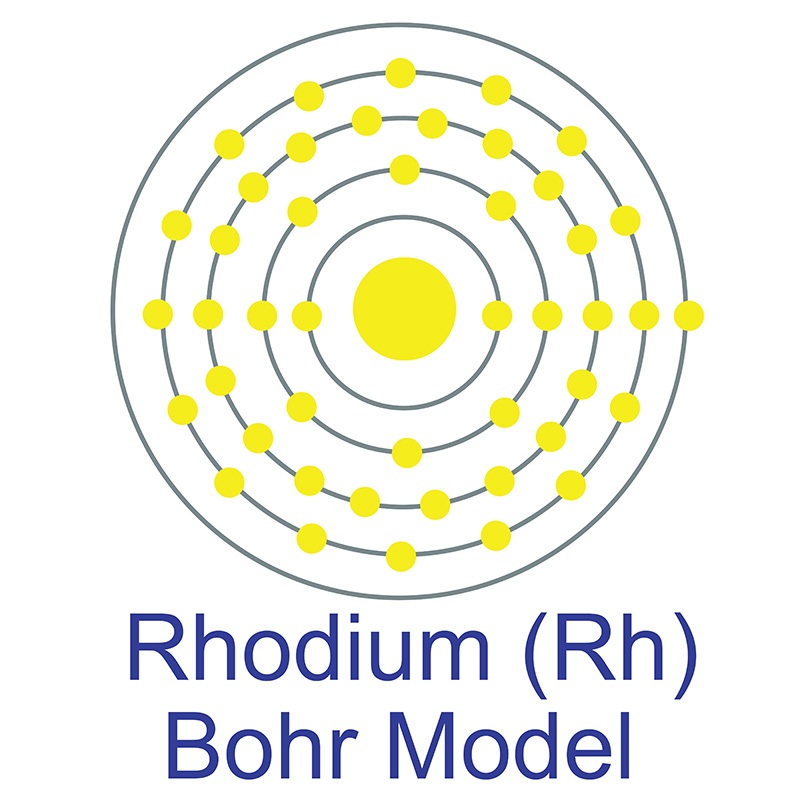
Rhodium(Rh) atomic and molecular weight, atomic number and elemental symbolRhodium is a Block D, Group 9, Period 5 element. The number of electrons in each of Rhodium's shells is 2, 8, 18, 16, 1 and its electronic configuration is [Kr] 4d8 5s1. In its elemental form rhodium's CAS number is 7440-16-6. The rhodium atom has a radius of 134.5.pm and it's Van der Waals radius is 200.pm. Rhodium is not toxic. Rhodium is a member of the platinum group of metals. It has a higher melting point than platinum, Elemental Rhodiumbut a lower Rhodium Bohr Modeldensity. It is alloyed with platinum and palladium in electrodes for spark plugs, advanced laboratory equipment and in thermocouples. Rhodium compounds also have catalytic uses in automotive catalytic converters. Rhodium is used as a plating metal in jewelry production to enhance the whiteness of white gold. Rhodium is available as metal and compounds with purities from 99% to 99.999% (ACS grade to ultra-high purity); metals in the form of foil, sputtering target, and rod, and compounds as submicron and nanopowder. Rhodium was first discovered by William Wollaston in 1803. The name Rhodium, originates from the Greek word 'Rhodon' which means rose. See Rhodium research below.

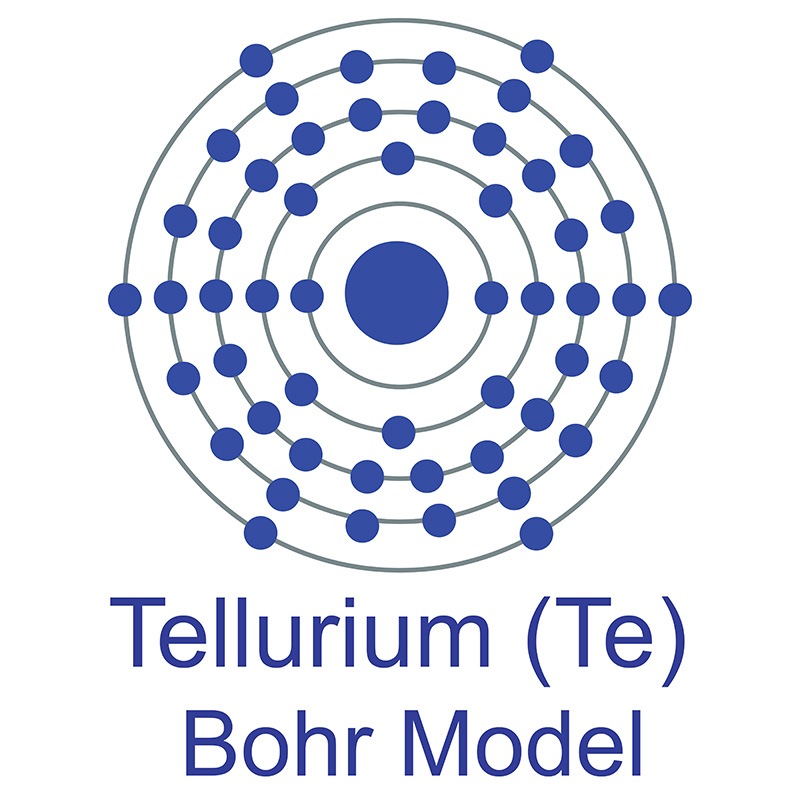
Tellurium(Te)atomic and molecular weight, atomic number and elemental symbolTellurium is a Block P, Group 16, Period 5 element. The number of electrons in each of Tellurium's shells is 2, 8, 18, 18, 6 and its electronic configuration is [Kr] 4d10 5s2 5p4. In its elemental form tellurium's CAS number is 13494-80-9. The tellurium atom has a radius of 143.2.pm and it's Van der Waals radius is 206.pm. Tellurium is a p-type semiconductor, and shows greater conductivity in certain directions, depending on alignment of the atoms. It is grown in crystalline form with other elements such as indium telluride. Its conductivity increases slightly with exposure to light which makes many tellurides candidates for solar energyapplications. Tellurium improves the machinability of copper and stainless steel, and its addition to lead decreases the corrosive action of sulfuric acid on lead and improves its strength and hardness. Elemental TelluriumTellurium is used as Tellurium Bohr Modela basic ingredient in blasting caps, and is added to cast iron for chill control. Tellurium is used in ceramics. Bismuth telluride has been used in thermoelectric devices. Iron is available as metal and compounds with purities from 99% to 99.999% (ACS grade to ultra-high purity); metals in the form of foil, sputtering target, and rod, and compounds as submicron and nanopowder. Tellurium was first discovered by Franz Muller von Reichenstein in 1782. The name Tellurium originates from the Greek word 'Tellus' meaning Earth. See Tellurium research below.

PRODUCT CATALOG News Foil Submicron & Nanopowder Tolling Ultra High Purity Sputtering Target Crystal Growth Rod, Plate, Powder, etc. Home

Have a Question? Ask a Chemical Engineer or Material Scientist   Request an MSDS or Certificate of Analysis


Search by Material, Product Name, Product Code, CAS Number, Formula, Element, Anion, Form, EC Number, MDL Number or PubChem ID.
German   Korean   French   Japanese   Spanish   Chinese (Simplified)   Portuguese   Russian   Chinese (Taiwan)   Italian   Turkish   Polish   Dutch   Czech   Swedish   Hungarian   Danish   Hebrew

Production Catalog Available in 36 Countries & Languages

Recent Research & Development for Rhodium

  • Water-soluble metal nanoparticles with PEG-tagged 15-membered azamacrocycles as stabilizers. Mejías N, Serra-Muns A, Pleixats R, Shafir A, Tristany M. Dalton Trans. 2009 Oct 7;(37):7748-55. Epub 2009 Jul 30. PMID: 19759949 [PubMed - in process]

  • Evidence for heterogeneous Sonogashira coupling of phenylacetylene and iodobenzene catalyzed by well defined rhodium nanoparticles. Kanuru VK, Humphrey SM, Kyffin JM, Jefferson DA, Burton JW, Armbrüster M, Lambert RM. Dalton Trans. 2009 Oct 7;(37):7602-5. Epub 2009 Jul 27. PMID: 19759929 [PubMed - in process]

  • Total synthesis of alkaloid (+/-)-g. B. 13 using a rh(i)-catalyzed ketone hydroarylation and late-stage pyridine reduction. Larson KK, Sarpong R. J Am Chem Soc. 2009 Sep 23;131(37):13244-5. PMID: 19754185 [PubMed - in process]

  • Thermodynamic Studies and Hydride Transfer Reactions from a Rhodium Complex to BX(3) Compounds. Mock MT, Potter RG, Camaioni DM, Li J, Dougherty WG, Kassel WS, Twamley B, Dubois DL. J Am Chem Soc. 2009 Sep 15. [Epub ahead of print] PMID: 19754124 [PubMed - as supplied by publisher]

  • Preparation of Multisubstituted Enamides via Rhodium-Catalyzed Carbozincation and Hydrozincation of Ynamides. Gourdet B, Rudkin ME, Watts CA, Lam HW. J Org Chem. 2009 Sep 15. [Epub ahead of print] PMID: 19754108 [PubMed - as supplied by publisher]

  • Asymmetric Transfer Hydrogenation of Ketones Catalyzed by Amino Acid Derived Rhodium Complexes: On the Origin of Enantioselectivity and Enantioswitchability. Ahlford K, Ekström J, Zaitsev AB, Ryberg P, Eriksson L, Adolfsson H. Chemistry. 2009 Sep 11. [Epub ahead of print] PMID: 19750526 [PubMed - as supplied by publisher]

  • A method for low volume and low Se concentration samples and application to paired cerebrospinal fluid and serum samples. Michalke B, Grill P, Berthele A. J Trace Elem Med Biol. 2009;23(4):243-50. Epub 2009 Aug 6. PMID: 19747619 [PubMed - in process]

  • A role for photoreceptors in retinal oedema and angiogenesis: an additional explanation for laser treatment? Foulds WS, Kaur C, Luu CD, Kek WK. Eye. 2009 Sep 11. [Epub ahead of print] PMID: 19745837 [PubMed - as supplied by publisher]

  • Thermodynamic trends in carbon-hydrogen bond activation in nitriles and chloroalkanes at rhodium. Evans ME, Li T, Vetter AJ, Rieth RD, Jones WD. J Org Chem. 2009 Sep 18;74(18):6907-14. PMID: 19743881 [PubMed - in process]

  • A fast ultrasound-assisted extraction procedure for trace elements determination in hair samples by ICP-MS for forensic analysis. Batista BL, Rodrigues JL, de Oliveira Souza VC, Barbosa F Jr. Forensic Sci Int. 2009 Sep 7. [Epub ahead of print] PMID: 19740615 [PubMed - as supplied by publisher]

  • Steric Tuning of the Amidomonophosphane-Rhodium(I) Catalyst in Asymmetric Addition of Arylboroxines to N-Phosphinoyl Aldimines. Hao X, Kuriyama M, Chen Q, Yamamoto Y, Yamada KI, Tomioka K. Org Lett. 2009 Sep 9. [Epub ahead of print] PMID: 19739616 [PubMed - as supplied by publisher]

  • High-throughput metal screening in pharmaceutical samples by ICP-MS with automated flow injection using a modified HPLC configuration. Tu Q, Wang T, Welch CJ. J Pharm Biomed Anal. 2009 Aug 15. [Epub ahead of print] PMID: 19733025 [PubMed - as supplied by publisher]

  • Rhodium-Catalyzed Ring-Opening Reactions of a 3-Aza-2-oxabicyclo[2.2.1]hept-5-ene with Arylboronic Acids. Machin BP, Ballantine M, Mandel J, Blanchard N, Tam W. J Org Chem. 2009 Sep 4. [Epub ahead of print] PMID: 19731959 [PubMed - as supplied by publisher]

  • Application of a Supramolecular-Ligand Library for the Automated Search for Catalysts for the Asymmetric Hydrogenation of Industrially Relevant Substrates. Meeuwissen J, Kuil M, van der Burg AM, Sandee AJ, Reek JN. Chemistry. 2009 Sep 3. [Epub ahead of print] PMID: 19731274 [PubMed - as supplied by publisher]

  • Sodium Tetraarylborates as Effective Nucleophiles in Rhodium/Diene-Catalyzed 1,4-Addition to beta,beta-Disubstituted alpha,beta-Unsaturated Ketones: Catalytic Asymmetric Construction of Quaternary Carbon Stereocenters. Shintani R, Tsutsumi Y, Nagaosa M, Nishimura T, Hayashi T. J Am Chem Soc. 2009 Sep 3. [Epub ahead of print] PMID: 19728707 [PubMed - as supplied by publisher]

  • Chiral amidophosphane-rhodium(i)-catalyzed asymmetric conjugate arylation of acyclic enones with arylboronic acids. Chen Q, Kuriyama M, Hao X, Soeta T, Yamamoto Y, Yamada K, Tomioka K. Chem Pharm Bull (Tokyo). 2009 Sep;57(9):1024-7. PMID: 19721271 [PubMed - in process]

  • Room-temperature rhodium-catalyzed asymmetric 1,4-addition of potassium trifluoro(organo)borates. Gendrineau T, Genet JP, Darses S. Org Lett. 2009 Aug 6;11(15):3486-9. PMID: 19719192 [PubMed - in process]

  • An Expedient Route to a Potent Gastrin/CCK-B Receptor Antagonist (+)-AG-041R. Sato S, Shibuya M, Kanoh N, Iwabuchi Y. J Org Chem. 2009 Aug 31. [Epub ahead of print] PMID: 19719158 [PubMed - as supplied by publisher]

  • Rhodium-catalyzed cross-coupling of organoboron compounds with vinyl acetate. Yu JY, Kuwano R. Angew Chem Int Ed Engl. 2009;48(39):7217-20. No abstract available. PMID: 19714694 [PubMed - in process]

  • Enantioselective rhodium-catalyzed [4+2+2] cycloaddition of dienyl isocyanates for the synthesis of bicyclic azocine rings. Yu RT, Friedman RK, Rovis T. J Am Chem Soc. 2009 Sep 23;131(37):13250-1. PMID: 19711950 [PubMed - in process]

Recent Research & Development for Tellurium

  • Multi-metal(loid) methylation in methanoarchaea is linked to central intermediates of methanogenesis. Thomas F, Diaz-Bone RA, Wuerfel O, Huber B, Weidenbach K, Schmitz RA, Hensel R. Appl Environ Microbiol. 2011 Oct 14. [Epub ahead of print] PMID: 22003009 [PubMed - as supplied by publisher]

  • Synthesis, structure, and bonding of orthorhombic r(5)au(2)te(2) (R = lu, ho, dy, y). Electronic structure of the binary parent valence compound eu(5)as(4). Chai P, Corbett JD. Inorg Chem. 2011 Nov 7;50(21):10949-55. Epub 2011 Oct 12. PMID: 21991925 [PubMed - in process]

  • Glucose-6-Phosphate Dehydrogenase Protects Escherichia coli from Tellurite-Mediated Oxidative Stress. Sandoval JM, Arenas FA, Vásquez CC. PLoS One. 2011;6(9):e25573. Epub 2011 Sep 30. PMID: 21984934 [PubMed - in process]

  • Microbial processing of tellurium as a tool in biotechnology. Turner RJ, Borghese R, Zannoni D. Biotechnol Adv. 2011 Sep 1. [Epub ahead of print] PMID: 21907273 [PubMed - as supplied by publisher]

  • Measurement of the ?? Decay Half-Life of ^{130}Te with the NEMO-3 Detector. Arnold R, Augier C, Baker J, Barabash AS, Basharina-Freshville A, Blondel S, Bongrand M, Broudin-Bay G, Brudanin V, Caffrey AJ, Chapon A, Chauveau E, Durand D, Egorov V, Flack R, Garrido X, Grozier J, Guillon B, Hubert P, Hugon C, Jackson CM, Jullian S, Kauer M, Klimenko A, Kochetov O, Konovalov SI, Kovalenko V, Lalanne D, Lamhamdi T, Lang K, Liptak Z, Lutter G, Mamedov F, Marquet Ch, Martin-Albo J, Mauger F, Mott J, Nachab A, Nemchenok I, Nguyen CH, Nova F, Novella P, Ohsumi H, Pahlka RB, Perrot F, Piquemal F, Reyss JL, Richards B, Ricol JS, Saakyan R, Sarazin X, Simard L, Simkovic F, Shitov Y, Smolnikov A, Söldner-Rembold S, Stekl I, Suhonen J, Sutton CS, Szklarz G, Thomas J, Timkin V, Torre S, Tretyak VI, Umatov V, Vála L, Vanyushin I, Vasiliev V, Vorobel V, Vylov Ts, Zukauskas A; NEMO-3 Collaboration. Phys Rev Lett. 2011 Aug 5;107(6):062504. Epub 2011 Aug 4. PMID: 21902318 [PubMed - in process]

  • Synthesis and characterization of wurtzite ZnTe nanorods with controllable aspect ratios. Zhang J, Jin S, Fry HC, Peng S, Shevchenko E, Wiederrecht GP, Rajh T. J Am Chem Soc. 2011 Oct 5;133(39):15324-7. Epub 2011 Sep 12. PMID: 21899348 [PubMed - in process]

  • A homometallic tricapped cubane cluster: [(Cp*Mo)4B4H4(?4-BH)3] (Cp* = ?5-C5Me5). Thakur A, Sahoo S, Ghosh S. Inorg Chem. 2011 Sep 5;50(17):7940-2. Epub 2011 Aug 11. PMID: 21834507 [PubMed - in process]

  • Selective antimicrobial activity associated with sulfur nanoparticles. Schneider T, Baldauf A, Ba LA, Jamier V, Khairan K, Sarakbi MB, Reum N, Schneider M, Röseler A, Becker K, Burkholz T, Winyard PG, Kelkel M, Diederich M, Jacob C. J Biomed Nanotechnol. 2011 Jun;7(3):395-405. PMID: 21830480 [PubMed - indexed for MEDLINE]

  • Semiconductor detectors allow low-dose-low-dose 1-day SPECT myocardial perfusion imaging. Nkoulou R, Pazhenkottil AP, Kuest SM, Ghadri JR, Wolfrum M, Husmann L, Fiechter M, Buechel RR, Herzog BA, Koepfli P, Burger C, Gaemperli O, Kaufmann PA. J Nucl Med. 2011 Aug;52(8):1204-9. PMID: 21810589 [PubMed - indexed for MEDLINE]

  • CsTe2O(6-x): novel mixed-valence tellurium oxides with framework-deficient pyrochlore-related structure. Siritanon T, Li J, Stalick JK, Macaluso RT, Sleight AW, Subramanian MA. Inorg Chem. 2011 Sep 5;50(17):8494-501. Epub 2011 Jul 27. PMID: 21793494 [PubMed - in process]

  • Bioactivity of the conjugation of green-emitting CdTe quantum dots with a carborane complex. Wu C, Shi L, Li Q, Zhao J, Selke M, Yan H, Wang X. J Nanosci Nanotechnol. 2011 Apr;11(4):3091-9. PMID: 21776675 [PubMed - indexed for MEDLINE]

  • Isolation and characterization of an environmental cadmium- and tellurite-resistant Pseudomonas strain. Chien CC, Jiang MH, Tsai MR, Chien CC. Environ Toxicol Chem. 2011 Oct;30(10):2202-7. doi: 10.1002/etc.620. Epub 2011 Aug 10. PMID: 21766319 [PubMed - in process]

  • An ultrasensitive hydrogen peroxide biosensor based on electrocatalytic synergy of graphene-gold nanocomposite, CdTe-CdS core-shell quantum dots and gold nanoparticles. Gu Z, Yang S, Li Z, Sun X, Wang G, Fang Y, Liu J. Anal Chim Acta. 2011 Sep 2;701(1):75-80. Epub 2011 Jul 4. PMID: 21763811 [PubMed - indexed for MEDLINE]

  • Synchronous determination of mercury (II) and copper (II) based on quantum dots-multilayer film. Ma Q, Ha E, Yang F, Su X. Anal Chim Acta. 2011 Sep 2;701(1):60-5. Epub 2011 Jun 17. PMID: 21763809 [PubMed - indexed for MEDLINE]

  • Procedure-Controlled Selective Synthesis of 5-Acyl-2-iminothiazolines and their Selenium and Tellurium Derivatives by Convergent Tandem Annulation. Wang Y, Zhang WX, Wang Z, Xi Z. Angew Chem Int Ed Engl. 2011 Jul 14. doi: 10.1002/anie.201101948. [Epub ahead of print] No abstract available. PMID: 21761522 [PubMed - as supplied by publisher]

  • Synthesis, structures and ab initio studies of selenium and tellurium bis(carbodithioates and carbothioates). Kato S, Tani K, Ishida M, Nonogaki J, Ebihara M, Hayashi S, Nakanishi W, Niyomura O, Ando F, Koketsu J. Dalton Trans. 2011 Aug 28;40(32):8156-69. Epub 2011 Jul 13. PMID: 21750832 [PubMed - in process]

  • Electrical bistability in self-assembled hybrid multilayers of phospholipid and nanoparticles. Yuan B, Hu SX, Lu NY, Xu F, Zhou K, Ma YQ, Li M. Nanotechnology. 2011 Aug 5;22(31):315303. Epub 2011 Jul 12. PMID: 21747161 [PubMed - indexed for MEDLINE]

  • Organomercury(II) and tellurium(II) compounds with the "pincer" ligand 2,6-[O(CH2CH2)2NCH2]2C6H3--stabilization of an unusual organotellurium(II) cationic species. Beleaga A, Bojan VR, Pöllnitz A, Rat CI, Silvestru C. Dalton Trans. 2011 Sep 21;40(35):8830-8. Epub 2011 Jul 11. PMID: 21743935 [PubMed - in process]

  • Differentiation between the motor and sensory fascicles of the peripheral nerves from adult rats using annexin V-CdTe-conjugated polymer. Meng X, Lu L, Wang H, Liu B. Neurol India. 2011 May-Jun;59(3):333-8. PMID: 21743158 [PubMed - indexed for MEDLINE]

  • Tellurium tetrachloride and diphenyl ditelluride cause cytotoxicity in rat hippocampal astrocytes. Roy S, Hardej D. Food Chem Toxicol. 2011 Oct;49(10):2564-74. Epub 2011 Jul 1. PMID: 21742007 [PubMed - in process]


American Elements is a copyrighted U.S. Trademark. All rights reserved.