American Elements Logo and U.S. Registered Trademark


Ruthenium 100 Metal Isotope
100Ru56


Product Product Code Order or Specifications
Ruthenium 100 Metal
RU-M-100-ISO Contact American Elements
Ruthenium 100 Metal (Ruthenium-100) is a stable (non-radioactive) isotope of Ruthenium. See below table for ENSDF Citation and Half Life. It is both naturally occurring and produced by fission. Ruthenium 100 Metal is one of over 250 stable metallic isotopes produced by American Elements for biological and biomedical labeling, as target materials and other applications. Ruthenium Metal is also available in ultra high purity and as nanoparticles. For thin film applications it is available as rod, pellets, pieces, granules and sputtering targets and as either an ingot or powder. Ruthenium Metal 100 isotopic material is generally immediately available.American Elements produces to many standard grades when applicable, including Mil Spec (military grade); ACS, Reagent and Technical Grade; Food, Agricultural and Pharmaceutical Grade; Optical Grade, USP and EP/BP (European Pharmacopoeia/British Pharmacopoeia)and follows applicable ASTM testing standards.Typical and custom packaging is available. Additional technical, research and safety (MSDS) information is available as is a Reference Calculator for converting relevant units of measurement.

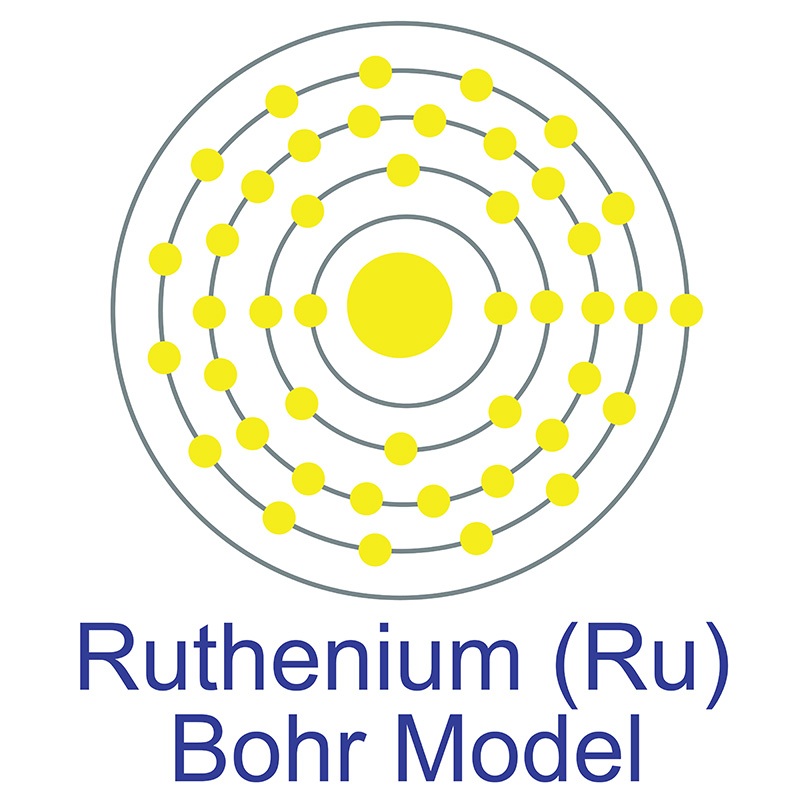
Ruthenium(Ru) atomic and molecular weight, atomic number and elemental symbolRuthenium is a Block D, Group 8, Period 5 element. The number of electrons in each of Ruthenium's shells is 2, 8, 18, 15, 1 and its electronic configuration is [Kr] 4d7 5s1. In its elemental form ruthenium's CAS number is 7440-18-8. The ruthenium atom has a radius of 132.5.pm and it's Van der Waals radius is 200.pm. Ruthenium tetroxide (RuO4) is very toxic and Ruthenium in its elemental form is considered carcinogen. Ruthenium is member of the platinum group of metals. It is one of the most effective hardeners for platinum and palladium , and is alloyed with these metals to make electrical contacts for severe wear resistanant Elemental Rutheniumelectronics and laboratory equipment. The corrosion resistance of titanium is improved aRuthenium Bohr Model hundredfold by addition of 0.1% ruthenium. It is also a versatile catalyst. Hydrogen sulfide can be split catalytically by light using an aqueous suspension of cadmium sulfide particles loaded with ruthenium dioxide. It is also believed to have pharmacological applications. Ruthenium is available as metal and compounds with purities from 99% to 99.999% (ACS grade to ultra-high purity); metals in the form of foil, sputtering target, and rod, and compounds as submicron and nanopowder. Ruthenium was first discovered by Karl Klaus in 1844. The name Ruthenium, originates from the Latin word 'Ruthenia' meaning Russia. See Ruthenium research below.

Formula N ENSDF Citation Half Life Jp Sn (keV) Sp (keV) Abundance
100Ru 44 NDS 81, 1 (1997) stable   0+ 9673.16  14 9184.5  14 12.6  1  %
PRODUCT CATALOG Foil Submicron & Nanopowder Tolling Ultra High Purity Sputtering Target Crystal Growth Rod, Plate, Powder, etc. Home

Have a Question? Ask a Chemical Engineer or Material Scientist   Request an MSDS or Certificate of Analysis


Search by Material, Product Name, Product Code, CAS Number, Formula, Element, Anion, Form, EC Number, MDL Number or PubChem ID.


German   Korean   French   Japanese   Spanish   Chinese (Simplified)   Portuguese   Russian   Chinese (Taiwan)   Italian   Turkish   Polish   Dutch   Czech   Swedish   Hungarian   Danish   Hebrew

Production Catalog Available in 36 Countries & Languages


Recent Research & Development for Ruthenium

  • Ruthenium-catalyzed oxidation of a carbon-carbon triple bond: facile syntheses of alkenyl 1,2-diketones from alkynes. Hu TC, Hsiao PI, Wang TH, Yang YW, Chang CY, Wu YH, Sun WC, Yu MS, Lee CY, Lo YH. Dalton Trans. 2011 Oct 21. [Epub ahead of print] PMID: 22015646 [PubMed - as supplied by publisher]

  • Deactivation Pathways for Metal-to-Ligand Charge Transfer Excited States of Ru Polypyridyl Complexes with Triphenylphosphine as a Ligand. Litke SV, Ershov AY, Meyer TJ. J Phys Chem A. 2011 Oct 20. [Epub ahead of print] PMID: 22013947 [PubMed - as supplied by publisher]

  • Chirality on the Non-Intercalated Part Dictates the Stereoselectivity for Threading Intercalation of Short Binuclear Ruthenium Complexes. Andersson J, Lincoln P. J Phys Chem B. 2011 Oct 19. [Epub ahead of print] PMID: 22010604 [PubMed - as supplied by publisher]

  • Formation of Sequence-Independent Z-DNA Induced by a Ruthenium Complex at Low Salt Concentrations. Wu Z, Tian T, Yu J, Weng X, Liu Y, Zhou X. Angew Chem Int Ed Engl. 2011 Oct 18. doi: 10.1002/anie.201104422. [Epub ahead of print] No abstract available. PMID: 22009837 [PubMed - as supplied by publisher]

  • Stimulation of kainate toxicity by zinc in cultured cerebellar granule neurons and the role of mitochondria in this process. Lozier ER, Stelmashook EV, Uzbekov RE, Novikova SV, Zorov SD, Alieva IB, Arbeille B, Zorov DB, Isaev NK. Toxicol Lett. 2011 Oct 10. [Epub ahead of print] PMID: 22008730 [PubMed - as supplied by publisher]

  • HOCl causes necrotic cell death in human monocyte derived macrophages through calcium dependent calpain activation. Yang YT, Whiteman M, Gieseg SP. Biochim Biophys Acta. 2011 Oct 10. [Epub ahead of print] PMID: 22008466 [PubMed - as supplied by publisher]

  • Small molecule positive allosteric modulation of TRPV1 activation by vanilloids and acidic pH. Kaszas K, Keller JM, Coddou CA, Mishra SK, Hoon MA, Stojilkovic S, Jacobson KA, Iadarola MJ. J Pharmacol Exp Ther. 2011 Oct 17. [Epub ahead of print] PMID: 22005042 [PubMed - as supplied by publisher]

  • A New Class of Cyclometalated Ruthenium Sensitizers of the Type CN^N for Efficient Dye-Sensitized Solar Cells. Kim JJ, Choi H, Paek S, Kim C, Lim K, Ju MJ, Kang HS, Kang MS, Ko J. Inorg Chem. 2011 Oct 17. [Epub ahead of print] PMID: 22004012 [PubMed - as supplied by publisher]

  • Water Oxidation by Mononuclear Ruthenium Complexes with TPA-Based Ligands. Radaram B, Ivie JA, Singh WM, Grudzien RM, Reibenspies JH, Webster CE, Zhao X. Inorg Chem. 2011 Oct 14. [Epub ahead of print] PMID: 21999861 [PubMed - as supplied by publisher]

  • Electrocatalytic reduction of CO(2) to CO by polypyridyl ruthenium complexes. Chen Z, Chen C, Weinberg DR, Kang P, Concepcion JJ, Harrison DP, Brookhart MS, Meyer TJ. Chem Commun (Camb). 2011 Oct 14. [Epub ahead of print] PMID: 21998823 [PubMed - as supplied by publisher]

  • Role of thromboxane A2-activated nonselective cation channels in hypoxic pulmonary vasoconstriction of rat. Yoo HY, Park SJ, Seo EY, Park KS, Han JA, Kim KS, Shin DH, Earm YE, Zhang YH, Kim SJ. Am J Physiol Cell Physiol. 2011 Oct 12. [Epub ahead of print] PMID: 21998141 [PubMed - as supplied by publisher]

  • Effect of substituent of terpyridines on the DNA-interaction of polypyridyl ruthenium(II) complexes. Patel MN, Gandhi DS, Parmar PA. Spectrochim Acta A Mol Biomol Spectrosc. 2011 Sep 22. [Epub ahead of print] PMID: 21996589 [PubMed - as supplied by publisher]

  • Concise Formal Synthesis of (+)-Neopeltolide. Yang Z, Zhang B, Zhao G, Yang J, Xie X, She X. Org Lett. 2011 Oct 13. [Epub ahead of print] PMID: 21995677 [PubMed - as supplied by publisher]

  • (2)H NMR calculations on polynuclear transition metal complexes: on the influence of local symmetry and other factors. Del Rosal I, Gutmann T, Walaszek B, Gerber IC, Chaudret B, Limbach HH, Buntkowsky G, Poteau R. Phys Chem Chem Phys. 2011 Oct 12. [Epub ahead of print] PMID: 21993614 [PubMed - as supplied by publisher]

  • Polyhydroxyalkanoates production from cellulose hydrolysate in Escherichia coli LS5218 with superior resistance to 5-hydroxymethylfurfural. Nduko JM, Suzuki W, Matsumoto K, Kobayashi H, Ooi T, Fukuoka A, Taguchi S. J Biosci Bioeng. 2011 Oct 11. [Epub ahead of print] PMID: 21993429 [PubMed - as supplied by publisher]

  • Photocurrent-Enhancement by Surface Plasmon Resonance of Silver Nanoparticles in Highly Porous Dye-Sensitized Solar Cells. Jeong NC, Prasittichai C, Hupp J. Langmuir. 2011 Oct 12. [Epub ahead of print] PMID: 21992773 [PubMed - as supplied by publisher]

  • Synthesis of a-Amino Acid Amides: Ruthenium-Catalyzed Amination of a-Hydroxy Amides. Zhang M, Imm S, Bähn S, Neumann H, Beller M. Angew Chem Int Ed Engl. 2011 Oct 10. doi: 10.1002/anie.201104309. [Epub ahead of print] No abstract available. PMID: 21987500 [PubMed - as supplied by publisher]

  • Ruthenium nitrosyl complexes with 1,4,7-trithiacyclononane and 2,2'-bipyridine (bpy) or 2-phenylazopyridine (pap) coligands. Electronic structure and reactivity aspects. De P, Maji S, Dutta Chowdhury A, Mobin SM, Kumar Mondal T, Paretzki A, Lahiri GK. Dalton Trans. 2011 Oct 11. [Epub ahead of print] PMID: 21986798 [PubMed - as supplied by publisher]

  • Regulation of Sarcoplasmic Reticulum Ca2+ leak by Cytosolic Ca2+ in Rabbit Ventricular Myocytes. Bovo E, Mazurek SR, Blatter LA, Zima AV. J Physiol. 2011 Oct 10. [Epub ahead of print] PMID: 21986204 [PubMed - as supplied by publisher]

  • Polydentate Analogues of 8-Hydroxyquinoline and Their Complexes with Ruthenium. El Ojaimi M, Thummel RP. Inorg Chem. 2011 Oct 10. [Epub ahead of print] PMID: 21985103 [PubMed - as supplied by publisher]


USA Science & Engineering FestivalSponsors of the United States Science & Engineering Festival on April 28, 2012 in Washington D.C. Please join us and our customers & co-sponsors NASA, Lockheed Martin and the Department of Defense inspiring the next generation of scientists and engineers.


  Print this Page
Periodic table of the elements science and academic information, elements and advanced materials data, scientific presentations and all pages, designs, concepts, logos, and color schemes herein are the copyrighted proprietary rights and intellectual property of American Elements. American Elements is a U.S. Registered Trademark. © 2001-2012. American Elements. All rights reserved.
Learn Six Sigma


American Elements is a copyrighted U.S. Trademark. All rights reserved.