American Elements produces to many standard grades when applicable, including Mil Spec (military grade); ACS, Reagent and Technical Grade; Food, Agricultural and Pharmaceutical Grade; Optical Grade, USP and EP/BP (European Pharmacopeia/British Pharmacopeia) and follows applicable ASTM testing standards.See safety data and research below and pricing/lead time above. American Elements specializes in producing high purity Silicon Arsenide Sputtering Targets with the highest possible density and smallest possible average grain sizes for use in semiconductor, chemical vapor deposition (CVD) and physical vapor deposition (PVD) display and optical applications. Our standard Sputtering Targets for thin film are available monoblock or bonded with dimensions and configurations up to 820 mm with hole drill locations and threading, beveling, grooves and backing designed to work with both older sputtering devises as well as the latest process equipment, such as large area coating for solar energy or fuel cells and flip-chip applications. Research sized targets are also produced as well as custom sizes and alloys. All targets are analyzed using best demonstrated techniques including X-Ray Fluorescence (XRF), Glow Discharge Mass Spectrometry (GDMS), and Inductively Coupled Plasma (ICP). "Sputtering" allows for thin film deposition of an ultra high purity sputtering metallic or Arsenide material onto another solid substrate by the controlled removal and conversion of the target material into a directed gaseous/plasma phase through ionic bombardment. "Sputtering" allows for thin film deposition of an ultra high purity sputtering metallic or oxide material onto another solid substrate by the controlled removal and conversion of the target material into a directed gaseous/plasma phase through ionic bombardment. We can also provide targets outside this range in addition to just about any size rectangular, annular, or oval target. Materials are produced using crystallization, solid state and other ultra high purification processes such as sublimation. American Elements specializes in producing custom compositions for commercial and research applications and for new proprietary technologies. American Elements also casts any of the rare earth metals and most other advanced materials into rod, bar or plate form, as well as other machined shapes and through other processes nanoparticles. We also produce Silicon as disc, granules, ingot, pellets, pieces, powder, and rod. Other shapes are available by request.
Silicon is a Block P, Group 14, Period 3 element. The number of electrons in each of Silicon's shells is 2, 8, 4 and its electronic configuration is [Ne] 3s2 3p2. In its elemental form silicon's CAS number is 7440-21-3. The silicon atom has a radius of 117.6.pm and it's Van der Waals radius is 210.pm. Silicon is not toxic but can cause chronic respiratory problems if inhaled as a fine silica or silicate dust. Asbestos silicates are carcinogenic. Silicon is one of man's most useful elements. It makes up 25.7% of the earth's crust, by weight, and is the second most abundant element, being exceeded only by oxygen. The Czochralski process is commonly used to produce single crystals of silicon used for solid-state or semiconductor devices. Silica, as sand, is a principal ingredient of glass, one of the most inexpensive of materials with excellent mechanical, optical, thermal, and electrical properties. Silicon is available as metal and compounds with purities from 99% to 99.9999% (ACS grade to ultra-high purity); metals in the form of foil, sputtering target, and rod, and compounds as submicron and nanopowder. Ultra high purity silicon can be doped with boron, gallium, phosphorus , or arsenic to produce silicon for use in transistors, solar cells, rectifiers, and other solid-state devices which are used extensively in the electronics and space-age industries. Hydrogenated amorphous silicon has shown promise in producing economical cells for converting solar energy into electricity. Silcones are important products of silicon. They range from liquids to hard, glasslike solids with many useful properties. Silicon was first discovered by Jons Berzelius in 1823. The name Silicon originates from the Latin word "silex" which means flint or hard stone. See Silicon research below.
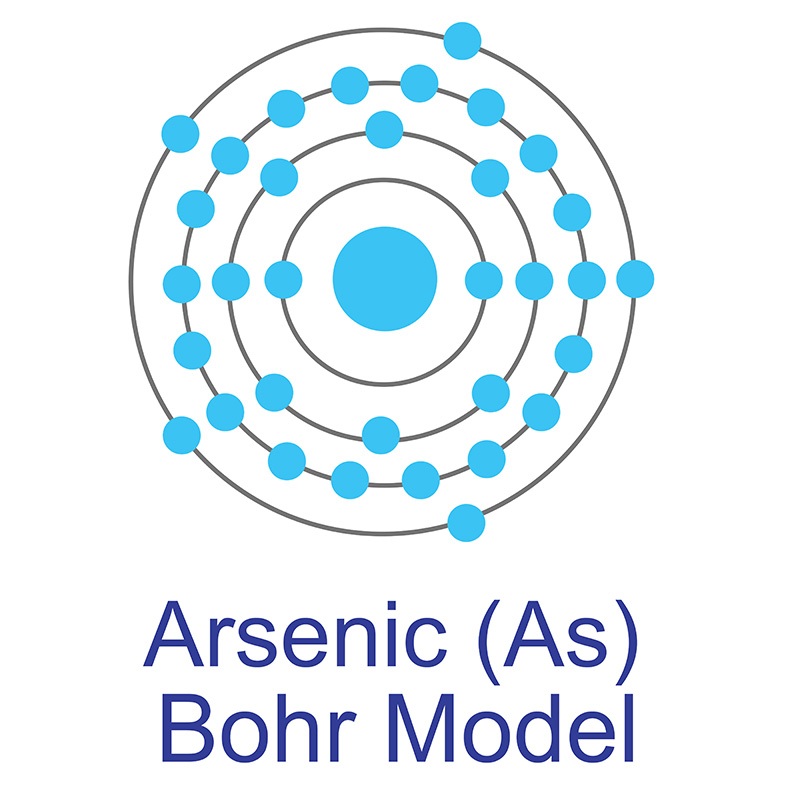
Arsenic is a Block P, Group 15, Period 4 element. The number of electrons in each of Arsenic's shells is 2, 8, 18, 5 and its electronic configuration is [Ar] 3d10 4s2 4p3. In its elemental form arsenic's CAS number is 1327-53-3. The arsenic atom has a radius of 124.5.pm and it's Van der Waals radius is 185.pm. Arsenic in the organic form is not harmful but in the inorganic form it is extremely toxic even in very small amounts. Arsenic has numerous applications as a semiconductor and other electronic applications as Indium arsenide, silicon arsenide and tin arsenidea. Arsenic is finding increasing uses as a doping agent in solid-state devices such as transistors. Gallium arsenide is used as a laser material to convert electricity directly into coherent light. Arsenic is used in bronzing and for hardening and improving the sphericity of shot. Due to its toxicity, arsenic compounds are used in insecticides and wood preservation.Arsenic is available as metal and compounds with purities from 99% to 99.9999% (ACS grade to ultra-high purity); metals in the form of foil, sputtering target, and rod, and compounds as submicron and nanopowder. Arsenic information, including Technical Data, Safety Data and its High Purity properties, research, applications and other useful facts are discussed here. Scientific facts such as the atomic structure, ionization energy, abundance on Earth, conductivity and thermal properties are included. See Arsenic research below.

American Elements semi conducting materials are crystal structures produced from ultra high purity starting materials synthesized by our high purity production facility which includes several large electric muffle furnaces, a tube furnace for hydrogen reduction, 50 gallon glass-lined Pfaudler reactors supported by our analytical laboratory containing X-ray diffraction, SEM, AA, BET surface area, and ICP Spectrometry for trace metals analysis. See a discussion of American Elements Ultra High Purity and Analytical capabilities. See Crystal Growth for processes used to fabricate semiconductor materials, which include:
Crystal "pulling" by the Czochaiski method for production of semiconductor materials
Flux growth and gradient freeze
Directional solidification of fluorites using both the Bridgman-Stockbarger and float zoning techniques
PACKAGING SPECIFICATIONS FOR BULK & RESEARCH QUANTITIES
Typical bulk packaging includes palletized plastic 5 gallon/25 kg. pails, fiber and steel drums to 1 ton super sacks in full container (FCL) or truck load (T/L) quantities. Research and sample quantities and hygroscopic, oxidizing or other air sensitive materials may be packaged under argon or vacuum. Shipping documentation includes a Certificate of Analysis and Material Safety Data Sheet (MSDS). Solutions are packaged in polypropylene, plastic or glass jars up to palletized 440 gallon liquid totes.
Desymmetrization of 7-dimethylphenylsilylcycloheptatriene. Towards the synthesis of new aminocycloheptitols.
Girard E, Desvergnes V, Tarnus C, Landais Y.
Org Biomol Chem. 2010 Oct 13. [Epub ahead of print]PMID: 20941452 [PubMed - as supplied by publisher]Related citations
Enzyme-functionalized polymer brush films on the inner wall of silicon-glass microreactors with tunable biocatalytic activity.
Costantini F, Benetti EM, Reinhoudt DN, Huskens J, Vancso GJ, Verboom W.
Lab Chip. 2010 Oct 13. [Epub ahead of print]PMID: 20941436 [PubMed - as supplied by publisher]Related citations
Wavelength-tunable excited-state absorption and optical limiting effects in the Q band region based on silicon phthalocyanine oligomers.
Ishii K, Sakai N.
Phys Chem Chem Phys. 2010 Oct 13. [Epub ahead of print]PMID: 20941425 [PubMed - as supplied by publisher]Related citations
Role of near-field enhancement in plasmonic laser nanoablation using gold nanorods on a silicon substrate.
Harrison RK, Ben-Yakar A.
Opt Express. 2010 Oct 11;18(21):22556-71. doi: 10.1364/OE.18.022556.PMID: 20941153 [PubMed - in process]Related citations
Ultrafast all-optical modulator with femtojoule absorbed switching energy in silicon-on-insulator.
Schönenberger S, Stöferle T, Moll N, Mahrt RF, Dahlem MS, Wahlbrink T, Bolten J, Mollenhauer T, Kurz H, Offrein BJ.
Opt Express. 2010 Oct 11;18(21):22485-96. doi: 10.1364/OE.18.022485.PMID: 20941147 [PubMed - in process]Related citations
The observation of super-long range surface plasmon polaritons modes and its application as sensory devices.
Zhang XL, Song JF, Lo GQ, Kwong DL.
Opt Express. 2010 Oct 11;18(21):22462-70. doi: 10.1364/OE.18.022462.PMID: 20941145 [PubMed - in process]Related citations
Silicon photonic temperature sensor?employing a ring resonator manufactured?using a standard CMOS process.
Kim GD, Lee HS, Park CH, Lee SS, Lim BT, Bae HK, Lee WG.
Opt Express. 2010 Oct 11;18(21):22215-21. doi: 10.1364/OE.18.022215.PMID: 20941123 [PubMed - in process]Related citations
Highly efficient nonlinearity reduction in silicon-on-insulator waveguides using vertical slots.
Yue Y, Zhang L, Wang J, Beausoleil RG, Willner AE.
Opt Express. 2010 Oct 11;18(21):22061-6. doi: 10.1364/OE.18.022061.PMID: 20941107 [PubMed - in process]Related citations
Quantitative evaluation of boron-induced disorder in multilayers containing silicon nanocrystals in an oxide matrix designed for photovoltaic applications.
Zatryb G, Podhorodecki A, Hao XJ, Misiewicz J, Shen YS, Green MA.
Opt Express. 2010 Oct 11;18(21):22004-9. doi: 10.1364/OE.18.022004.PMID: 20941101 [PubMed - in process]Related citations
Discrete parametric band conversion in silicon for mid-infrared applications.
Tien EK, Huang Y, Gao S, Song Q, Qian F, Kalyoncu SK, Boyraz O.
Opt Express. 2010 Oct 11;18(21):21981-9. doi: 10.1364/OE.18.021981.PMID: 20941099 [PubMed - in process]Related citations
Split of surface plasmon resonance of gold nanoparticles on silicon substrate: a study of dielectric functions.
Zhu S, Chen TP, Cen ZH, Goh ES, Yu SF, Liu YC, Liu Y.
Opt Express. 2010 Oct 11;18(21):21926-31. doi: 10.1364/OE.18.021926.PMID: 20941092 [PubMed - in process]Related citations
Solution-processed photodetectors from colloidal silicon nano/micro particle composite.
Tu CC, Tang L, Huang J, Voutsas A, Lin LY.
Opt Express. 2010 Oct 11;18(21):21622-7. doi: 10.1364/OE.18.021622.PMID: 20941060 [PubMed - in process]Related citations
FDTD modeling of anisotropic nonlinear optical phenomena in silicon waveguides.
Dissanayake CM, Premaratne M, Rukhlenko ID, Agrawal GP.
Opt Express. 2010 Sep 27;18(20):21427-48. doi: 10.1364/OE.18.021427.PMID: 20941040 [PubMed - in process]Related citations
Multi-channel WDM RZ-to-NRZ format conversion at 50 Gbit/s based on single silicon microring resonator.
Ding Y, Peucheret C, Pu M, Zsigri B, Seoane J, Liu L, Xu J, Ou H, Zhang X, Huang D.
Opt Express. 2010 Sep 27;18(20):21121-30. doi: 10.1364/OE.18.021121.PMID: 20941008 [PubMed - in process]Related citations
Tunable photonic crystal based on?capillary attraction and repulsion.
Chan CT, Yeh JA.
Opt Express. 2010 Sep 27;18(20):20894-9. doi: 10.1364/OE.18.020894.PMID: 20940984 [PubMed - in process]Related citations
Tailoring the dispersion behavior of silicon nanophotonic slot waveguides.
Mas S, Caraquitena J, Galán JV, Sanchis P, Martí J.
Opt Express. 2010 Sep 27;18(20):20839-44. doi: 10.1364/OE.18.020839.PMID: 20940978 [PubMed - in process]Related citations
High performance nanophotonic circuits based on partially buried horizontal slot waveguides.
Xiong C, Pernice WH, Li M, Tang HX.
Opt Express. 2010 Sep 27;18(20):20690-8. doi: 10.1364/OE.18.020690.PMID: 20940965 [PubMed - in process]Related citations
Label-free optical biosensing using a horizontal air-slot SiN(x) microdisk resonator.
Lee S, Eom SC, Chang JS, Huh C, Sung GY, Shin JH.
Opt Express. 2010 Sep 27;18(20):20638-44. doi: 10.1364/OE.18.020638.PMID: 20940958 [PubMed - in process]Related citations
Flattened dispersion in silicon slot waveguides.
Zhang L, Yue Y, Beausoleil RG, Willner AE.
Opt Express. 2010 Sep 13;18(19):20529-34. doi: 10.1364/OE.18.020529.PMID: 20940946 [PubMed - in process]Related citations
Recent Research & Development for Arsenic
Arsenic trioxide treatment decreases the oxygen consumption rate of tumor cells and radiosensitizes solid tumors.
Diepart C, Karroum O, Magat J, Feron O, Verrax J, Buc Calderon P, Grégoire V, Leveque P, Stockis J, Dauguet N, Jordan BF, Gallez B.
Cancer Res. 2011 Dec 2. [Epub ahead of print]
PMID:
22139377
[PubMed - as supplied by publisher]
Arsenic-Induced Straighthead: An Impending Threat to Sustainable Rice Production in South and South-East Asia!
Azizur Rahman M, Mamunur Rahman M, Hasegawa H.
Bull Environ Contam Toxicol. 2011 Dec 4. [Epub ahead of print]
PMID:
22139332
[PubMed - as supplied by publisher]
Comparative Soil Metal Analyses in Sudbury (Ontario, Canada) and Lubumbashi (Katanga, DR-Congo).
Narendrula R, Nkongolo KK, Beckett P.
Bull Environ Contam Toxicol. 2011 Dec 4. [Epub ahead of print]
PMID:
22139330
[PubMed - as supplied by publisher]
Purification, crystallization and preliminary X-ray diffraction studies of the arsenic repressor ArsR from Corynebacterium glutamicum.
Santha S, Pandaranayaka EP, Rosen BP, Thiyagarajan S.
Acta Crystallogr Sect F Struct Biol Cryst Commun. 2011 Dec 1;67(Pt 12):1616-8. Epub 2011 Nov 26.
PMID:
22139180
[PubMed - in process]
Arsenic contamination and speciation in surrounding waters of three old cinnabar mines.
Larios R, Fernández-Martínez R, Silva V, Loredo J, Rucandio I.
J Environ Monit. 2011 Dec 5. [Epub ahead of print]
PMID:
22139034
[PubMed - as supplied by publisher]
Arsenic Exposure and Hypertension: A Systematic Review.
Abhyankar LN, Jones MR, Guallar E, Navas-Acien A.
Environ Health Perspect. 2011 Dec 2. [Epub ahead of print]
PMID:
22138666
[PubMed - as supplied by publisher]
Metals in biology: defining metalloproteomes.
Yannone SM, Hartung S, Menon AL, Adams MW, Tainer JA.
Curr Opin Biotechnol. 2011 Dec 2. [Epub ahead of print]
PMID:
22138493
[PubMed - as supplied by publisher]
Total and inorganic arsenic concentrations in different species of economically important algae harvested from coastal zones of Chile.
Díaz O, Tapia Y, Muñoz O, Montoro R, Velez D, Almela C.
Food Chem Toxicol. 2011 Nov 25. [Epub ahead of print]
PMID:
22138359
[PubMed - as supplied by publisher]
Zamzam water: Concentration of trace elements and other characteristics.
Shomar B.
Chemosphere. 2011 Dec 2. [Epub ahead of print]
PMID:
22138338
[PubMed - as supplied by publisher]
Removal of methylated arsenic using a nanostructured zirconia-based sorbent: Process performance and adsorption chemistry.
Zheng YM, Yu L, Chen JP.
J Colloid Interface Sci. 2011 Oct 12. [Epub ahead of print]
PMID:
22137855
[PubMed - as supplied by publisher]
Humans seem to produce arsenobetaine and dimethylarsinate after a bolus dose of seafood.
Molin M, Ulven SM, Dahl L, Telle-Hansen VH, Holck M, Skjegstad G, Ledsaak O, Sloth JJ, Goessler W, Oshaug A, Alexander J, Fliegel D, Ydersbond TA, Meltzer HM.
Environ Res. 2011 Dec 1. [Epub ahead of print]
PMID:
22137101
[PubMed - as supplied by publisher]
A modified batch reactor system to study equilibrium-reactive transport problems.
Jeppu GP, Clement TP, Barnett MO, Lee KK.
J Contam Hydrol. 2011 Oct 20. [Epub ahead of print]
PMID:
22136983
[PubMed - as supplied by publisher]
Identification of the GST-T1 and GST-M1 Null Genotypes using High Resolution Melting Analysis.
Drobna Z, Del Razo LM, Garcia-Vargas G, Sanchez-Ramirez B, Gonzalez-Horta C, Ballinas ML, Loomis D, Styblo M.
Chem Res Toxicol. 2011 Dec 2. [Epub ahead of print]
PMID:
22136492
[PubMed - as supplied by publisher]
Uranium and trace elements in phosphate fertilizers-saudi arabia.
Khater AE.
Health Phys. 2012 Jan;102(1):63-70.
PMID:
22134079
[PubMed - in process]
Natural attenuation of arsenic in soils near a highly contaminated historical mine waste dump.
Drahota P, Filippi M, Ettler V, Rohovec J, Mihaljevic M, Sebek O.
Sci Total Environ. 2011 Nov 29. [Epub ahead of print]
PMID:
22134035
[PubMed - as supplied by publisher]
Removing arsenic from synthetic groundwater with iron electrocoagulation: An Fe and As K-edge EXAFS study.
van Genuchten CM, Addy SE, Pena J, Gadgil A.
Environ Sci Technol. 2011 Dec 1. [Epub ahead of print]
PMID:
22132945
[PubMed - as supplied by publisher]
Embryotoxicity assessment of developmental neurotoxicants using a neuronal endpoint in the embryonic stem cell test.
Baek DH, Kim TG, Lim HK, Kang JW, Seong SK, Choi SE, Lim SY, Park SH, Nam BH, Kim EH, Kim MS, Park KL.
J Appl Toxicol. 2011 Dec 1. doi: 10.1002/jat.1747. [Epub ahead of print]
PMID:
22131109
[PubMed - as supplied by publisher]
Comparing different means of signal treatment for improving the detection power in HPLC-ICP-MS.
Prikler S, Pick D, Einax JW.
Anal Bioanal Chem. 2011 Dec 1. [Epub ahead of print]
PMID:
22130722
[PubMed - as supplied by publisher]
Biological monitoring versus air monitoring strategies in assessing environmental-occupational exposure.
Jakubowski M.
J Environ Monit. 2011 Dec 1. [Epub ahead of print]
PMID:
22130625
[PubMed - as supplied by publisher]
Overexpression of alfalfa mitochondrial HSP23 in prokaryotic and eukaryotic model systems confers enhanced tolerance to salinity and arsenic stress.
Lee KW, Cha JY, Kim KH, Kim YG, Lee BH, Lee SH.
Biotechnol Lett. 2011 Nov 30. [Epub ahead of print]
PMID:
22127759
[PubMed - as supplied by publisher]
Proud sponsors of Aeromat 2012. Please join us and our customers & co-sponsors Boeing and ATI on
June 18-20, 2012
in Charlotte, North Carolina