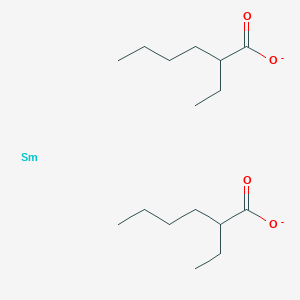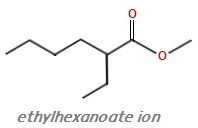
Samarium 2 - Ethylhexanoate is an Samarium source that is soluble in organic solvents as an organometallic compound (also known as metalorganic, organo-inorganic and metallo-organic compounds) as an organometallic compound (also known as metalorganic, organo-inorganic and metallo-organic compounds). Ethylhexanoates are carboxylates with many commercial applications They are commonly used in various catalysts for oxidation, hydrogenation and polymerization and as an adhesion promoter. It is generally immediately available in most volumes. Ultra high purity and high purity forms may be considered. Samarium 2-Ethylhexanoate is one of numerous organo-metallic compounds (also known as metalorganic, organo-inorganic and metallo-organic compounds) sold by American Elements under the tradename AE Organo-Metallics™ for uses requiring non-aqueous solubility such as recent solar energy and water treatment applications. Similar results can sometimes also be achieved with Nanoparticles (also see Nanotechnology and Quantum Dots) and by thin film deposition. Note American Elements additionally supplies many materials as solutions. The numerous commercial applications for Silver include metallurgy, glass and glass polishing, ceramics, catalysts, and in phosphors. In steel manufacturing it is used to remove free oxygen and sulfur by forming stable oxysulfides and by tying up undesirable trace elements, such as lead and antimony. It is considered to be the most efficient glass polishing agent for precision optical polishing.American Elements produces to many standard grades when applicable, including Mil Spec (military grade); ACS, Reagent and Technical Grade; Food, Agricultural and Pharmaceutical Grade; Optical Grade, USP and EP/BP (European Pharmacopoeia/British Pharmacopoeia)and follows applicable ASTM testing standards.Typical and custom packaging is available. Additional technical, research and safety (MSDS) information is available as is a Reference Calculator for converting relevant units of measurement.
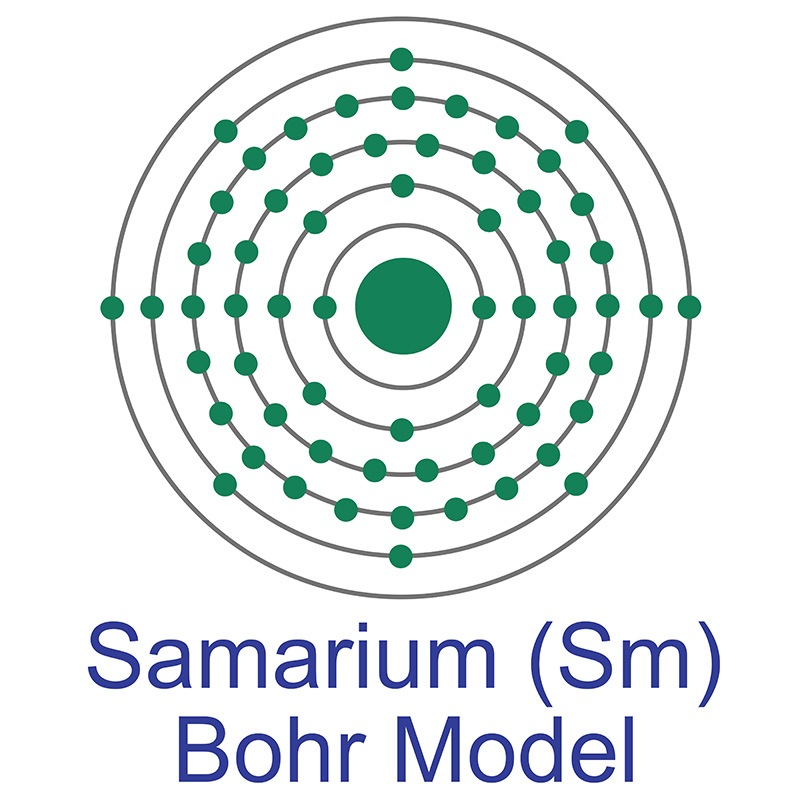
Samarium is a Block F, Group 3, Period 6 element. The number of electrons in each of Samarium's shells is 2, 8, 18, 24, 8, 2 and its electronic configuration is [Xe]4f6 6s2. In its elemental form samarium's CAS number is 7440-19-9. The samarium atom has a radius of 180.4.pm and it's Van der Waals radius is unknown. Samarium is somewhat toxic. Samarium is primarily utilized in the production of samarium-cobalt (Sm2Co17) permanent magnets. Samarium is available as metal and compounds with purities from 99% to 99.999% (ACS grade to ultra-high purity); metals in the form of foil, sputtering target, and rod, and compounds as submicron and nanopowder. It is also used in laser applications and for its dielectric properties. Samarium-cobalt magnets replaced the more expensive platinum-cobalt magnets in the early 1970s. While now overshadowed by the less expensive neodymium-iron-boron magnet, they are still valued for their ability to function at high temperatures. They are utilized in lightweight electronic equipment where size or space is a limiting factor and where functionality at high temperature is a concern. Applications include electronic watches, aeospace equipment, microwave technology and servomotors. Because of its weak spectral absorption band samarium is used in the filter glass on Nd:YAG solid state lasers to surround the laser rod to improve efficiency by absorbing stray emissions. Samarium was first discovered by Paul Emile Lecoq de Boisbaudran in 1879. Samarium is named after the mineral samarskite. See Samarium research below.
PACKAGING SPECIFICATIONS FOR BULK & RESEARCH QUANTITIES
Typical bulk packaging includes palletized plastic 5 gallon/25 kg. pails, fiber and steel drums to 1 ton super sacks in full container (FCL) or truck load (T/L) quantities. Research and sample quantities and hygroscopic, oxidizing or other air sensitive materials may be packaged under argon or vacuum. Shipping documentation includes a Certificate of Analysis and Material Safety Data Sheet (MSDS). Solutions are packaged in polypropylene, plastic or glass jars up to palletized 440 gallon liquid totes.
Chemical characterization: Designation: (CAS#)
Samarium (CAS# 7440-19-9), 100%
Identification number(s):
EINECS Number: 231-128-7
3 Hazards identification
Hazard designation: F Highly flammable
Information pertaining to particular dangers for man and environment
R 11 Highly flammable.
R 15 Contact with water liberates extremely flammable gases.
4 First aid measures
After inhalation
Supply fresh air. If required, provide artificial respiration. Keep patient warm. Consult doctor if symptoms persist.
Seek immediate medical advice.
After skin contact
Instantly wash with water and soap and rinse thoroughly.
Seek immediate medical advice.
After eye contact
Rinse opened eye for several minutes under running water. Then consult doctor.
After swallowing Seek immediate medical advice.
5 Fire fighting measures
Suitable extinguishing agents
Special powder for metal fires. Do not use water.
For safety reasons unsuitable extinguishing agents
Water.
Halocarbon extinguisher
Protective equipment:
Wear self-contained breathing apparatus.
Wear full protective suit.
Measures for environmental protection:
Do not allow material to be released to the environment without proper governmental permits.
Measures for cleaning/collecting:
Ensure adequate ventilation.
Do not flush with water or aqueous cleansing agents
Keep away from ignition sources.
Additional information:
See Section 7 for information on safe handling
See section 8 for information on personal protection equipment.
See Section 13 for information on disposal.
7 Handling and storage
Handling
Information for safe handling:
Keep containers tightly sealed.
Store in cool, dry place in tightly closed containers.
Ensure good ventilation/exhaustion at the workplace.
Information about protection against explosions and fires:
Keep ignition sources away - Do not smoke.
Protect against electrostatic charges.
Fumes can combine with air to form an explosive mixture.
Storage
Requirements to be met by storerooms and containers:
Store in cool location.
Information about storage in one common storage facility:
Do not store together with oxidizing and acidic materials.
Store away from water.
Store away from halogens.
Further information about storage conditions:
Store under dry inert gas.
Protect from humidity and keep away from water.
Keep container tightly sealed.
Store in cool, dry conditions in well sealed containers.
8 Exposure controls and personal protection
Additional information about design of technical systems:
Properly operating chemical fume hood designed for hazardous chemicals and having an average face velocity of at least 100 feet per minute.
Components with critical values that require monitoring at the workplace:
Not required.
Additional information: No data
Personal protective equipment
General protective and hygienic measures
The usual precautionary measures should be adhered to in handling the chemicals.
Keep away from foodstuffs, beverages and food.
Instantly remove any soiled and impregnated garments.
Wash hands during breaks and at the end of the work.
Breathing equipment: Use breathing protection with high concentrations.
Protection of hands: Impervious gloves
Eye protection:
Safety glasses
Full face protection
Face protection
Body protection: Protective work clothing.
9 Physical and chemical properties:
General Information
Form: Chunks
Colour: Silver grey
Smell: Not determined
Value/Range Unit Method
Change in condition
Melting point/Melting range: 1072 ° C
Boiling point/Boiling range: 1900 ° C
Sublimation temperature / start: Not determined
Flash point: Not applicable
Inflammability (solid, gaseous) Highly flammable.
Contact with water liberates extremely flammable gases.
Ignition temperature: Not determined
Decomposition temperature: Not determined
Critical values for explosion:
Lower: Not determined
Upper: Not determined
Steam pressure: Not determined
Density at 20 ° C 7.54 g/cm³
Solubility in / Miscibility with
Water: Not determined
10 Stability and reactivity
Thermal decomposition / conditions to be avoided:
No decomposition if used and stored according to specifications.
Materials to be avoided:
Oxidizing agents
Water/moisture
Acids
Halogens
Air
Dangerous reactions: Contact with water releases flammable gases
Dangerous products of decomposition: Hydrogen
11 Toxicological information
Acute toxicity:
Primary irritant effect:
on the skin: Irritant for skin and mucous membranes.
on the eye: Irritant effect.
Sensitization: No sensitizing effect known.
Additional toxicological information:
To the best of our knowledge the acute and chronic toxicity of this substance is not fully known.
No classification data on carcinogenic properties of this material is available from the EPA, IARC, NTP, OSHA or ACGIH.
12 Ecological information:
General notes:
Do not allow material to be released to the environment without proper governmental permits.
Water hazard class 1 (Self-assessment): slightly hazardous for water.
Do not allow undiluted product or large quantities of it to reach ground water, water bodies or sewage system.
13 Disposal considerations
Product:
Recommendation
Consult state, local or national regulations for proper disposal.
Hand over to disposers of hazardous waste.
Must be specially treated under adherence to official regulations.
Uncleaned packagings:
Recommendation:
Disposal must be made according to official regulations.
14 Transport information
Land transport ADR/RID and GGVS/GGVE (cross-border/domestic)
ADR/RID-GGVS/E Class: 4.1 (F3) Flammable solids.
Kemler Number: 40
UN-Number: 3178
Packaging group: III
Label 4.1
Designation of goods: 3178 FLAMMABLE SOLID, INORGANIC, N.O.S.
(samarium)
Code letter and hazard designation of product: F Highly flammable
Risk phrases:
11 Highly flammable.
15 Contact with water liberates extremely flammable gases.
National regulations
Information about limitation of use:
For use only by technically qualified individuals.
Employment restrictions concerning young persons must be observed.
Water hazard class:
Water hazard class 1 (Self-assessment): slightly hazardous for water.
16 Other information:
Employers should use this information only as a supplement to other information gathered by them, and should make independent judgement of suitability of this information to ensure proper use and protect the health and safety of employees. This information is furnished without warranty, and any use of the product not in conformance with this Material Safety Data Sheet, or in combination with any other product or process, is the responsibility of the user.
Proud sponsors of Aeromat 2012. Please join us and our customers & co-sponsors Boeing and ATI on
June 18-20, 2012
in Charlotte, North Carolina