American Elements


Hafnium Telluride
High Purity HfTe2
Product
Product Code
Order or Specifications
(5N) 99.999% Hafnium Telluride Powder
HF-TE-05-P
Contact American Elements
(5N) 99.999% Hafnium Telluride Ingot
HF-TE-05-I
Contact American Elements
(5N) 99.999% Hafnium Telluride Chunk
HF-TE-05-CK
Contact American Elements
(5N) 99.999% Hafnium Telluride Sputtering Target
HF-TE-05-ST
Contact American Elements
(5N) 99.999% Hafnium Telluride Lump
HF-TE-05-L
Contact American Elements
(5N) 99.999% Hafnium Telluride Wafer
HF-TE-05-WSX
Contact American Elements


CHEMICAL
IDENTIFICATION
Formula CAS No. PubChem
SID
PubChem CID MDL No. EC No IUPAC Name Beilstein
Re. No.
SMILES
Identifier
InChI
Identifier
InChI
Key
HfTe2 11126-07-01                

Compound Formula Mol. Wt. Appearance Density

Exact Mass

Monoisotopic Mass Charge MSDS
HfTe2     g/cm3       Safety Data Sheet


Telluride IonHafnium Telluride (HfTe) is a crystal grown product generally immediately available in most volumes. Technical, research and safety (MSDS) information is available as is a Reference Calculator for converting relevant units of measurement. Hafnium Telluride (HfTe) is also available as Quantum Dots. HfTe Quantum Dots have the widest wavelength range reaching sizes as small as less then 500 nm; within the range sufficient to emit light in the blue-white range. Hafnium Telluride Quantum Dots are charged aqueous soluble nano crystals with narrow emission spectra from 490 nm to 740 nm. Hafnium Telluride (HfTe) is also used in solar energy and advanced optical applications.

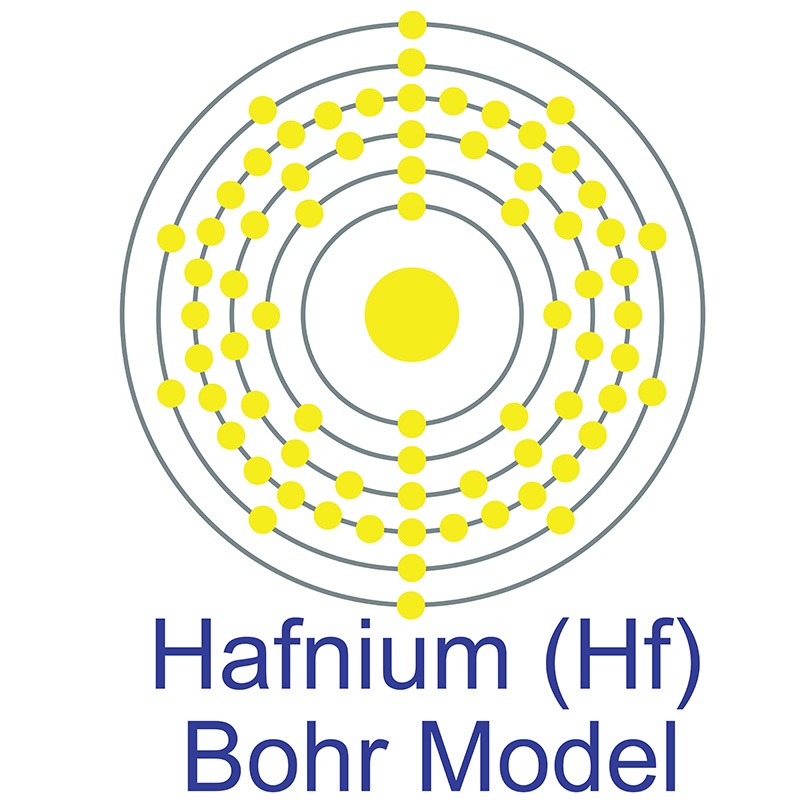
Hafnium(Hf) atomic and molecular weight, atomic number and elemental symbol Hafnium is a Block D, Group 4, Period 6 element. The number of electrons in each of Hafnium's shells is 2, 8, 18, 32, 10, 2 and its electronic configuration is [Xe] 4f14 5d2 6s2. In its elemental form hafnium's CAS number is 7440-58-6.The hafnium atom has a radius of 156.4.pm and it's Van der Waals radius is 200.pm. Hafnium is not toxic. Hafnium is one of the Group IV transition elements that is refined from various zirconic mineral deposits. Hafnium is available as metal and compounds with purities from 99% to 99.999% (ACS grade to ultra-high purity); metals in the form of foil, sputtering target, and rod, and compounds as submicron and nanopowder. It's primary uses are due to its ability as a nuclear "getter" or absorber of neutrons. It is a primary component in nuclear control rods for this purpose. It also finds uses as a dopant in the alloy of Elemental Hafniumsteel and Hafnium Bohr Modeltitanium. It is also used in the production of mantles for high intensity incandescent lamps. Hafnium is replacing polysilicon as the principle gate or electrode material in metal oxide semiconductor field effect transistors (MOSFETs) which are the basis for all modern semiconductors. As semiconductors have gotten smaller, the limiting factor in further size reduction has been the ability of the silicon oxide gate to perform below 10 angstroms where leakage occurs. Recent research has been devoted to the development of High-k materials which can function as a di-electric barrier or gate with lower leakage. Using hafnium based alloys as this di-electric gate has allowed for the development of MOSFET gates smaller than 10 angstroms. This allows for further size reduction, reduced switching power requirements and improved performance. Hafnium was first discovered by Dirk Coster in 1923. See Hafnium research below.

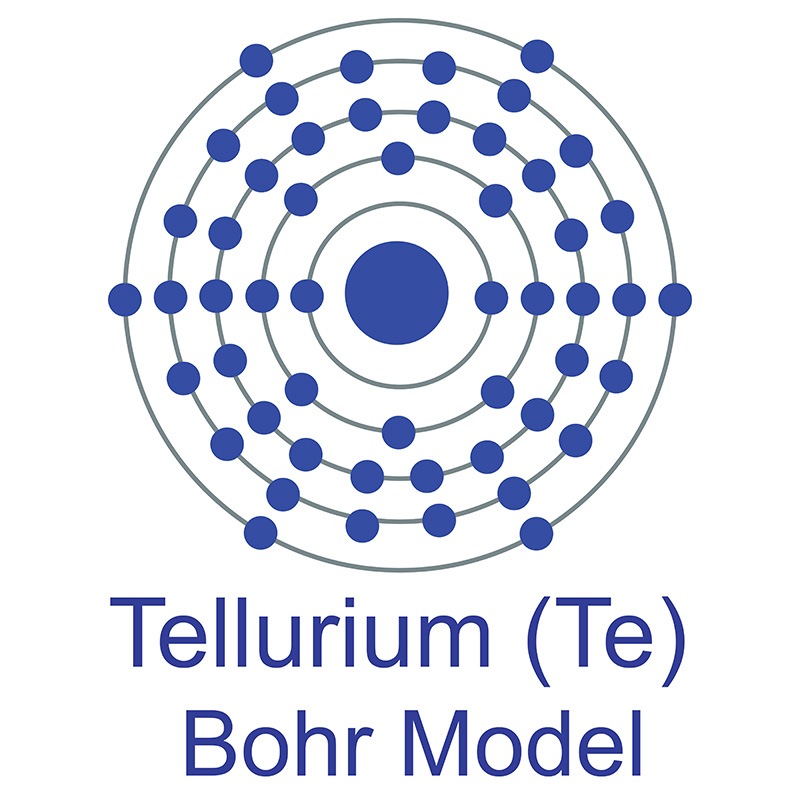
Tellurium(Te)atomic and molecular weight, atomic number and elemental symbolTellurium is a Block P, Group 16, Period 5 element. The number of electrons in each of Tellurium's shells is 2, 8, 18, 18, 6 and its electronic configuration is [Kr] 4d10 5s2 5p4. In its elemental form tellurium's CAS number is 13494-80-9. The tellurium atom has a radius of 143.2.pm and it's Van der Waals radius is 206.pm. Tellurium is a p-type semiconductor, and shows greater conductivity in certain directions, depending on alignment of the atoms. It is grown in crystalline form with other elements such as indium telluride. Its conductivity increases slightly with exposure to light which makes many tellurides candidates for solar energyapplications. Tellurium improves the machinability of copper and stainless steel, and its addition to lead decreases the corrosive action of sulfuric acid on lead and improves its strength and hardness. Elemental TelluriumTellurium is used as Tellurium Bohr Modela basic ingredient in blasting caps, and is added to cast iron for chill control. Tellurium is used in ceramics. Bismuth telluride has been used in thermoelectric devices. Iron is available as metal and compounds with purities from 99% to 99.999% (ACS grade to ultra-high purity); metals in the form of foil, sputtering target, and rod, and compounds as submicron and nanopowder. Tellurium was first discovered by Franz Muller von Reichenstein in 1782. The name Tellurium originates from the Greek word 'Tellus' meaning Earth. See Tellurium research below.

American Elements semi conducting materials are crystal structures produced from ultra high purity starting materials synthesized by our high purity production facility which includes several large electric muffle furnaces, a tube furnace for hydrogen reduction, 50 gallon glass-lined Pfaudler reactors supported by our analytical laboratory containing X-ray diffraction, SEM, AA, BET surface area, and ICP Spectrometry for trace metals analysis. See a discussion of American Elements Ultra High Purity and Analytical capabilities. See Crystal Growth for processes used to fabricate semiconductor materials, which include:

  • Crystal "pulling" by the Czochaiski method for production of semiconductor materials
  • Flux growth and gradient freeze
  • Directional solidification of fluorites using both the Bridgman-Stockbarger and float zoning techniques

Have a Question? Ask a Chemical Engineer or Material Scientist   Request an MSDS or Certificate of Analysis

 
Safety &
Handling
 
Signal Word Hazard Statements Hazard Codes Risk Codes Safety Precautions RTECS No. Transport Information WGK Germany
N/A N/A N/A N/A N/A N/A N/A N/A


PACKAGING SPECIFICATIONS FOR BULK & RESEARCH QUANTITIES


Typical bulk packaging includes palletized plastic 5 gallon/25 kg. pails, fiber and steel drums to 1 ton super sacks in full container (FCL) or truck load (T/L) quantities. Research and sample quantities and hygroscopic, oxidizing or other air sensitive materials may be packaged under argon or vacuum. Shipping documentation includes a Certificate of Analysis and Material Safety Data Sheet (MSDS). Solutions are packaged in polypropylene, plastic or glass jars up to palletized 440 gallon liquid totes.


Show me more hafnium
 
Customers for this product have also looked at:
Hafnium Sputtering Target Hafnium Oxide Nanopowder Hafnium Wire Hafnium Oxide Hafnium Powder
Hafnium Acetate Solution Cobalt Hafnium Niobium Hafnium Acetylacetonate Tantalum Hafnium Carbide Hafnium Chloride
Hafnium Rod Hafnium Foil Hafnium Pellets Hafnium Metal Hafnium Oxide Pellets


Search by Material, Product Name, Product Code, CAS Number, Formula, Element, Anion, Form, EC Number, MDL Number or PubChem ID.
German   Korean   French   Japanese   Spanish   Chinese (Simplified)   Portuguese   Russian   Chinese (Taiwan)   Italian   Turkish   Polish   Dutch   Czech   Swedish   Hungarian   Danish   Hebrew

Production Catalog Available in 36 Countries & Languages


Recent Research & Development for Hafnium

  • N(2) Activation by a Hafnium Complex: A DFT Study on CO-Assisted Dinitrogen Cleavage and Functionalization. Zhang X, Butschke B, Schwarz H. Chemistry. 2010 Sep 28. [Epub ahead of print] PubMed PMID: 20878807.

  • Effective enrichment and mass spectrometry analysis of phosphopeptides using mesoporous metal oxide nanomaterials. Nelson CA, Szczech JR, Dooley CJ, Xu Q, Lawrence MJ, Zhu H, Jin S, Ge Y. Anal Chem. 2010 Sep 1;82(17):7193-201. PubMed PMID: 20704311; PubMed Central PMCID: PMC2936271.

  • Synthesis, characterization and biological study on Cr(3+), ZrO(2+), HfO(2+) and UO(2)(2+) complexes of oxalohydrazide and bis(3-hydroxyimino)butan-2-ylidene)-oxalohydrazide. El-Asmy AA, El-Gammal OA, Radwan HA. Spectrochim Acta A Mol Biomol Spectrosc. 2010 Sep 1;76(5):496-501. Epub 2010 Apr 21. PubMed PMID: 20451440.

  • Intramolecular sigma-bond metathesis/protonolysis on zirconium(IV) and hafnium(IV) pyridylamido olefin polymerization catalyst precursors: exploring unexpected reactivity paths. Luconi L, Giambastiani G, Rossin A, Bianchini C, Lledós A. Inorg Chem. 2010 Aug 2;49(15):6811-3. PubMed PMID: 20583749.

  • Guided-mode resonant wave plates. Magnusson R, Shokooh-Saremi M, Johnson EG. Opt Lett. 2010 Jul 15;35(14):2472-4. doi: 10.1364/OL.35.002472. PubMed PMID: 20634867.

  • Initiation of a passivated interface between hafnium oxide and In(Ga)As(0 0 1)-(4x2). Clemens JB, Bishop SR, Lee JS, Kummel AC, Droopad R. J Chem Phys. 2010 Jun 28;132(24):244701. PubMed PMID: 20590208.

  • Zirconium(IV)- and hafnium(IV)-catalyzed highly enantioselective epoxidation of homoallylic and bishomoallylic alcohols. Li Z, Yamamoto H. J Am Chem Soc. 2010 Jun 16;132(23):7878-80. PubMed PMID: 20481541; PubMed Central PMCID: PMC2886809.

  • Combined U-Pb and Lu-Hf isotope analyses by laser ablation MC-ICP-MS: methodology and applications. Matteini M, Dantas EL, Pimentel MM, Bühn B. An Acad Bras Cienc. 2010 Jun;82(2):479-91. PubMed PMID: 20563428.

  • Preparation and structures of enantiomeric dinuclear zirconium and hafnium complexes containing two homochiral N atoms, and their catalytic property for polymerization of rac-lactide. Hu M, Wang M, Zhu H, Zhang L, Zhang H, Sun L. Dalton Trans. 2010 May 14;39(18):4440-6. Epub 2010 Mar 31. PubMed PMID: 20358041.

  • Effect of deposition temperature on the characteristics of HfN(x) thin films prepared by plasma assisted cyclic chemical vapor deposition. Kim EJ, Woo HG, Kim DH. J Nanosci Nanotechnol. 2010 May;10(5):3463-6. PubMed PMID: 20358979.

  • A younger age for ALH84001 and its geochemical link to shergottite sources in Mars. Lapen TJ, Righter M, Brandon AD, Debaille V, Beard BL, Shafer JT, Peslier AH. Science. 2010 Apr 16;328(5976):347-51. PubMed PMID: 20395507.

  • Improved reliability from a plasma-assisted metal-insulator-metal capacitor comprising a high-k HfO2 film on a flexible polyimide substrate. Meena JS, Chu MC, Kuo SW, Chang FC, Ko FH. Phys Chem Chem Phys. 2010 Mar 20;12(11):2582-9. Epub 2010 Jan 26. PubMed PMID: 20200734.

  • Optical coatings in microscale channels by atomic layer deposition. Gabriel NT, Talghader JJ. Appl Opt. 2010 Mar 10;49(8):1242-8. doi: 10.1364/AO.49.001242. PubMed PMID: 20220879.

  • Effect of TiF4, ZrF4, HfF4 and AmF on erosion and erosion/abrasion of enamel and dentin in situ. Wiegand A, Hiestand B, Sener B, Magalhães AC, Roos M, Attin T. Arch Oral Biol. 2010 Mar;55(3):223-8. Epub 2010 Jan 18. PubMed PMID: 20083245.

  • Hydrolysis of bis(p-nitrophenyl)phosphate by tetravalent metal complexes with Klaui's oxygen tripodal ligand. Yi XY, Lam TC, Williams ID, Leung WH. Inorg Chem. 2010 Mar 1;49(5):2232-8. PubMed PMID: 20131806.

  • Synthesis of nested coaxial multiple-walled nanotubes by atomic layer deposition. Gu D, Baumgart H, Abdel-Fattah TM, Namkoong G. ACS Nano. 2010 Feb 23;4(2):753-8. Erratum in: ACS Nano. 2010 Jul 27;4(7):4331. PubMed PMID: 20085347.

  • Synthesis and characterisation of ionic liquids based on 1-butyl-3-methylimidazolium chloride and MCl(4), M = Hf and Zr. Campbell PS, Santini CC, Bouchu D, Fenet B, Rycerz L, Chauvin Y, Gaune-Escard M, Bessada C, Rollet AL. Dalton Trans. 2010 Feb 7;39(5):1379-88. Epub 2009 Dec 1. PubMed PMID: 20104366.

  • Dielectric surface-controlled low-voltage organic transistors via n-alkyl phosphonic acid self-assembled monolayers on high-k metal oxide. Acton BO, Ting GG, Shamberger PJ, Ohuchi FS, Ma H, Jen AK. ACS Appl Mater Interfaces. 2010 Feb;2(2):511-20. PubMed PMID: 20356199.

  • In situ reaction mechanism studies on ozone-based atomic layer deposition of Al(2)O(3) and HfO(2). Rose M, Niinistö J, Endler I, Bartha JW, Kücher P, Ritala M. ACS Appl Mater Interfaces. 2010 Feb;2(2):347-50. PubMed PMID: 20356179.

  • Is titanium tetrafluoride (TiF4) effective to prevent carious and erosive lesions? A review of the literature. Wiegand A, Magalhães AC, Attin T. Oral Health Prev Dent. 2010;8(2):159-64. Review. PubMed PMID: 20589250.


Customers for this product have also looked at:
Thulium Telluride Tellurium 2-Ethylhexanoate Tellurium Fluoride Tellurium Oxide Tellurium Bars
Tellurium Chloride Tellurium Pellets Tellurium Sputtering Target Tellurium Oxide Nanopowder Tellurium Nitrate
Antimony Telluride Tellurium Foil Tellurium Powder Tellurium Meta Tellurium Oxide Pellets

Recent Research & Development for Tellurium

  • Multi-metal(loid) methylation in methanoarchaea is linked to central intermediates of methanogenesis. Thomas F, Diaz-Bone RA, Wuerfel O, Huber B, Weidenbach K, Schmitz RA, Hensel R. Appl Environ Microbiol. 2011 Oct 14. [Epub ahead of print] PMID: 22003009 [PubMed - as supplied by publisher]

  • Synthesis, structure, and bonding of orthorhombic r(5)au(2)te(2) (R = lu, ho, dy, y). Electronic structure of the binary parent valence compound eu(5)as(4). Chai P, Corbett JD. Inorg Chem. 2011 Nov 7;50(21):10949-55. Epub 2011 Oct 12. PMID: 21991925 [PubMed - in process]

  • Glucose-6-Phosphate Dehydrogenase Protects Escherichia coli from Tellurite-Mediated Oxidative Stress. Sandoval JM, Arenas FA, Vásquez CC. PLoS One. 2011;6(9):e25573. Epub 2011 Sep 30. PMID: 21984934 [PubMed - in process]

  • Microbial processing of tellurium as a tool in biotechnology. Turner RJ, Borghese R, Zannoni D. Biotechnol Adv. 2011 Sep 1. [Epub ahead of print] PMID: 21907273 [PubMed - as supplied by publisher]

  • Measurement of the ?? Decay Half-Life of ^{130}Te with the NEMO-3 Detector. Arnold R, Augier C, Baker J, Barabash AS, Basharina-Freshville A, Blondel S, Bongrand M, Broudin-Bay G, Brudanin V, Caffrey AJ, Chapon A, Chauveau E, Durand D, Egorov V, Flack R, Garrido X, Grozier J, Guillon B, Hubert P, Hugon C, Jackson CM, Jullian S, Kauer M, Klimenko A, Kochetov O, Konovalov SI, Kovalenko V, Lalanne D, Lamhamdi T, Lang K, Liptak Z, Lutter G, Mamedov F, Marquet Ch, Martin-Albo J, Mauger F, Mott J, Nachab A, Nemchenok I, Nguyen CH, Nova F, Novella P, Ohsumi H, Pahlka RB, Perrot F, Piquemal F, Reyss JL, Richards B, Ricol JS, Saakyan R, Sarazin X, Simard L, Simkovic F, Shitov Y, Smolnikov A, Söldner-Rembold S, Stekl I, Suhonen J, Sutton CS, Szklarz G, Thomas J, Timkin V, Torre S, Tretyak VI, Umatov V, Vála L, Vanyushin I, Vasiliev V, Vorobel V, Vylov Ts, Zukauskas A; NEMO-3 Collaboration. Phys Rev Lett. 2011 Aug 5;107(6):062504. Epub 2011 Aug 4. PMID: 21902318 [PubMed - in process]

  • Synthesis and characterization of wurtzite ZnTe nanorods with controllable aspect ratios. Zhang J, Jin S, Fry HC, Peng S, Shevchenko E, Wiederrecht GP, Rajh T. J Am Chem Soc. 2011 Oct 5;133(39):15324-7. Epub 2011 Sep 12. PMID: 21899348 [PubMed - in process]

  • A homometallic tricapped cubane cluster: [(Cp*Mo)4B4H4(?4-BH)3] (Cp* = ?5-C5Me5). Thakur A, Sahoo S, Ghosh S. Inorg Chem. 2011 Sep 5;50(17):7940-2. Epub 2011 Aug 11. PMID: 21834507 [PubMed - in process]

  • Selective antimicrobial activity associated with sulfur nanoparticles. Schneider T, Baldauf A, Ba LA, Jamier V, Khairan K, Sarakbi MB, Reum N, Schneider M, Röseler A, Becker K, Burkholz T, Winyard PG, Kelkel M, Diederich M, Jacob C. J Biomed Nanotechnol. 2011 Jun;7(3):395-405. PMID: 21830480 [PubMed - indexed for MEDLINE]

  • Semiconductor detectors allow low-dose-low-dose 1-day SPECT myocardial perfusion imaging. Nkoulou R, Pazhenkottil AP, Kuest SM, Ghadri JR, Wolfrum M, Husmann L, Fiechter M, Buechel RR, Herzog BA, Koepfli P, Burger C, Gaemperli O, Kaufmann PA. J Nucl Med. 2011 Aug;52(8):1204-9. PMID: 21810589 [PubMed - indexed for MEDLINE]

  • CsTe2O(6-x): novel mixed-valence tellurium oxides with framework-deficient pyrochlore-related structure. Siritanon T, Li J, Stalick JK, Macaluso RT, Sleight AW, Subramanian MA. Inorg Chem. 2011 Sep 5;50(17):8494-501. Epub 2011 Jul 27. PMID: 21793494 [PubMed - in process]

  • Bioactivity of the conjugation of green-emitting CdTe quantum dots with a carborane complex. Wu C, Shi L, Li Q, Zhao J, Selke M, Yan H, Wang X. J Nanosci Nanotechnol. 2011 Apr;11(4):3091-9. PMID: 21776675 [PubMed - indexed for MEDLINE]

  • Isolation and characterization of an environmental cadmium- and tellurite-resistant Pseudomonas strain. Chien CC, Jiang MH, Tsai MR, Chien CC. Environ Toxicol Chem. 2011 Oct;30(10):2202-7. doi: 10.1002/etc.620. Epub 2011 Aug 10. PMID: 21766319 [PubMed - in process]

  • An ultrasensitive hydrogen peroxide biosensor based on electrocatalytic synergy of graphene-gold nanocomposite, CdTe-CdS core-shell quantum dots and gold nanoparticles. Gu Z, Yang S, Li Z, Sun X, Wang G, Fang Y, Liu J. Anal Chim Acta. 2011 Sep 2;701(1):75-80. Epub 2011 Jul 4. PMID: 21763811 [PubMed - indexed for MEDLINE]

  • Synchronous determination of mercury (II) and copper (II) based on quantum dots-multilayer film. Ma Q, Ha E, Yang F, Su X. Anal Chim Acta. 2011 Sep 2;701(1):60-5. Epub 2011 Jun 17. PMID: 21763809 [PubMed - indexed for MEDLINE]

  • Procedure-Controlled Selective Synthesis of 5-Acyl-2-iminothiazolines and their Selenium and Tellurium Derivatives by Convergent Tandem Annulation. Wang Y, Zhang WX, Wang Z, Xi Z. Angew Chem Int Ed Engl. 2011 Jul 14. doi: 10.1002/anie.201101948. [Epub ahead of print] No abstract available. PMID: 21761522 [PubMed - as supplied by publisher]

  • Synthesis, structures and ab initio studies of selenium and tellurium bis(carbodithioates and carbothioates). Kato S, Tani K, Ishida M, Nonogaki J, Ebihara M, Hayashi S, Nakanishi W, Niyomura O, Ando F, Koketsu J. Dalton Trans. 2011 Aug 28;40(32):8156-69. Epub 2011 Jul 13. PMID: 21750832 [PubMed - in process]

  • Electrical bistability in self-assembled hybrid multilayers of phospholipid and nanoparticles. Yuan B, Hu SX, Lu NY, Xu F, Zhou K, Ma YQ, Li M. Nanotechnology. 2011 Aug 5;22(31):315303. Epub 2011 Jul 12. PMID: 21747161 [PubMed - indexed for MEDLINE]

  • Organomercury(II) and tellurium(II) compounds with the "pincer" ligand 2,6-[O(CH2CH2)2NCH2]2C6H3--stabilization of an unusual organotellurium(II) cationic species. Beleaga A, Bojan VR, Pöllnitz A, Rat CI, Silvestru C. Dalton Trans. 2011 Sep 21;40(35):8830-8. Epub 2011 Jul 11. PMID: 21743935 [PubMed - in process]

  • Differentiation between the motor and sensory fascicles of the peripheral nerves from adult rats using annexin V-CdTe-conjugated polymer. Meng X, Lu L, Wang H, Liu B. Neurol India. 2011 May-Jun;59(3):333-8. PMID: 21743158 [PubMed - indexed for MEDLINE]

  • Tellurium tetrachloride and diphenyl ditelluride cause cytotoxicity in rat hippocampal astrocytes. Roy S, Hardej D. Food Chem Toxicol. 2011 Oct;49(10):2564-74. Epub 2011 Jul 1. PMID: 21742007 [PubMed - in process]


USA Science & Engineering FestivalSponsors of the United States Science & Engineering Festival on April 28, 2012 in Washington D.C. Please join us and our customers & co-sponsors NASA, Lockheed Martin and the Department of Defense inspiring the next generation of scientists and engineers.


PRODUCT CATALOG Hafnium Products News Foil Submicron & Nanopowder Tolling Ultra High Purity Sputtering Target Crystal Growth Rod, Plate, Powder, etc. Home

  Print this Page
Periodic table of the elements science and academic information, elements and advanced materials data, scientific presentations and all pages, designs, concepts, logos, and color schemes herein are the copyrighted proprietary rights and intellectual property of American Elements. American Elements is a U.S. Registered Trademark. © 2001-2012. American Elements. All rights reserved.
Learn Six Sigma


American Elements is a copyrighted U.S. Trademark. All rights reserved.