Thorium Slugs

High Purity Th Slugs
CAS 7440-29-1


Product Product Code Order or Specifications
(2N) 99% Thorium Slugs TH-M-02-SL Contact American Elements
(2N5) 99.5% Thorium Slugs TH-M-025-SL Contact American Elements
(3N) 99.9% Thorium Slugs TH-M-03-SL Contact American Elements
(3N5) 99.95% Thorium Slugs TH-M-035-SL Contact American Elements
(4N) 99.99% Thorium Slugs TH-M-04-SL Contact American Elements

CHEMICAL
IDENTIFIER
Formula CAS No. PubChem SID PubChem CID MDL No. EC No Beilstein
Re. No.
SMILES
Identifier
InChI
Identifier
InChI
Key
Th 7440-29-1 166489 23960 N/A 231-139-7   N/A [Th] InChI=1S/Th ZSLUVFAKFWKJRC-UHFFFAOYSA-N

PROPERTIES Mol. Wt. Appearance Density Tensile Strength Melting Point Boiling Point Thermal Conductivity Electrical Resistivity Eletronegativity Specific Heat Heat of Vaporization Heat of Fusion MSDS
232.03 N/A 232.03 kg/m³ 144 MPa 1842 °C 4820 °C N/A N/A N/A N/A N/A N/A Safety Data Sheet

American Elements produces to many standard grades when applicable, including Mil Spec (military grade); ACS, Reagent and Technical Grade; Food, Agricultural and Pharmaceutical Grade; Optical Grade, USP and EP/BP (European Pharmacopeia/British Pharmacopeia) and follows applicable ASTM testing standards.See safety data and research below and pricing/lead time above. American Elements specializes in producing Thorium as ribbon in various thicknesses and sizes. Most ribbon is rolled High Purity Metallic Ribbonfor use in coating and thin film Chemical Vapor Deposition (CVD) and Physical Vapor Deposition (PVD) processes including Thermal and Electron Beam (E-Beam) Evaporation, Low Temperature Organic Evaporation, Atomic Layer Deposition (ALD), Organometallic and Chemical Vapor Deposition (MOCVD) for specific applications such as fuel cells and solar energy. Thicknesses up to 0.02" and widths up to 1" are available for most metals. Materials are produced using crystallization, solid state and other ultra high purification processes such as sublimation. American Elements specializes in producing custom compositions for commercial and research applications and for new proprietary technologies. American Elements also casts any of the rare earth metals and most other advanced materials into rod, bar or plate form, as well as other machined shapes and through other processes such as nanoparticles (See also application discussion at Nanotechnology Information and at Quantum Dots) and in the form of solutions and organometallics. We also produce Thorium as rods, powder and plates. Other shapes are available by request.

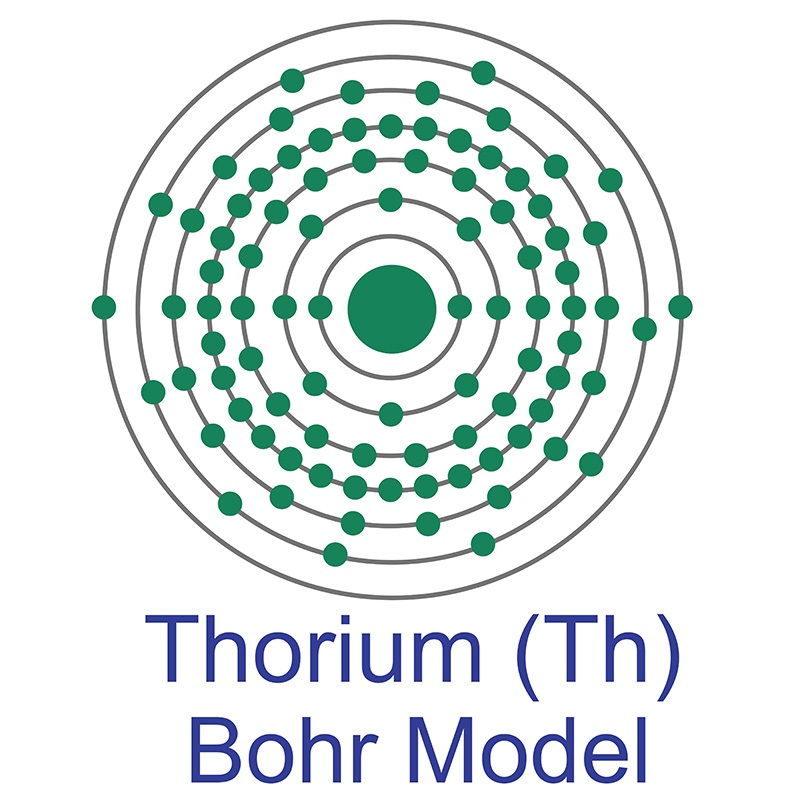
Thorium(Th) atomic and molecular weight, atomic number and elemental symbol Thorium is a Block F, Group 3, Period 7 element. The number of electrons in each of Thorium's shells is 2, 8, 18, 32, 18, 10, 2 and its electronic configuration is [Rn] 6d2 7s2. In its elemental form thorium's CAS number is 7440-29-1. The thorium atom has a radius of 179.8.pm and its Van der Waals radius is 200.pm. Thorium is radioactive and can collect in bones which may cause bone cancer several years after exposure. Breathing in substantial amounts of thorium may beThorium Bohr Model lethal. Thorium is a lanthanide (rare earth) material with potential nuclear power applications. Thorium is available as metal and compounds with purities Elemental Thoriumfrom 99% to99.999% (ACS grade to ultra-high purity); metals in the form of foil, sputtering target, and rod, and compounds as submicron and nanopowder. It ispresently used as a tungsten coating in electronic parts due to its high emission factor. Thorium in the form of its fluoride and oxide is used in advanced optic applications for its high refractive index.It is also used in several other high temperature glass applications, such as in the mantle of lamps and to produce crystal growth crucibles and ampules. Thorium, first discovered by Jons Berzelius in 1828, is found in small amounts in most rocks and soils. The name Thorium originates from the Scandinavian god, Thor, the Norse god of war and thunder. See Thorium research below.


HEALTH, SAFETY & TRANSPORTATION INFORMATION
N/A
N/A
N/A
N/A
N/A
N/A
N/A
N/A
N/A        

CUSTOMERS FOR THORIUM SLUGS HAVE ALSO LOOKED AT
Thorium Sheet Thorium Nitrate Thorium Oxide Nanopowder Thorium Acetate Thorium Pellets
Thorium Oxide Pellets Thorium Wire Thorium Carbide Thorium Metal Thorium 2 - Ethylhexanoate
Thorium Sputtering Target Thorium Chloride Thorium Sulfate Thorium Foil Thorium Oxide
Show Me MORE Forms of Thorium

PACKAGING SPECIFICATIONS FOR BULK & RESEARCH QUANTITIES
Typical bulk packaging includes palletized plastic 5 gallon/25 kg. pails, fiber and steel drums to 1 ton super sacks in full container (FCL) or truck load (T/L) quantities. Research and sample quantities and hygroscopic, oxidizing or other air sensitive materials may be packaged under argon or vacuum. Shipping documentation includes a Certificate of Analysis and Material Safety Data Sheet (MSDS). Solutions are packaged in polypropylene, plastic or glass jars up to palletized 440 gallon liquid totes.


Have a Question? Ask a Chemical Engineer or Material Scientist
Request an MSDS or Certificate of Analysis


German   Korean   French   Japanese   Spanish   Chinese (Simplified)   Portuguese   Russian   Chinese (Taiwan)  Italian   Turkish   Polish   Dutch   Czech   Swedish   Hungarian   Danish   Hebrew

Production Catalog Available in 36 Countries & Languages


Recent Research & Development for Thorium

  • Uranium and thorium adsorption from aqueous solution using a novel polyhydroxyethylmethacrylate-pumice composite. Akkaya R. J Environ Radioact. 2013 Feb 13;120C:58-63. doi: 10.1016/j.jenvrad.2012.11.015.
  • Nitrite complexes of uranium and thorium. Dulong F, Pouessel J, Thuéry P, Berthet JC, Ephritikhine M, Cantat T. Chem Commun (Camb). 2013 Feb 26;49(24):2412-4. doi: 10.1039/c3cc39163a.
  • Radioactive characterization of the main materials involved in the titanium dioxide production process and their environmental radiological impact. Mantero J, Gazquez MJ, Bolivar JP, Garcia-Tenorio R, Vaca F. J Environ Radioact. 2013 Feb 12;120C:26-32. doi: 10.1016/j.jenvrad.2013.01.002.
  • Recent developments in actinide-ligand multiple bonding. Hayton TW. Chem Commun (Camb). 2013 Feb 11.
  • Coherence-enhanced optical determination of the ^{229}th isomeric transition. Liao WT, Das S, Keitel CH, Pálffy A. Phys Rev Lett. 2012 Dec 28;109(26):262502. 2012 Dec 28.
  • Analysis of Naturally-occurring Radionuclides in Coal Combustion Fly Ash, Gypsum, and Scrubber Residue Samples. Roper AR, Stabin MG, Delapp RC, Kosson DS. Health Phys. 2013 Mar;104(3):264-9. doi: 10.1097/HP.0b013e318279f3bf.
  • Thorotrast: Analysis of the time evolution of its a activity concentration, in the 70 years following the chemical purification of Thorium. Bianconi A, Corradini M, Leali M, Lodi Rizzini E, Venturelli L, Zurlo N. Phys Med. 2013 Jan 17. doi:pii: S1120-1797(12)00229-3. 10.1016/j.ejmp.2012.12.003.
  • Three-Dimensional MOF-Type Architectures with Tetravalent Uranium Hexanuclear Motifs (U(6) O(8) ). Falaise C, Volkringer C, Vigier JF, Henry N, Beaurain A, Loiseau T. Chemistry. 2013 Jan 16. doi: 10.1002/chem.201203914.
  • Incidental hyperdensities within the reticuloendothelial system. Amirbekian S, Ibrahim SM, Shin MS. Clin Imaging. 2013 Jan 9. doi:pii: S0899-7071(12)00270-7. 10.1016/j.clinimag.2012.09.001.
  • Gamma ray spectrometry logs as a hydrocarbon indicator for clastic reservoir rocks in Egypt. Al-Alfy IM, Nabih MA, Eysa EA. Appl Radiat Isot. 2013 Mar;73:90-5. doi: 10.1016/j.apradiso.2012.11.016. 2012 Dec 20.
  • Potential treatment of inflammatory and proliferative diseases by ultra-low doses of ionizing radiations. Sanders CL. Dose Response. 2012 Dec;10(4):610-25. doi: 10.2203/dose-response.12-017.Sanders. 2012 Oct 9.
  • Proton transfer in Th(IV) hydrate clusters: a link to hydrolysis of Th(OH)(2)(2+) to Th(OH)(3)(+) in aqueous solution. Rutkowski PX, Michelini Mdel C, Gibson JK. J Phys Chem A. 2013 Jan 17;117(2):451-9. doi: 10.1021/jp309658x. 2013 Jan 4.
  • Synthesis, spectral, thermal and antibacterial investigations of mixed ligand complexes of thorium(IV) derived from 8-hydroxyquinoline and some amino acids. Patil SS, Thakur GA, Shaikh MM. Acta Pol Pharm. 2012 Nov-Dec;69(6):1087-93.
  • Toxicity of irradiated advanced heavy water reactor fuels. Priest ND, Richardson RB, Edwards GW. Health Phys. 2013 Feb;104(2):195-210. doi: 10.1097/HP.0b013e3182764cf5.
  • Further insights in the ability of classical nonadditive potentials to model actinide ion-water interactions. Réal F, Trumm M, Schimmelpfennig B, Masella M, Vallet V. J Comput Chem. 2013 Apr 5;34(9):707-19. doi: 10.1002/jcc.23184. 2012 Dec 12.
  • Nuclear energy: Thorium fuel has risks. Ashley SF, Parks GT, Nuttall WJ, Boxall C, Grimes RW. Nature. 2012 Dec 6;492(7427):31-3. doi: 10.1038/492031a. No abstract available.
  • A horizon scan of global conservation issues for 2013. Sutherland WJ, Bardsley S, Clout M, Depledge MH, Dicks LV, Fellman L, Fleishman E, Gibbons DW, Keim B, Lickorish F, Margerison C, Monk KA, Norris K, Peck LS, Prior SV, Scharlemann JP, Spalding MD, Watkinson AR. Trends Ecol Evol. 2013 Jan;28(1):16-22. doi: 10.1016/j.tree.2012.10.022. 2012 Dec 7.
  • Radionuclides and radiation indices of high background radiation area in Chavara-Neendakara placer deposits (Kerala, India). Derin MT, Vijayagopal P, Venkatraman B, Chaubey RC, Gopinathan A. PLoS One. 2012;7(11):e50468. doi: 10.1371/journal.pone.0050468. 2012 Nov 21.
  • Radium and thorium applications for the general public: unexpected consequences of the discovery from pierre and marie curie. Cazalaà JB. Anesthesiology. 2012 Dec;117(6):1202. doi: 10.1097/ALN.0b013e31827ce176. No abstract available.
  • An investigation into the adsorption of thorium(IV) from aqueous solutions by a carboxylate-functionalised graft copolymer derived from titanium dioxide-densified cellulose. Anirudhan TS, Sreekumari SS, Jalajamony S. J Environ Radioact. 2013 Feb;116:141-7. doi: 10.1016/j.jenvrad.2012.10.001. 2012 Nov 12.