|
Tungsten Silicon Sputtering Target |
High Purity
W - SiSputtering Target
7440-33-7 |
| Product |
Product Code | Order or Specifications |
| (2N) 99% Tungsten Silicon Sputtering Target |
W-SI-02-ST |
 |
| (2N5) 99.5% Tungsten Silicon Sputtering Target |
W-SI-025-ST |
 |
| (3N) 99.9% Tungsten Silicon Sputtering Target |
W-SI-03-ST |
 |
| (3N5) 99.95% Tungsten Silicon Sputtering Target |
W-SI-035-ST |
 |
| (4N) 99.99% Tungsten Silicon Sputtering Target |
W-SI-04-ST |
 |
| (5N) 99.999% Tungsten Silicon Sputtering Target |
W-SI-05-ST |
 |
|
American Elements produces to many standard grades when applicable, including Mil Spec (military grade); ACS, Reagent and Technical Grade; Food, Agricultural and Pharmaceutical Grade; Optical Grade, USP and EP/BP (European Pharmacopeia/British Pharmacopeia) and follows applicable ASTM testing standards.See safety data and research below and pricing/lead time above. American Elements specializes in producing high purity Tungsten Silicon Sputtering Targets with the highest possible density and smallest possible average grain sizes for use in semiconductor, chemical vapor deposition (CVD) and physical vapor deposition (PVD) display and optical applications. Our standard Sputtering Targets for thin film are available monoblock or bonded with dimensions and configurations up to 820 mm with hole drill locations and threading, beveling, grooves and backing designed to work with both older sputtering devises as well as the latest process equipment, such as large area coating for solar energy or fuel cells and flip-chip applications. Research sized targets are also produced as well as custom sizes and alloys. All targets are analyzed using best demonstrated techniques including X-Ray Fluorescence (XRF), Glow Discharge Mass Spectrometry (GDMS), and Inductively Coupled Plasma (ICP). "Sputtering" allows for thin film deposition of an ultra high purity sputtering metallic or oxide material onto another solid substrate by the controlled removal and conversion of the target material into a directed gaseous/plasma phase through ionic bombardment. We can also provide targets outside this range in addition to just about any size rectangular, annular, or oval target. Materials are produced using crystallization, solid state and other ultra high purification processes such as sublimation. American Elements specializes in producing custom compositions for commercial and research applications and for new proprietary technologies. American Elements also casts any of the rare earth metals and most other advanced materials into rod, bar or plate form, as well as other machined shapes and through other processes nanoparticles. We also produce Tungsten as disc, granules, ingot, pellets, pieces, powder, and rod. Other shapes are available by request.
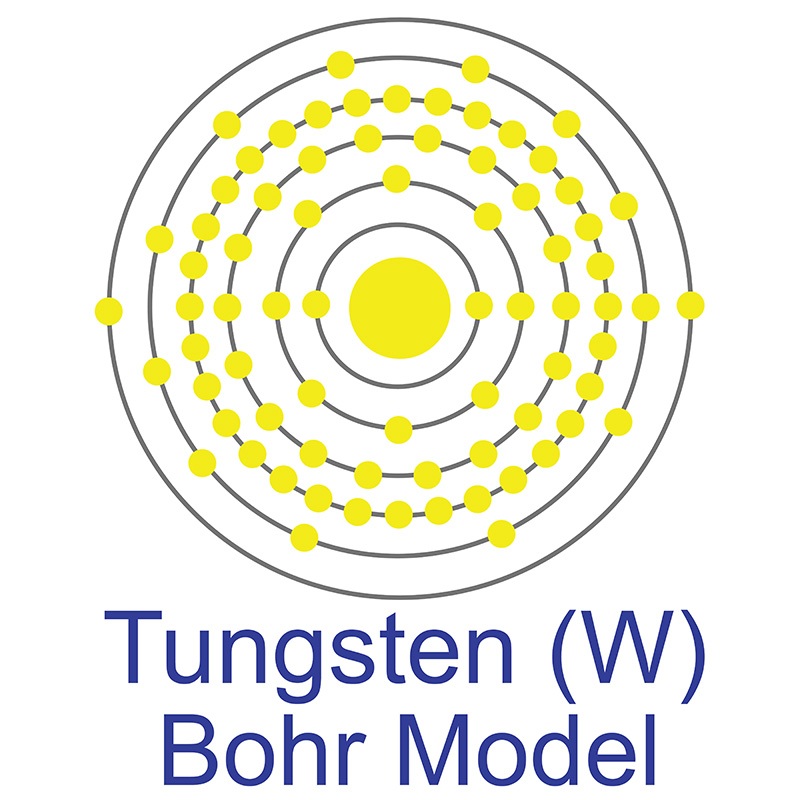
Tungsten is a Block D, Group 6, Period 6 element. The number of electrons in each of Tungsten's shells is 2, 8, 18, 32, 12, 2 and its electronic configuration is [Xe] 4f14 5d4 6s2. In its elemental form tungsten's CAS number is 7440-33-7. The tungsten atom has a radius of 137.pm and it's Van der Waals radius is 200.pm. Tungsten is considered to be only mildly toxic. Tungsten has the highest melting point of all the metallic elements and because of this has its first significant commercial application as the filament in incandescent light bulbs and fluorescent light bulbs. Tungsten is available as metal and compounds with purities from 99% to 99.999% (ACS grade to ultra-high purity); metals in the form of foil, sputtering target, and rod, and compounds as submicron and nanopowder. Later it was used in the first television tubes. The first imaging equipment involved X-ray bombardment of a tungsten target. Tungsten expands at nearly the same rate as borosilicate glass and is used to make metal to glass seals. It is the primary metal in heating elements for electric furnaces and in any components where high pressure/temperature environments are expected, such as aerospace and engine systems. Tungsten was first discovered by Fausto and Juan Jose de Elhuyar in 1783. In reference to its density, Tungsten gets its name from the swedish words tung and sten meaning heavy stone. See Tungsten research below.

Silicon is a Block P, Group 14, Period 3 element. The number of electrons in each of Silicon's shells is 2, 8, 4 and its electronic configuration is [Ne] 3s2 3p2. In its elemental form silicon's CAS number is 7440-21-3. The silicon atom has a radius of 117.6.pm and it's Van der Waals radius is 210.pm. Silicon is not toxic but can cause chronic respiratory problems if inhaled as a fine silica or silicate dust. Asbestos silicates are carcinogenic. Silicon is one of man's most useful elements. It makes up 25.7% of the earth's crust, by weight, and is the second most abundant element, being exceeded only by oxygen. The Czochralski process is commonly used to produce single crystals of silicon used for solid-state or semiconductor devices. Silica, as sand, is a principal ingredient of glass, one of the most inexpensive of materials with excellent mechanical, optical, thermal, and electrical properties. Silicon is available as metal and compounds with purities from 99% to 99.9999% (ACS grade to ultra-high purity); metals in the form of foil, sputtering target, and rod, and compounds as submicron and nanopowder. Ultra high purity silicon can be doped with boron, gallium, phosphorus , or arsenic to produce silicon for use in transistors, solar cells, rectifiers, and other solid-state devices which are used extensively in the electronics and space-age industries. Hydrogenated amorphous silicon has shown promise in producing economical cells for converting solar energy into electricity. Silcones are important products of silicon. They range from liquids to hard, glasslike solids with many useful properties. Silicon was first discovered by Jons Berzelius in 1823. The name Silicon originates from the Latin word "silex" which means flint or hard stone. See Silicon research below.
|
| Formula |
CAS No. |
Appearance |
Molecular Weight |
| W |
7440-33-7 |
Silvery |
183.85 |
|
|
|
|
|
|
|
Search by Material, Product Name, Product Code, CAS Number, Formula, Element, Anion, Form, EC Number, MDL Number or PubChem ID. |
|
PACKAGING SPECIFICATIONS FOR BULK & RESEARCH QUANTITIES |
Typical bulk packaging includes palletized plastic 5 gallon/25 kg. pails, fiber and steel drums to 1 ton super sacks in full container (FCL) or truck load (T/L) quantities. Research and sample quantities and hygroscopic, oxidizing or other air sensitive materials may be packaged under argon or vacuum. Shipping documentation includes a Certificate of Analysis and Material Safety Data Sheet (MSDS). Solutions are packaged in polypropylene, plastic or glass jars up to palletized 440 gallon liquid totes.
|
|
| |
Customers for this product have also looked at: |
Recent Research & Development for Tungsten
- Gas nanosensor design packages based on tungsten oxide: mesocages, hollow spheres, and nanowires.
Hoa ND, El-Safty SA.
Nanotechnology. 2011 Dec 2;22(48):485503. Epub 2011 Nov 9.
PMID:
22071572
[PubMed - in process]
- Experimental hypothyroidism delays fEPSPs and disrupts hippocampal long-term potentiation in the dentate gyrus of hippocampal formation and Y-maze performance in adult rats.
Seda Artis A, Bitiktas S, Taskin E, Dolu N, Liman N, Suer C.
J Neuroendocrinol. 2011 Nov 9. doi: 10.1111/j.1365-2826.2011.02253.x. [Epub ahead of print]
PMID:
22070634
[PubMed - as supplied by publisher]
- Glycolaldehyde as a Probe Molecule for Biomass-derivatives: Reaction of C-OH and C=O Functional Groups on Monolayer Ni Surfaces.
Yu W, Barteau MA, Chen JG.
J Am Chem Soc. 2011 Nov 8. [Epub ahead of print]
PMID:
22066750
[PubMed - as supplied by publisher]
- [Bis-(4-methyl-1,3-thia-zol-2-yl-?N)methane]-tricarbonyl-dichlorido-tungsten(II).
Strasser CE, Cronje S, Raubenheimer HG.
Acta Crystallogr E Struct Rep Online. 2011 Oct 1;67(Pt 10):m1460. Epub 2011 Sep 30.
PMID:
22065685
[PubMed]
- Carbon nanotube composite coating of neural microelectrodes preferentially improves the multiunit signal-to-noise ratio.
Baranauskas G, Maggiolini E, Castagnola E, Ansaldo A, Mazzoni A, Angotzi GN, Vato A, Ricci D, Panzeri S, Fadiga L.
J Neural Eng. 2011 Nov 8;8(6):066013. [Epub ahead of print]
PMID:
22064890
[PubMed - as supplied by publisher]
- Use of carbon nanotubes and electrothermal atomic absorption spectrometry for the speciation of very low amounts of arsenic and antimony in waters.
López-García I, Rivas RE, Hernández-Córdoba M.
Talanta. 2011 Oct 30;86:52-7. Epub 2011 Aug 27.
PMID:
22063510
[PubMed - in process]
- Mechanism of W(CO)(6) sonolysis in diphenylmethane.
Cau C, Nikitenko SI.
Ultrason Sonochem. 2011 Oct 19. [Epub ahead of print]
PMID:
22054911
[PubMed - as supplied by publisher]
- Synthesis of macrocyclic natural products by catalyst-controlled stereoselective ring-closing metathesis.
Yu M, Wang C, Kyle AF, Jakubec P, Dixon DJ, Schrock RR, Hoveyda AH.
Nature. 2011 Nov 2;479(7371):88-93. doi: 10.1038/nature10563.
PMID:
22051677
[PubMed - in process]
- Combinatorial atmospheric pressure chemical vapor deposi-tion (cAPCVD); a route to functional property optimization.
Kafizas A, Parkin IP.
J Am Chem Soc. 2011 Nov 4. [Epub ahead of print]
PMID:
22050427
[PubMed - as supplied by publisher]
- Comparative evaluation of marginal adaptation between nanocomposites and microhybrid composites exposed to two light cure units.
Sharma RD, Sharma J, Rani A.
Indian J Dent Res. 2011 May;22(3):495.
PMID:
22048600
[PubMed - in process]
- Comparison of secondary neutron dose in proton therapy resulting from the use of a tungsten alloy MLC or a brass collimator system.
Diffenderfer ES, Ainsley CG, Kirk ML, McDonough JE, Maughan RL.
Med Phys. 2011 Nov;38(11):6248.
PMID:
22047390
[PubMed - in process]
- Vector potential photoelectron microscopy.
Browning R.
Rev Sci Instrum. 2011 Oct;82(10):103703.
PMID:
22047299
[PubMed - in process]
- Structural Effects Behind the Low Temperature Nonconventional Relaxor Behavior of the Sr(2)NaNb(5)O(15) Bronze.
Torres-Pardo A, Jiménez R, González-Calbet JM, García-González E.
Inorg Chem. 2011 Oct 28. [Epub ahead of print]
PMID:
22035503
[PubMed - as supplied by publisher]
- Accelerated electron beam induced breakdown of commercial WO(3) into nanorods in the presence of triethylamine.
Dawson G, Zhou W, Blackley R.
Phys Chem Chem Phys. 2011 Oct 27. [Epub ahead of print]
PMID:
22030615
[PubMed - as supplied by publisher]
- Multilayer chitosan-based open tubular capillary anion exchange column with integrated monolithic capillary suppressor.
Huang X, Foss FW Jr, Dasgupta PK.
Anal Chim Acta. 2011 Nov 30;707(1-2):210-7. Epub 2011 Sep 24.
PMID:
22027141
[PubMed - in process]
- Multispectral near-IR reflectance and transillumination imaging of teeth.
Chung S, Fried D, Staninec M, Darling CL.
Biomed Opt Express. 2011 Oct 1;2(10):2804-14. Epub 2011 Sep 15.
PMID:
22025986
[PubMed]
- Efficient Heterogeneous Epoxidation of Alkenes by a Supported Tungsten Oxide Catalyst.
Kamata K, Yonehara K, Sumida Y, Hirata K, Nojima S, Mizuno N.
Angew Chem Int Ed Engl. 2011 Oct 25. doi: 10.1002/anie.201106064. [Epub ahead of print] No abstract available.
PMID:
22025368
[PubMed - as supplied by publisher]
- Structural transformation of tungsten oxide nanourchins into IF-WS(2) nanoparticles: an aberration corrected STEM study.
Leonard-Deepak F, Castro-Guerrero CF, Mejía-Rosales S, José-Yacamán M.
Nanoscale. 2011 Oct 24. [Epub ahead of print]
PMID:
22025289
[PubMed - as supplied by publisher]
- Academic aspects of lunar water resources and their relevance to lunar protolife.
Green J.
Int J Mol Sci. 2011;12(9):6051-76. Epub 2011 Sep 19.
PMID:
22016644
[PubMed - in process]
- Evaluation of ocular hazards from 4 types of curing lights.
Labrie D, Moe J, Price RB, Young ME, Felix CM.
J Can Dent Assoc. 2011 Oct;77:b116.
PMID:
22014874
[PubMed - in process]
|
| American Elements is a copyrighted U.S. Trademark. All rights reserved. |
| |