American Elements Logo and U.S. Registered Trademark


Zirconium Aluminum Sputtering Target
High Purity Zr - Al Sputtering Target
7440-67-7
Product Product Code Order or Specifications
(2N) 99% Zirconium Aluminum Sputtering Target ZR-AL-02-ST Contact American Elements
(2N5) 99.5% Zirconium Aluminum Sputtering Target ZR-AL-025-ST Contact American Elements
(3N) 99.9% Zirconium Aluminum Sputtering Target ZR-AL-03-ST Contact American Elements
(3N5) 99.95% Zirconium Aluminum Sputtering Target ZR-AL-035-ST Contact American Elements
(4N) 99.99% Zirconium Aluminum Sputtering Target ZR-AL-04-ST Contact American Elements
(5N) 99.999% Zirconium Aluminum Sputtering Target ZR-AL-05-ST Contact American Elements
American Elements produces to many standard grades when applicable, including Mil Spec (military grade); ACS, Reagent and Technical Grade; Food, Agricultural and Pharmaceutical Grade; Optical Grade, USP and EP/BP (European Pharmacopeia/British Pharmacopeia) and follows applicable ASTM testing standards.See safety data and research below and pricing/lead time above. American Elements specializes in producing high purity Zirconium Aluminum Sputtering Targets with the highest possible density High Purity (99.99%) Metallic Sputtering Targetand smallest possible average grain sizes for use in semiconductor, chemical vapor deposition (CVD) and physical vapor deposition (PVD) display and optical applications. Our standard Sputtering Targets for thin film are available monoblock or bonded with dimensions and configurations up to 820 mm with hole drill locations and threading, beveling, grooves and backing designed to work with both older sputtering devises as well as the latest process equipment, such as large area coating for solar energy or fuel cells and flip-chip applications. Research sized targets are also produced as well as custom sizes and alloys. All targets are analyzed using best demonstrated techniques including X-Ray Fluorescence (XRF), Glow Discharge Mass Spectrometry (GDMS), and Inductively Coupled Plasma (ICP). "Sputtering" allows for thin film deposition of an ultra high purity sputtering metallic or oxide material onto another solid substrate by the controlled removal and conversion of the target material into a directed gaseous/plasma phase through ionic bombardment. We can also provide targets outside this range in addition to just about any size rectangular, annular, or oval target. Materials are produced using crystallization, solid state and other ultra high purification processes such as sublimation. American Elements specializes in producing custom compositions for commercial and research applications and for new proprietary technologies. American Elements also casts any of the rare earth metals and most other advanced materials into rod, bar or plate form, as well as other machined shapes and through other processes nanoparticles. Other shapes are available by request.

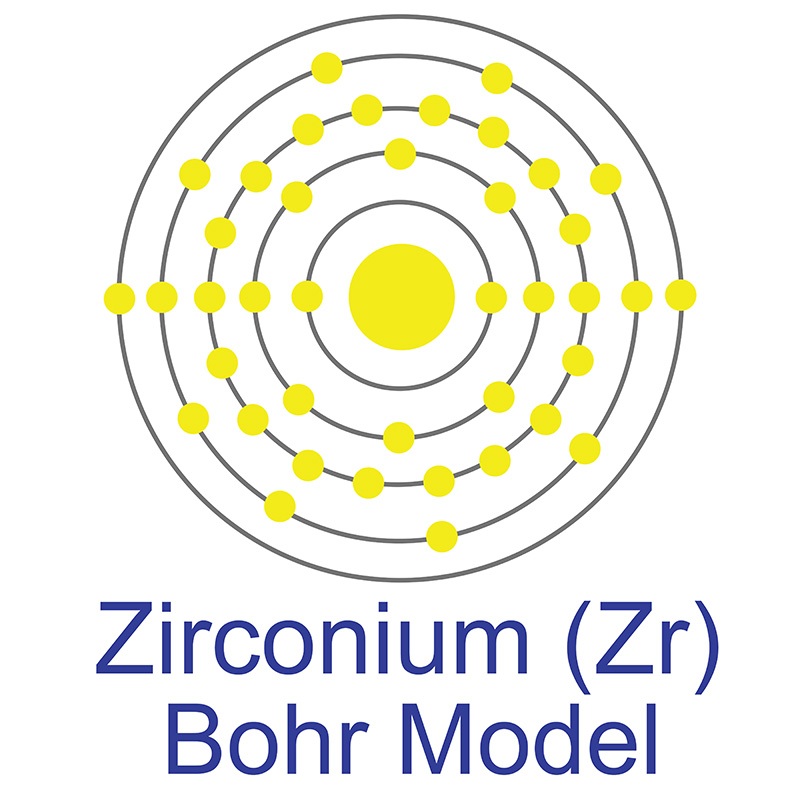
Zirconium(Zr) atomic and molecular weight, atomic number and elemental symbol Zirconium is a Block D, Group 4, Period 5 element. The number of electrons in each of Zirconium's shells is 2, 8, 18, 10, 2 and its electronic configuration is [Kr] 4d2 5s2. In its elemental form zirconium's CAS number is 7440-67-7. The zirconium atom has a radius of 159.pm and it's Van der Waals radius is 200.pm. Zirconium is non-toxic. Zirconium’s principal mineral is zircon (Zirconium Silicate) and is primarily used in its oxide or zirconia form. Zirconium dioxide has a high melting point (2,700° C) and a low thermal conductivity. Its polymorphism, however, restricts its widespread use in ceramic industry. During a heating process, zirconia will undergo a phase transformation process. The changeZirconium Bohr Model in volume associated with this transformation makes the usage of pure zirconia in many applications impossible. Addition of some oxides, such as CaO, MgO, and Y2O3, into the zirconia structure in a Elemental Zirconiumcertain degree results in a solid solution, which is a cubic form and has no phase transformation during heating and cooling. This solid solution material is termed as stabilized zirconia, a valuable refractory. Stabilized zirconia is used as a grinding media and engineering ceramics due to its increased hardness and high thermal shock resistivity. Stabilized zirconia is also used in applications such as oxygen sensors and solid oxide fuel cells due to its high oxygen ion conductivity.Zirconium was first discovered by William Gregor in 1791. The name Zirconium originated from the Persian word 'zargun' meaning gold color or gold-like. See Zirconium research below.

Aluminum(Al) atomic and molecular weight, atomic number and elemental symbolAluminum is a Block P, Group 13, Period 3 element. The number of electrons in each of Aluminum's shells is 2, 8, 3 and its electronic configuration is [Ne] 3s2 3p1. In its elemental form aluminum's CAS number is 7429-90-5. The aluminum atom has a radius of 143.2.pm and it's Van der Waals radius is 200.pm. Aluminum is the most abundant metal in the earth's crust. Aluminum is not known to be harmful but ingestion may cause Alzheimer's disease.Aluminum is a silvery-white metal that possesses many desirable characteristics. It is light, nonmagnetic and nonsparking. It stands second among metals in the scale of malleability, and sixth in ductility. It is extensively used in manyAluminum Bohr Model industrial applications where a strong, light, easily constructed material is needed. Although it's electrical conductivity is only about 60% that of copper, it is used in electrical transmission Elemental Aluminumlines because of its light weight. Pure aluminum is soft and lacks strength, but alloyed with small amounts of copper, magnesium, silicon, manganese, or other elements impart a variety of useful properties. These alloys are of vital importance in the construction of modern aircraft and rockets. Aluminum, evaporated in a vacuum, forms a highly reflective coating for both visible light and radiant heat. They are used to coat telescope mirrors. Aluminum is available as metal and compounds with purities from 99% to 99.9999% (ACS grade to ultra-high purity); metals in the form of foil, sputtering target, and rod, and compounds as submicron and nanopowder. See Aluminum research below.

Formula CAS No. Appearance Molecular Weight Density Melting Point Boiling Point
Zr 7440-67-7 White Powder 91.22 6506 kg/m³ 1852°C 3580 °C
PRODUCT CATALOG Zirconium Products Metals News Foil Submicron & Nanopowder Tolling Ultra High Purity Sputtering Target Crystal Growth Rod, Plate, Powder, etc. Home

Have a Question? Ask a Chemical Engineer or Material Scientist   Request an MSDS or Certificate of Analysis


Search by Material, Product Name, Product Code, CAS Number, Formula, Element, Anion, Form, EC Number, MDL Number or PubChem ID.


German   Korean   French   Japanese   Spanish   Chinese (Simplified)   Portuguese   Russian   Chinese (Taiwan)   Italian   Turkish   Polish   Dutch   Czech   Swedish   Hungarian   Danish   Hebrew

Production Catalog Available in 36 Countries & Languages

PACKAGING SPECIFICATIONS FOR BULK & RESEARCH QUANTITIES


Typical bulk packaging includes palletized plastic 5 gallon/25 kg. pails, fiber and steel drums to 1 ton super sacks in full container (FCL) or truck load (T/L) quantities. Research and sample quantities and hygroscopic, oxidizing or other air sensitive materials may be packaged under argon or vacuum. Shipping documentation includes a Certificate of Analysis and Material Safety Data Sheet (MSDS). Solutions are packaged in polypropylene, plastic or glass jars up to palletized 440 gallon liquid totes.


Show me more forms of Zirconium
 
Customers for this product have also looked at:
Aluminum Zirconium Alloy Zirconium Wire Zirconium Powder Zirconium Oxide Zirconium Pellets
Zirconium Acetate Zirconium Foil Zirconium Oxide Pellets Zirconium Metal Zirconium Acetylacetonate
Zirconium Nitrate Solution Zirconium Nanoparticles Zirconium Scandium Iron Alloy Zirconium Sputtering Target Zirconium Chloride


Recent Research & Development for Zirconium

  • Zirconium arsenate-modified silica nanoparticles for specific capture of phosphopeptides and direct analysis by matrix-assisted laser desorption/ionization mass spectrometry. Zhao PX, Guo XF, Wang H, Qi CB, Xia HS, Zhang HS. Anal Bioanal Chem. 2011 Nov 22. [Epub ahead of print] PMID: 22105300 [PubMed - as supplied by publisher]

  • A surface derivatization strategy for combinatorial analysis of cell response to mixtures of protein domains. Chiang C, Karuri SW, Kshatriya PP, Schwartz J, Schwarzbauer JE, Karuri NW. Langmuir. 2011 Nov 21. [Epub ahead of print] PMID: 22103809 [PubMed - as supplied by publisher]

  • Environmentally stable flexible metal-insulator-metal capacitors using zirconium-silicate and hafnium-silicate thin film composite materials as gate dielectrics. Meena JS, Chu MC, Wu CS, Ravipati S, Ko FH. J Nanosci Nanotechnol. 2011 Aug;11(8):6858-67. PMID: 22103091 [PubMed - in process]

  • Highly sensitive protein kinase activity assay based on electrochemiluminescence nanoprobes. Zhao Z, Zhou X, Xing D. Biosens Bioelectron. 2011 Oct 25. [Epub ahead of print] PMID: 22100765 [PubMed - as supplied by publisher]

  • Corrosion fatigue behavior of a biocompatible ultrafine-grained niobium alloy in simulated body fluid. Rubitschek F, Niendorf T, Karaman I, Maier HJ. J Mech Behav Biomed Mater. 2012 Jan;5(1):181-92. Epub 2011 Sep 8. PMID: 22100093 [PubMed - in process]

  • Fabrication and characterization of biocompatible nacre-like structures from ?-zirconium hydrogen phosphate hydrate and chitosan. Waraich SM, Hering B, Burghard Z, Bill J, Behrens P, Menzel H. J Colloid Interface Sci. 2011 Oct 29. [Epub ahead of print] PMID: 22099057 [PubMed - as supplied by publisher]

  • Wear resistance of experimental titanium alloys for dental applications. Faria AC, Rodrigues RC, Claro AP, de Mattos Mda G, Ribeiro RF. J Mech Behav Biomed Mater. 2011 Nov;4(8):1873-9. Epub 2011 Jun 15. PMID: 22098886 [PubMed - in process]

  • Carbon Fiber-Reinforced Cyanate Ester/Nano-ZrW(2)O(8) Composites with Tailored Thermal Expansion. Badrinarayanan P, Rogalski MK, Kessler MR. ACS Appl Mater Interfaces. 2011 Nov 18. [Epub ahead of print] PMID: 22098430 [PubMed - as supplied by publisher]

  • Single-step fabrication of nanolamellar structured oxide ceramic coatings by metal-organic chemical vapor deposition. Eils NK, Mechnich P, Keune H, Wahl G, Klages CP. J Nanosci Nanotechnol. 2011 Sep;11(9):8396-402. PMID: 22097592 [PubMed - in process]

  • Metalcones: hybrid organic-inorganic films fabricated using atomic and molecular layer deposition techniques. George SM, Lee BH, Yoon B, Abdulagatov AI, Hall RA. J Nanosci Nanotechnol. 2011 Sep;11(9):7948-55. PMID: 22097511 [PubMed - in process]

  • Reliability and fatigue failure modes of implant-supported aluminum-oxide fixed dental prostheses. Stappert CF, Baldassarri M, Zhang Y, Hänssler F, Rekow ED, Van P Thompson. Clin Oral Implants Res. 2011 Sep 5. doi: 10.1111/j.1600-0501.2011.02281.x. [Epub ahead of print] PMID: 22093019 [PubMed - as supplied by publisher]

  • Titanium-zirconium alloy narrow-diameter implants (Straumann Roxolid(®) ) for the rehabilitation of horizontally deficient edentulous ridges: prospective study on 18 consecutive patients. Chiapasco M, Casentini P, Zaniboni M, Corsi E, Anello T. Clin Oral Implants Res. 2011 Aug 18. doi: 10.1111/j.1600-0501.2011.02296.x. [Epub ahead of print] PMID: 22092806 [PubMed - as supplied by publisher]

  • Retention of implant-supported zirconium oxide ceramic restorations using different luting agents. Nejatidanesh F, Savabi O, Shahtoosi M. Clin Oral Implants Res. 2011 Nov 14. doi: 10.1111/j.1600-0501.2011.02358.x. [Epub ahead of print] PMID: 22092303 [PubMed - as supplied by publisher]

  • Tetra-kis(picolinato-?N,O)zirconium(IV) dihydrate. Steyn M, Visser HG, Roodt A, Muller TJ. Acta Crystallogr E Struct Rep Online. 2011 Sep 1;67(Pt 9):m1240-1. Epub 2011 Aug 17. PMID: 22065566 [PubMed]

  • 2,4-Pentanediolate as an Alkoxide/Diketonate "Hybrid" Ligand and the Formation of Aluminum and Zirconium Derivatives. Bierschenk EJ, Wilk NR, Hanusa TP. Inorg Chem. 2011 Nov 4. [Epub ahead of print] PMID: 22053749 [PubMed - as supplied by publisher]

  • Ultrasound-assisted synthesis of mesoporous zirconia-hydroxyapatite nanocomposites and their dual surface affinity for Cr3+/Cr2O72- ions. Achelhi K, Masse S, Laurent GP, Roux C, Laghzizil A, Saoiabi A, Coradin T. Langmuir. 2011 Nov 4. [Epub ahead of print] PMID: 22053732 [PubMed - as supplied by publisher]

  • Synthesis, Characterization, and Materials Chemistry of Group 4 Silylimides. Cosham SD, Johnson AL, Molloy KC, Kingsley AJ. Inorg Chem. 2011 Nov 4. [Epub ahead of print] PMID: 22053704 [PubMed - as supplied by publisher]

  • Influence of cement thickness on resin-zirconia microtensile bond strength. Lee TH, Ahn JS, Shim JS, Han CH, Kim SJ. J Adv Prosthodont. 2011 Sep;3(3):119-25. Epub 2011 Sep 25. PMID: 22053241 [PubMed]

  • Reliability of a new biokinetic model of zirconium in internal dosimetry: part ii, parameter sensitivity analysis. Li WB, Greiter M, Oeh U, Hoeschen C. Health Phys. 2011 Dec;101(6):677-92. PMID: 22048486 [PubMed - in process]

  • Reliability of a new biokinetic model of zirconium in internal dosimetry: part I, parameter uncertainty analysis. Li WB, Greiter M, Oeh U, Hoeschen C. Health Phys. 2011 Dec;101(6):660-76. PMID: 22048485 [PubMed - in process]

Recent Research & Development for Aluminum

  • In vitro evaluation of human osteoblast adhesion to a thermally oxidized gamma-TiAl intermetallic alloy of composition Ti-48Al-2Cr-2Nb (at.%). Bello SA, de Jesús-Maldonado I, Rosim-Fachini E, Sundaram PA, Diffoot-Carlo N. J Mater Sci Mater Med. 2010 May;21(5):1739-50. Epub 2010 Feb 17. PubMed PMID: 20162332; PubMed Central PMCID: PMC2871339.

  • Li12Cu16+xAl26-x (x = 3.2): a new intermetallic structure type. Pavlyuk V, Dmytriv G, Tarasiuk I, Pauly H, Ehrenberg H. Acta Crystallogr C. 2008 Aug;64(Pt 8):i73-5. Epub 2008 Jul 26. PubMed PMID: 18682632.

  • Li8Cu12+xAl6-x (x = 1.16): a new structure type related to Laves phases. Pavlyuk V, Dmytriv G, Tarasiuk I, Pauly H, Ehrenberg H. Acta Crystallogr C. 2008 Feb;64(Pt 2):i15-7. Epub 2008 Jan 22. PubMed PMID: 18252986.

  • Biocompatibility studies of human fetal osteoblast cells cultured on gamma titanium aluminide. Rivera-Denizard O, Diffoot-Carlo N, Navas V, Sundaram PA. J Mater Sci Mater Med. 2008 Jan;19(1):153-8. Epub 2007 Jun 28. PubMed PMID: 17597368.

  • Bone tissue reaction to Ti-48Al-2Cr-2Nb (at.%) in a rodent model: a preliminary SEM study. Castañeda-Muñoz DF, Sundaram PA, Ramírez N. J Mater Sci Mater Med. 2007 Jul;18(7):1433-8. Epub 2007 Mar 27. PubMed PMID: 17387593.

  • Microstructural analysis of iron aluminide formed by self-propagating high-temperature synthesis mechanism in aluminium matrix composite. Olszówka-Myalska A, Maziarz W. J Microsc. 2006 Oct;224(Pt 1):1-3. PubMed PMID: 17100891.

  • A respiratory model for uranium aluminide based on occupational data. Leggett RW, Eckerman KF, Boice JD Jr. J Radiol Prot. 2005 Dec;25(4):405-16. Epub 2005 Dec 5. PubMed PMID: 16340069.

  • Self-assembling of atomic vacancies at an oxide/intermetallic alloy interface. Maurice V, Despert G, Zanna S, Bacos MP, Marcus P. Nat Mater. 2004 Oct;3(10):687-91. Epub 2004 Sep 19. PubMed PMID: 15378049.

  • Composition-structure relationships in polar intermetallics: experimental and theoretical studies of LaNi(1 + x)Al(6 - x) (x = 0.44). Gout D, Benbow E, Gourdon O, Miller GJ. Inorg Chem. 2004 Jul 26;43(15):4604-9. PubMed PMID: 15257588.

  • Treatment of compounds and alloys in radiation hydrodynamics simulations of ablative laser loading. Swift DC, Gammel JT, Clegg SM. Phys Rev E Stat Nonlin Soft Matter Phys. 2004 May;69(5 Pt 2):056401. Epub 2004 May 6. PubMed PMID: 15244945.


American Elements is a copyrighted U.S. Trademark. All rights reserved.