American Elements produces to many standard grades when applicable, including Mil Spec (military grade); ACS, Reagent and Technical Grade; Food, Agricultural and Pharmaceutical Grade; Optical Grade, USP and EP/BP (European Pharmacopeia/British Pharmacopeia) and follows applicable ASTM testing standards.See safety data and research below and pricing/lead time above. American Elements specializes in producing high purity Zirconium Gadolinium Sputtering Targets with the highest possible density and smallest possible average grain sizes for use in semiconductor, chemical vapor deposition (CVD) and physical vapor deposition (PVD) display and optical applications. Our standard Sputtering Targets for thin film are available monoblock or bonded with dimensions and configurations up to 820 mm with hole drill locations and threading, beveling, grooves and backing designed to work with both older sputtering devises as well as the latest process equipment, such as large area coating for solar energy or fuel cells and flip-chip applications. Research sized targets are also produced as well as custom sizes and alloys. All targets are analyzed using best demonstrated techniques including X-Ray Fluorescence (XRF), Glow Discharge Mass Spectrometry (GDMS), and Inductively Coupled Plasma (ICP). "Sputtering" allows for thin film deposition of an ultra high purity sputtering metallic or oxide material onto another solid substrate by the controlled removal and conversion of the target material into a directed gaseous/plasma phase through ionic bombardment. We can also provide targets outside this range in addition to just about any size rectangular, annular, or oval target. Materials are produced using crystallization, solid state and other ultra high purification processes such as sublimation. American Elements specializes in producing custom compositions for commercial and research applications and for new proprietary technologies. American Elements also casts any of the rare earth metals and most other advanced materials into rod, bar or plate form, as well as other machined shapes and through other processes nanoparticles. Other shapes are available by request.
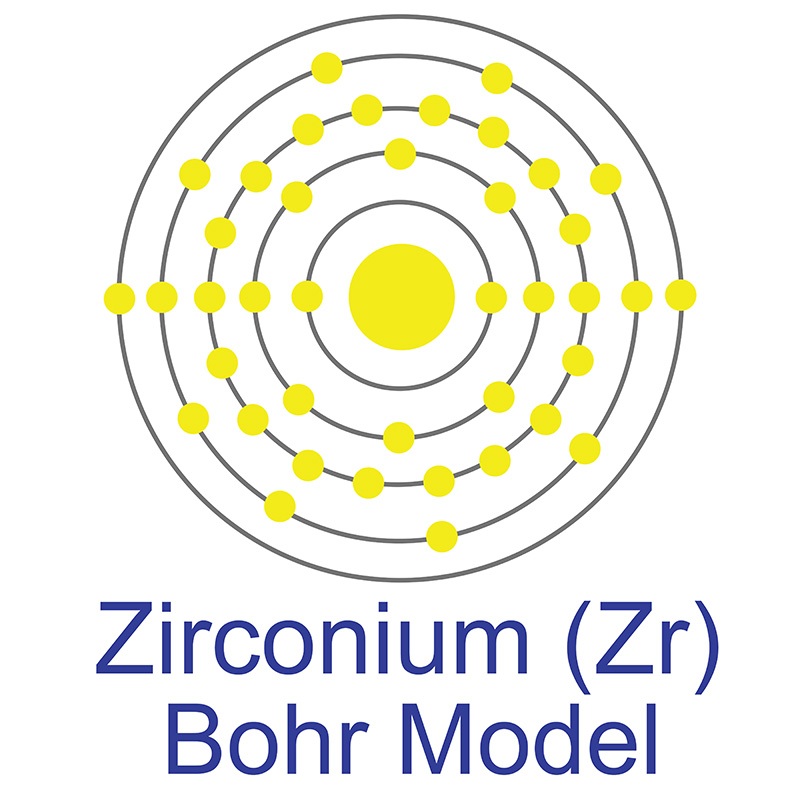
Zirconium is a Block D, Group 4, Period 5 element. The number of electrons in each of Zirconium's shells is 2, 8, 18, 10, 2 and its electronic configuration is [Kr] 4d2 5s2. In its elemental form zirconium's CAS number is 7440-67-7. The zirconium atom has a radius of 159.pm and it's Van der Waals radius is 200.pm. Zirconium is non-toxic. Zirconium’s principal mineral is zircon (Zirconium Silicate) and is primarily used in its oxide or zirconia form. Zirconium dioxide has a high melting point (2,700° C) and a low thermal conductivity. Its polymorphism, however, restricts its widespread use in ceramic industry. During a heating process, zirconia will undergo a phase transformation process. The change in volume associated with this transformation makes the usage of pure zirconia in many applications impossible. Addition of some oxides, such as CaO, MgO, and Y2O3, into the zirconia structure in a certain degree results in a solid solution, which is a cubic form and has no phase transformation during heating and cooling. This solid solution material is termed as stabilized zirconia, a valuable refractory. Stabilized zirconia is used as a grinding media and engineering ceramics due to its increased hardness and high thermal shock resistivity. Stabilized zirconia is also used in applications such as oxygen sensors and solid oxide fuel cells due to its high oxygen ion conductivity.Zirconium was first discovered by William Gregor in 1791. The name Zirconium originated from the Persian word 'zargun' meaning gold color or gold-like. See Zirconium research below.
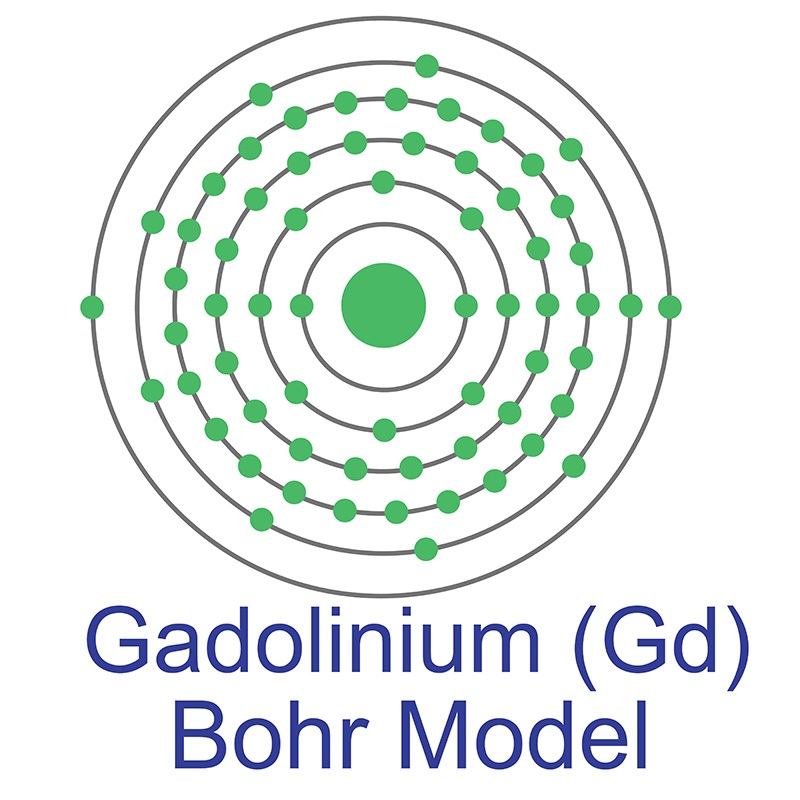
Gadolinium is a Block F, Group 3, Period 6 element. The number of electrons in each of Gadolinium's shells is 2, 8, 18, 25, 9, 2 and its electronic configuration is [Xe] 4f7 5d1 6s2. In its elemental form gadolinium's CAS number is 7440-54-2. The gadolinium atom has a radius of 178.7.pm and it's Van der Waals radius is unknown. Gadolinium is very toxic. Gadolinium is utilized for both its high magnetic moment (7.94µB) and in phosphors and scintillator material. When complexed with EDTA ligands, it is used as an injectable contrast agent for patients undergoing magnetic resonance imaging. With its high magnetic moment, gadolinium can reduce relaxation times and thereby enhance signal intensity. The extra stable half-full 4f electron shell with no low lying energy levels creates applications as an inert phosphor host. Gadolinium can therefore act as hosts for x-ray cassettes and in scintillator materials for computer tomography. Gadolinium is available as metal and compounds with purities from 99% to 99.999% (ACS grade to ultra-high purity); metals in the form of foil, sputtering target, and rod, and compounds as submicron and nanopowder. Gadolinium was first discovered by Jean de Marignac in 1880. The element is named after the Finnish chemist and geologist Johan Gadolin. See Gadolinium research below. With its high magnetic moment, gadolinium can reduce relaxation times and thereby enhance signal intensity. The extra stable half-full 4f electron shell with no low lying energy levels creates applications as an inert phosphor host. Gadolinium can therefore act as hosts for x-ray cassettes and in scintillator materials for computer tomography.
PACKAGING SPECIFICATIONS FOR BULK & RESEARCH QUANTITIES
Typical bulk packaging includes palletized plastic 5 gallon/25 kg. pails, fiber and steel drums to 1 ton super sacks in full container (FCL) or truck load (T/L) quantities. Research and sample quantities and hygroscopic, oxidizing or other air sensitive materials may be packaged under argon or vacuum. Shipping documentation includes a Certificate of Analysis and Material Safety Data Sheet (MSDS). Solutions are packaged in polypropylene, plastic or glass jars up to palletized 440 gallon liquid totes.
Zirconium arsenate-modified silica nanoparticles for specific capture of phosphopeptides and direct analysis by matrix-assisted laser desorption/ionization mass spectrometry.
Zhao PX, Guo XF, Wang H, Qi CB, Xia HS, Zhang HS.
Anal Bioanal Chem. 2011 Nov 22. [Epub ahead of print]
PMID:
22105300
[PubMed - as supplied by publisher]
A surface derivatization strategy for combinatorial analysis of cell response to mixtures of protein domains.
Chiang C, Karuri SW, Kshatriya PP, Schwartz J, Schwarzbauer JE, Karuri NW.
Langmuir. 2011 Nov 21. [Epub ahead of print]
PMID:
22103809
[PubMed - as supplied by publisher]
Environmentally stable flexible metal-insulator-metal capacitors using zirconium-silicate and hafnium-silicate thin film composite materials as gate dielectrics.
Meena JS, Chu MC, Wu CS, Ravipati S, Ko FH.
J Nanosci Nanotechnol. 2011 Aug;11(8):6858-67.
PMID:
22103091
[PubMed - in process]
Highly sensitive protein kinase activity assay based on electrochemiluminescence nanoprobes.
Zhao Z, Zhou X, Xing D.
Biosens Bioelectron. 2011 Oct 25. [Epub ahead of print]
PMID:
22100765
[PubMed - as supplied by publisher]
Corrosion fatigue behavior of a biocompatible ultrafine-grained niobium alloy in simulated body fluid.
Rubitschek F, Niendorf T, Karaman I, Maier HJ.
J Mech Behav Biomed Mater. 2012 Jan;5(1):181-92. Epub 2011 Sep 8.
PMID:
22100093
[PubMed - in process]
Fabrication and characterization of biocompatible nacre-like structures from ?-zirconium hydrogen phosphate hydrate and chitosan.
Waraich SM, Hering B, Burghard Z, Bill J, Behrens P, Menzel H.
J Colloid Interface Sci. 2011 Oct 29. [Epub ahead of print]
PMID:
22099057
[PubMed - as supplied by publisher]
Wear resistance of experimental titanium alloys for dental applications.
Faria AC, Rodrigues RC, Claro AP, de Mattos Mda G, Ribeiro RF.
J Mech Behav Biomed Mater. 2011 Nov;4(8):1873-9. Epub 2011 Jun 15.
PMID:
22098886
[PubMed - in process]
Carbon Fiber-Reinforced Cyanate Ester/Nano-ZrW(2)O(8) Composites with Tailored Thermal Expansion.
Badrinarayanan P, Rogalski MK, Kessler MR.
ACS Appl Mater Interfaces. 2011 Nov 18. [Epub ahead of print]
PMID:
22098430
[PubMed - as supplied by publisher]
Single-step fabrication of nanolamellar structured oxide ceramic coatings by metal-organic chemical vapor deposition.
Eils NK, Mechnich P, Keune H, Wahl G, Klages CP.
J Nanosci Nanotechnol. 2011 Sep;11(9):8396-402.
PMID:
22097592
[PubMed - in process]
Metalcones: hybrid organic-inorganic films fabricated using atomic and molecular layer deposition techniques.
George SM, Lee BH, Yoon B, Abdulagatov AI, Hall RA.
J Nanosci Nanotechnol. 2011 Sep;11(9):7948-55.
PMID:
22097511
[PubMed - in process]
Reliability and fatigue failure modes of implant-supported aluminum-oxide fixed dental prostheses.
Stappert CF, Baldassarri M, Zhang Y, Hänssler F, Rekow ED, Van P Thompson.
Clin Oral Implants Res. 2011 Sep 5. doi: 10.1111/j.1600-0501.2011.02281.x. [Epub ahead of print]
PMID:
22093019
[PubMed - as supplied by publisher]
Titanium-zirconium alloy narrow-diameter implants (Straumann Roxolid(®) ) for the rehabilitation of horizontally deficient edentulous ridges: prospective study on 18 consecutive patients.
Chiapasco M, Casentini P, Zaniboni M, Corsi E, Anello T.
Clin Oral Implants Res. 2011 Aug 18. doi: 10.1111/j.1600-0501.2011.02296.x. [Epub ahead of print]
PMID:
22092806
[PubMed - as supplied by publisher]
Retention of implant-supported zirconium oxide ceramic restorations using different luting agents.
Nejatidanesh F, Savabi O, Shahtoosi M.
Clin Oral Implants Res. 2011 Nov 14. doi: 10.1111/j.1600-0501.2011.02358.x. [Epub ahead of print]
PMID:
22092303
[PubMed - as supplied by publisher]
Tetra-kis(picolinato-?N,O)zirconium(IV) dihydrate.
Steyn M, Visser HG, Roodt A, Muller TJ.
Acta Crystallogr E Struct Rep Online. 2011 Sep 1;67(Pt 9):m1240-1. Epub 2011 Aug 17.
PMID:
22065566
[PubMed]
2,4-Pentanediolate as an Alkoxide/Diketonate "Hybrid" Ligand and the Formation of Aluminum and Zirconium Derivatives.
Bierschenk EJ, Wilk NR, Hanusa TP.
Inorg Chem. 2011 Nov 4. [Epub ahead of print]
PMID:
22053749
[PubMed - as supplied by publisher]
Ultrasound-assisted synthesis of mesoporous zirconia-hydroxyapatite nanocomposites and their dual surface affinity for Cr3+/Cr2O72- ions.
Achelhi K, Masse S, Laurent GP, Roux C, Laghzizil A, Saoiabi A, Coradin T.
Langmuir. 2011 Nov 4. [Epub ahead of print]
PMID:
22053732
[PubMed - as supplied by publisher]
Synthesis, Characterization, and Materials Chemistry of Group 4 Silylimides.
Cosham SD, Johnson AL, Molloy KC, Kingsley AJ.
Inorg Chem. 2011 Nov 4. [Epub ahead of print]
PMID:
22053704
[PubMed - as supplied by publisher]
Influence of cement thickness on resin-zirconia microtensile bond strength.
Lee TH, Ahn JS, Shim JS, Han CH, Kim SJ.
J Adv Prosthodont. 2011 Sep;3(3):119-25. Epub 2011 Sep 25.
PMID:
22053241
[PubMed]
Reliability of a new biokinetic model of zirconium in internal dosimetry: part ii, parameter sensitivity analysis.
Li WB, Greiter M, Oeh U, Hoeschen C.
Health Phys. 2011 Dec;101(6):677-92.
PMID:
22048486
[PubMed - in process]
Reliability of a new biokinetic model of zirconium in internal dosimetry: part I, parameter uncertainty analysis.
Li WB, Greiter M, Oeh U, Hoeschen C.
Health Phys. 2011 Dec;101(6):660-76.
PMID:
22048485
[PubMed - in process]
T(1) assessment of hip joint cartilage following intra-articular
gadolinium injection: A pilot study. Bittersohl B, Hosalkar HS, Kim YJ, Werlen S, Trattnig S, Siebenrock KA,
Mamisch TC. Magn Reson Med. 2010 Oct;64(4):1200-7.
PubMed PMID: 20872764.
The
time window of MRI of murine atherosclerotic plaques after administration of CB2
receptor targeted micelles: inter-scan variability and relation between plaque
signal intensity increase and gadolinium content of inversion recovery prepared
versus non-prepared fast spin echo. Te Boekhorst BC, Bovens SM, van de Kolk CW, Cramer MJ, Doevendans PA, Ten Hove
M, van der Weerd L, Poelmann R, Strijkers GJ, Pasterkamp G, van Echteld CJ. NMR Biomed. 2010 Oct;23(8):939-51. PubMed
PMID: 20878972.
Coordination chemistry of amide-functionalised
tetraazamacrocycles: structural, relaxometric and cytotoxicity studies. Martinelli J, Balali-Mood B, Panizzo R, Lythgoe MF, White AJ, Ferretti P,
Steinke JH, Vilar R. Dalton
Trans. 2010 Sep 28. [Epub ahead of print] PubMed PMID: 20877892.
Gadolinium released from MR contrast
agents is deposited in brain tumors: in situ demonstration using scanning
electron microscopy with energy dispersive X-ray spectroscopy. Xia D, Davis RL, Crawford JA, Abraham JL. Acta Radiol. 2010
Sep 26. [Epub ahead of print] PubMed PMID: 20868305.
Midregional
pro-atrial natriuretic peptide: a novel marker of myocardial fibrosis in patients
with hypertrophic cardiomyopathy. Elmas E, Doesch C, Fluechter S, Freundt M, Weiss C, Lang S, Kälsch T, Haghi D,
Papassotiriou J, Kunde J, Schoenberg SO, Borggrefe M, Papavassiliu T. Int J Cardiovasc Imaging. 2010 Sep 26. [Epub
ahead of print] PubMed PMID: 20872251.
Translocator Protein PET
Imaging for Glial Activation in Multiple Sclerosis. Oh U, Fujita M, Ikonomidou VN, Evangelou IE, Matsuura E, Harberts E, Ohayon J,
Pike VW, Zhang Y, Zoghbi SS, Innis RB, Jacobson S. J Neuroimmune Pharmacol. 2010
Sep 25. [Epub ahead of print] PubMed PMID: 20872081.
Influence of small caliber coronary arteries on the diagnostic accuracy of
adenosine stress cardiac magnetic resonance imaging. Pilz G, Heer T, Graw M, Ali E, Klos M, Scheck R, Zeymer U, Höfling B. Clin Res Cardiol. 2010 Sep
24. [Epub ahead of print] PubMed PMID: 20862587.
Reference region-based pharmacokinetic modeling in quantitative dynamic
contract-enhanced MRI allows robust treatment monitoring in a rat liver tumor
model despite cardiovascular changes. Steingoetter A, Svensson J, Kosanke Y, Botnar RM, Schwaiger M, Rummeny E,
Braren R. Magn Reson Med. 2010 Sep 24. [Epub ahead of
print] PubMed PMID: 20872863.
Comparison of half-dose and full-dose
gadolinium MR contrast on the enhancement of bone and soft tissue tumors.
Costelloe CM, Murphy WA Jr, Haygood TM, Kumar R, McEnery KW, Stafford RJ, Roy
A, Bassett RL Jr, Harrell RK, Madewell JE. Skeletal Radiol. 2010 Sep 24. [Epub ahead of print] PubMed PMID: 20862469.
Gd-EOB-DTPA enhanced MR
imaging: Evaluation of biliary and renal excretion in normal and cirrhotic
livers. Tamada T, Ito K, Sone T, Kanki A, Sato T, Higashi H. Eur J Radiol. 2010 Sep 23. [Epub ahead of print] PubMed PMID: 20869827.
Increases
in the number of brain metastases detected at frame-fixed, thin-slice MRI for
gamma knife surgery planning. Nagai A, Shibamoto Y, Mori Y, Hashizume C, Hagiwara M, Kobayashi T. Neuro Oncol. 2010 Sep 23. [Epub ahead of print]
PubMed PMID: 20864500.
BOLD
cardiovascular magnetic resonance at 3.0 tesla in myocardial ischemia. Manka R, Paetsch I, Schnackenburg B, Gebker R, Fleck E, Jahnke C. J
Cardiovasc Magn Reson. 2010 Sep 22;12(1):54. [Epub ahead of print] PubMed PMID:
20860792.
Revisiting an old friend: manganese-based MRI contrast agents. Pan D, Caruthers SD, Senpan A, Schmieder AH, Wickline SA, Lanza GM. Wiley Interdiscip
Rev Nanomed Nanobiotechnol. 2010 Sep 21. [Epub ahead of print] PubMed PMID:
20860051.
Childhood cholesteatoma. Nevoux J, Lenoir M, Roger G, Denoyelle F, Ducou Le Pointe H, Garabédian EN.Eur Ann Otorhinolaryngol Head Neck Dis. 2010
Sep;127(4):143-50. Epub 2010 Aug 11. PubMed PMID: 20860924.
Comparison of portal venous and delayed phases of
gadolinium-enhanced magnetic resonance imaging study of cirrhotic liver for the
detection of contrast washout of hypervascular hepatocellular carcinoma. Cereser L, Furlan A, Bagatto D, Girometti R, Como G, Avellini C, Orsaria M,
Zuiani C, Bazzocchi M. J Comput
Assist Tomogr. 2010 Sep-Oct;34(5):706-11. PubMed PMID: 20861773.
Three-dimensional multiphase time-resolved low-dose
contrast-enhanced magnetic resonance angiography using TWIST on a 32-channel coil
at 3 T: a quantitative and qualitative comparison of a conventional gadolinium
chelate with a high-relaxivity agent. Giesel FL, Runge V, Kirchin M, Mehndiratta A, Gerigk L, Corell B, von Gall C,
Kauczor HU, Essig M. J Comput Assist Tomogr. 2010
Sep-Oct;34(5):678-83. PubMed PMID: 20861769.
[Accessory nerve schwannoma
of the intracisternal type: a case report.]. Sadatomo T, Yuki K, Migita K, Hidaka T, Kurisu K. No Shinkei Geka. 2010
Sep;38(9):831-7. Japanese. PubMed PMID: 20864772.
Use of cardiac magnetic resonance imaging to evaluate cardiac
structure, function and fibrosis in children with infantile Pompe disease on
enzyme replacement therapy. Barker PC, Pasquali SK, Darty S, Ing RJ, Li JS, Kim RJ, Dearmey S, Kishnani
PS, Campbell MJ. Mol Genet Metab. 2010 Jul 23. [Epub ahead of print]
PubMed PMID: 20875764.
Differential diagnosis and
prognosis of T1-weighted post-gadolinium intralabyrinthine hyperintensities. Dubrulle F, Kohler R, Vincent C, Puech P, Ernst O. Eur
Radiol. 2010 Jun 10. [Epub ahead of print] PubMed PMID: 20862477.
Proud sponsors of Aeromat 2012. Please join us and our customers & co-sponsors Boeing and ATI on
June 18-20, 2012
in Charlotte, North Carolina