Yttria Stabilized Zirconia is available both partially and fully stabilized. Grades are available for applications include structural ceramics for turbine blades and anti-ballistic and armour ceramics and ionically conductive uses. A variety of surface areas can be produced. Forms include tape casting powder, screen printable ink and plasma spray/thermal spray powder. Proprietary formulations can be produced under non-disclosure arrangements. Additional technical information, such as resistivity and ink rheology data, and safety (MSDS) data are also available.
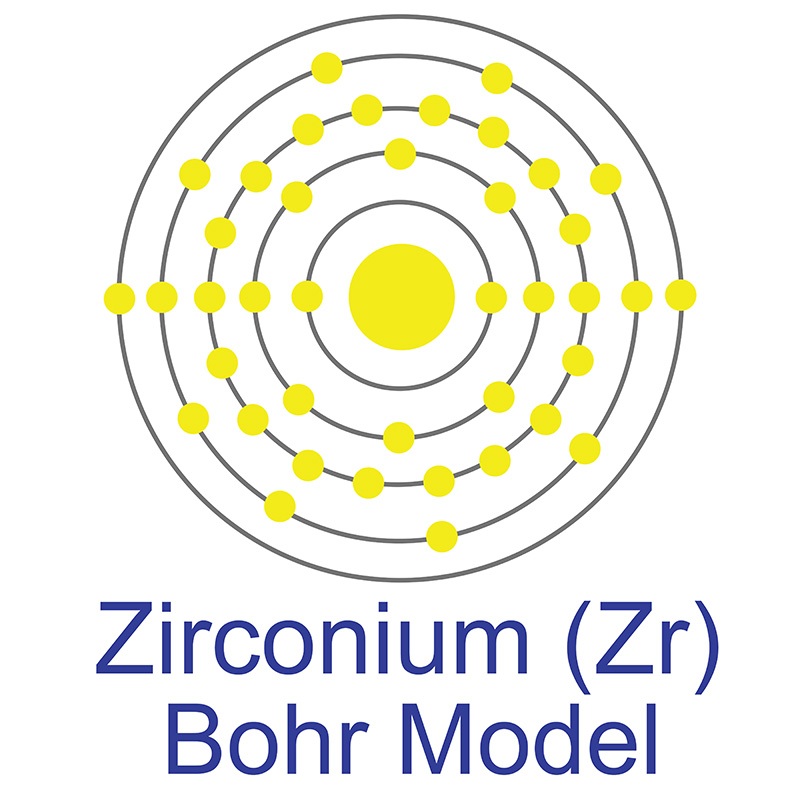
Zirconium is a Block D, Group 4, Period 5 element. The number of electrons in each of Zirconium's shells is 2, 8, 18, 10, 2 and its electronic configuration is [Kr] 4d2 5s2. In its elemental form zirconium's CAS number is 7440-67-7. The zirconium atom has a radius of 159.pm and it's Van der Waals radius is 200.pm. Zirconium is non-toxic. Zirconium is primarily used in it's oxide or zirconia form. Zirconium dioxide has a high melting point (2,700° C) and a low thermal conductivity. Its polymorphism, however, restricts its widespread use in ceramic industry. During a heating process, zirconia will undergo a phase transformation process. The change in volume associated with this transformation makes the usage of pure zirconia in many applications impossible. Addition of some oxides, such as CaO, MgO, and Y2O3, into the zirconia structure in a certain degree results in a solid solution, which is a cubic form and has no phase transformation during heating and cooling. This solid solution material is termed as stabilized zirconia, a valuable refractory. Stabilized zirconia is used as a grinding media and engineering ceramics due to its increased hardness and high thermal shock resistivity. Stabilized zirconia is also used in applications such as oxygen sensors and solid oxide fuel cells due to its high oxygen ion conductivity.Zirconium was first discovered by William Gregor in 1791. The name Zirconium originated from the Persian word 'zargun' meaning gold color or gold-like. See Zirconium research below.
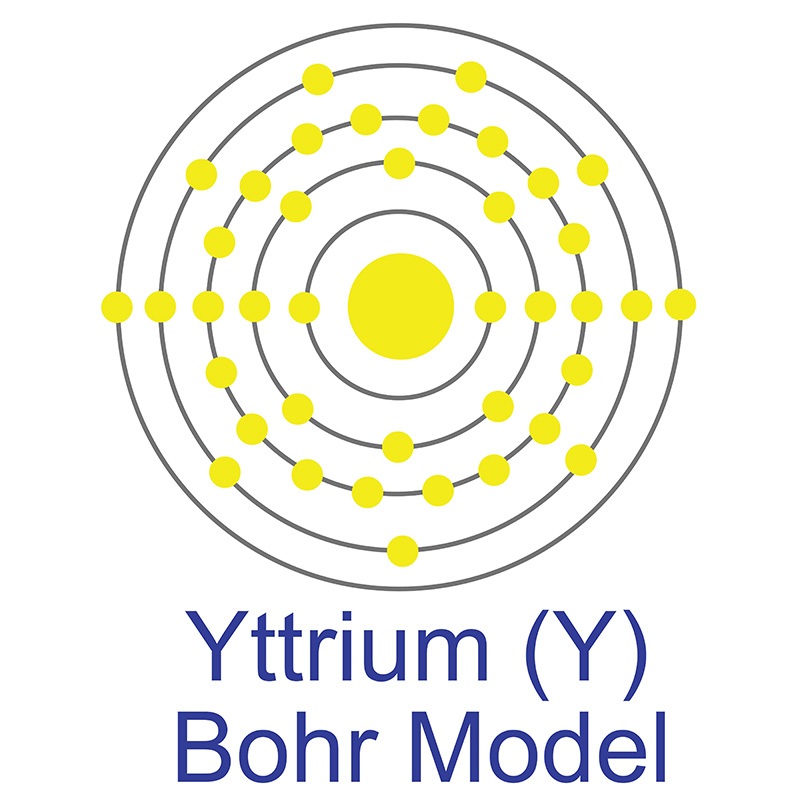
Yttrium is a Block D, Group 3, Period 5 element. The number of electrons in each of Yttrium's shells is 2, 8, 18, 9, 2 and its electronic configuration is [Kr] 4d1 5s2. In its elemental form Yttrium's CAS number is 7440-65-5. The yttrium atom has a radius of 177.6.pm and it's Van der Waals radius is 200.pm. Insoluble compounds of Yttrium are non-toxic, although water soluble compounds are somewhat toxic. Yttrium has the highest thermo-dynamic affinity for oxygen of any element. This characteristic is the basis for many of its applications. While not part of the rare earth series, it resembles the heavy rare earths which are sometimes referred to as the “yttrics” for this reason. Another unique characteristic derives from its ability to form crystals with useful properties. Yttrium is available as metal and compounds with purities from 99% to 99.999% (ACS grade to ultra high purity); metals in the form of foil, sputtering target, and rod, and compounds assubmicron and nanopowder. Some of the many applications of yttrium include in ceramics for crucibles for molten reactive metals, in florescent lighting phosphors, computer displays and automotive fuel consumption sensors.Yttria stabilized zirconium oxide are used in high temperature applications, such as in thermal plasma sprays to protect aerospace high temperature surfaces and as an electrolyte in solid oxide fuel cells. The name Yttrium originated from a Swedish village near Vaxholm called Yttbery where Yttrium was discovered. Crystals of the yttrium-iron-garnet (YIG) variety are essential to microwave communication equipment. The phosphor Eu:Y2O2S creates the red color in televisions. Crystals of the yttrium-aluminum-garnet (YAG) variety are utilized with neodymium in a number of laser applications. Yttria can also increase the strength of metallic alloys. Yttrium was first discovered by Johann Gadolin in 1794. See Yttrium research below.
PACKAGING SPECIFICATIONS FOR BULK & RESEARCH QUANTITIES
Typical bulk packaging includes palletized plastic 5 gallon/25 kg. pails, fiber and steel drums to 1 ton super sacks in full container (FCL) or truck load (T/L) quantities. Research and sample quantities and hygroscopic, oxidizing or other air sensitive materials may be packaged under argon or vacuum. Shipping documentation includes a Certificate of Analysis and Material Safety Data Sheet (MSDS). Solutions are packaged in polypropylene, plastic or glass jars up to palletized 440 gallon liquid totes.
Low-Fluence Q-Switched 1,064-nm Neodymium-Doped Yttrium Aluminum Garnet Laser for the Treatment of Facial Partial Unilateral Lentiginosis in Koreans.
Lee Y, Choi EH, Lee SW.
Dermatol Surg. 2011 Sep 7. doi: 10.1111/j.1524-4725.2011.02147.x. [Epub ahead of print]
PMID:
22093176
[PubMed - as supplied by publisher]
Successful Treatment of Cosmetic Mucosal Tattoos Via Q-Switched Laser.
Kirby W, Chen C, Desai A, Desai T.
Dermatol Surg. 2011 Aug 23. doi: 10.1111/j.1524-4725.2011.02135.x. [Epub ahead of print]
PMID:
22093036
[PubMed - as supplied by publisher]
Letter: successful treatment of multiple miliary osteomas of the face using an erbium-doped yttrium aluminum garnet laser.
Ortiz AE, Ross EV.
Dermatol Surg. 2011 Oct;37(10):1548-50. doi: 10.1111/j.1524-4725.2011.02112.x.
PMID:
22092945
[PubMed - in process]
Commentary on Treatment of Acne Scars in Asian Patients using a 2,790-nm Fractional Yttrium Scandium Gallium Garnet Laser.
Perez M.
Dermatol Surg. 2011 Oct;37(10):1470-2. doi: 10.1111/j.1524-4725.2011.02116.x. No abstract available.
PMID:
22092942
[PubMed - in process]
Fractional Thermoablation Using an Erbium-Doped Yttrium Aluminum Garnet Fractionated Laser for the Treatment of Pulsed Dye Laser-Resistant Port Wine Stain Birthmarks.
Toren KL, Marquart JD.
Dermatol Surg. 2011 Sep 14. doi: 10.1111/j.1524-4725.2011.02160.x. [Epub ahead of print] No abstract available.
PMID:
22092921
[PubMed - as supplied by publisher]
The effect of erbium-doped: yttrium, aluminium and garnet laser irradiation on the surface microstructure and roughness of double acid-etched implants.
Kim JH, Herr Y, Chung JH, Shin SI, Kwon YH.
J Periodontal Implant Sci. 2011 Oct;41(5):234-41. Epub 2011 Oct 31.
PMID:
22087414
[PubMed - in process]
120-W 2-?m THULIUM:YTTRIUM-ALUMINIUM-GARNET VAPOENUCLEATION OF THE PROSTATE: 12-MONTH FOLLOW-UP.
Muir G.
BJU Int. 2011 Nov 15. doi: 10.1111/j.1464-410X.2011.10816.x. [Epub ahead of print] No abstract available.
PMID:
22085314
[PubMed - as supplied by publisher]
120-W 2-µm thulium:yttrium-aluminium-garnet vapoenucleation of the prostate: 12-month follow-up.
Netsch C, Pohlmann L, Herrmann TR, Gross AJ, Bach T.
BJU Int. 2011 Nov 15. doi: 10.1111/j.1464-410X.2011.10767.x. [Epub ahead of print]
PMID:
22085294
[PubMed - as supplied by publisher]
An Unusual Organoyttrium Alkyl Complex Containing a [C(5) HMe(3) (?(3) -CH(2) )-C(5) H(4) N-?](-) Ligand and an Elusive Cyclopentadienide-Based Scandium Tuck-Over Zwitterion Obtained by C?H Bond Activation.
Jian Z, Cui D.
Chemistry. 2011 Nov 14. doi: 10.1002/chem.201102378. [Epub ahead of print]
PMID:
22083978
[PubMed - as supplied by publisher]
Radioembolization versus Standard Care of Hepatic Metastases: Comparative Retrospective Cohort Study of Survival Outcomes and Adverse Events in Salvage Patients.
Bester L, Meteling B, Pocock N, Pavlakis N, Chua TC, Saxena A, Morris DL.
J Vasc Interv Radiol. 2011 Nov 11. [Epub ahead of print]
PMID:
22079516
[PubMed - as supplied by publisher]
Quantitative evaluation of scintillation camera imaging characteristics of isotopes used in liver radioembolization.
Elschot M, Nijsen JF, Dam AJ, de Jong HW.
PLoS One. 2011;6(11):e26174. Epub 2011 Nov 3.
PMID:
22073149
[PubMed - in process]
Lasers or light sources for treating port-wine stains.
Faurschou A, Olesen AB, Leonardi-Bee J, Haedersdal M.
Cochrane Database Syst Rev. 2011 Nov 9;11:CD007152.
PMID:
22071834
[PubMed - in process]
Treating and Downstaging Hepatocellular Carcinoma in the Caudate Lobe with Yttrium-90 Radioembolization.
Ibrahim SM, Kulik L, Baker T, Ryu RK, Mulcahy MF, Abecassis M, Salem R, Lewandowski RJ.
Cardiovasc Intervent Radiol. 2011 Nov 9. [Epub ahead of print]
PMID:
22069121
[PubMed - as supplied by publisher]
catena-Poly[[tetra-kis-(hexa-methyl-phospho-ramide-?O)bis-(nitrato-?O,O')yttrium(III)] [silver(I)-di-?-sulfido-molybdenum(VI)-di-?-sulfido]].
Zhang J.
Acta Crystallogr E Struct Rep Online. 2011 Sep 1;67(Pt 9):m1206-7. Epub 2011 Aug 6.
PMID:
22065643
[PubMed]
Yttrium-90 Time-of-Flight PET/CT Is Superior to Bremsstrahlung SPECT/CT for Postradioembolization Imaging of Microsphere Biodistribution.
Kao YH, Tan EH, Ng CE, Goh SW.
Clin Nucl Med. 2011 Dec;36(12):e186-7.
PMID:
22064104
[PubMed - in process]
End-functionalized Polymerization of 2-Vinylpyridine through Initial C-H Bond Activation of N-Heteroaromatics and Internal Alkynes by Yttrium Ene-diamido Complexes.
Kaneko H, Nagae H, Tsurugi H, Mashima K.
J Am Chem Soc. 2011 Nov 7. [Epub ahead of print]
PMID:
22059504
[PubMed - as supplied by publisher]
Catalytic, Enantioselective Intramolecular Hydroamination of Primary Amines Tethered to Di- and Tri-substituted Alkenes.
Chapurina Y, Ibrahim H, Guillot R, Kolodziej E, Collin J, Trifonov A, Schulz E, Hannedouche J.
J Org Chem. 2011 Nov 7. [Epub ahead of print]
PMID:
22059438
[PubMed - as supplied by publisher]
Size effect of endohedral cluster on fullerene cage: Preparation and structural studies of Y(3)N@C(78)-C(2).
Ma Y, Wang T, Wu J, Feng Y, Xu W, Jiang L, Zheng J, Shu C, Wang C.
Nanoscale. 2011 Nov 7. [Epub ahead of print]
PMID:
22057827
[PubMed - as supplied by publisher]
MDCT Necrosis Quantification in the Assessment of Hepatocellular Carcinoma Response to Yttrium 90 Radioembolization Therapy: Comparison of Two-dimensional and Volumetric Techniques.
Galizia MS, Töre HG, Chalian H, McCarthy R, Salem R, Yaghmai V.
Acad Radiol. 2011 Nov 2. [Epub ahead of print]
PMID:
22054801
[PubMed - as supplied by publisher]
Q-switched laser treatment of amiodarone pigmentation.
Bernstein EF.
J Drugs Dermatol. 2011 Nov 1;10(11):1316-9.
PMID:
22052315
[PubMed - in process]
Zirconium arsenate-modified silica nanoparticles for specific capture of phosphopeptides and direct analysis by matrix-assisted laser desorption/ionization mass spectrometry.
Zhao PX, Guo XF, Wang H, Qi CB, Xia HS, Zhang HS.
Anal Bioanal Chem. 2011 Nov 22. [Epub ahead of print]
PMID:
22105300
[PubMed - as supplied by publisher]
A surface derivatization strategy for combinatorial analysis of cell response to mixtures of protein domains.
Chiang C, Karuri SW, Kshatriya PP, Schwartz J, Schwarzbauer JE, Karuri NW.
Langmuir. 2011 Nov 21. [Epub ahead of print]
PMID:
22103809
[PubMed - as supplied by publisher]
Environmentally stable flexible metal-insulator-metal capacitors using zirconium-silicate and hafnium-silicate thin film composite materials as gate dielectrics.
Meena JS, Chu MC, Wu CS, Ravipati S, Ko FH.
J Nanosci Nanotechnol. 2011 Aug;11(8):6858-67.
PMID:
22103091
[PubMed - in process]
Highly sensitive protein kinase activity assay based on electrochemiluminescence nanoprobes.
Zhao Z, Zhou X, Xing D.
Biosens Bioelectron. 2011 Oct 25. [Epub ahead of print]
PMID:
22100765
[PubMed - as supplied by publisher]
Corrosion fatigue behavior of a biocompatible ultrafine-grained niobium alloy in simulated body fluid.
Rubitschek F, Niendorf T, Karaman I, Maier HJ.
J Mech Behav Biomed Mater. 2012 Jan;5(1):181-92. Epub 2011 Sep 8.
PMID:
22100093
[PubMed - in process]
Fabrication and characterization of biocompatible nacre-like structures from ?-zirconium hydrogen phosphate hydrate and chitosan.
Waraich SM, Hering B, Burghard Z, Bill J, Behrens P, Menzel H.
J Colloid Interface Sci. 2011 Oct 29. [Epub ahead of print]
PMID:
22099057
[PubMed - as supplied by publisher]
Wear resistance of experimental titanium alloys for dental applications.
Faria AC, Rodrigues RC, Claro AP, de Mattos Mda G, Ribeiro RF.
J Mech Behav Biomed Mater. 2011 Nov;4(8):1873-9. Epub 2011 Jun 15.
PMID:
22098886
[PubMed - in process]
Carbon Fiber-Reinforced Cyanate Ester/Nano-ZrW(2)O(8) Composites with Tailored Thermal Expansion.
Badrinarayanan P, Rogalski MK, Kessler MR.
ACS Appl Mater Interfaces. 2011 Nov 18. [Epub ahead of print]
PMID:
22098430
[PubMed - as supplied by publisher]
Single-step fabrication of nanolamellar structured oxide ceramic coatings by metal-organic chemical vapor deposition.
Eils NK, Mechnich P, Keune H, Wahl G, Klages CP.
J Nanosci Nanotechnol. 2011 Sep;11(9):8396-402.
PMID:
22097592
[PubMed - in process]
Metalcones: hybrid organic-inorganic films fabricated using atomic and molecular layer deposition techniques.
George SM, Lee BH, Yoon B, Abdulagatov AI, Hall RA.
J Nanosci Nanotechnol. 2011 Sep;11(9):7948-55.
PMID:
22097511
[PubMed - in process]
Reliability and fatigue failure modes of implant-supported aluminum-oxide fixed dental prostheses.
Stappert CF, Baldassarri M, Zhang Y, Hänssler F, Rekow ED, Van P Thompson.
Clin Oral Implants Res. 2011 Sep 5. doi: 10.1111/j.1600-0501.2011.02281.x. [Epub ahead of print]
PMID:
22093019
[PubMed - as supplied by publisher]
Titanium-zirconium alloy narrow-diameter implants (Straumann Roxolid(®) ) for the rehabilitation of horizontally deficient edentulous ridges: prospective study on 18 consecutive patients.
Chiapasco M, Casentini P, Zaniboni M, Corsi E, Anello T.
Clin Oral Implants Res. 2011 Aug 18. doi: 10.1111/j.1600-0501.2011.02296.x. [Epub ahead of print]
PMID:
22092806
[PubMed - as supplied by publisher]
Retention of implant-supported zirconium oxide ceramic restorations using different luting agents.
Nejatidanesh F, Savabi O, Shahtoosi M.
Clin Oral Implants Res. 2011 Nov 14. doi: 10.1111/j.1600-0501.2011.02358.x. [Epub ahead of print]
PMID:
22092303
[PubMed - as supplied by publisher]
Tetra-kis(picolinato-?N,O)zirconium(IV) dihydrate.
Steyn M, Visser HG, Roodt A, Muller TJ.
Acta Crystallogr E Struct Rep Online. 2011 Sep 1;67(Pt 9):m1240-1. Epub 2011 Aug 17.
PMID:
22065566
[PubMed]
2,4-Pentanediolate as an Alkoxide/Diketonate "Hybrid" Ligand and the Formation of Aluminum and Zirconium Derivatives.
Bierschenk EJ, Wilk NR, Hanusa TP.
Inorg Chem. 2011 Nov 4. [Epub ahead of print]
PMID:
22053749
[PubMed - as supplied by publisher]
Ultrasound-assisted synthesis of mesoporous zirconia-hydroxyapatite nanocomposites and their dual surface affinity for Cr3+/Cr2O72- ions.
Achelhi K, Masse S, Laurent GP, Roux C, Laghzizil A, Saoiabi A, Coradin T.
Langmuir. 2011 Nov 4. [Epub ahead of print]
PMID:
22053732
[PubMed - as supplied by publisher]
Synthesis, Characterization, and Materials Chemistry of Group 4 Silylimides.
Cosham SD, Johnson AL, Molloy KC, Kingsley AJ.
Inorg Chem. 2011 Nov 4. [Epub ahead of print]
PMID:
22053704
[PubMed - as supplied by publisher]
Influence of cement thickness on resin-zirconia microtensile bond strength.
Lee TH, Ahn JS, Shim JS, Han CH, Kim SJ.
J Adv Prosthodont. 2011 Sep;3(3):119-25. Epub 2011 Sep 25.
PMID:
22053241
[PubMed]
Reliability of a new biokinetic model of zirconium in internal dosimetry: part ii, parameter sensitivity analysis.
Li WB, Greiter M, Oeh U, Hoeschen C.
Health Phys. 2011 Dec;101(6):677-92.
PMID:
22048486
[PubMed - in process]
Reliability of a new biokinetic model of zirconium in internal dosimetry: part I, parameter uncertainty analysis.
Li WB, Greiter M, Oeh U, Hoeschen C.
Health Phys. 2011 Dec;101(6):660-76.
PMID:
22048485
[PubMed - in process]