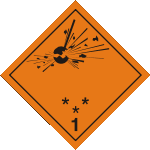
 Explosives Explosives |
- Division 1.1: Substances and articles which have a mass explosion hazard
- Division 1.2: Substances and articles which have a projection hazard but not a mass explosion hazard
- Division 1.3: Substances and articles which have a fire hazard and either a minor blast hazard or a minor projection hazard or both, but not a mass explosion hazard
|
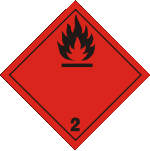 Flammable Gases Flammable Gases |
- Gases which at 20 °C and a standard pressure of 101.3 kPa:
- -are ignitable when in a mixture of 13 per cent or less by volume with air; or
- -have a flammable range with air of at least 12 percentage points regardless of the lower flammable limit.
|
 Non-flammable Non-toxic Gases Non-flammable Non-toxic Gases |
- Gases which:
- are asphyxiant - gases which dilute or replace the oxygen normally in the atmosphere; or
- are oxidizing - gases which may, generally by providing oxygen, cause or contribute to the combustion of other material more than air does; or
- do not come under the other divisions
|
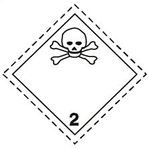 Toxic Gases Toxic Gases |
- Gases which:
- are known to be so toxic or corrosive to humans as to pose a hazard to health; or
- are presumed to be toxic or corrosive to humans because they have an LC50 value equal to or less than 5000 ml/m3 (ppm).
|
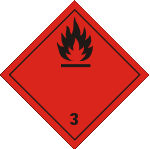 Flammable Liquids Flammable Liquids |
- Liquids which have a flash point of less than 60 °C and which are capable of sustaining combustion
|
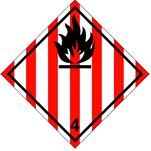 Flammable Solids self-reactive substances and solid desensitized explosives Flammable Solids self-reactive substances and solid desensitized explosives |
- Solids which, under conditions encountered in transport, are readily combustible or may cause or contribute to fire through friction; self-reactive substances which are liable to undergo a strongly exothermic reaction; solid desensitized explosives which may explode if not diluted sufficiently
|
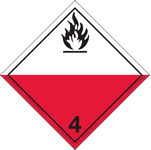 Substances Liable to Spontaneous Combustion Substances Liable to Spontaneous Combustion |
- Substances which are liable to spontaneous heating under normal conditions encountered in transport, or to heating up in contact with air, and being then liable to catch fire
|
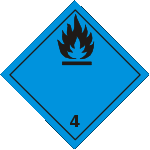 Substances which in contact with water emit flammable gases Substances which in contact with water emit flammable gases |
- Substances which, by interaction with water, are liable to become spontaneously flammable or to give off flammable gases in dangerous quantities
|
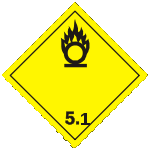 Oxidizing Substances Oxidizing Substances |
- Substances which, while in themselves not necessarily combustible, may, generally by yielding oxygen, cause, or contribute to, the combustion of other material
|
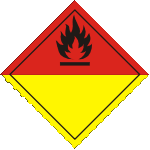 Organic Peroxides Organic Peroxides |
- Organic substances which contain the bivalent -O-O- structure and may be considered derivatives of hydrogen peroxide, where one or both of the hydrogen atoms have been replaced by organic radicals
|
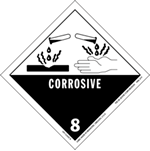 Corrosive Substances Corrosive Substances |
- Substances which:
- cause full thickness destruction of intact skin tissue on exposure time of less than 4 hours; or
- exhibit a corrosion rate of more than 6.25 mm per year on either steel or aluminium surfaces at 55 °C
|
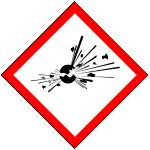 Exploding Bomb: GHS01
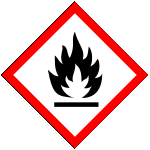 Flame: GHS02
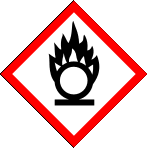 Flame Over Circle: GHS03
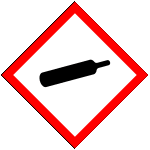 Gas Cylinder: GHS04
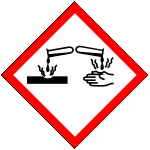 Corrosion: GHS05
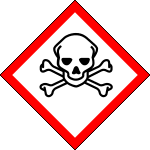 Skull and Crossbones: GHS06
 Exclamation Mark: GHS07
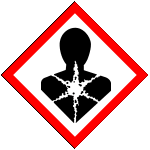 Health Hazard: GHS08
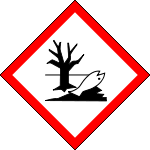 Hazardous to the Environment: GHS09
 B - Biohazard
 C - Corrosive
 E - Explosive
 F - Flammable
F+ - Extremely Flammable
F - Flammable
F+ - Extremely Flammable Xi - Irritant
Xn - Harmful
Xi - Irritant
Xn - Harmful N - Dangerous for the Environment
 O - Oxidizing
 R - Radioactive
 T - Toxic