wpe6.gif (6819 bytes)

ZIRCONATE INFORMATION CENTER
AE Zirconates ™

32.4 (A)/00.022


Hydrogen                                Helium  
Lithium Beryllium                     Boron Carbon Nitrogen Oxygen Fluorine Neon
Sodium Magnesium                     Aluminum Silicon Phosphorus Sulfur Chlorine Argon
Potassium Calcium Scandium Titanium Vanadium Chromium Manganese Iron Cobalt Nickel Copper Zinc Gallium Germanium Arsenic Selenium Bromine Krypton
Rubidium Strontium Yttrium Zirconium Niobium Molybdenum Technetium Ruthenium Rhodium Palladium Silver Cadmium Indium Tin Antimony Tellurium Iodine Xenon
Cesium Barium Lanthanum Hafnium Tantalum Tungsten Rhenium Osmium Iridium Platinum Gold Mercury Thallium Lead Bismuth Polonium Astatine Radon
Francium Radium Actinium Rutherfordium Dubnium Seaborgium Bohrium Hassium Meitnerium Darmstadtium Roentgenium Copernicium Ununtrium Ununquadium Ununpentium Ununhexium Ununseptium Ununoctium
                                   
    Cerium Praseodymium Neodymium Promethium Samarium Europium Gadolinium Terbium Dysprosium Holmium Erbium Thulium Ytterbium Lutetium    
    Thorium Protactinium Uranium Neptunium Plutonium Americium Curium Berkelium Californium Einsteinium Fermium Mendelevium Nobelium Lawerencium      

(click on an element to view our products)

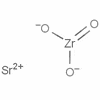
Strontium Zirconate
Strontium Zirconate

A zirconate is a salt formed between zirconium, oxygen, and another element usually a metal. One of the most common and useful zirconates is lead zirconate titanate also called PZT. It is a ceramic perovskite material that shows a marked piezoelectric effect. PZT-based compounds are used to manufacture ultrasound transducers, ceramic capacitors, and STM/AFM actuators. Being piezoelectric, it develops a voltage across two of its faces when compressed which is useful for sensor applications. It can also physically change shape when an external electric field is applied making it very valuable in actuator applications. PZT, being pyroelectric, develops a voltage difference across two of its faces when it experiences a temperature change, making it useful as a heat detecting sensor. It is also ferroelectric, which means it has a spontaneous electric polarization which can be reversed in the presence of an electric field. These properties make PZT-based compounds one of the most prominent and useful electroceramics.

Commercially, PZT is rarely used in its pure form, rather it is doped with either acceptor dopants or donor dopants. In general, acceptor doping creates hard PZT while donor doping creates soft PZT, which generally differ in their piezoelectric constants. Soft PZT has a higher piezoelectric constant, but larger losses in the material due to internal friction. In hard PZT, domain wall motion is pinned by the impurities, decreasing losses in the material but at the expense of a reduced piezoelectric constant.
PZT is used to make ultrasound transducers and other sensors and actuators, as well as high-value ceramic capacitors and FRAM chips. PZT is also used in the manufacture of ceramic resonators for reference timing in electronic circuitry.

Structurally similar to lead scandium tantalate and barium strontium titanate, PZT can be used for manufacture of uncooled staring array infrared imaging sensors for thermographic cameras. Both thin film and bulk structures are used.

Purities include 99%, 99.9%, 99.99%, 99.999% and 99.9999% which are sometimes referred to as 2N, 3N, 4N, 5N and 6N.

Physical properties may include nanopowder, nano particle, submicron, - 325 mesh, rod, foil, and high surface area bromide with particle distribution and particle size controlled and certified. We produce larger - 40 mesh, - 100 mesh, -200 mesh range sizes and < 0.5 mm, 2 mm, 5 mm and other mm size shot, granules, lump, flake and pieces, too.

American Elements maintains industrial scale production for all its zirconate products.

American Elements will execute Non-Disclosure or Confidentiality Agreements to protect customer know-how.

Please select a Zirconate Material from the table:


PRODUCT CATALOG U.S. Operations Price Quote Nanoparticles Submicron & Nanopowder Tolling Ultra High Purity Sputtering Target Crystal Growth Advanced Materials Information Center Home


  Print this Page
Periodic table of the elements science and academic information, elements and advanced materials data, scientific presentations and all pages, designs, concepts, logos, and color schemes herein are the copyrighted proprietary rights and intellectual property of American Elements. American Elements is a U.S. Registered Trademark. © 1998-2012. American Elements. All rights reserved.
Learn Six Sigma


Swiss Nanoconvention 2012Proud sponsors of the 2012 Swiss NanoConvention. Please join us and our customers & co-sponsors EMPA and the EPFL on
May 22-24, 2012 in Lausanne, Switzerland.


Recent Research & Development for Zirconate

  • Nano-embossing technology on ferroelectric thin film Pb(Zr0.3,Ti0.7)O3 for multi-bit storage application. Shen Z, Chen Z, Lu Q, Qiu Z, Jiang A, Qu X, Chen Y, Liu R. Nanoscale Res Lett. 2011 Jul 27;6(1):474. [Epub ahead of print] PMID: 21794156 [PubMed - as supplied by publisher] Free Article

  • NOVEL LEAD ZIRCONATE TITANATE COMPOSITE VIA FREEZING TECHNOLOGY FOR HIGH FREQUENCY TRANSDUCER APPLICATIONS. Zhu BP, Zhou QF, Hu CH, Shung KK, Gorzkowski EP, Pan MJ. J Adv Dielectr. 2011 Jan 1;1(1):85-89. PMID: 21785672 [PubMed] Free PMC Article

  • Strontium doped lead zirconate titanate ceramics: study of calcination and sintering process to improve piezo effect. Khalid M, Shoaib M, Khan AA. J Nanosci Nanotechnol. 2011 Jun;11(6):5440-5. PMID: 21770202 [PubMed - in process]

  • Porous piezoceramics: theory, technology, and properties. Rybyanets A. IEEE Trans Ultrason Ferroelectr Freq Control. 2011 Jul;58(7):1492-507. PMID: 21768033 [PubMed - in process]

  • Propane-1,2-diaminium tris-(pyridine-2,6-dicarboxyl-ato-?O,N,O)zirconate(IV) trihydrate. Pasdar H, Shakiba S, Aghabozorg H, Notash B. Acta Crystallogr Sect E Struct Rep Online. 2011 May 1;67(Pt 5):m587. Epub 2011 Apr 13. PMID: 21754310 [PubMed] Free PMC Article

  • Development of Nanoscale Inhomogeneities during Drying of Sol-Gel Derived Amorphous Lead Zirconate Titanate Precursor Thin Films. Stawski TM, Veldhuis SA, Castricum HL, Keim EG, Eeckhaut G, Bras W, Blank DH, Ten Elshof JE. Langmuir. 2011 Jul 28. [Epub ahead of print] PMID: 21736322 [PubMed - as supplied by publisher]

  • An alternating focused ultrasound system for thermal therapy studies in small animals. Chen X, Novák P, Benson DG Jr, Webber JS, Hennings L, Shafirstein G, Corry PM, Griffin RJ, Moros EG. Med Phys. 2011 Apr;38(4):1877-87. PMID: 21626921 [PubMed - indexed for MEDLINE]

  • A single vibration mode tubular piezoelectric ultrasonic motor. He S, Chiarot PR, Park S. IEEE Trans Ultrason Ferroelectr Freq Control. 2011 May;58(5):1049-61. PMID: 21622060 [PubMed - in process]

  • Particle manipulation in a microfluidic channel using acoustic trap. Jeong JS, Lee JW, Lee CY, Teh SY, Lee A, Shung KK. Biomed Microdevices. 2011 Aug;13(4):779-88. PMID: 21603963 [PubMed - in process]

  • Scaling and disorder analysis of local I-V curves from ferroelectric thin films of lead zirconate titanate. Maksymovych P, Pan M, Yu P, Ramesh R, Baddorf AP, Kalinin SV. Nanotechnology. 2011 Jun 24;22(25):254031. Epub 2011 May 16. PMID: 21572199 [PubMed - in process]

  • Experimental evaluation of an adaptive Joule-Thomson cooling system including silicon-microfabricated heat exchanger and microvalve components. Zhu W, Park JM, White MJ, Nellis GF, Gianchandani YB. J Vac Sci Technol A. 2011 Mar 1;29(2):21005-210056. PMID: 21552354 [PubMed]

  • Bis(2-amino-6-methyl-pyridinium) tris-(pyridine-2,6-dicarboxyl-ato)zirconate(IV) dihydrate. Pasdar H, Ebdam A, Aghabozorg H, Notash B. Acta Crystallogr Sect E Struct Rep Online. 2011 Feb 2;67(Pt 3):m294. PMID: 21522235 [PubMed] Free PMC Article

  • High-frequency ultrasonic transducer based on lead-free BSZT piezoceramics. Lee ST, Lam KH, Zhang XM, Chan HL. Ultrasonics. 2011 Oct;51(7):811-4. Epub 2011 Mar 17. PMID: 21477833 [PubMed - in process]

  • Spatially selective photochemical reduction of silver on nanoembossed ferroelectric PZT nanowires. Shen Z, Chen G, Chen Z, Qu X, Chen Y, Liu R. Langmuir. 2011 May 3;27(9):5167-70. Epub 2011 Apr 8. PMID: 21476531 [PubMed - in process]

  • Tandem insertion of halocarbenoids and lithium acetylides into zirconacycles: a novel rearrangement to zirconium alkenylidenates by ß-addition to an alkynyl zirconocene. Stec J, Thomas E, Dixon S, Whitby RJ. Chemistry. 2011 Apr 18;17(17):4896-904. doi: 10.1002/chem.201002962. Epub 2011 Mar 21. PMID: 21425365 [PubMed - indexed for MEDLINE]

  • Distinguishing crystallographic misorientations of lanthanum zirconate epilayers on nickel substrates by electron backscatter diffraction. Ji Y, Wang L, Zhang Y, Wei B, Wang J, Cheng Y, Suo H. Ultramicroscopy. 2011 Apr;111(5):314-9. Epub 2011 Jan 19. PMID: 21396525 [PubMed]

  • Stretchable ferroelectric nanoribbons with wavy configurations on elastomeric substrates. Feng X, Yang BD, Liu Y, Wang Y, Dagdeviren C, Liu Z, Carlson A, Li J, Huang Y, Rogers JA. ACS Nano. 2011 Apr 26;5(4):3326-32. Epub 2011 Mar 23. PMID: 21395261 [PubMed]

  • Effect of manganese doping on the size effect of lead zirconate titanate thin films and the extrinsic nature of 'dead layers'. Lou XJ, Wang J. J Phys Condens Matter. 2010 Feb 10;22(5):055901. Epub 2010 Jan 15. PMID: 21386350 [PubMed]

  • Lasing action and optical amplification in Nd3+ doped electrooptic lanthanum lead zirconate titanate ceramics. Zhao H, Sun X, Zhang JW, Zou YK, Li KK, Wang Y, Jiang H, Huang PL, Chen X. Opt Express. 2011 Feb 14;19(4):2965-71. doi: 10.1364/OE.19.002965. PMID: 21369120 [PubMed]

  • An integrated microfluidic chip with 40 MHz lead-free transducer for fluid analysis. Lee ST, Lam KH, Lei L, Zhang XM, Chan HL. Rev Sci Instrum. 2011 Feb;82(2):024903. PMID: 21361626 [PubMed - indexed for MEDLINE]


American Elements Products can also be sourced at these sites:


electronics-ee.com