wpe6.gif (6819 bytes)

MOLYBDATE INFORMATION CENTER
AE Molybdates ™

32.4 (A)/00.022

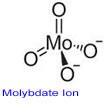
Molybdate Ion

Molybdate is a compound containing both the oxoanion and molybdenum. Molybdenum has the ability to form a wide range of oxoanions which can be polymeric extrended structures or descrete structures. Polymeric extended structures are only found in the solid state and the larger oxoanions are members of a group of compounds called polyoxometalates or isopolymetalates. Potassium molybdate and other very large structures contain discrete molybdenum oxoanions ranging in sixe from the simplest MoO42-.

Purities include 99%, 99.9%, 99.99%, 99.999% and 99.9999% which are sometimes referred to as 2N, 3N, 4N, 5N and 6N.

Physical properties may include nanopowder, nano particle, submicron, - 325 mesh, rod, foil, and high surface area carbonate with particle distribution and particle size controlled and certified. We produce larger - 40 mesh, - 100 mesh, -200 mesh range sizes and < 0.5 mm, 2 mm, 5 mm and other mm size shot, granules, lump, flake and pieces, too.

American Elements maintains industrial scale production for all its molybdate products.

American Elements will execute Non-Disclosure or Confidentiality Agreements to protect customer know-how.

Please select from the table a Molybdate Material


Hydrogen                                Helium  
Lithium Beryllium                     Boron Carbon Nitrogen Oxygen Fluorine Neon
Sodium Magnesium                     Aluminum Silicon Phosphorus Sulfur Chlorine Argon
Potassium Calcium Scandium Titanium Vanadium Chromium Manganese Iron Cobalt Nickel Copper Zinc Gallium Germanium Arsenic Selenium Bromine Krypton
Rubidium Strontium Yttrium Zirconium Niobium Molybdenum Technetium Ruthenium Rhodium Palladium Silver Cadmium Indium Tin Antimony Tellurium Iodine Xenon
Cesium Barium Lanthanum Hafnium Tantalum Tungsten Rhenium Osmium Iridium Platinum Gold Mercury Thallium Lead Bismuth Polonium Astatine Radon
Francium Radium Actinium Rutherfordium Dubnium Seaborgium Bohrium Hassium Meitnerium Darmstadtium Roentgenium Copernicium Ununtrium Ununquadium Ununpentium Ununhexium Ununseptium Ununoctium
                                   
    Cerium Praseodymium Neodymium Promethium Samarium Europium Gadolinium Terbium Dysprosium Holmium Erbium Thulium Ytterbium Lutetium    
    Thorium Protactinium Uranium Neptunium Plutonium Americium Curium Berkelium Californium Einsteinium Fermium Mendelevium Nobelium Lawerencium    

(click on an element to view our products)

       
Aluminum Molybdate
Barium Molybdate
Bismuth Molybdate Bi2MoO6
Bismuth Molybdate Bi2(MoO4)3
Cadmium Molybdate
Calcium Molybdate
Cesium Molybdate
Cobalt Molybdate
Copper Molybdate
Iron Molybdate
Lead Molybdate
Lithium Molybdate
Magnesium Molybdate
Manganese Molybdate
Nickel(II) Molybdate
Potassium Molybdate
Rubidium Molybdate
Silver Molybdate
Sodium Molybdate
Strontium Molybdate
Thallium Molybdate
Zinc Molybdate
       

French Molybdate German Molybdat Italian Molibdato Portuguese Molibdato Spanish Molibdato 钼酸 モリブデン Swedish Molybdat


PRODUCT CATALOG U.S. Operations Price Quote Nanoparticles Submicron & Nanopowder Tolling Ultra High Purity Sputtering Target Crystal Growth Advanced Materials Information Center Home


German   Korean   French   Japanese   Spanish   Chinese (Simplified)   Portuguese   Russian   Chinese (Taiwan)   Italian   Turkish   Polish   Dutch   Czech   Swedish   Hungarian   Danish   Hebrew

Production Catalog Available in 36 Countries & Languages
  Print this Page
Periodic table of the elements science and academic information, elements and advanced materials data, scientific presentations and all pages, designs, concepts, logos, and color schemes herein are the copyrighted proprietary rights and intellectual property of American Elements. American Elements is a U.S. Registered Trademark. © 1998-2012. American Elements. All rights reserved.
Learn Six Sigma


Swiss Nanoconvention 2012Proud sponsors of the 2012 Swiss NanoConvention. Please join us and our customers & co-sponsors EMPA and the EPFL on
May 22-24, 2012 in Lausanne, Switzerland.


Recent Research & Development for Molybdates

  • Structural investigation of the negative thermal expansion in yttrium and rare earth molybdates. Guzmán-Afonso C, González-Silgo C, González-Platas J, Torres ME, Lozano-Gorrín AD, Sabalisck N, Sánchez-Fajardo V, Campo J, Rodríguez-Carvajal J. J Phys Condens Matter. 2011 Aug 17;23(32):325402. Epub 2011 Jul 28. PMID: 21795779 [PubMed - in process]

  • Combined Theoretical and Mass Spectrometry Study of the Formation-Fragmentation of Small Polyoxomolybdates. Vila`-Nadal L, Wilson EF, Miras HN, Rodri´guez-Fortea A, Cronin L, Poblet JM. Inorg Chem. 2011 Aug 15;50(16):7811-7819. Epub 2011 Jul 19. PMID: 21766888 [PubMed - as supplied by publisher]

  • Reduced molybenum-oxide-based core-shell hybrids: "blue" electrons are delocalized on the shell. Todea AM, Szakács J, Konar S, Bögge H, Crans DC, Glaser T, Rousseličre H, Thouvenot R, Gouzerh P, Müller A. Chemistry. 2011 Jun 6;17(24):6635-42. doi: 10.1002/chem.201003260. Epub 2011 May 3. PMID: 21542032 [PubMed - in process]

  • Synthesis and structure of pillared molybdates and tungstates with framework layers. Nicholls JL, Hulse SE, Callear SK, Tizzard GJ, Stephenson RA, Hursthouse MB, Clegg W, Harrington RW, Fogg AM. Inorg Chem. 2010 Sep 20;49(18):8545-51. PMID: 20718486 [PubMed]

  • P6Mo18O73 heteropolyanion and its four-copper complex: theoretical and experimental investigation. Zhang FQ, Zhang XM, Fang RQ, Wu HS. Dalton Trans. 2010 Sep 21;39(35):8256-60. Epub 2010 Aug 5. PMID: 20689880 [PubMed - indexed for MEDLINE]

  • Reaction controlled assemblies of polyoxotungstates (-molybdates) and coordination polymers. Hou G, Bi L, Li B, Wu L. Inorg Chem. 2010 Jul 19;49(14):6474-83. PMID: 20550186 [PubMed]

  • Steric hindrance-dependent rational design and synthesis of three new Keggin-based supramolecular networks. Zhang X, Yi Z, Zhao L, Chen Q, Gu X, Xu J, Wang X, Yang C, Xu X, Xia W. Dalton Trans. 2009 Nov 14;(42):9198-206. Epub 2009 Sep 3. PMID: 20449197 [PubMed]

  • Controllable synthesis and luminescent properties of novel erythrocyte-like CaMoO4 hierarchical nanostructures via a simple surfactant-free hydrothermal route. Luo YS, Dai XJ, Zhang WD, Yang Y, Sun CQ, Fu SY. Dalton Trans. 2010 Mar 7;39(9):2226-31. Epub 2009 Dec 23. PMID: 20162195 [PubMed - indexed for MEDLINE]

  • Lamellar transition-metal molybdate-CTA mesostructured composites (metal = Ni, Co): one-pot synthesis and application in treatment of acid fuchsine. Yao HB, Li XB, Liu SJ, Yu SH. Chem Commun (Camb). 2009 Nov 28;(44):6732-4. Epub 2009 Oct 6. PMID: 19885461 [PubMed]

  • Thermodynamic properties of the gaseous gallium molybdates and tungstates. Lopatin SI, Shugurov SM, Gunina AO. J Phys Chem A. 2009 Dec 3;113(48):13469-74. PMID: 19831372 [PubMed - indexed for MEDLINE]

  • Evaluation of food additives as alternative or complementary chemicals to conventional fungicides for the control of major postharvest diseases of stone fruit. Palou L, Smilanick JL, Crisosto CH. J Food Prot. 2009 May;72(5):1037-46. PMID: 19517732 [PubMed - indexed for MEDLINE]

  • Emergence of a diffusive metal state with no magnetic order near the Mott transition in frustrated pyrochlore-type molybdates. Iguchi S, Hanasaki N, Kinuhara M, Takeshita N, Terakura C, Taguchi Y, Takagi H, Tokura Y. Phys Rev Lett. 2009 Apr 3;102(13):136407. Epub 2009 Apr 3. PMID: 19392382 [PubMed]

  • Nd(2)(WO(4))(3). Weil M, Stöger B, Aleksandrov L. Acta Crystallogr Sect E Struct Rep Online. 2009 May 23;65(Pt 6):i45. PMID: 21582980 [PubMed] Free PMC Article

  • Investigation of chemical bond characteristics, thermal expansion coefficients and bulk moduli of alpha-R2MoO6 and R2Mo2O7 (R = rare earths) by using a dielectric chemical bond method. Li H, Zhang S, Zhou S, Cao X. J Comput Chem. 2009 Sep;30(12):1892-8. PMID: 19115283 [PubMed]

  • Synthesis, characterization and luminescence study of Eu(III) tungstates and molybdates nanotubes using carbon nanotubes as templates. Tang Z, Zhou L, Wang F, Zhou L. Spectrochim Acta A Mol Biomol Spectrosc. 2009 Mar;72(2):348-55. Epub 2008 Oct 25. PMID: 19046924 [PubMed - indexed for MEDLINE]

  • Synthetic approaches for noncentrosymmetric molybdates. Hubbard DJ, Johnston AR, Casalongue HS, Sarjeant AN, Norquist AJ. Inorg Chem. 2008 Oct 6;47(19):8518-25. PMID: 18821818 [PubMed - indexed for MEDLINE]

  • Chiral Strandberg-type molybdates [(RPO3)2Mo5O15]2- as molecular gelators: self-assembled fibrillar nanostructures with enhanced optical activity. Carraro M, Sartorel A, Scorrano G, Maccato C, Dickman MH, Kortz U, Bonchio M. Angew Chem Int Ed Engl. 2008;47(38):7275-9. No abstract available. PMID: 18688897 [PubMed]

  • On the origin of alternating bond distortions and the emergence of chirality in polyoxometalate anions. Yan L, López X, Carbó JJ, Sniatynsky R, Duncan DC, Poblet JM. J Am Chem Soc. 2008 Jul 2;130(26):8223-33. Epub 2008 Jun 4. PMID: 18528985 [PubMed]

  • Anomalous nernst effects in pyrochlore molybdates with spin chirality. Hanasaki N, Sano K, Onose Y, Ohtsuka T, Iguchi S, Kézsmárki I, Miyasaka S, Onoda S, Nagaosa N, Tokura Y. Phys Rev Lett. 2008 Mar 14;100(10):106601. Epub 2008 Mar 12. PMID: 18352216 [PubMed]

  • New approach to the synthesis of an organopolymolybdate polymer in aqueous media by linkage of multicarboxylic ligands. Gao GG, Xu L, Qu XS, Liu H, Yang YY. Inorg Chem. 2008 Apr 21;47(8):3402-7. Epub 2008 Mar 5. PMID: 18318483 [PubMed]

Price Quote   |  Home Page   |  Product Catalog

Oxide & Metal  |  Chloride


American Elements is a copyrighted U.S. Trademark. All rights reserved.


  Untitled Document