American Elements Logo and U.S. Registered Trademark


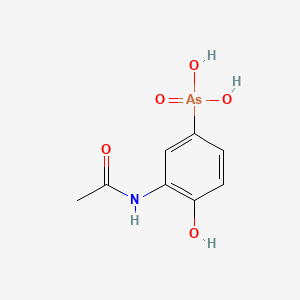
Acetarsone
C8H10AsNO5
97-44-9
Product Product Code Order or Specifications
(2N) 99% Acetarsone      AS-OM-02 Contact American Elements
(3N) 99.9% Acetarsone AS-OM-03 Contact American Elements
(4N) 99.99% Acetarsone AS-OM-04 Contact American Elements
(5N) 99.999% Acetarsone AS-OM-05 Contact American Elements
Acetarsone is generally immediately available in most volumes. High purity, submicron and nanopowder forms may be considered.American Elements produces to many standard grades when applicable, including Mil Spec (military grade); ACS, Reagent and Technical Grade; Food, Agricultural and Pharmaceutical Grade; Optical Grade, USP and EP/BP (European Pharmacopoeia/British Pharmacopoeia)and follows applicable ASTM testing standards.Typical and custom packaging is available. Additional technical, research and safety (MSDS) information is available as is a Reference Calculator for converting relevant units of measurement.

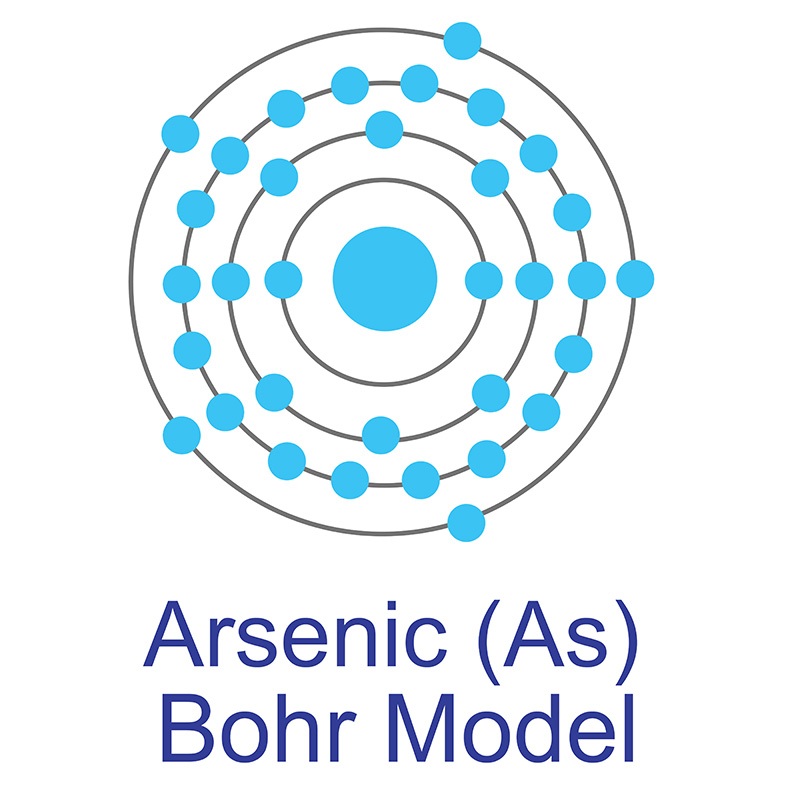
Arsenic(As) atomic and molecular weight, atomic number and elemental symbolArsenic is a Block P, Group 15, Period 4 element. The number of electrons in each of Arsenic's shells is 2, 8, 18, 5 and its electronic configuration is [Ar] 3d10 4s2 4p3. In its elemental form arsenic's CAS number is 1327-53-3.Elemental Arsenic The arsenic atom has a radius of 124.5.pm and it's Van der Waals radius is 185.pm. Arsenic in the organic form is not harmful but in the inorganic form it is extremely toxic even in very small amounts. Arsenic has numerous applications as a semiconductor and other electronic applications as Indium arsenide, silicon arsenide and tin arsenidea. Arsenic is finding increasing uses as a doping agent in solid-state devices such as transistors. Gallium arsenide is used as a laser material to convert electricity directly into coherent light. Arsenic is used in bronzing and for hardening and improving the sphericity of shot. Arsenic is available as metal and compounds with purities from 99% to 99.9999% (ACS grade to ultra-high purity); metals in Arsenic Bohr Modelthe form of foil, sputtering target, and rod, and compounds as submicron and nanopowder. Arsenic information, including Technical Data, Safety Data and its High Purity properties, research, applications and other useful facts are discussed here. Scientific facts such as the atomic structure, ionization energy, abundance on Earth, conductivity and thermal properties are included. See Arsenic research below.

Formula CAS No. Appearance Molecular Weight
C8H10AsNO5 97-44-9   275.09
PRODUCT CATALOG Arsenic Products Foil Submicron & Nanopowder Tolling Ultra High Purity Sputtering Target Crystal Growth Rod, Plate, Powder, etc. Home

Have a Question? Ask a Chemical Engineer or Material Scientist   Request an MSDS or Certificate of Analysis


Search by Material, Product Name, Product Code, CAS Number, Formula, Element, Anion, Form, EC Number, MDL Number or PubChem ID.


German   Korean   French   Japanese   Spanish   Chinese (Simplified)   Portuguese   Russian   Chinese (Taiwan)  Italian   Turkish   Polish   Dutch   Czech   Swedish   Hungarian   Danish   Hebrew

Production Catalog Available in 36 Countries & Languages

PACKAGING SPECIFICATIONS FOR BULK & RESEARCH QUANTITIES


Typical bulk packaging includes palletized plastic 5 gallon/25 kg. pails, fiber and steel drums to 1 ton super sacks in full container (FCL) or truck load (T/L) quantities. Research and sample quantities and hygroscopic, oxidizing or other air sensitive materials may be packaged under argon or vacuum. Shipping documentation includes a Certificate of Analysis and Material Safety Data Sheet (MSDS). Solutions are packaged in polypropylene, plastic or glass jars up to palletized 440 gallon liquid totes.


Show me more forms of Arsenic
 
Customers for this product have also looked at:
Arsenic Foil

Recent Research & Development for Arsenic

  • Arsenic trioxide treatment decreases the oxygen consumption rate of tumor cells and radiosensitizes solid tumors. Diepart C, Karroum O, Magat J, Feron O, Verrax J, Buc Calderon P, Grégoire V, Leveque P, Stockis J, Dauguet N, Jordan BF, Gallez B. Cancer Res. 2011 Dec 2. [Epub ahead of print] PMID: 22139377 [PubMed - as supplied by publisher]

  • Arsenic-Induced Straighthead: An Impending Threat to Sustainable Rice Production in South and South-East Asia! Azizur Rahman M, Mamunur Rahman M, Hasegawa H. Bull Environ Contam Toxicol. 2011 Dec 4. [Epub ahead of print] PMID: 22139332 [PubMed - as supplied by publisher]

  • Comparative Soil Metal Analyses in Sudbury (Ontario, Canada) and Lubumbashi (Katanga, DR-Congo). Narendrula R, Nkongolo KK, Beckett P. Bull Environ Contam Toxicol. 2011 Dec 4. [Epub ahead of print] PMID: 22139330 [PubMed - as supplied by publisher]

  • Purification, crystallization and preliminary X-ray diffraction studies of the arsenic repressor ArsR from Corynebacterium glutamicum. Santha S, Pandaranayaka EP, Rosen BP, Thiyagarajan S. Acta Crystallogr Sect F Struct Biol Cryst Commun. 2011 Dec 1;67(Pt 12):1616-8. Epub 2011 Nov 26. PMID: 22139180 [PubMed - in process]

  • Arsenic contamination and speciation in surrounding waters of three old cinnabar mines. Larios R, Fernández-Martínez R, Silva V, Loredo J, Rucandio I. J Environ Monit. 2011 Dec 5. [Epub ahead of print] PMID: 22139034 [PubMed - as supplied by publisher]

  • Arsenic Exposure and Hypertension: A Systematic Review. Abhyankar LN, Jones MR, Guallar E, Navas-Acien A. Environ Health Perspect. 2011 Dec 2. [Epub ahead of print] PMID: 22138666 [PubMed - as supplied by publisher]

  • Metals in biology: defining metalloproteomes. Yannone SM, Hartung S, Menon AL, Adams MW, Tainer JA. Curr Opin Biotechnol. 2011 Dec 2. [Epub ahead of print] PMID: 22138493 [PubMed - as supplied by publisher]

  • Total and inorganic arsenic concentrations in different species of economically important algae harvested from coastal zones of Chile. Díaz O, Tapia Y, Muñoz O, Montoro R, Velez D, Almela C. Food Chem Toxicol. 2011 Nov 25. [Epub ahead of print] PMID: 22138359 [PubMed - as supplied by publisher]

  • Zamzam water: Concentration of trace elements and other characteristics. Shomar B. Chemosphere. 2011 Dec 2. [Epub ahead of print] PMID: 22138338 [PubMed - as supplied by publisher]

  • Removal of methylated arsenic using a nanostructured zirconia-based sorbent: Process performance and adsorption chemistry. Zheng YM, Yu L, Chen JP. J Colloid Interface Sci. 2011 Oct 12. [Epub ahead of print] PMID: 22137855 [PubMed - as supplied by publisher]

  • Humans seem to produce arsenobetaine and dimethylarsinate after a bolus dose of seafood. Molin M, Ulven SM, Dahl L, Telle-Hansen VH, Holck M, Skjegstad G, Ledsaak O, Sloth JJ, Goessler W, Oshaug A, Alexander J, Fliegel D, Ydersbond TA, Meltzer HM. Environ Res. 2011 Dec 1. [Epub ahead of print] PMID: 22137101 [PubMed - as supplied by publisher]

  • A modified batch reactor system to study equilibrium-reactive transport problems. Jeppu GP, Clement TP, Barnett MO, Lee KK. J Contam Hydrol. 2011 Oct 20. [Epub ahead of print] PMID: 22136983 [PubMed - as supplied by publisher]

  • Identification of the GST-T1 and GST-M1 Null Genotypes using High Resolution Melting Analysis. Drobna Z, Del Razo LM, Garcia-Vargas G, Sanchez-Ramirez B, Gonzalez-Horta C, Ballinas ML, Loomis D, Styblo M. Chem Res Toxicol. 2011 Dec 2. [Epub ahead of print] PMID: 22136492 [PubMed - as supplied by publisher]

  • Uranium and trace elements in phosphate fertilizers-saudi arabia. Khater AE. Health Phys. 2012 Jan;102(1):63-70. PMID: 22134079 [PubMed - in process]

  • Natural attenuation of arsenic in soils near a highly contaminated historical mine waste dump. Drahota P, Filippi M, Ettler V, Rohovec J, Mihaljevic M, Sebek O. Sci Total Environ. 2011 Nov 29. [Epub ahead of print] PMID: 22134035 [PubMed - as supplied by publisher]

  • Removing arsenic from synthetic groundwater with iron electrocoagulation: An Fe and As K-edge EXAFS study. van Genuchten CM, Addy SE, Pena J, Gadgil A. Environ Sci Technol. 2011 Dec 1. [Epub ahead of print] PMID: 22132945 [PubMed - as supplied by publisher]

  • Embryotoxicity assessment of developmental neurotoxicants using a neuronal endpoint in the embryonic stem cell test. Baek DH, Kim TG, Lim HK, Kang JW, Seong SK, Choi SE, Lim SY, Park SH, Nam BH, Kim EH, Kim MS, Park KL. J Appl Toxicol. 2011 Dec 1. doi: 10.1002/jat.1747. [Epub ahead of print] PMID: 22131109 [PubMed - as supplied by publisher]

  • Comparing different means of signal treatment for improving the detection power in HPLC-ICP-MS. Prikler S, Pick D, Einax JW. Anal Bioanal Chem. 2011 Dec 1. [Epub ahead of print] PMID: 22130722 [PubMed - as supplied by publisher]

  • Biological monitoring versus air monitoring strategies in assessing environmental-occupational exposure. Jakubowski M. J Environ Monit. 2011 Dec 1. [Epub ahead of print] PMID: 22130625 [PubMed - as supplied by publisher]

  • Overexpression of alfalfa mitochondrial HSP23 in prokaryotic and eukaryotic model systems confers enhanced tolerance to salinity and arsenic stress. Lee KW, Cha JY, Kim KH, Kim YG, Lee BH, Lee SH. Biotechnol Lett. 2011 Nov 30. [Epub ahead of print] PMID: 22127759 [PubMed - as supplied by publisher]


USA Science & Engineering FestivalSponsors of the United States Science & Engineering Festival on April 28, 2012 in Washington D.C. Please join us and our customers & co-sponsors NASA, Lockheed Martin and the Department of Defense inspiring the next generation of scientists and engineers.


  Print this Page
Periodic table of the elements science and academic information, elements and advanced materials data, scientific presentations and all pages, designs, concepts, logos, and color schemes herein are the copyrighted proprietary rights and intellectual property of American Elements. American Elements is a U.S. Registered Trademark. © 2001-2012. American Elements. All rights reserved.
Learn Six Sigma


American Elements is a copyrighted U.S. Trademark. All rights reserved.