American Elements produces to many standard grades when applicable, including Mil Spec (military grade); ACS, Reagent and Technical Grade; Food, Agricultural and Pharmaceutical Grade; Optical Grade, USP and EP/BP (European Pharmacopeia/British Pharmacopeia) and follows applicable ASTM testing standards.See safety data and research below and pricing/lead time above. American Elements specializes in producing high purity Indium Zirconium Sputtering targets with the highest possible density and smallest possible average grain sizes for use in semiconductor, chemical vapor deposition (CVD) and physical vapor deposition (PVD) display and optical applications. Our standard Sputtering Targets for thin film are available monoblock or bonded with dimensions and configurations up to 820 mm with hole drill locations and threading, beveling, grooves and backing designed to work with both older sputtering devises as well as the latest process equipment, such as large area coating for solar energy or fuel cells and flip-chip applications. Research sized targets are also produced as well as custom sizes and alloys. All targets are analyzed using best demonstrated techniques including X-Ray Fluorescence (XRF), Glow Discharge Mass Spectrometry (GDMS), and Inductively Coupled Plasma (ICP). "Sputtering" allows for thin film deposition of an ultra high purity sputtering metallic or oxide material onto another solid substrate by the controlled removal and conversion of the target material into a directed gaseous/plasma phase through ionic bombardment. We can also provide targets outside this range in addition to just about any size rectangular, annular, or oval target. Materials are produced using crystallization, solid state and other ultra high purification processes such as sublimation. American Elements specializes in producing custom compositions for commercial and research applications and for new proprietary technologies. American Elements also casts any of the rare earth metals and most other advanced materials into rod, bar or plate form, as well as other machined shapes and through other processes such as nanoparticles (See also application discussion at Nanotechnology Information and at Quantum Dots) and in the form of solutions and organometallics. We also produce Indium as disc, granules,ingot, pellets, pieces, powder, and rod. Other shapes are available by request.
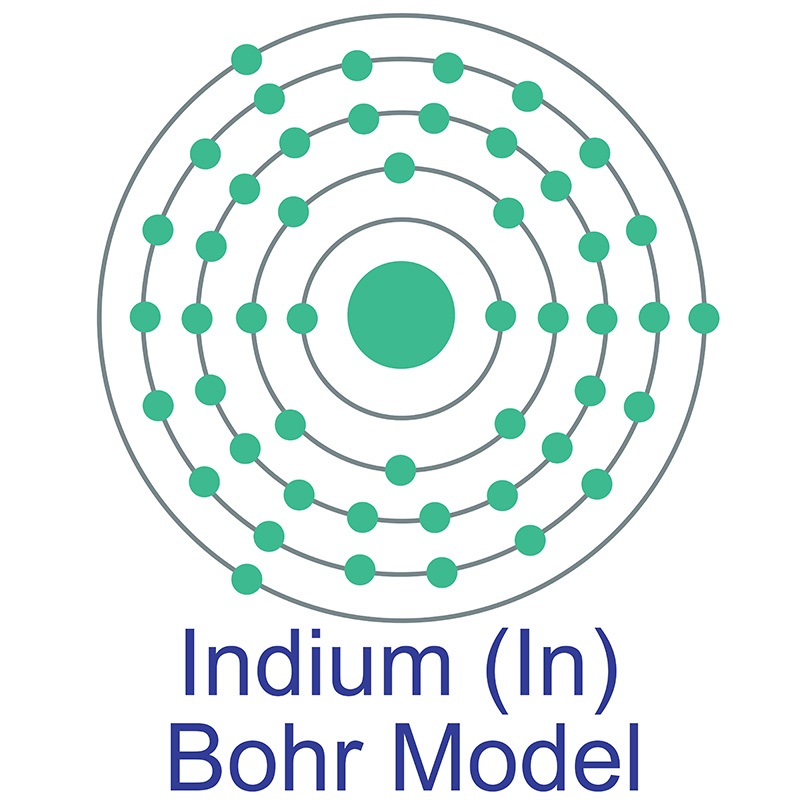
Indium is a Block P, Group 13, Period 5 element. The number of electrons in each of Indium's shells is 2, 8, 18, 18, 3 and its electronic configuration is [Kr] 4d10 5s2 5p1. In its elemental form indium's CAS number is 7440-74-6. The indium atom has a radius of 162.6.pm and it's Van der Waals radius is 193.pm. Indium is only slightly toxic. Indium has found application in semi-conductor materials and other electronic applications. It is used to make low-melting alloys, such as an alloy of 24% indium - 76% Indium is liquid at room temperature. It is used in making bearing alloys, germanium transistors, rectifiers, and photoconductors. It can be plated onto metal and evaporated onto glass, forming a mirror as good as that made with silver but with more resistance to atmospheric corrosion. Indium is available as metal and compounds with purities from 99% to 99.9999% (ACS grade to ultra-high purity); metals in the form of foil, sputtering target, and rod, and compounds as submicron and nanopowder. Indium is also used in various metal alloys (See AE Alloys). Indium was first discovered by Ferdinand Reich in 1863. See Indium research below.
Zirconium is a Block D, Group 4, Period 5 element. The number of electrons in each of Zirconium's shells is 2, 8, 18, 10, 2 and its electronic configuration is [Kr] 4d2 5s2. In its elemental form zirconium's CAS number is 7440-67-7. The zirconium atom has a radius of 159.pm and it's Van der Waals radius is 200.pm. Zirconium is non-toxic. Zirconium is primarily used in it's oxide or zirconia form. Zirconium dioxide has a high melting point (2,700° C) and a low thermal conductivity. Its polymorphism, however, restricts its widespread use in ceramic industry. During a heating process, zirconia will undergo a phase transformation process. The change in volume associated with this transformation makes the usage of pure zirconia in many applications impossible. Addition of some oxides, such as CaO, MgO, and Y2O3, into the zirconia structure in a certain degree results in a solid solution, which is a cubic form and has no phase transformation during heating and cooling. This solid solution material is termed as stabilized zirconia, a valuable refractory. Stabilized zirconia is used as a grinding media and engineering ceramics due to its increased hardness and high thermal shock resistivity. Stabilized zirconia is also used in applications such as oxygen sensors and solid oxide fuel cells due to its high oxygen ion conductivity.Zirconium was first discovered by William Gregor in 1791. The name Zirconium originated from the Persian word 'zargun' meaning gold color or gold-like. See Zirconium research below.
PACKAGING SPECIFICATIONS FOR BULK & RESEARCH QUANTITIES
Typical bulk packaging includes palletized plastic 5 gallon/25 kg. pails, fiber and steel drums to 1 ton super sacks in full container (FCL) or truck load (T/L) quantities. Research and sample quantities and hygroscopic, oxidizing or other air sensitive materials may be packaged under argon or vacuum. Shipping documentation includes a Certificate of Analysis and Material Safety Data Sheet (MSDS). Solutions are packaged in polypropylene, plastic or glass jars up to palletized 440 gallon liquid totes.
Diastereoselective indium-mediated allylation of N-tert-butanesulfinyl ketimines: easy access to asymmetric quaternary stereocenters bearing nitrogen atoms.
Sirvent JA, Foubelo F, Yus M.
Chem Commun (Camb). 2012 Jan 26. [Epub ahead of print]
PMID:
22281839
[PubMed - as supplied by publisher]
Focusing on Energy and Optoelectronic Applications: A Journey for Graphene and Graphene Oxide at Large Scale.
Wan X, Huang Y, Chen Y.
Acc Chem Res. 2012 Jan 26. [Epub ahead of print]
PMID:
22280410
[PubMed - as supplied by publisher]
A Wheel-Shaped Indium-Telluride Nanocluster [In(18)Te(30)(dach)(6)](6-): Its Formation and Structure.
Wang YH, Luo W, Jiang JB, Bian GQ, Zhu QY, Dai J.
Inorg Chem. 2012 Jan 26. [Epub ahead of print]
PMID:
22279965
[PubMed - as supplied by publisher]
Distribution of Cell-Free and Cell-Associated HIV Surrogates in the Female Genital Tract After Simulated Vaginal Intercourse.
Louissaint NA, Fuchs EJ, Bakshi RP, Nimmagadda S, Du Y, Macura KJ, King KE, Wahl R, Goldsmith AJ, Caffo B, Cao YJ, Anderson J, Hendrix CW.
J Infect Dis. 2012 Jan 25. [Epub ahead of print]
PMID:
22279121
[PubMed - as supplied by publisher]
Visible to near-infrared light harvesting in Ag(2)S nanoparticles/ZnO nanowire array photoanodes.
Wu JJ, Chang RC, Chen DW, Wu CT.
Nanoscale. 2012 Jan 26. [Epub ahead of print]
PMID:
22278401
[PubMed - as supplied by publisher]
Enhancement of light extraction in GaN-based light-emitting diodes using rough beveled ZnO nanocone arrays.
Yin Z, Liu X, Wu Y, Hao X, Xu X.
Opt Express. 2012 Jan 16;20(2):1013-21. doi: 10.1364/OE.20.001013.
PMID:
22274448
[PubMed - in process]
MgO nano-facet embedded silver-based dielectric/metal/dielectric transparent electrode.
Kim S, Yu HK, Hong K, Kim K, Son JH, Lee I, Kim KB, Kim TY, Lee JL.
Opt Express. 2012 Jan 16;20(2):845-53. doi: 10.1364/OE.20.000845.
PMID:
22274430
[PubMed - in process]
Carrier dynamics in InN nanorod arrays.
Ahn H, Yu CC, Yu P, Tang J, Hong YL, Gwo S.
Opt Express. 2012 Jan 16;20(2):769-75. doi: 10.1364/OE.20.000769.
PMID:
22274422
[PubMed - in process]
Coherent and directional emission at 1.55 µm from PbSe colloidal quantum dot electroluminescent device on silicon.
Heo J, Jiang Z, Xu J, Bhattacharya P.
Opt Express. 2011 Dec 19;19(27):26394-8. doi: 10.1364/OE.19.026394.
PMID:
22274223
[PubMed - in process]
Transformation of Indium Nanoparticles to ß-Indium Sulfide: Digestive Ripening and Visible Light-Induced Photocatalytic Properties.
Cingarapu S, Ikenbbery MA, Hamal DB, Sorensen CM, Hohn K, Klabunde KJ.
Langmuir. 2012 Jan 24. [Epub ahead of print]
PMID:
22272650
[PubMed - as supplied by publisher]
Tailoring 3D-Single-Walled Carbon Nanotubes Anchored to Indium Tin Oxide for Natural Cellular Uptake and Intracellular Sensing.
Mendes PM, Rawson F, Jackson S, Yeung C.
Nano Lett. 2012 Jan 23. [Epub ahead of print]
PMID:
22268573
[PubMed - as supplied by publisher]
Vaginal distribution and retention of a multiparticulate drug delivery system, assessed by gamma scintigraphy and magnetic resonance imaging.
Mehta S, Verstraelen H, Peremans K, Villeirs G, Vermeire S, De Vos F, Mehuys E, Remon JP, Vervaet C.
Int J Pharm. 2012 Jan 13. [Epub ahead of print]
PMID:
22265911
[PubMed - as supplied by publisher]
Synthesis and characterization of InNbO(4) nanopowder for gas sensors.
Balamurugan C, Vijayakumar E, Subramania A.
Talanta. 2012 Jan 15;88:115-20. Epub 2011 Nov 26.
PMID:
22265476
[PubMed - in process]
Interfacial effects on the optical behavior of Ge:ITO and Ge:ZnO nanocomposite films.
Shih GH, Allen CG, Potter BG Jr.
Nanotechnology. 2012 Feb 24;23(7):075203. Epub 2012 Jan 20.
PMID:
22261039
[PubMed - in process]
Synthesis of Indium Borate and Its Application in Photodegradation of 4-Chlorophenol.
Yuan J, Wu Q, Zhang P, Yao J, He T, Cao Y.
Environ Sci Technol. 2012 Jan 19. [Epub ahead of print]
PMID:
22260653
[PubMed - as supplied by publisher]
Electrochromic Properties of a Metallo-Supramolecular Polymer Derived from Tetra(2-pyridyl-1,4-pyrazine) Ligands Integrated in Thin Multilayer Films.
da Silva CA, Vidotti M, Fiorito PA, Cordoba De Torresi SI, Torresi RM, Alves WA.
Langmuir. 2012 Jan 19. [Epub ahead of print]
PMID:
22260213
[PubMed - as supplied by publisher]
Bis-(µ-pyridine-2,3-dicarboxyl-ato)bis-[aqua-(3-carb-oxy-pyridine-2-carboxyl-ato)indium(III)] tetra-hydrate.
Eshtiagh-Hosseini H, Mirzaei M, Mousavinezhad A, Necas M, Mague JT.
Acta Crystallogr Sect E Struct Rep Online. 2012 Jan 1;68(Pt 1):m71-2. Epub 2011 Dec 21.
PMID:
22259367
[PubMed - in process]
Indium Tin Oxide devices for amperometric detection of vesicular release by single cells.
Meunier A, Fulcrand R, Darchen F, Guille Collignon M, Lemaître F, Amatore C.
Biophys Chem. 2011 Dec 24. [Epub ahead of print]
PMID:
22257976
[PubMed - as supplied by publisher]
A transparent µECoG array for simultaneous recording and optogenetic stimulation.
Ledochowitsch P, Olivero E, Blanche T, Maharbiz MM.
Conf Proc IEEE Eng Med Biol Soc. 2011 Aug;2011:2937-40.
PMID:
22254956
[PubMed - in process]
Flexible PET/ITO electrode array for implantable biomedical applications.
Ahani A, Saadati-Fard L, Sodagar AM, Boroumad FA.
Conf Proc IEEE Eng Med Biol Soc. 2011 Aug;2011:2878-81.
PMID:
22254942
[PubMed - in process]
Elution behavior of polyethylene and polypropylene standards on carbon sorbents.
Chitta R, Macko T, Brüll R, Kalies G.
J Chromatogr A. 2010 Oct 14. [Epub ahead of print]PMID: 21035809 [PubMed - as supplied by publisher]Related citations
Effect of Cyclic Impact Load on Shear Bond Strength of Zirconium Dioxide Ceramics.
Kawai N, Shinya A, Yokoyama D, Gomi H, Shinya A.
J Adhes Dent. 2010 Sep 28. doi: 10.3290/j.jad.a19471. [Epub ahead of print]PMID: 20978648 [PubMed - as supplied by publisher]Related citations
Differences in metal ion release following cobalt-chromium and oxidized zirconium total knee arthroplasty.
Garrett S, Jacobs N, Yates P, Smith A, Wood D.
Acta Orthop Belg. 2010 Aug;76(4):513-20.PMID: 20973359 [PubMed - indexed for MEDLINE]Related citations
DNA binding studies of new valine derived chiral complexes of tin(IV) and zirconium(IV).
Arjmand F, Jamsheera A.
Spectrochim Acta A Mol Biomol Spectrosc. 2010 Jun 12. [Epub ahead of print]PMID: 20965776 [PubMed - as supplied by publisher]Related citations
Influence of counter-ions on the self-assembly of ZrO(2) nanodisks.
Ji H, Liu X, Wang X, Yao X.
J Colloid Interface Sci. 2011 Jan 15;353(2):356-62. Epub 2010 Oct 16.PMID: 20951993 [PubMed - in process]Related citations
The interaction of osteoblasts with bone-implant materials: 1. the effect of physico-chemical surface properties of implant materials.
Kubies D, Himmlová L, Riedel T, Tresohlavá E, Balík K, Douderová M, Bártová J, Pesáková V.
Physiol Res. 2010 Oct 15. [Epub ahead of print]PMID: 20945966 [PubMed - as supplied by publisher]Free ArticleRelated citations
Fracture resistance of endodontically-treated teeth: effect of combination bleaching and an antioxidant.
Khoroushi M, Feiz A, Khodamoradi R.
Oper Dent. 2010 Sep-Oct;35(5):530-7.PMID: 20945744 [PubMed - indexed for MEDLINE]Related citations
Mechanism of catalytic cyclohydroamination by zirconium salicyloxazoline complexes.
Allan LE, Clarkson GJ, Fox DJ, Gott AL, Scott P.
J Am Chem Soc. 2010 Nov 3;132(43):15308-20.PMID: 20939579 [PubMed - in process]Related citations
Antibacterial properties of nine pure metals: a laboratory study using Staphylococcus aureus and Escherichia coli.
Yasuyuki M, Kunihiro K, Kurissery S, Kanavillil N, Sato Y, Kikuchi Y.
Biofouling. 2010 Oct;26(7):851-8.PMID: 20938849 [PubMed - in process]Related citations
One-Pot Preparation and Uranyl Adsorption Properties of Hierarchically Porous Zirconium Titanium Oxide Beads using Phase Separation Processes to Vary Macropore Morphology.
Drisko GL, Chee Kimling M, Scales N, Ide A, Sizgek E, Caruso RA, Luca V.
Langmuir. 2010 Nov 16;26(22):17581-8. Epub 2010 Oct 11.PMID: 20936801 [PubMed - in process]Related citations
Renewable high-octane gasoline by aqueous-phase hydrodeoxygenation of C5 and C6 carbohydrates over Pt/Zirconium phosphate catalysts.
Li N, Tompsett GA, Huber GW.
ChemSusChem. 2010 Oct 25;3(10):1154-7. No abstract available. PMID: 20936668 [PubMed - in process]Related citations
Can the method of fixation influence the wear behaviour of ZrN coated unicompartmental mobile knee prostheses?
Affatato S, Spinelli M, Lopomo N, Grupp TM, Marcacci M, Toni A.
Clin Biomech (Bristol, Avon). 2010 Oct 7. [Epub ahead of print]PMID: 20934240 [PubMed - as supplied by publisher]Related citations
Measurement of dissolved reactive phosphorus using the diffusive gradients in thin films technique with a high-capacity binding phase.
Ding S, Xu D, Sun Q, Yin H, Zhang C.
Environ Sci Technol. 2010 Nov 1;44(21):8169-74.PMID: 20886846 [PubMed - in process]Related citations
Raman microspectroscopy of organic inclusions in spodumenes from Nilaw (Nuristan, Afghanistan).
Weselucha-Birczynska A, Slowakiewicz M, Natkaniec-Nowak L, Proniewicz LM.
Spectrochim Acta A Mol Biomol Spectrosc. 2010 Sep 28. [Epub ahead of print]PMID: 20884283 [PubMed - as supplied by publisher]Related citations
Effect of thermocycling on the bond strength between dual-cured resin cements and zirconium-oxide ceramics.
D'Amario M, Campidoglio M, Morresi AL, Luciani L, Marchetti E, Baldi M.
J Oral Sci. 2010;52(3):425-30.PMID: 20881336 [PubMed - in process]Free ArticleRelated citations
Surface damages of zirconia by Nd:YAG dental laser irradiation.
Noda M, Okuda Y, Tsuruki J, Minesaki Y, Takenouchi Y, Ban S.
Dent Mater J. 2010 Oct 14;29(5):536-41. Epub 2010 Sep 18.PMID: 20877130 [PubMed - in process]Free ArticleRelated citations
Conjunctive and compromised data fusion schemes for identification of multiple notches in an aluminium plate using Lamb wave signals.
Lu Y, Ye L, Wang D, Wang X, Su Z.
IEEE Trans Ultrason Ferroelectr Freq Control. 2010 Sep;57(9):2005-16.PMID: 20875990 [PubMed - in process]Related citations
A new smile for Judy: a multimaterial approach.
Nash RW.
Dent Today. 2010 Aug;29(8):92, 94. No abstract available. PMID: 20873651 [PubMed - indexed for MEDLINE]Related citations
Matched-pair total knee arthroplasty retrieval analysis: Oxidized zirconium vs. CoCrMo.
Heyse TJ, Chen DX, Kelly N, Boettner F, Wright TM, Haas SB.
Knee. 2010 Sep 22. [Epub ahead of print]PMID: 20869251 [PubMed - as supplied by publisher]Related citations
Surface modification of chromatography adsorbents by low temperature low pressure plasma.
Arpanaei A, Winther-Jensen B, Theodosiou E, Kingshott P, Hobley TJ, Thomas OR.
J Chromatogr A. 2010 Oct 29;1217(44):6905-16. Epub 2010 Sep 23.PMID: 20869062 [PubMed - in process]Related citations