About Potassium
At 2.4% by mass of the earth’s crust, potassium is the 7th most abundant element in the earth’s crust, present in seawater, most soils, and minerals such as orthoclase, sylvite, carnallite, kainite, and langbeinite. Elemental potassium is typical of the alkali metals: it is a waxy solid soft enough to be cut with a knife, initially silvery in appearance, but rapidly darkens when exposed to oxygen in the air. It is extremely reactive because of its high electropositivity and will explode violently in contact with water, quickly converting to potassium hydroxide and liberating hydrogen gas. Potassium is the second least dense element that is solid at room temperature (behind lithium), and it is one of only three elements (with sodium and lithium) capable of floating on hydrocarbon-based mineral oil. Though potassium is nontoxic, it is classified as a hazardous material because of its dangerous reaction with water. Additionally, naturally occurring potassium is composed of three isotopes, two stable and one radioactive, and as such it is the most common radioactive element present in the human body.
For centuries prior to the element’s discovery, humans had used potash (potassium carbonate) in glass, soaps, and other applications, obtaining the compound by leaching wood ashes. In 1807, Sir Humphry Davy isolated metallic potassium from molten potassium hydroxide (caustic potash) using electrolysis. The element derives its name from potash and its elemental symbol “K” from the neo-Latin kalium and the Arabic al-qalyah or qali, meaning “alkali.” Currently, pure potassium metal is often produced in a similar electrolytic reaction of sodium metal and potassium chloride. Potassium compounds such as potassium chloride (often referred to as potash, muriate of potash, or MOP in the mineral industry), hydroxide, nitrate, carbonate, chloride, bromide, iodide, and sulfate are abundant and easily extracted from deposits in ancient lakes and seabeds, making them extremely commercially viable for industrial use. These compounds are highly soluble and are components of many soaps and detergents, glass and ceramic glazes, stains, and dyes. Compounds like potassium nitrate are used in gunpowder and pyrotechnics to produce the violet color in fireworks. High purity potassium compounds have numerous pharmacological, medical, and electronics applications. Sodium and potassium alloys are useful as heat transfer mediums, desiccants, reducing agents, and can be used in nuclear reactors.
Potassium is essential to life: the uptake of potassium ions is one of the key mechanisms of the human body and as such, compounds are important dietary components and can be used in food additives such as baking powder (potassium sodium tartrate) and low-sodium salt substitutes. Plants utilize soil-based potassium as a nutrient, and one of the main commercial uses of potassium compounds such as chloride, sulfate, and nitrate is in the production of fertilizers.
Additionally, experiments with potassium have shed light on several potentially useful applications for the element in the field of high technology. Potassium-ion batteries are an experimental design based on lithium-ion technology that substitute ions of potassium for those of lithium and have shown to retain charge after nearly 40 times more cycles than a similar lithium-ion model. Researchers have constructed a negative temperature system by cooling potassium gas to one billionth of a degree below absolute zero, a highly unusual achievement that could allow for further study of quantum effects in practical applications such as superconductivity.
Products
 High purity potassium compounds have numerous pharmacological, medical, and electronics applications.
  Important compounds include the chloride (often referred to as potash, muriate of potash, or MOP in the mineral industry), hydroxide, nitrate, carbonate, chloride, bromide, iodide, and sulfate. Lower purity compounds are used in pyrotechnics for its violet color on ignition and in glass and ceramic glazes to produce this color. Potassium is also used as a nutrient in plant growth. Potassium is available as metal and compounds with purities from 99% to 99.999% (ACS grade to ultra-high purity).Elemental or metallic forms include pellets, wire and granules for evaporation source material purposes. Potassium oxide is available in powder and dense pellet form for such uses as optical coating and thin film applications. Oxides tend to be insoluble. Potassium fluoride is another insoluble form for uses in which oxygen is undesirable such as metallurgy, chemical and physical vapor deposition and in some optical coatings. Potassium is available in soluble forms including chlorides, nitrates and acetates. These compounds are also manufactured as solutions at specified stoichiometries.
Potassium Properties
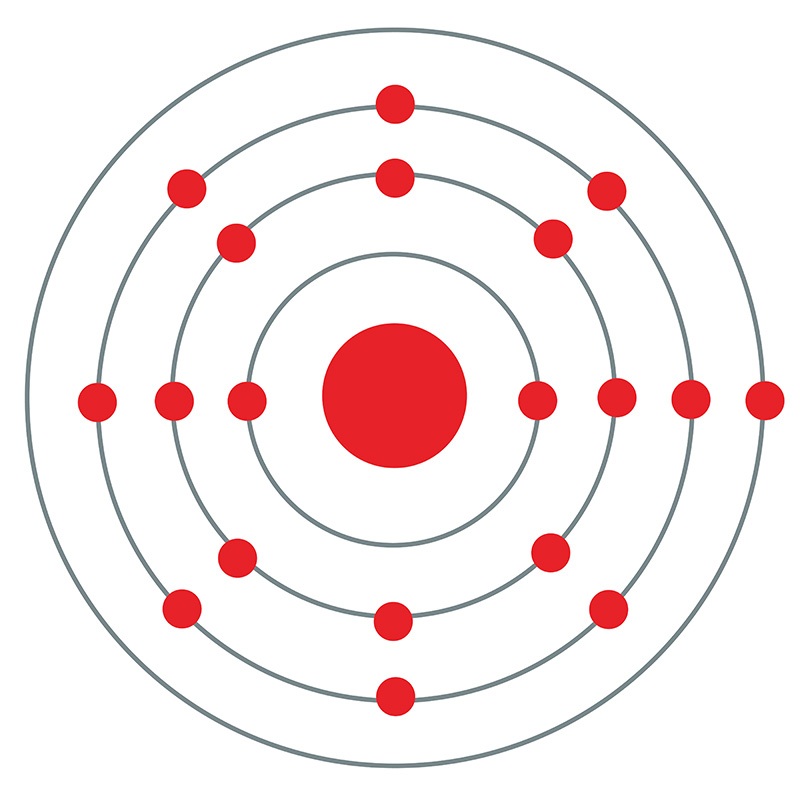
 Potassium is a Block S, Group 1, Period 4 element. The number of electrons in each of Potassium's shells is 2, 8, 8, 1 and its electron configuration is [Ar] 4s1.The potassium atom has a radius of 227.2 pm and its Van der Waals radius is 275 pm. In its elemental form, CAS 7440-09-7, potassium has a silvery gray appearance. Potassium is the seventh most abundant element on earth.
  It is one of the most reactive and electropositive of all metals and rapidly oxidizes.
 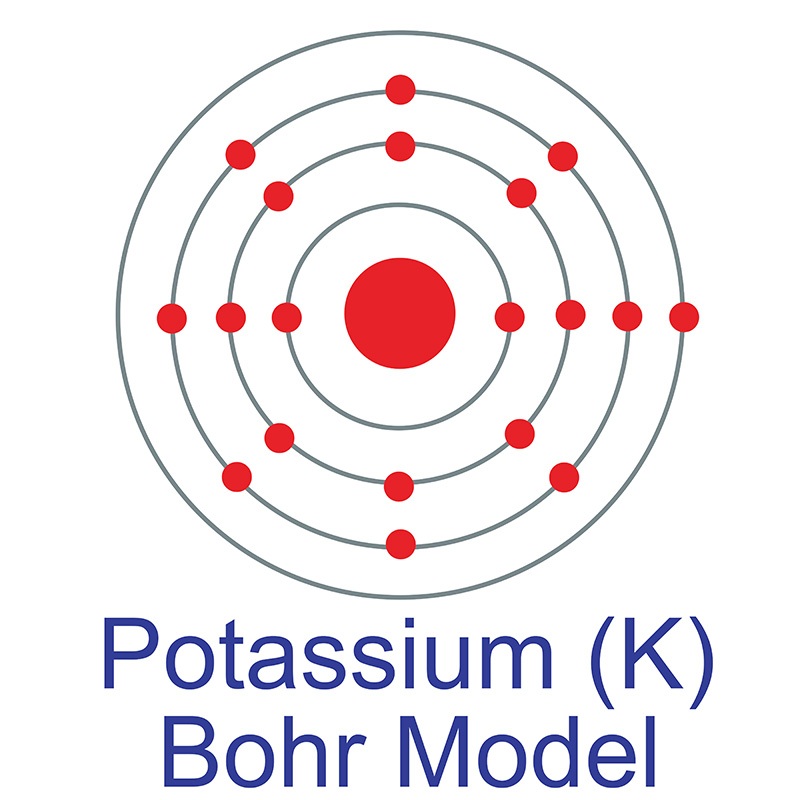 high purity properties, research, applications and other useful facts are discussed below. Scientific facts such as the atomic structure, ionization energy, abundance on earth, conductivity and thermal properties are also included.
Health, Safety & Transportation Information for Potassium
Potassium is not toxic in its elemental form; however, safety data for its compounds can vary widely depending on the form. For potential hazard information, toxicity, and road, sea and air transportation limitations, such as DOT Hazard Class, DOT Number, EU Number, NFPA Health rating and RTECS Class, please see the specific material or compound referenced in the Products tab. The below information applies to elemental (metallic) Potassium.
| Safety Data | |
|---|---|
| Signal Word | Danger |
| Hazard Statements | H260-H314 |
| Hazard Codes | F,C |
| Risk Codes | 14/15-34 |
| Safety Precautions | 8-43-45 |
| RTECS Number | N/A |
| Transport Information | UN 2257 4.3/PG 1 |
| WGK Germany | 1 |
| Globally Harmonized System of Classification and Labelling (GHS) |

 |
SECTION 1. IDENTIFICATION
Product Name: Potassium Metal
Product Number: All applicable American Elements product codes, e.g.K-M-02, K-M-03, K-M-04, K-M-05
CAS #: 7440-09-7
Relevant identified uses of the substance: Scientific research and development
Supplier details:
American Elements
1093 Broxton Ave. Suite 2000
Los Angeles, CA 90024
Tel: +1 310-208-0551
Fax: +1 310-208-0351
Emergency telephone number:
Domestic, North America +1 800-424-9300
International +1 703-527-3887
SECTION 2. HAZARDS IDENTIFICATION
Classification of the substance or mixture
GHS Classification in accordance with 29 CFR 1910 (OSHA HCS)
Substances and mixtures, which in contact with water, emit flammable gases(Category 1), H260
Skin corrosion(Category 1A), H314
Serious eye damage(Category 1), H318
Carcinogenicity(Category 1A), H350
For the full text of the H-Statements mentioned in this Section, see Section 16.
GHS Label elements, including precautionary statements
Pictogram


GHS02 GHS08 GHS05
Signal word
Danger
Hazard statement(s)
H260
In contact with water releases flammable gases which may ignite spontaneously.
H314
Causes severe skin burns and eye damage.
H318
Causes serious eye damage.
H350
May cause cancer.
Precautionary statement(s)
P201
Obtain special instructions before use.
P202
Do not handle until all safety precautions have been read and understood.
P223
Keep away from any possible contact with water, because of violent reaction and possible flash fire.
P231 + P232
Handle under inert gas. Protect from moisture.
P260
Do not breathe dust or mist.
P264
Wash skin thoroughly after handling.
P280
Wear protective gloves/ protective clothing/ eye protection/ face protection.
P281
Use personal protective equipment as required.
P301 + P330 + P331
IF SWALLOWED: Rinse mouth. Do NOT induce vomiting.
P303 + P361 + P353
IF ON SKIN (or hair): Remove/ Take off immediately all contaminated clothing. Rinse skin with water/ shower.
P304 + P340 + P310
IF INHALED: Remove victim to fresh air and keep at rest in a position comfortable for breathing. Immediately call a POISON CENTER or doctor/ physician.
P305 + P351 + P338 + P310
IF IN EYES: Rinse cautiously with water for several minutes. Remove contact lenses, if present and easy to do. Continue rinsing. Immediately call a POISON CENTER or doctor/ physician.
P308 + P313
IF exposed or concerned: Get medical advice/ attention.
P335 + P334
Brush off loose particles from skin. Immerse in cool water/ wrap in wet bandages.
P363
Wash contaminated clothing before reuse.
P370 + P378
In case of fire: Use dry sand, dry chemical or alcohol-resistant foam for extinction.
P402 + P404
Store in a dry place. Store in a closed container.
P405
Store locked up.
P501
Dispose of contents/ container to an approved waste disposal plant.
Hazards not otherwise classified (HNOC) or not covered by GHS
Reacts violently with water.
May form explosive peroxides.
SECTION 3. COMPOSITION/INFORMATION ON INGREDIENTS
Formula: K
Molecular weight: 39.10 g/mol
Hazardous components
Component
Potassium
CAS-No.
7440-09-7
EC-No.
231-119-8
Index-No.
019-001-00-2
Classification
Water-react.1; Skin Corr.1A; Eye Dam.1; H260, H314
Concentration
>=90-<=100%
Paraffin oils
CAS-No.
8012-95-1
EC-No.
232-384-2
Classification
Carc.1A; H350
Concentration
>=1-<5%
For the full text of the H-Statements mentioned in this Section, see Section 16.
SECTION 4. FIRST AID MEASURES
Description of first aid measures
General advice
Consult a physician. Show this safety data sheet to the doctor in attendance.
Move out of dangerous area.
If inhaled
If breathed in, move person into fresh air. If not breathing, give artificial respiration. Consult a physician.
In case of skin contact
Take off contaminated clothing and shoes immediately. Wash off with soap and plenty of water. Consult a physician.
In case of eye contact
Rinse thoroughly with plenty of water for at least 15 minutes and consult a physician.
Continue rinsing eyes during transport to hospital.
If swallowed
Do NOT induce vomiting. Never give anything by mouth to an unconscious person. Rinse mouth with water. Consult a physician.
Most important symptoms and effects, both acute and delayed
The most important known symptoms and effects are described in the labelling (see section 2) and/or in section 11
Indication of any immediate medical attention and special treatment needed
No data available
SECTION 5. FIREFIGHTING MEASURES
Extinguishing media
Suitable extinguishing media
Dry powder
Special hazards arising from the substance or mixture
Carbon oxides, Potassium oxides
Advice for firefighters
Wear self-contained breathing apparatus for firefighting if necessary.
Further information
No data available
SECTION 6. ACCIDENTAL RELEASE MEASURES
Personal precautions, protective equipment and emergency procedures
Use personal protective equipment. Avoid dust formation. Avoid breathing vapours, mist or gas. Ensure adequate ventilation. Evacuate personnel to safe areas. Avoid breathing dust.
For personal protection see section 8.
Environmental precautions
Prevent further leakage or spillage if safe to do so. Do not let product enter drains.
Methods and materials for containment and cleaning up
Sweep up and shovel. Contain spillage, and then collect with an electrically protected vacuum cleaner or by wet-brushing and place in container for disposal according to local regulations (see section 13). Do not flush with water.
Keep in suitable, closed containers for disposal.
Reference to other sections
For disposal see section 13.
SECTION 7. HANDLING AND STORAGE
Precautions for safe handling
Avoid formation of dust and aerosols.
Further processing of solid materials may result in the formation of combustible dusts. The potential for combustible dust formation should be taken into consideration before additional processing occurs.
Provide appropriate exhaust ventilation at places where dust is formed.Keep away from sources of ignition -No smoking.
For precautions see section 2.
Conditions for safe storage, including any incompatibilities
Keep container tightly closed in a dry and well-ventilated place.
Never allow product to get in contact with water during storage.
Handle and store under inert gas.
Storage class (TRGS 510):Hazardous materials, which set free flammable gases upon contact with water
Specific end use(s)
Apart from the uses mentioned in section 1 no other specific uses are stipulated
SECTION 8. EXPOSURE CONTROLS/PERSONAL PROTECTION
Additional information about design of technical systems:
Properly operating chemical fume hood designed for hazardous chemicals and having an average face velocity of at least 100 feet per minute.
Control parameters
Components with limit values that require monitoring at the workplace:
The product does not contain any relevant quantities of materials with critical values that have to be monitored at the workplace.
Additional information:
No data
Exposure controls
Personal protective equipment
General protective and hygienic measures
The usual precautionary measures for handling chemicals should be followed.
Keep away from foodstuffs, beverages and feed.
Remove all soiled and contaminated clothing immediately.
Wash hands before breaks and at the end of work.
Avoid contact with the eyes and skin.
SECTION 9. PHYSICAL AND CHEMICAL PROPERTIES
Information on basic physical and chemical properties
Appearance
Form: Solid
Colour: grey
Odour
No data available
Odour Threshold
No data available
pH
No data available
Melting point/freezing point
Melting point/range: 64 °C (147 °F)
Initial boiling point and boiling range
774 °C (1,425 °F) at 1,013 hPa (760 mmHg)
Flash point
No data available
Evaporation rate
No data available
Flammability (solid, gas)
No data available
Upper/lower flammability or explosive limits
No data available
Vapour pressure
0.12 hPa (0.09 mmHg) at 260 °C (500 °F)
Vapour density
No data available
Relative density
0.860 g/cm3
Water solubility
No data available
Partition coefficient: n-octanol/water
No data available
Auto-ignition temperature
No data available
Decomposition temperature
No data available
Viscosity
No data available
Explosive properties
No data available
Oxidizing properties
No data available
Other safety information
No data available
SECTION 10. STABILITY AND REACTIVITY
Reactivity
No data available
Chemical stability
Stable under recommended storage conditions.
Possibility of hazardous reactions
Reacts violently with water.
Conditions to avoid
Exposure to moisture
Incompatible materials
Oxidizing agents, Strong oxidizing agents, Carbon oxides, Reacts violently with water., Reacts with water to generate Hydrogen gas.
Hazardous decomposition products
Other decomposition products-No data available
In the event of fire: see section 5
SECTION 11. TOXICOLOGICAL INFORMATION
Information on toxicological effects
Acute toxicity
No data available
Inhalation: No data available
Dermal: No data available
No data available
Skin corrosion/irritation
No data available
Serious eye damage/eye irritation
No data available
Respiratory or skin sensitisation
No data available
Germ cell mutagenicity
No data available
Carcinogenicity
IARC:
1-Group 1: Carcinogenic to humans(Paraffin oils)
NTP:
Known to be human carcinogen
The reference note has been added by TD based on the background information of the NTP.
(Paraffin oils)
OSHA:
No component of this product present at levels greater than or equal to 0.1% is identified as a
carcinogen or potential carcinogen by OSHA.
Reproductive toxicity
No data available
No data available
Specific target organ toxicity -single exposure
No data available
Specific target organ toxicity -repeated exposure
No data available
Aspiration hazard
No data available
Additional Information
RTECS: Not available
Material is extremely destructive to tissue of the mucous membranes and upper respiratory tract, eyes, and skin., spasm, inflammation and edema of the larynx, spasm, inflammation and edema of the bronchi, pneumonitis, pulmonary edema, burning sensation, Cough, wheezing, laryngitis, Shortness of breath, Headache, Nausea
SECTION 12. ECOLOGICAL INFORMATION
Toxicity
No data available
Persistence and degradability
No data available
Bioaccumulative potential
No data available
Mobility in soil
No data available
Results of PBT and vPvB assessment
PBT/vPvB assessment not available as chemical safety assessment not required/not conducted
Other adverse effects
No data available
SECTION 13. DISPOSAL CONSIDERATIONS
Waste treatment methods
Product
Burn in a chemical incinerator equipped with an afterburner and scrubber but exert extra care in igniting as this material is highly flammable.
Offer surplus and non-recyclable solutions to a licensed disposal company.
Contact a licensed professional waste disposal service to dispose of this material.
Dissolve or mix the material with a combustible solvent and burn in a chemical incinerator equipped with an afterburner and scrubber.
Contaminated packaging
Dispose of as unused product.
SECTION 14. TRANSPORT INFORMATION
DOT (US)
UN number: 2257
Class: 4.3
Packing group: I
Proper shipping name: Potassium
Reportable Quantity (RQ):
Poison Inhalation Hazard: No
IMDG
UN number: 2257
Class: 4.3
Packing group: I
EMS-No: F-G, S-N
Proper shipping name: POTASSIUM
IATA
UN number: 2257
Class: 4.3
Packing group: I
Proper shipping name: Potassium
IATA Passenger: Not permitted for transport
SECTION 15. REGULATORY INFORMATION
SARA 302 Components
No chemicals in this material are subject to the reporting requirements of SARA Title III, Section 302.
SARA 313 Components
This material does not contain any chemical components with known CAS numbers that exceed the threshold (De Minimis) reporting levels established by SARA Title III, Section 313.
SARA 311/312 Hazards
Reactivity Hazard, Acute Health Hazard, Chronic Health Hazard
Massachusetts Right To Know Components
Potassium
CAS-No.
7440-09-7
Revision Date
1993-04-24
Paraffin oils
8012-95-1
2007-03-01
Pennsylvania Right To Know Components
Potassium
CAS-No.
7440-09-7
Revision Date
1993-04-24
Paraffin oils
8012-95-1
2007-03-01
New Jersey Right To Know Components
Potassium
CAS-No.
7440-09-7
Revision Date
1993-04-24
Paraffin oils
8012-95-1
2007-03-01
California Prop. 65 Components
WARNING! This product contains a chemical known to the State of California to cause cancer.
Paraffin oils
16. OTHER INFORMATION
Safety Data Sheet according to Regulation (EC) No. 1907/2006 (REACH).The above information is believed to be correct but does not purport to be all inclusive and shall be used only as a guide. The information in this document is based on the present state of our knowledge and is applicable to the product with regard to appropriate safety precautions. It does not represent any guarantee of the properties of the product.American Elements shall not be held liable for any damage resulting from handling or from contact with the above product. See reverse side of invoice or packing slip for additional terms and conditions of sale.COPYRIGHT 1997-2016 AMERICAN ELEMENTS. LICENSED GRANTED TO MAKE UNLIMITED PAPER COPIES FOR INTERNAL USE ONLY.
Potassium Isotopes
Potassium (K) has 25 isotopes ranging from 32K to 56K. Three of these occur naturally: 39K (93.3%), 41K (6.7%), and 40K (0.012%).
| Nuclide | Isotopic Mass | Half-Life | Mode of Decay | Nuclear Spin | Magnetic Moment | Binding Energy (MeV) | Natural Abundance (% by atom) |
|---|---|---|---|---|---|---|---|
| 32K | 32.02192(54)# | Unknown | p to 31Ar | 1+# | N/A | 217.64 | - |
| 33K | 33.00726(21)# | <25 ns | p to 32Ar | (3/2+)# | N/A | 238.76 | - |
| 34K | 33.99841(32)# | <40 ns | p to 33Ar | 1+# | N/A | 255.22 | - |
| 35K | 34.988010(21) | 178(8) ms | ß- to 35Ar; ß- + p to 33Cl | 3/2+ | N/A | 272.62 | - |
| 36K | 35.981292(8) | 342(2) ms | ß- to 36Ar; ß- + p to 35Cl; ß- + a to 32S | 2+ | N/A | 287.22 | - |
| 37K | 36.97337589(10) | 1.226(7) s | EC to 37Ar | 3/2+ | 0.2032 | 302.75 | - |
| 38K | 37.9690812(5) | 7.636(18) min | EC to 38Ar | 3+ | 1.37 | 314.55 | - |
| 39K | 38.96370668(20) | STABLE | - | 3/2+ | 0.3914658 | 328.22 | 93.2581 |
| 40K | 39.96399848(21) | 1.248(3)E+9 y | EC to 40Ar | 4- | -1.298099 | 336.3 | 0.0117 |
| 41K | 40.96182576(21) | STABLE | - | 3/2+ | 0.2148699 | 346.24 | 6.7302 |
| 42K | 41.96240281(24) | 12.360(12) h | ß- to 42Ca | 2- | -1.1425 | 353.39 | - |
| 43K | 42.960716(10) | 22.3(1) h | ß- to 43Ca | 3/2+ | 0.163 | 363.33 | - |
| 44K | 43.96156(4) | 22.13(19) min | ß- to 44Ca | 2- | -0.856 | 370.48 | - |
| 45K | 44.960699(11) | 17.3(6) min | ß- to 45Ca | 3/2+ | 0.1734 | 379.49 | - |
| 46K | 45.961977(17) | 105(10) s | ß- to 46Ca | 2(-) | -1.05 | 386.63 | - |
| 47K | 46.961678(9) | 17.50(24) s | ß- to 47Ca | 1/2+ | 1.93 | 394.71 | - |
| 48K | 47.965514(26) | 6.8(2) s | ß- to 48Ca;ß- + n to 47Ca | (2-) | N/A | 399.07 | - |
| 49K | 48.96745(8) | 1.26(5) s | ß- to 49Ca;ß- + n to 48Ca | (3/2+) | N/A | 405.28 | - |
| 50K | 49.97278(30) | 472(4) ms | ß- to 50Ca;ß- + n to 49Ca | (0-,1,2-) | N/A | 408.7 | - |
| 51K | 50.97638(54)# | 365(5) ms | ß- to 51Ca;ß- + n to 50Ca | 3/2+# | N/A | 413.05 | - |
| 52K | 51.98261(75)# | 105(5) ms | ß- + n to 51Ca; ß- + 2n to 50Ca; ß- to 52Ca | (2-)# | N/A | 415.54 | - |
| 53K | 52.98712(75)# | 30(5) ms | ß- + n to 52Ca; ß- + 2n to 51Ca; ß- to 53Ca | (3/2+)# | N/A | 418.96 | - |
| 54K | 53.99420(97)# | 10(5) ms | ß- to 54Ca;ß- + n to 53Ca | 2-# | N/A | 420.52 | - |
| 55K | 54.99971(107)# | 3# ms | ß- to 55Ca;ß- + n to 54Ca | 3/2+# | N/A | 423.94 | - |
| 56K | 56 | Unknown | Unknown | N/A | N/A | N/A | - |