American Elements produces to many standard grades when applicable, including Mil Spec (military grade); ACS, Reagent and Technical Grade; Food, Agricultural and Pharmaceutical Grade; Optical Grade, USP and EP/BP (European Pharmacopeia/British Pharmacopeia) and follows applicable ASTM testing standards.See safety data and research below and pricing/lead time above. American Elements specializes in producing high purity Molybdenum Silicon sputtering targets with the highest possible density and smallest possible average grain sizes for use in semiconductor, chemical vapor deposition (CVD) and physical vapor deposition (PVD) display and optical applications. Our standard Sputtering Targets for thin film are available monoblock or bonded with dimensions and configurations up to 820 mm with hole drill locations and threading, beveling, grooves and backing designed to work with both older sputtering devises as well as the latest process equipment, such as large area coating for solar energy or fuel cells and flip-chip applications. Research sized targets are also produced as well as custom sizes and alloys. All targets are analyzed using best demonstrated techniques including X-Ray Fluorescence (XRF), Glow Discharge Mass Spectrometry (GDMS), and Inductively Coupled Plasma (ICP). "Sputtering" allows for thin film deposition of an ultra high purity sputtering metallic or oxide material onto another solid substrate by the controlled removal and conversion of the target material into a directed gaseous/plasma phase through ionic bombardment. We can also provide targets outside this range in addition to just about any size rectangular, annular, or oval target. Materials are produced using crystallization, solid state and other ultra high purification processes such as sublimation. American Elements specializes in producing custom compositions for commercial and research applications and for new proprietary technologies. American Elements also casts any of the rare earth metals and most other advanced materials into rod, bar or plate form, as well as other machined shapes and through other processes such as nanoparticles (See also application discussion at Nanotechnology Information and at Quantum Dots) and in the form of solutions and organometallics. We also produce Molybdenum as disc, granules, ingot, pellets, pieces, powder, and rod. Other shapes are available by request.
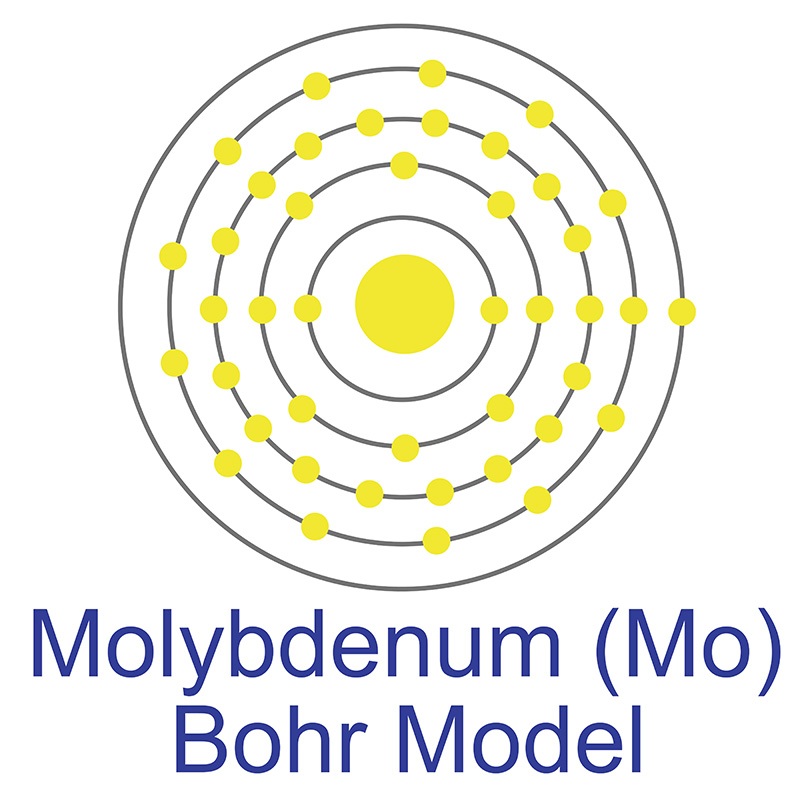
Molybdenum is a Block D, Group 6, Period 5 element. The number of electrons in each of Molybdenum's shells is 2, 8, 18, 13, 1 and its electronic configuration is [Kr] 4d5 5s1. In its elemental form molybdenum's CAS number is 7439-98-7. The molybdenum atom has a radius of 136.3.pm and it's Van der Waals radius is 200.pm. Molybdenum is toxic unless it is in small quantities. Molybdenum has the third highest melting point of any element, exceeded only by tungsten and tantalum. Molybdenum is a catalyst in the oil refining. It has many other applications, including in catalysts, pigments, corrosion inhibitors and lubricants. It has a very high elastic modulus. Molybdenum is available as metal and compounds with purities from 99% to 99.999% (ACS grade to ultra-high purity); metals in the form of foil, sputtering target, and rod, and compounds as submicron and nanopowder. It is used in steel alloys to add hardness and raise melting points. It is a component in Hastelloys brand steel. Molybdenum is used in nuclear reactors and aerospace components. Molybdenum was first discovered by Carl Wilhelm in 1778. The origin of the name Molybdenum comes from the Greek word molubdos meaning lead. See Molybdenum research below.
Silicon is a Block P, Group 14, Period 3 element. The number of electrons in each of Silicon's shells is 2, 8, 4 and its electronic configuration is [Ne] 3s2 3p2. In its elemental form silicon's CAS number is 7440-21-3. The silicon atom has a radius of 117.6.pm and it's Van der Waals radius is 210.pm. Silicon is not toxic but can cause chronic respiratory problems if inhaled as a fine silica or silicate dust. Asbestos silicates are carcinogenic. Silicon is one of man's most useful elements. It makes up 25.7% of the earth's crust, by weight, and is the second most abundant element, being exceeded only by oxygen. The Czochralski process is commonly used to produce single crystals of silicon used for solid-state or semiconductor devices. Silica, as sand, is a principal ingredient of glass, one of the most inexpensive of materials with excellent mechanical, optical, thermal, and electrical properties. Silicon is available as metal and compounds with purities from 99% to 99.9999% (ACS grade to ultra-high purity); metals in the form of foil, sputtering target, and rod, and compounds as submicron and nanopowder. Ultra high purity silicon can be doped with boron, gallium, phosphorus , or arsenic to produce silicon for use in transistors, solar cells, rectifiers, and other solid-state devices which are used extensively in the electronics and space-age industries. Hydrogenated amorphous silicon has shown promise in producing economical cells for converting solar energy into electricity. Silcones are important products of silicon. They range from liquids to hard, glasslike solids with many useful properties. Silicon was first discovered by Jons Berzelius in 1823. The name Silicon originates from the Latin word "silex" which means flint or hard stone. See Silicon research below.
PACKAGING SPECIFICATIONS FOR BULK & RESEARCH QUANTITIES
Typical bulk packaging includes palletized plastic 5 gallon/25 kg. pails, fiber and steel drums to 1 ton super sacks in full container (FCL) or truck load (T/L) quantities. Research and sample quantities and hygroscopic, oxidizing or other air sensitive materials may be packaged under argon or vacuum. Shipping documentation includes a Certificate of Analysis and Material Safety Data Sheet (MSDS). Solutions are packaged in polypropylene, plastic or glass jars up to palletized 440 gallon liquid totes.
Process development for the separation and recovery of Mo and Co from chloride leach liquors of petroleum refining catalyst by solvent extraction.
Banda R, Sohn SH, Lee MS.
J Hazard Mater. 2012 Jan 9. [Epub ahead of print]
PMID:
22336581
[PubMed - as supplied by publisher]
Selective cleavage of pepsin by molybdenum metallopeptidase.
Yenjai S, Malaikaew P, Liwporncharoenvong T, Buranaprapuk A.
Biochem Biophys Res Commun. 2012 Feb 5. [Epub ahead of print]
PMID:
22330807
[PubMed - as supplied by publisher]
Iminopyridine Complexes of Manganese, Rhenium, and Molybdenum Derived from Amino Ester Methylserine and Peptides Gly-Gly, Gly-Val, and Gly-Gly-Gly: Self-Assembly of the Peptide Chains.
Alvarez CM, García-Rodríguez R, Miguel D.
Inorg Chem. 2012 Feb 13. [Epub ahead of print]
PMID:
22329711
[PubMed - as supplied by publisher]
Low-Temperature, Solution-Processed MoO(x) for Efficient and Stable Organic Solar Cells.
Zilberberg K, Gharbi H, Behrendt A, Trost S, Riedl T.
ACS Appl Mater Interfaces. 2012 Feb 15. [Epub ahead of print]
PMID:
22324481
[PubMed - as supplied by publisher]
A molecular MoS? edge site mimic for catalytic hydrogen generation.
Karunadasa HI, Montalvo E, Sun Y, Majda M, Long JR, Chang CJ.
Science. 2012 Feb 10;335(6069):698-702.
PMID:
22323816
[PubMed - in process]
The use of total reflectance X-ray fluorescence (TXRF) for the determination of metals in the pharmaceutical industry.
Antosz FJ, Xiang Y, Diaz AR, Jensen AJ.
J Pharm Biomed Anal. 2012 Jan 16. [Epub ahead of print]
PMID:
22316622
[PubMed - as supplied by publisher]
Kinetic Resolution of Planar-Chiral (?(6) -Arene)Chromium Complexes by Molybdenum-Catalyzed Asymmetric Ring-Closing Metathesis.
Ogasawara M, Wu WY, Arae S, Watanabe S, Morita T, Takahashi T, Kamikawa K.
Angew Chem Int Ed Engl. 2012 Feb 3. doi: 10.1002/anie.201108292. [Epub ahead of print]
PMID:
22308166
[PubMed - as supplied by publisher]
Measurement of mass attenuation coefficients of Rhizophora spp. binderless particleboards in the 16.59-25.26keV photon energy range and their density profile using x-ray computed tomography.
Marashdeh MW, Bauk S, Tajuddin AA, Hashim R.
Appl Radiat Isot. 2012 Jan 20. [Epub ahead of print]
PMID:
22304963
[PubMed - as supplied by publisher]
Nitrite and Nitrite Reductases: From Molecular Mechanisms to Significance in Human Health and Disease.
Castiglione N, Rinaldo S, Giardina G, Stelitano V, Cutruzzolà F.
Antioxid Redox Signal. 2012 Feb 5. [Epub ahead of print]
PMID:
22304560
[PubMed - as supplied by publisher]
Molybdenum(vi) catalysts obtained from ?(3)-allyl dicarbonyl precursors: Synthesis, characterization and catalytic performance in cyclooctene epoxidation.
Gamelas CA, Gomes AC, Bruno SM, Almeida Paz FA, Valente AA, Pillinger M, Romão CC, Gonçalves IS.
Dalton Trans. 2012 Feb 2. [Epub ahead of print]
PMID:
22302175
[PubMed - as supplied by publisher]
Field-Effect Tunneling Transistor Based on Vertical Graphene Heterostructures.
Britnell L, Gorbachev RV, Jalil R, Belle BD, Schedin F, Mishchenko A, Georgiou T, Katsnelson MI, Eaves L, Morozov SV, Peres NM, Leist J, Geim AK, Novoselov KS, Ponomarenko LA.
Science. 2012 Feb 2. [Epub ahead of print]
PMID:
22300848
[PubMed - as supplied by publisher]
Spectroscopic reflectometry of mirror surfaces during plasma exposure.
Wisse M, Eren B, Marot L, Steiner R, Meyer E.
Rev Sci Instrum. 2012 Jan;83(1):013509.
PMID:
22299953
[PubMed - in process]
[Absorption characteristics of molybdenum by reed and cattail].
Lian JJ, Xu SG, Han CW.
Huan Jing Ke Xue. 2011 Nov;32(11):3335-40. Chinese.
PMID:
22295632
[PubMed - in process]
Conserved Signal Peptide Recognition Systems across the Prokaryotic Domains.
Coulthurst SJ, Dawson A, Hunter WN, Sargent F.
Biochemistry. 2012 Feb 13. [Epub ahead of print]
PMID:
22289056
[PubMed - as supplied by publisher]
Two methods can simultaneously display both intramuscular nerves and blood vessels.
Yu DZ, Liu AT, Zhang JL, Dang RS, Chen G, Liu BL, Han T, Yi J, Nagasao T, Jiang H.
Plast Reconstr Surg. 2012 Feb;129(2):401-11.
PMID:
22286423
[PubMed - in process]
Synthesis, characterization and biological activities of some new chromium molybdenum and tungsten complexes with 2,6-diaminopyridine.
Soliman AA, Ali SA, Marei AH, Nassar DH.
Spectrochim Acta A Mol Biomol Spectrosc. 2012 Apr;89:329-32. Epub 2011 Dec 30.
PMID:
22286054
[PubMed - in process]
Tuning the Photochromic Properties of Molybdenum Bisphosphonate Polyoxometalates.
El Moll H, Dolbecq A, Mbomekalle IM, Marrot J, Deniard P, Dessapt R, Mialane P.
Inorg Chem. 2012 Jan 27. [Epub ahead of print]
PMID:
22283587
[PubMed - as supplied by publisher]
In vivo evaluation of defined polished titanium surfaces to prevent soft tissue adhesion.
Hayes JS, Welton JL, Wieling R, Richards RG.
J Biomed Mater Res B Appl Biomater. 2012 Jan 27. doi: 10.1002/jbm.b.31967. [Epub ahead of print]
PMID:
22282225
[PubMed - as supplied by publisher]
Reaction dynamics of Mo + O(2) ? MoO + O studied by a crossed-beam velocity map imaging technique.
Honma K, Matsumoto Y.
J Chem Phys. 2012 Jan 21;136(3):034301.
PMID:
22280754
[PubMed - in process]
A new class of electrocatalysts for hydrogen production from water electrolysis: metal monolayers supported on low-cost transition metal carbides.
Esposito DV, Hunt ST, Kimmel YC, Chen JG.
J Am Chem Soc. 2012 Feb 15;134(6):3025-33. Epub 2012 Feb 1.
PMID:
22280370
[PubMed - in process]
Desymmetrization of 7-dimethylphenylsilylcycloheptatriene. Towards the synthesis of new aminocycloheptitols.
Girard E, Desvergnes V, Tarnus C, Landais Y.
Org Biomol Chem. 2010 Oct 13. [Epub ahead of print]PMID: 20941452 [PubMed - as supplied by publisher]Related citations
Enzyme-functionalized polymer brush films on the inner wall of silicon-glass microreactors with tunable biocatalytic activity.
Costantini F, Benetti EM, Reinhoudt DN, Huskens J, Vancso GJ, Verboom W.
Lab Chip. 2010 Oct 13. [Epub ahead of print]PMID: 20941436 [PubMed - as supplied by publisher]Related citations
Wavelength-tunable excited-state absorption and optical limiting effects in the Q band region based on silicon phthalocyanine oligomers.
Ishii K, Sakai N.
Phys Chem Chem Phys. 2010 Oct 13. [Epub ahead of print]PMID: 20941425 [PubMed - as supplied by publisher]Related citations
Role of near-field enhancement in plasmonic laser nanoablation using gold nanorods on a silicon substrate.
Harrison RK, Ben-Yakar A.
Opt Express. 2010 Oct 11;18(21):22556-71. doi: 10.1364/OE.18.022556.PMID: 20941153 [PubMed - in process]Related citations
Ultrafast all-optical modulator with femtojoule absorbed switching energy in silicon-on-insulator.
Schönenberger S, Stöferle T, Moll N, Mahrt RF, Dahlem MS, Wahlbrink T, Bolten J, Mollenhauer T, Kurz H, Offrein BJ.
Opt Express. 2010 Oct 11;18(21):22485-96. doi: 10.1364/OE.18.022485.PMID: 20941147 [PubMed - in process]Related citations
The observation of super-long range surface plasmon polaritons modes and its application as sensory devices.
Zhang XL, Song JF, Lo GQ, Kwong DL.
Opt Express. 2010 Oct 11;18(21):22462-70. doi: 10.1364/OE.18.022462.PMID: 20941145 [PubMed - in process]Related citations
Silicon photonic temperature sensor?employing a ring resonator manufactured?using a standard CMOS process.
Kim GD, Lee HS, Park CH, Lee SS, Lim BT, Bae HK, Lee WG.
Opt Express. 2010 Oct 11;18(21):22215-21. doi: 10.1364/OE.18.022215.PMID: 20941123 [PubMed - in process]Related citations
Highly efficient nonlinearity reduction in silicon-on-insulator waveguides using vertical slots.
Yue Y, Zhang L, Wang J, Beausoleil RG, Willner AE.
Opt Express. 2010 Oct 11;18(21):22061-6. doi: 10.1364/OE.18.022061.PMID: 20941107 [PubMed - in process]Related citations
Quantitative evaluation of boron-induced disorder in multilayers containing silicon nanocrystals in an oxide matrix designed for photovoltaic applications.
Zatryb G, Podhorodecki A, Hao XJ, Misiewicz J, Shen YS, Green MA.
Opt Express. 2010 Oct 11;18(21):22004-9. doi: 10.1364/OE.18.022004.PMID: 20941101 [PubMed - in process]Related citations
Discrete parametric band conversion in silicon for mid-infrared applications.
Tien EK, Huang Y, Gao S, Song Q, Qian F, Kalyoncu SK, Boyraz O.
Opt Express. 2010 Oct 11;18(21):21981-9. doi: 10.1364/OE.18.021981.PMID: 20941099 [PubMed - in process]Related citations
Split of surface plasmon resonance of gold nanoparticles on silicon substrate: a study of dielectric functions.
Zhu S, Chen TP, Cen ZH, Goh ES, Yu SF, Liu YC, Liu Y.
Opt Express. 2010 Oct 11;18(21):21926-31. doi: 10.1364/OE.18.021926.PMID: 20941092 [PubMed - in process]Related citations
Solution-processed photodetectors from colloidal silicon nano/micro particle composite.
Tu CC, Tang L, Huang J, Voutsas A, Lin LY.
Opt Express. 2010 Oct 11;18(21):21622-7. doi: 10.1364/OE.18.021622.PMID: 20941060 [PubMed - in process]Related citations
FDTD modeling of anisotropic nonlinear optical phenomena in silicon waveguides.
Dissanayake CM, Premaratne M, Rukhlenko ID, Agrawal GP.
Opt Express. 2010 Sep 27;18(20):21427-48. doi: 10.1364/OE.18.021427.PMID: 20941040 [PubMed - in process]Related citations
Multi-channel WDM RZ-to-NRZ format conversion at 50 Gbit/s based on single silicon microring resonator.
Ding Y, Peucheret C, Pu M, Zsigri B, Seoane J, Liu L, Xu J, Ou H, Zhang X, Huang D.
Opt Express. 2010 Sep 27;18(20):21121-30. doi: 10.1364/OE.18.021121.PMID: 20941008 [PubMed - in process]Related citations