American Elements Logo and U.S. Registered Trademark


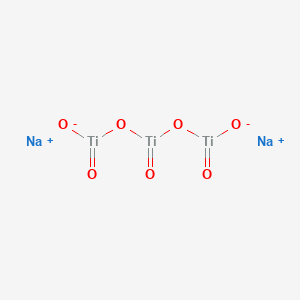
Sodium Metatitanate   
Na2Ti3O7
12034-36-5
Product Product Code Order or Specifications
(2N) 99% Sodium Metatitanate    TI-MN-02 Contact American Elements
(3N) 99.9% Sodium Metatitanate    TI-MN-03 Contact American Elements
(4N) 99.99% Sodium Metatitanate    TI-MN-04 Contact American Elements
(5N) 99.999% Sodium Metatitanate    TI-MN-05 Contact American Elements

Sodium Metatitanate is one of numerous organo-metallic compounds (also known as metalorganic, organo-inorganic and metallo-organic compounds) sold by American Elements under the tradename AE Organo-Metallics™ for uses requiring non-aqueous solubility such as recent solar energy and water treatment applications. Similar results can sometimes also be achieved with Nanoparticles (also see Nanotechnology and Quantum Dots) and by thin film deposition. Note American Elements additionally supplies many materials as solutions. Sodium Metatitanate is generally immediately available in most volumes. High purity, submicron and nanopowder forms may be considered. Additional technical, research and safety information is available.

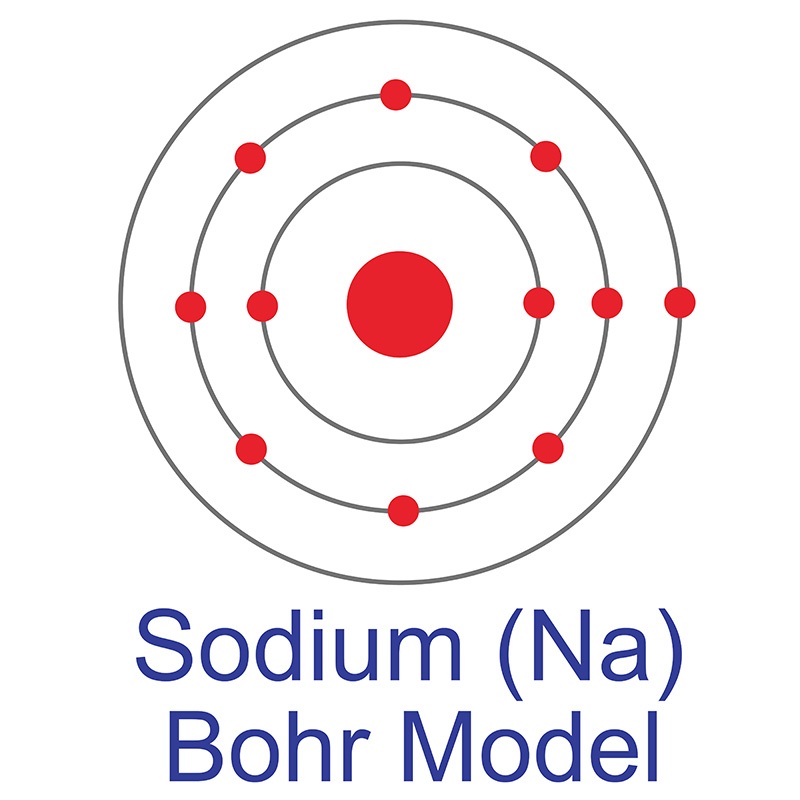
Sodium(Na) atomic and molecular weight, atomic number and elemental symbolSodium is a Block S, Group 1, Period 3 element. The number of electrons in each of Sodium's shells is 2, 8, 1 and its electronic configuration is [Ne] 3s1. In its elemental form sodium's CAS number is 7440-23-5. The sodium atom has a radius of 185.8.pm and it's Van der Waalsradius is 227.pm. Sodium is not toxic but skin contact may cause irritation and burns. Sodium is primarily used in its metallic form in the production of Sodium Bohr Modelchemical esters and in the manufacturing of various other organic compounds. The metal is used in the alloy of tin, nickel and copper for its structural characteristics. Sodium is availableas metal and compounds with purities from 99% to 99.9999% (ACS grade to ultra-high purity); metals in the form of foil, sputtering target, and rod, and compounds as submicron and nanopowder. High purity sodium compounds are used as reducing agents. Sodium compounds are used in low tech applications throughout industry. Sodium was first discovered by Sir Humphrey Davy in 1807. The name Sodium comes from the Latin word "natrium" which means sodium carbonate. See Sodium research below.

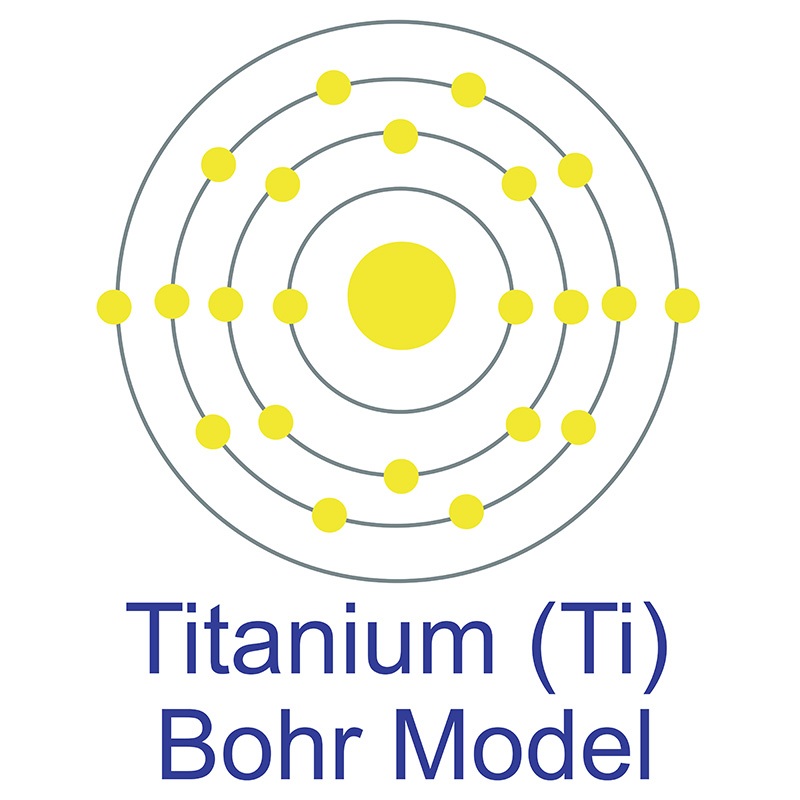
Titanium(Ti) atomic and molecular weight, atomic number and elemental symbolTitanium is a Block D, Group 4, Period 4 element. The number of electrons in each of Titanium's shells is 2, 8, 10, 2 and its electronic configuration is [Ar] 3d2 4s2. In its elemental form titanium's CAS number is 7440-32-6. The titanium atom has a radius of 144.8.pm and it's Van der Waals radius is 200.pm. Titanium metal is not considered to be toxic although titanium as metal shavings or powder is considered a fire hazard. In its metallic form it is not only very strong and light weight, but also highly resistant to corrosion. Thus it can be found in Elemental Titaniumnumerous aerospace and military applications. In its oxide form it used in low grades to produce a white pigment. Titanium is the bases for numerous commercially essential compound groups, such as Titanium Bohr Modeltitanium titanates in electronic and di-electric formulations and in crystal growth for ruby and sapphire lasers. Titanium information, including Technical Data, Safety Data and its high purity properties, research, applications and other useful facts are discussed here. Scientific facts such as the atomic structure, ionization energy , abundance on Earth, conductivity and thermal properties are included. Titanium was first discovered by William Gregor in 1791. Titanium was named after the word Titanos which is Greek for Titans. See Titanium research below.

Formula CAS No. Appearance Molecular Weight
Na2Ti3O7 12034-36-5   301.58
PRODUCT CATALOG Sodium Products Foil Submicron & Nanopowder Tolling Ultra High Purity Sputtering Target Crystal Growth Rod, Plate, Powder, etc. Home

Have a Question? Ask a Chemical Engineer or Material Scientist   Request an MSDS or Certificate of Analysis


Search by Material, Product Name, Product Code, CAS Number, Formula, Element, Anion, Form, EC Number, MDL Number or PubChem ID.
German   Korean   French   Japanese   Spanish   Chinese (Simplified)   Portuguese   Russian   Chinese (Taiwan)   Italian   Turkish   Polish   Dutch   Czech   Swedish   Hungarian   Danish   Hebrew

Production Catalog Available in 36 Countries & Languages

PACKAGING SPECIFICATIONS FOR BULK & RESEARCH QUANTITIES


Typical bulk packaging includes palletized plastic 5 gallon/25 kg. pails, fiber and steel drums to 1 ton super sacks in full container (FCL) or truck load (T/L) quantities. Research and sample quantities and hygroscopic, oxidizing or other air sensitive materials may be packaged under argon or vacuum. Shipping documentation includes a Certificate of Analysis and Material Safety Data Sheet (MSDS). Solutions are packaged in polypropylene, plastic or glass jars up to palletized 440 gallon liquid totes.


Show me more forms of Sodium
 

Customers for this product have also looked at:
Sodium Fluoride Sodium Chloride Sodium Oxide Sputtering Target Sodium Sulfate Sodium Oxide Powder
Sodium Nitrate Sodium Acetate Sodium 2 - Ethylhexanoate Sodium Tungstate Sodium Oxide
Sodium Oxide Nanopowder Sodium Oxide Pellets Sodium Cubes Gold(I) Sodium Cyanide Sodium Benzoate

Recent Research & Development for Sodium

  • Natural history of Christianson syndrome. Schroer RJ, Holden KR, Tarpey PS, Matheus MG, Griesemer DA, Friez MJ, Fan JZ, Simensen RJ, Strømme P, Stevenson RE, Stratton MR, Schwartz CE. Am J Med Genet A. 2010 Oct 14. [Epub ahead of print]PMID: 20949524 [PubMed - as supplied by publisher]Related citations

  • Prevention of Selenite-Induced Cataractogenesis by an Ethanolic Extract of Cineraria maritima: An Experimental Evaluation of the Traditional Eye Medication. Anitha TS, Annadurai T, Thomas PA, Geraldine P. Biol Trace Elem Res. 2010 Oct 15. [Epub ahead of print]PMID: 20949376 [PubMed - as supplied by publisher]Related citations

  • NMR of heparin API: investigation of unidentified signals in the USP-specified range of 2.12-3.00 ppm. Lee SE, Chess EK, Rabinow B, Ray GJ, Szabo CM, Melnick B, Miller RL, Nair LM, Moore EG. Anal Bioanal Chem. 2010 Oct 15. [Epub ahead of print]PMID: 20949261 [PubMed - as supplied by publisher]Related citations

  • Domain-based identification and analysis of glutamate receptor ion channels and their relatives in prokaryotes. Ger MF, Rendon G, Tilson JL, Jakobsson E. PLoS One. 2010 Oct 6;5(10). pii: e12827.PMID: 20949136 [PubMed - in process]Free PMC ArticleRelated citations

  • [Syndrome of Inappropriate Antidiuretic Hormone Secretion Following Adjuvant CDDP and 5-FU Administration in a Patient with Esophageal Carcinoma.] Horio T, Tsujimoto H, Akase T, Sakamoto N, Yaguchi Y, Hiraki S, Aiko S, Takechi H, Hase K, Maehara T. Gan To Kagaku Ryoho. 2010 Oct;37(10):1945-1948. Japanese. PMID: 20948261 [PubMed - as supplied by publisher]Related citations

  • [A Case of Esophageal Small Cell Carcinoma with Syndrome of Inappropriate Antidiuretic Hormone Secretion.] Kanzaki M, Muto Y, Yoshinouchi S, Maeda M, Miyoshi S, Teshima S. Gan To Kagaku Ryoho. 2010 Oct;37(10):1941-1944. Japanese. PMID: 20948260 [PubMed - as supplied by publisher]Related citations

  • Surgical Intrauterine Insemination with Cat Semen Cryopreserved with Orvus ES Paste or Sodium Lauryl Sulfate. Tsutsui T, Mizutani T, Matsubara Y, Toyonaga M, Oba H, Hori T. J Vet Med Sci. 2010 Oct 8. [Epub ahead of print]PMID: 20948170 [PubMed - as supplied by publisher]Free ArticleRelated citations

  • Sodium and Potassium Balance Depends on {alpha}ENaC Expression in Connecting Tubule. Christensen BM, Perrier R, Wang Q, Zuber AM, Maillard M, Mordasini D, Malsure S, Ronzaud C, Stehle JC, Rossier BC, Hummler E. J Am Soc Nephrol. 2010 Oct 14. [Epub ahead of print]PMID: 20947633 [PubMed - as supplied by publisher]Related citations

  • Is epidural analgesia necessary after video-assisted thoracoscopic lobectomy? Kamiyoshihara M, Nagashima T, Ibe T, Atsumi J, Shimizu K, Takeyoshi I. Asian Cardiovasc Thorac Ann. 2010 Oct;18(5):464-8.PMID: 20947601 [PubMed - in process]Related citations

  • Glucocorticoid-induced leucine zipper 1 stimulates the epithelial sodium channel by regulating serum- and glucocorticoid-induced kinase 1 stability and subcellular localization. Soundararajan R, Wang J, Melters D, Pearce D. J Biol Chem. 2010 Oct 14. [Epub ahead of print]PMID: 20947508 [PubMed - as supplied by publisher]Free ArticleRelated citations

  • Development and application of a validated HPLC method for the analysis of dissolution samples of levothyroxine sodium drug products. Collier JW, Shah RB, Bryant AR, Habib MJ, Khan MA, Faustino PJ. J Pharm Biomed Anal. 2010 Oct 12. [Epub ahead of print]PMID: 20947276 [PubMed - as supplied by publisher]Related citations

  • Critical flux and chemical cleaning-in-place during the long-term operation of a pilot-scale submerged membrane bioreactor for municipal wastewater treatment. Wei CH, Huang X, Ben Aim R, Yamamoto K, Amy G. Water Res. 2010 Oct 1. [Epub ahead of print]PMID: 20947121 [PubMed - as supplied by publisher]Related citations

  • Temporal Lobe Epilepsy Induces Intrinsic Alterations in Na Channel Gating in Layer II Medial Entorhinal Cortex Neurons. Hargus NJ, Merrick EC, Nigam A, Kalmar CL, Baheti AR, Bertram EH 3rd, Patel MK. Neurobiol Dis. 2010 Oct 11. [Epub ahead of print]PMID: 20946956 [PubMed - as supplied by publisher]Related citations

  • Treatment of euvolemic hyponatremia in the intensive care unit by urea. Decaux G, Andres C, Gankam Kengne F, Soupart A. Crit Care. 2010 Oct 14;14(5):R184. [Epub ahead of print]PMID: 20946646 [PubMed - as supplied by publisher]Related citations

  • Curcumin supplementation could improve diabetes-induced endothelial dysfunction associated with decreased vascular superoxide production and PKC inhibition. Rungseesantivanon S, Thenchaisri N, Ruangvejvorachai P, Patumraj S. BMC Complement Altern Med. 2010 Oct 14;10(1):57. [Epub ahead of print]PMID: 20946622 [PubMed - as supplied by publisher]Free ArticleRelated citations

  • Impaired sodium levels in the suprachiasmatic nucleus are associated with the formation of cardiovascular deficiency in sleep-deprived rats. Chang HM, Mai FD, Lei SL, Ling YC. J Anat. 2010 Oct 15. doi: 10.1111/j.1469-7580.2010.01312.x. [Epub ahead of print]PMID: 20946541 [PubMed - as supplied by publisher]Related citations

  • A seed high-lysine trait is negatively associated with the TCA cycle and slows down Arabidopsis seed germination. Angelovici R, Fait A, Fernie AR, Galili G. New Phytol. 2010 Oct 11. doi: 10.1111/j.1469-8137.2010.03478.x. [Epub ahead of print]PMID: 20946418 [PubMed - as supplied by publisher]Related citations

  • A Highly Accurate and Consistent Microfluidic Viscometer for Continuous Blood Viscosity Measurement. Kang YJ, Yoon SY, Lee KH, Yang S. Artif Organs. 2010 Oct 14. doi: 10.1111/j.1525-1594.2010.01078.x. [Epub ahead of print]PMID: 20946281 [PubMed - as supplied by publisher]Related citations

  • Comparative Study of Polymeric Stabilizers for Magnetite Nanoparticles Using ATRP. Golas PL, Louie S, Lowry GV, Matyjaszewski K, Tilton RD. Langmuir. 2010 Oct 14. [Epub ahead of print]PMID: 20945936 [PubMed - as supplied by publisher]Related citations

  • A Characterization of the Raman Modes in a J-Aggregate-Forming Dye: A Comparison between Theory and Experiment. Coles DM, Meijer AJ, Tsoi WC, Charlton MD, Kim JS, Lidzey DG. J Phys Chem A. 2010 Oct 14. [Epub ahead of print]PMID: 20945930 [PubMed - as supplied by publisher]Related citations


Customers for this product have also looked at:
Titanium Nanoparticles Titanium Pellets Titanium Sputtering Target Titanium(IV) Oxide Acetylacetonate Titanium Fluoride
Titanium Oxide Titanium Powder Titanium Bars Titanium Chloride Titanium Nickel Copper
Titanium Molybdenum Alloy Titanium Foil Titanium Oxide Pellets Titanium Metal Titanium Acetate


Recent Research & Development for Titanium

  • Anticancer efficacy enhancement and attenuation of side effects of doxorubicin with titanium dioxide nanoparticles. Chen Y, Wan Y, Wang Y, Zhang H, Jiao Z. Int J Nanomedicine. 2011;6:2321-6. Epub 2011 Oct 18. PMID: 22072869 [PubMed - in process]

  • Keyhole Cochlear Implantation: Current Status. Black B. Otol Neurotol. 2011 Nov 8. [Epub ahead of print] PMID: 22072266 [PubMed - as supplied by publisher]

  • Characterization of a hydroxyapatite sputtered film subject to hydrothermal treatment using FE-SEM and STEM. Ozeki K, Aoki H, Masuzawa T. Biomed Mater Eng. 2011 Jan 1;21(3):179-89. PMID: 22072082 [PubMed - in process]

  • In vitro evaluation of cytotoxicity of permanent prosthetic materials. Sabaliauskas V, Juciute R, Bukelskiene V, Rutkunas V, Trumpaite-Vanagiene R, Puriene A. Stomatologija. 2011;13(3):75-80. PMID: 22071414 [PubMed - in process]

  • Effect of ionic products of dicalcium silicate coating on osteoblast differentiation and collagen production via TGF-ß1 pathway. Li J, Wei L, Sun J, Guan G. J Biomater Appl. 2011 Nov 9. [Epub ahead of print] PMID: 22071351 [PubMed - as supplied by publisher]

  • Reconstruction of defects of maxillary sinus wall after removal of a huge odontogenic lesion using prebended 3D titanium-mesh and CAD/CAM technique - Methodology article - Stoetzer M, Rana M, Von See C, Eckardt AM, Gellrich NC. Head Face Med. 2011 Nov 9;7(1):21. [Epub ahead of print] PMID: 22070833 [PubMed - as supplied by publisher]

  • Total Synthesis of (-)-Virginiamycin M2: Application of Crotylsilanes Accessed by Enantioselective Rh(II) or Cu(I) Promoted Carbenoid Si-H Insertion. Wu J, Panek JS. J Org Chem. 2011 Nov 9. [Epub ahead of print] PMID: 22070230 [PubMed - as supplied by publisher]

  • Reduced stress shielding with limited micromotions using a carbon fibre composite biomimetic hip stem: a finite element model. Caouette C, Yahia LH, Bureau MN. Proc Inst Mech Eng H. 2011 Sep;225(9):907-19. PMID: 22070028 [PubMed - in process]

  • Numerical simulation of bone remodelling around dental implants. Ojeda J, Martínez-Reina J, García-Aznar JM, Domínguez J, Doblaré M. Proc Inst Mech Eng H. 2011 Sep;225(9):897-906. PMID: 22070027 [PubMed - in process]

  • [Application of titanium plate and Teflon patch in chest wall reconstruction after sternal. tumor resection]. Wu X, Chen M, Yu F. Zhongguo Xiu Fu Chong Jian Wai Ke Za Zhi. 2011 Oct;25(10):1224-6. Chinese. PMID: 22069979 [PubMed - in process]

  • Pediatric bony craniovertebral junction abnormalities: Institutional experience of 10 years. Kale SS, Ailawadhi P, Yerramneni VK, Chandra PS, Kumar R, Sharma BS, Mahapatra AK. J Pediatr Neurosci. 2011 Oct;6(Suppl 1):S91-5. PMID: 22069436 [PubMed]

  • Dietary Exposure Estimates of 14 Trace Elements in Xuanwei and Fuyuan, Two High Lung Cancer Incidence Areas in China. Zhang L, Lv J, Liao C. Biol Trace Elem Res. 2011 Nov 9. [Epub ahead of print] PMID: 22068732 [PubMed - as supplied by publisher]

  • Comparative approach to capture bacterial diversity of coastal waters. Na H, Kim OS, Yoon SH, Kim Y, Chun J. J Microbiol. 2011 Oct;49(5):729-40. Epub 2011 Nov 9. PMID: 22068488 [PubMed - in process]

  • Combined Use of Titanium Mesh and Resorbable PLLA-PGA Implant in the Treatment of Large Orbital Floor Fractures. Magana FG, Arzac RM, De Hilario Aviles L. J Craniofac Surg. 2011 Nov 5. [Epub ahead of print] PMID: 22067850 [PubMed - as supplied by publisher]

  • No improvement in long-term wear and revision rates with the second-generation Biomet cup (RingLoc) in young patients. Boesenach B, van der Heide HJ, Nelissen RG. Acta Orthop. 2011 Nov 9. [Epub ahead of print] PMID: 22066563 [PubMed - as supplied by publisher]

  • Clinical outcomes of TS-1 chemotherapy for advanced and recurrent gastric cancer. Lee SR, Kim HO, Yoo CH. J Korean Surg Soc. 2011 Sep;81(3):163-8. Epub 2011 Sep 26. PMID: 22066117 [PubMed]

  • Melanosis ilei induced by prolonged charcoal ingestion. Kim GM, Jun EJ, Kim YC, Park JM, Hong SI, Cheung DY, Kim JI, Lee YS. J Korean Surg Soc. 2011 Jul;81(1):66-9. Epub 2011 Jul 11. PMID: 22066103 [PubMed]

  • The mixed-valent titanium phosphate, Li(2)Ti(2)(PO(4))(3), dilithium dititanium(III/IV) tris-(orthophosphate). Kee Y, Lee SS, Yun H. Acta Crystallogr E Struct Rep Online. 2011 Sep 1;67(Pt 9):i49. Epub 2011 Aug 17. PMID: 22065701 [PubMed]

  • Transition from Anodic Titania Nanotubes to Nanowires: Arising from Nanotube Growth to Application in Dye-Sensitized Solar Cells. Sun L, Zhang S, Wang X, Sun XW, Ong DY, Wang X, Zhao D. Chemphyschem. 2011 Nov 7. doi: 10.1002/cphc.201100450. [Epub ahead of print] PMID: 22065460 [PubMed - as supplied by publisher]

  • Influence of metal ions on human lymphocytes and the generation of titanium-specific T-lymphocytes. Chan E, Cadosch D, Gautschi OP, Sprengel K, Filgueira L. J Appl Biomater Biomech. 2011 May-Aug;9(2):137-43. doi: 10.5301/JABB.2011.8567. PMID: 22065391 [PubMed - in process]


Material Safety Data Sheet
  • 1 Identification of substance

    • Product details

    • Trade name Titanium Ingot

  • 2 Composition/Data on components:

    • Chemical characterization:
                 Designation: (CAS#)                                        
      Titanium (CAS# 7440-45-1); 100%
    • Identification number(s):
    • EINECS Number: 231-154-9
  • 3 Hazards identification

    • Hazard designation: F Highly flammable
    • Information pertaining to particular dangers for man and environment
      R 11 Highly flammable.
      R 15 Contact with water liberates extremely flammable gases.
  • 4 First aid measures

    • After inhalation
      Supply fresh air. If required, provide artificial respiration. Keep patient warm. Consult doctor if symptoms persist.
      Seek immediate medical advice.
    • After skin contact
      Instantly wash with water and soap and rinse thoroughly.
      Seek immediate medical advice.
    • After eye contact
      Rinse opened eye for several minutes under running water. Then consult doctor.
    • After swallowing Seek immediate medical advice.
  • 5 Fire fighting measures

    • Suitable extinguishing agents
      Special powder for Oxide fires. Do not use water.
    • For safety reasons unsuitable extinguishing agents
      Water.
      Carbon dioxide
    • Protective equipment:
      Wear self-contained breathing apparatus.
      Wear full protective suit.
  • 6 Accidental release measures

    • Person-related safety precautions:
      Wear protective equipment. Keep unprotected persons away.
      Ensure adequate ventilation
      Keep away from ignition sources
    • Measures for environmental protection:
      Do not allow material to be released to the environment without proper governmental permits.
    • Measures for cleaning/collecting:
      Ensure adequate ventilation.
      Do not flush with water or aqueous cleansing agents
      Keep away from ignition sources.
    • Additional information:
      See Section 7 for information on safe handling
      See section 8 for information on personal protection equipment.
      See Section 13 for information on disposal.
  • 7 Handling and storage


    • Handling
    • Information for safe handling:
      Keep containers tightly sealed.
      Store in cool, dry place in tightly closed containers.
      Ensure good ventilation/exhaustion at the workplace.
    • Information about protection against explosions and fires:
      Keep ignition sources away - Do not smoke.
      Protect against electrostatic charges.

    • Storage
    • Requirements to be met by storerooms and containers:
      Store in cool location.
    • Information about storage in one common storage facility:
      Do not store together with oxidizing and acidic materials.
      Store away from water.
      Store away from air.
    • Further information about storage conditions:
      Keep container tightly sealed.
      Store in cool, dry conditions in well sealed containers.
  • 8 Exposure controls and personal protection

    • Additional information about design of technical systems:
      Properly operating chemical fume hood designed for hazardous chemicals and having an average face velocity of at least 100 feet per minute.

    • Components with critical values that require monitoring at the
      workplace:                                                             
      Not required.
    • Additional information: No data

    • Personal protective equipment
    • General protective and hygienic measures
      The usual precautionary measures should be adhered to in handling the chemicals.
      Keep away from foodstuffs, beverages and food.
      Instantly remove any soiled and impregnated garments.
      Wash hands during breaks and at the end of the work.
    • Breathing equipment: Use breathing protection with high concentrations.
    • Protection of hands: Impervious gloves
    • Eye protection:
      Safety glasses
      Full face protection
      Face protection
    • Body protection: Protective work clothing.
  • 9 Physical and chemical properties:

    • General Information

    • Form: Solid.
    • Colour: Grey
    • Smell: Odourless
    •   Value/Range  Unit    Method      
    • Change in condition
    • Melting point/Melting range:                   795 ° C
    • Boiling point/Boiling range:                  3468 ° C
    • Sublimation temperature / start:   Not determined

    • Flash point:                       Not applicable

    • Inflammability (solid, gaseous)    Highly flammable.
      Contact with water liberates extremely flammable gases.

    • Ignition temperature:              Not determined

    • Decomposition temperature:         Not determined

    • Critical values for explosion:
    • Lower:                             Not determined
    • Upper:                             Not determined

    • Steam pressure:                    Not determined

    • Density                at   20 ° C            6.67 g/cm³

    • Solubility in / Miscibility with
    • Water:                             Not determined
  • 10 Stability and reactivity

    • Thermal decomposition / conditions to be avoided:
      No decomposition if used and stored according to specifications.
    • Materials to be avoided:
      Water/moisture
      Acids
      Oxidizing agents
      Oxygen
    • Dangerous reactions:
      Contact with water releases flammable gases
      Reacts with moist air
      Contact with acids releases flammable gases
      Reacts with oxidizing agents
    • Dangerous products of decomposition: Oxide oxide
  • 11 Toxicological information

    • Acute toxicity:
    • Primary irritant effect:
    • on the skin: Irritant for skin and mucous membranes.
    • on the eye: Irritant effect.
    • Sensitization: No sensitizing effect known.
    • Additional toxicological information:
      To the best of our knowledge the acute and chronic toxicity of this substance is not fully known.
      No classification data on carcinogenic properties of this material is available from the EPA, IARC, NTP, OSHA or ACGIH.
  • 12 Ecological information:

    • General notes:
      Do not allow material to be released to the environment without proper governmental permits.
      Water hazard class 1 (Self-assessment): slightly hazardous for water.
      Do not allow undiluted product or large quantities of it to reach ground water, water bodies or sewage system.
  • 13 Disposal considerations


    • Product:
    • Recommendation
      Consult state, local or national regulations for proper disposal.
      Hand over to disposers of hazardous waste.
      Must be specially treated under adherence to official regulations.

    • Uncleaned packagings:
    • Recommendation:
      Disposal must be made according to official regulations.
  • 14 Transport information


    • Land transport ADR/RID and GGVS/GGVE (cross-border/domestic)
    • ADR/RID-GGVS/E Class:     4.1 (F3) Flammable solids.
    • Kemler Number:            40
    • UN-Number:                1333
    • Packaging group:          II
    • Label                     4.1
    • Designation of goods:     1333 Titanium

    • Maritime transport IMDG/GGVSea:
    • IMDG/GGVSea Class:        4.1
    • UN Number:                1333
    • Label                     4.1
    • Packaging group:          II
    • Correct technical name:   Titanium

    • Air transport ICAO-TI and IATA-DGR:
    • ICAO/IATA Class:          4.1
    • UN/ID Number:             1333
    • Label                     4.1
    • Packaging group:          II
    • Correct technical name:   Titanium
  • 15 Regulatory information


    • Designation according to EC guidelines:

    • Code letter and hazard designation of product: F Highly flammable

    • Risk phrases:
      11  Highly flammable.
      15  Contact with water liberates extremely flammable gases.

    • Safety phrases:
      7/8 Keep container tightly closed and dry.
      43  In case of fire, use Oxidelic extinguishing powder. Never use water.

    • National regulations

    • Information about limitation of use:
      For use only by technically qualified individuals.
      Employment restrictions concerning young persons must be observed.

    • Water hazard class:
      Water hazard class 1 (Self-assessment): slightly hazardous for water.
  • 16 Other information:

      Employers should use this information only as a supplement to other information gathered by them, and should make independent judgement of suitability of this information to ensure proper use and protect the health and safety of employees.  This information is furnished without warranty, and any use of the product not in conformance with this Material Safety Data Sheet, or in combination with any other product or process, is the responsibility of the user.
  •  


    USA Science & Engineering FestivalSponsors of the United States Science & Engineering Festival on April 28, 2012 in Washington D.C. Please join us and our customers & co-sponsors NASA, Lockheed Martin and the Department of Defense inspiring the next generation of scientists and engineers.


      Print this Page
    Periodic table of the elements science and academic information, elements and advanced materials data, scientific presentations and all pages, designs, concepts, logos, and color schemes herein are the copyrighted proprietary rights and intellectual property of American Elements. American Elements is a U.S. Registered Trademark. © 2001-2012. American Elements. All rights reserved.
    Learn Six Sigma


    American Elements is a copyrighted U.S. Trademark. All rights reserved.