SECTION 1. IDENTIFICATION
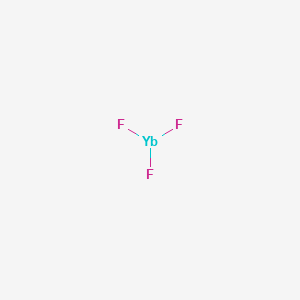
Product Name: Ytterbium Fluoride Sputtering Target
Product Number: All applicable American Elements product codes, e.g. YB-F-03ST
, YB-F-04ST
, YB-F-05ST
, YB-F-02-ST
CAS #: 13760-80-0
Relevant identified uses of the substance: Scientific research and development
Supplier details:
American Elements
10884 Weyburn Ave.
Los Angeles, CA 90024
Tel: +1 310-208-0551
Fax: +1 310-208-0351
Emergency telephone number:
Domestic, North America: +1 800-424-9300
International: +1 703-527-3887
SECTION 2. HAZARDS IDENTIFICATION
• Hazard description: Xn Harmful
• Information pertaining to particular dangers for man and environment
R 20/21/22 Harmful by inhalation, in contact with skin and if
swallowed.
R 36/37/38 Irritating to eyes, respiratory system and skin.
SECTION 3. COMPOSITION/INFORMATION ON INGREDIENTS
Chemical characterization:
Description:
(CAS#)
Ytterbium fluoride (CAS# 13860-80-0), 100%
• Identification number(s):
• EINECS Number: 237-354-2
SECTION 4. FIRST AID MEASURES
• If inhaled:
Supply patient with fresh air. If not breathing, provide artificial respiration. Keep patient warm. Consult doctor if symptoms persist.
Seek immediate medical advice.
• In case of skin contact:
Instantly wash with water and soap and rinse thoroughly.
Seek immediate medical advice.
Rub in Ca-gluconate solution or Ca-gluconate gel immediately.
• In case of eye contact:
Rinse opened eye for several minutes under running water. Then
consult doctor.
• If swallowed:
Seek immediate medical advice.
SECTION 5. FIREFIGHTING MEASURES
• Suitable extinguishing agents
Use fire fighting measures that suit the environment.
• Special hazards caused by the material, its products of combustion or flue gases:
Can be released in case of fire:
Hydrogen fluoride (HF)
• Protective equipment:
Wear self-contained breathing apparatus.
Wear full protective suit.
SECTION 6. ACCIDENTAL RELEASE MEASURES
• Person-related safety precautions:
Use personal protective equipment. Keep unprotected persons away.
Ensure adequate ventilation
• Measures for environmental protection:
Do not allow material to be released to the environment without official permits.
• Measures for cleaning/collecting:
Dispose of contaminated material as waste according to item 13.
Ensure adequate ventilation.
• Additional information:
See Section 7 for information on safe handling
See section 8 for information on personal protection equipment.
See Section 13 for information on disposal.
SECTION 7. HANDLING AND STORAGE
• Handling
• Information for safe handling:
Keep containers tightly sealed.
Store in cool, dry place in tightly closed containers.
Ensure good ventilation/exhaustion at the workplace.
• Information about protection against explosions and fires:
The product is not flammable
• Storage
• Requirements to be met by storerooms and containers:
No special requirements.
• Information about storage in one common storage facility:
Do not store together with acids.
• Further information about storage conditions:
Keep container tightly sealed.
Store in cool, dry conditions in well-sealed containers.
SECTION 8. EXPOSURE CONTROLS/PERSONAL PROTECTION
• Additional information about design of technical systems:
Properly operating chemical fume hood designed for hazardous chemicals and having an average face velocity of at least 100 feet per minute.
• Components with critical values that require monitoring at the workplace:
Fluorides (as F) mg/m3
ACGIH TLV 2.5
Austria TWA 2.5
Belgium TWA 2.5
Finland TWA 2.5
France TWA 2.5
Germany MAK 2.5
Hungary TWA 1; 2-STEL
Netherlands TWA 3.5
Norway TWA 0.6
Poland TWA 1; 3-STEL
Sweden NGV 2
Switzerland MAK-W 1.5
United Kingdom TWA 2.5
Russia TWA 2
Denmark TWA 2.5
USA PEL 2.5
• Additional information: No data
• Personal protective equipment
• General protective and hygienic measures
The usual precautionary measures should be adhered to in handling the chemicals.
Keep away from foodstuffs, beverages and food.
Instantly remove any soiled and impregnated garments.
Wash hands during breaks and at the end of the work.
Avoid contact with the eyes and skin.
• Breathing equipment: Use breathing protection with high concentrations.
• Protection of hands: Impervious gloves
• Eye protection:
Safety glasses
Face protection
• Body protection: Protective work clothing.
SECTION 9. PHYSICAL AND CHEMICAL PROPERTIES
• General Information
• Form: Crystalline
• Colour: White
• Smell: Odorless
• Value/Range Unit Method
• • Melting point/Melting range: 1157 ° C
• Boiling point/Boiling range: 2200 ° C
• Sublimation temperature / start: No data available
• Flash point: N/A
• Ignition temperature: No data available
• Decomposition temperature: No data available
• Danger of explosion: Product is not explosive.
• Critical values for explosion:
• Lower: No data available
• Upper: No data available
• Steam pressure: No data available
• Density: at 20°C 8.168 g/cm3
• Solubility in / Miscibility with
• Water: Insoluble
Not miscible or difficult to mix
SECTION 10. STABILITY AND REACTIVITY
• Thermal decomposition / conditions to be avoided:
No decomposition if used and stored according to specifications.
• Materials to be avoided: Acids
• Dangerous reactions: No dangerous reactions known
• Dangerous products of decomposition: Hydrogen fluoride
SECTION 11. TOXICOLOGICAL INFORMATION
• Acute toxicity:
• Primary irritant effect:
• on the skin: Irritant for skin and mucous membranes.
• on the eye: Irritant effect.
• Sensitization: No sensitizing effect known.
• Additional toxicological information:
Danger by skin resorption.
To the best of our knowledge the acute and chronic toxicity of this substance is not fully known.
No classification data on carcinogenic properties of this material is available from the EPA, IARC, NTP, OSHA or ACGIH.
SECTION 12. ECOLOGICAL INFORMATION
• General notes:
Do not allow material to be released to the environment without official permits.
Water hazard class 1 (Self-assessment): slightly hazardous for water.
Do not allow undiluted product or large quantities of it to reach groundwater, water bodies or sewage system.
SECTION 13. DISPOSAL CONSIDERATIONS
• Product:
• Recommendation
Consult official regulations for proper disposal.
Hand over to disposers of hazardous waste.
Must be specially treated under adherence to official regulations.
• Uncleaned packagings:
• Recommendation:
Disposal must be made according to official regulations.
SECTION 14. TRANSPORT INFORMATION
• Land transport ADR/RID and GGVS/GGVE (cross-border/domestic)
• ADR/RID-GGVS/E Class: 6.1 (T5) Toxic substances.
• Kemler Number: 60
• UN-Number: 3288
• Packaging group: III
• Label 6.1
• Designation of goods: 3288 TOXIC SOLID, INORGANIC, N.O.S.
(ytterbium fluoride)
• Maritime transport IMDG/GGVSea:
• IMDG/GGVSea Class: 6.1
• UN Number: 3288
• Label 6.1
• Packaging group: III
• Correct technical name: TOXIC SOLID, INORGANIC, N.O.S. (ytterbium fluoride)
• Air transport ICAO-TI and IATA-DGR:
• ICAO/IATA Class: 6.1
• UN/ID Number: 3288
• Label 6.1
• Packaging group: III
• Correct technical name: TOXIC SOLID, INORGANIC, N.O.S. (ytterbium fluoride)
SECTION 15. REGULATORY INFORMATION
• Designation according to EC guidelines:
• Code letter and hazard designation of product: Xn Harmful
• Risk phrases:
20/21/22 Harmful by inhalation, in contact with skin and if swallowed.
36/37/38 Irritating to eyes, respiratory system and skin.
• Safety phrases:
9 Keep container in a well-ventilated place.
26 In case of contact with eyes, rinse immediately with plenty of water and seek medical advice.
36/37 Wear suitable protective clothing and gloves.
• National regulations
• Information about limitation of use:
For use only by technically qualified individuals.
Employment restrictions concerning young persons must be observed.
• Water hazard class:
Water hazard class 1 (Self-assessment): slightly hazardous for water.
SECTION 16. OTHER INFORMATION
Safety Data Sheet according to Regulation (EC) No. 1907/2006 (REACH). The above information is believed to be correct but does not purport to be all inclusive and shall be used only as a guide. The information in this document is based on the present state of our knowledge and is applicable to the product with regard to appropriate safety precautions. It does not represent any guarantee of the properties of the product. American Elements shall not be held liable for any damage resulting from handling or from contact with the above product. See reverse side of invoice or packing slip for additional terms and conditions of sale. COPYRIGHT 1997-2022 AMERICAN ELEMENTS. LICENSED GRANTED TO MAKE UNLIMITED PAPER COPIES FOR INTERNAL USE ONLY.


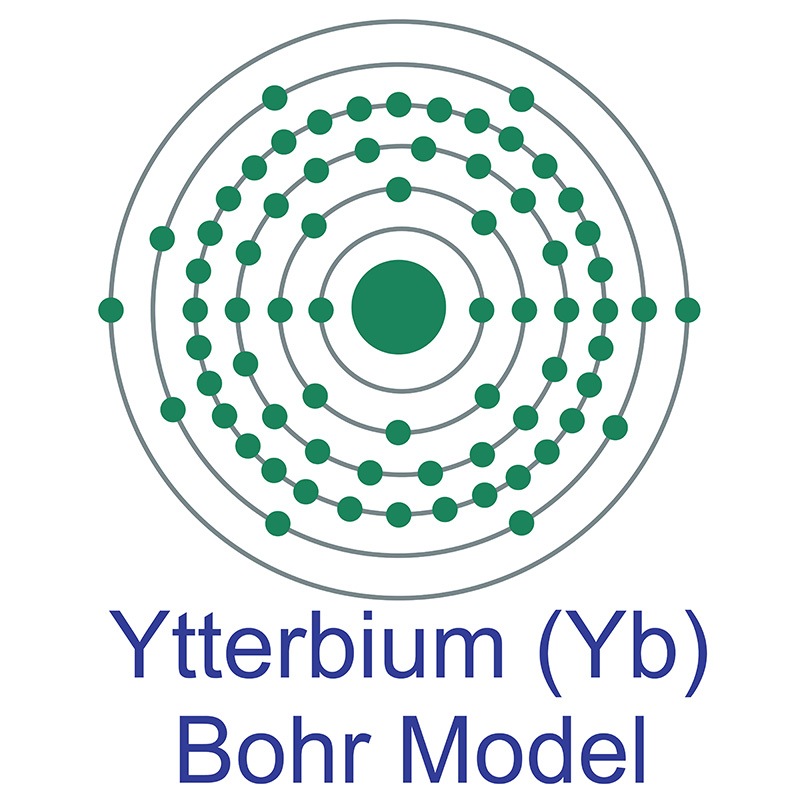 The number of electrons in each of Ytterbium's shells is [2, 8, 18, 32, 8, 2] and its electron configuration is [Xe]4f14 6s2. The Ytterbium atom has a radius of 176 pm and a Van der Waals radius of 242 pm. Ytterbium was discovered by Jean Charles Galissard de Marignac in 1878 and first isolated by Georges Urbain in 1907.
 In its elemental form, ytterbium has a silvery-white color. Ytterbium is found in monazite sand as well as the ores euxenite and xenotime. Ytterbium is named after Ytterby, a village in Sweden. Ytterbium can be used as a source for gamma rays, for the doping of stainless steel, or other active