American Elements produces to many standard grades when applicable, including Mil Spec (military grade); ACS, Reagent and Technical Grade; Food, Agricultural and Pharmaceutical Grade; Optical Grade, USP and EP/BP (European Pharmacopeia/British Pharmacopeia) and follows applicable ASTM testing standards.See safety data and research below and pricing/lead time above. American Elements specializes in producing high purity Aluminum Gadolinium Sputtering Targets with the highest possible density and smallest possible average grain sizes for use in semiconductor, chemical vapor deposition (CVD) and physical vapor deposition (PVD) display and optical applications. Our standard Sputtering Targets for thin film are available monoblock or bonded with dimensions and configurations up to 820 mm with hole drill locations and threading, beveling, grooves and backing designed to work with both older sputtering devises as well as the latest process equipment, such as large area coating for solar energy or fuel cells and flip-chip applications. Research sized targets are also produced as well as custom sizes and alloys. All targets are analyzed using best demonstrated techniques including X-Ray Fluorescence (XRF), Glow Discharge Mass Spectrometry (GDMS), and Inductively Coupled Plasma (ICP). "Sputtering" allows for thin film deposition of an ultra high purity sputtering metallic or oxide material onto another solid substrate by the controlled removal and conversion of the target material into a directed gaseous/plasma phase through ionic bombardment. "Sputtering" allows for thin film deposition of an ultra high purity sputtering metallic or oxide material onto another solid substrate by the controlled removal and conversion of the target material into a directed gaseous/plasma phase through ionic bombardment. We can also provide targets outside this range in addition to just about any size rectangular, annular, or oval target. Materials are produced using crystallization, solid state and other ultra high purification processes such as sublimation. American Elements specializes in producing custom compositions for commercial and research applications and for new proprietary technologies. American Elements also casts any of the rare earth metals and most other advanced materials into rod, bar or plate form, as well as other machined shapes and through other processes nanoparticles. We also produce Aluminum as disc, granules, ingot, pellets, pieces, powder, and rod. Other shapes are available by request.
Aluminum is a Block P, Group 13, Period 3 element. The number of electrons in each of Aluminum's shells is 2, 8, 3 and its electronic configuration is [Ne] 3s2 3p1. In its elemental form aluminum's CAS number is 7429-90-5. The aluminum atom has a radius of 143.2.pm and it's Van der Waals radius is 200.pm. Aluminum is not known to be harmful but ingestion may cause Alzheimer's disease.Aluminum is a silvery-white metal that possesses many desirable characteristics. It is light, nonmagnetic and nonsparking.
It stands second among metals in the scale of malleability, and sixth in ductility. It is extensively used in many industrial applications where a strong, light, easily constructed material is needed. Although it's electrical conductivity is only about 60% that of copper, it is used in electrical transmission lines because of its light weight. Pure aluminum is soft and lacks strength, but alloyed with small amounts of copper, magnesium, silicon, manganese, or other elements impart a variety of useful properties. These alloys are of vital importance in the construction of modern aircraft and rockets. Aluminum, evaporated in a vacuum, forms a highly reflective coating for both visible light and radiant heat. They are used to coat telescope mirrors. Aluminum is available as metal and compounds with purities from 99% to 99.9999% (ACS grade to ultra-high purity); metals in the form of foil, sputtering target, and rod, and compounds as submicron and nanopowder. See Aluminum research below.
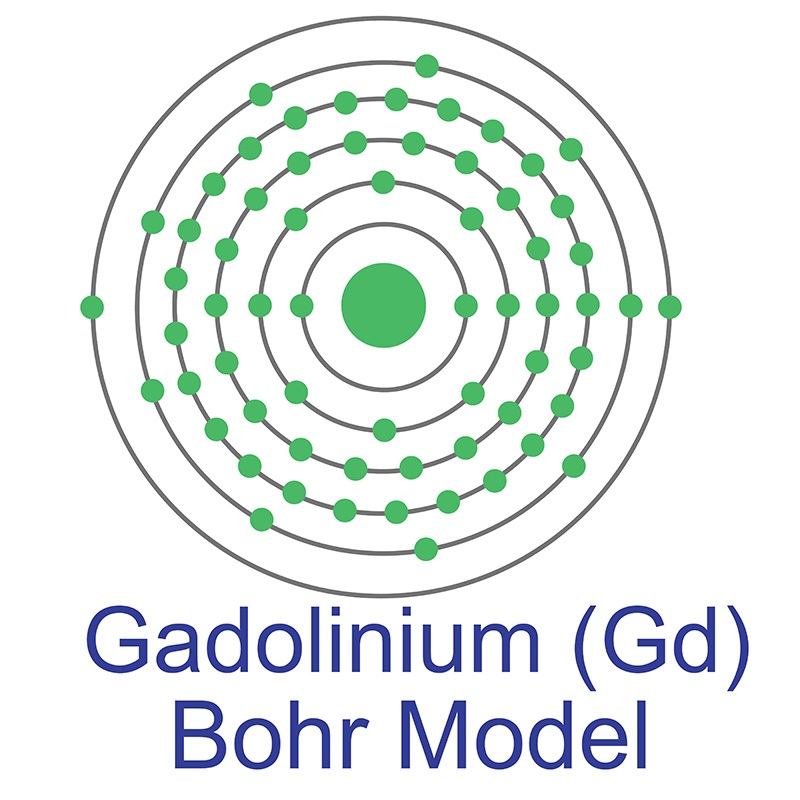
Gadolinium is a Block F, Group 3, Period 6 element. The number of electrons in each of Gadolinium's shells is 2, 8, 18, 25, 9, 2 and its electronic configuration is [Xe] 4f7 5d1 6s2. In its elemental form gadolinium's CAS number is 7440-54-2. The gadolinium atom has a radius of 178.7.pm and it's Van der Waals radius is unknown. Gadolinium is very toxic. Gadolinium is utilized for both its high magnetic moment (7.94µB) and in phosphors and scintillator material. When complexed with EDTA ligands, it is used as an injectable contrast agent for patients undergoing magnetic resonance imaging. With its high magnetic moment, gadolinium can reduce relaxation times and thereby enhance signal intensity. The extra stable half-full 4f electron shell with no low lying energy levels creates applications as an inert phosphor host. Gadolinium can therefore act as hosts for x-ray cassettes and in scintillator materials for computer tomography. Gadolinium is available as metal and compounds with purities from 99% to 99.999% (ACS grade to ultra-high purity); metals in the form of foil, sputtering target, and rod, and compounds as submicron and nanopowder. Gadolinium was first discovered by Jean de Marignac in 1880. The element is named after the Finnish chemist and geologist Johan Gadolin. See Gadolinium research below.
PACKAGING SPECIFICATIONS FOR BULK & RESEARCH QUANTITIES
Typical bulk packaging includes palletized plastic 5 gallon/25 kg. pails, fiber and steel drums to 1 ton super sacks in full container (FCL) or truck load (T/L) quantities. Research and sample quantities and hygroscopic, oxidizing or other air sensitive materials may be packaged under argon or vacuum. Shipping documentation includes a Certificate of Analysis and Material Safety Data Sheet (MSDS). Bullion and bar forms are best if purchasing solely for physical possession and risk exposure.
Characterisation of optically stimulated luminescence dosemeters to measure organ doses in diagnostic radiology.
Endo A, Katoh T, Kobayashi I, Joshi R, Sur J, Okano T.
Dentomaxillofac Radiol. 2011 Nov 24. [Epub ahead of print]
PMID:
22116136
[PubMed - as supplied by publisher]
Metal recovery from high-grade WEEE: A life cycle assessment.
Bigum M, Brogaard L, Christensen TH.
J Hazard Mater. 2011 Oct 17. [Epub ahead of print]
PMID:
22115841
[PubMed - as supplied by publisher]
Protein interactions with nanosized hydrotalcites of different composition.
Bellezza F, Alberani A, Posati T, Tarpani L, Latterini L, Cipiciani A.
J Inorg Biochem. 2011 Oct 8;106(1):134-142. [Epub ahead of print]
PMID:
22115829
[PubMed - as supplied by publisher]
Neurobehavioral toxic effects of perinatal oral exposure to aluminum on the developmental motor reflexes, learning, memory and brain neurotransmitters of mice offspring.
Abu-Taweel GM, Ajarem JS, Ahmad M.
Pharmacol Biochem Behav. 2011 Nov 13. [Epub ahead of print]
PMID:
22115621
[PubMed - as supplied by publisher]
Lithium-Ion Conducting Electrolyte Salts for Lithium Batteries.
Aravindan V, Gnanaraj J, Madhavi S, Liu HK.
Chemistry. 2011 Nov 24. doi: 10.1002/chem.201101486. [Epub ahead of print]
PMID:
22114046
[PubMed - as supplied by publisher]
Contact fatigue response of porcelain-veneered alumina model systems.
Stappert CF, Baldassarri M, Zhang Y, Stappert D, Thompson VP.
J Biomed Mater Res B Appl Biomater. 2011 Nov 24. doi: 10.1002/jbm.b.31977. [Epub ahead of print]
PMID:
22113973
[PubMed - as supplied by publisher]
Influence of formulation pH and suspension state on freezing-induced agglomeration of aluminum adjuvants.
Salnikova MS, Davis H, Mensch C, Celano L, Thiriot DS.
J Pharm Sci. 2011 Nov 23. doi: 10.1002/jps.22815. [Epub ahead of print]
PMID:
22113733
[PubMed - as supplied by publisher]
Evidence of foliar aluminium accumulation in local, regional and global datasets of wild plants.
Metali F, Salim KA, Burslem DF.
New Phytol. 2011 Nov 23. doi: 10.1111/j.1469-8137.2011.03965.x. [Epub ahead of print]
PMID:
22111583
[PubMed - as supplied by publisher]
Turning aluminium into a noble-metal-like catalyst for low-temperature activation of molecular hydrogen.
Chopra IS, Chaudhuri S, Veyan JF, Chabal YJ.
Nat Mater. 2011 Nov 23;10(12):986. doi: 10.1038/nmat3174. No abstract available.
PMID:
22109610
[PubMed - in process]
Fabrication of a dual-layer aluminum nanowires polarization filter array.
Gruev V.
Opt Express. 2011 Nov 21;19(24):24361-9. doi: 10.1364/OE.19.024361.
PMID:
22109463
[PubMed - in process]
Image-quality perception as a function of dose in digital radiography.
Lehnert T, Naguib NN, Korkusuz H, Bauer RW, Kerl JM, Mack MG, Vogl TJ.
AJR Am J Roentgenol. 2011 Dec;197(6):1399-403.
PMID:
22109295
[PubMed - in process]
Highly sensitive nano-porous lattice biosensor based on localized surface plasmon resonance and interference.
Yeom SH, Kim OG, Kang BH, Kim KJ, Yuan H, Kwon DH, Kim HR, Kang SW.
Opt Express. 2011 Nov 7;19(23):22882-91. doi: 10.1364/OE.19.022882.
PMID:
22109166
[PubMed - in process]
Regulatory role of zinc during aluminium-induced altered carbohydrate metabolism in rat brain.
Singla N, Dhawan DK.
J Neurosci Res. 2011 Nov 23. doi: 10.1002/jnr.22790. [Epub ahead of print]
PMID:
22108899
[PubMed - as supplied by publisher]
Three-shell-based lens barrel for the effective athermalization of an IR optical system.
Yang HS, Kihm H, Moon IK, Jung GJ, Choi SC, Lee KJ, Hwang HY, Kim SW, Lee YW.
Appl Opt. 2011 Nov 20;50(33):6206-13. doi: 10.1364/AO.50.006206.
PMID:
22108878
[PubMed - in process]
Influences of heat seal lacquer thickness on the quality of blister packages.
Mühlfeld L, Langguth P, Häusler H, Hagels H.
Eur J Pharm Sci. 2011 Nov 16. [Epub ahead of print]
PMID:
22108348
[PubMed - as supplied by publisher]
Efficient extraction of vaccines formulated in aluminum hydroxide gel by including surfactants in the extraction buffer.
Zhu D, Huang S, McClellan H, Dai W, Syed NR, Gebregeorgis E, Mullen GE, Long C, Martin LB, Narum D, Duffy P, Miller LH, Saul A.
Vaccine. 2011 Nov 18. [Epub ahead of print]
PMID:
22107848
[PubMed - as supplied by publisher]
Electronic structure investigation of highly compressed aluminum with k edge absorption spectroscopy.
Benuzzi-Mounaix A, Dorchies F, Recoules V, Festa F, Peyrusse O, Levy A, Ravasio A, Hall T, Koenig M, Amadou N, Brambrink E, Mazevet S.
Phys Rev Lett. 2011 Oct 14;107(16):165006. Epub 2011 Oct 13.
PMID:
22107398
[PubMed - in process]
Short-time electron dynamics in aluminum excited by femtosecond extreme ultraviolet radiation.
Medvedev N, Zastrau U, Förster E, Gericke DO, Rethfeld B.
Phys Rev Lett. 2011 Oct 14;107(16):165003. Epub 2011 Oct 12.
PMID:
22107395
[PubMed - in process]
Nanoporous Polymeric Nanofibers Based on Selectively Etched PS-b-PDMS Block Copolymers.
Birlik Demirel G, Buyukserin F, Morris MA, Demirel G.
ACS Appl Mater Interfaces. 2011 Nov 22. [Epub ahead of print]
PMID:
22107361
[PubMed - as supplied by publisher]
Low bias electron scattering in structure-identified single wall carbon nanotubes: role of substrate polar phonons.
Chandra B, Perebeinos V, Berciaud S, Katoch J, Ishigami M, Kim P, Heinz TF, Hone J.
Phys Rev Lett. 2011 Sep 30;107(14):146601. Epub 2011 Sep 28.
PMID:
22107221
[PubMed - in process]
T(1) assessment of hip joint cartilage following intra-articular
gadolinium injection: A pilot study. Bittersohl B, Hosalkar HS, Kim YJ, Werlen S, Trattnig S, Siebenrock KA,
Mamisch TC. Magn Reson Med. 2010 Oct;64(4):1200-7.
PubMed PMID: 20872764.
The
time window of MRI of murine atherosclerotic plaques after administration of CB2
receptor targeted micelles: inter-scan variability and relation between plaque
signal intensity increase and gadolinium content of inversion recovery prepared
versus non-prepared fast spin echo. Te Boekhorst BC, Bovens SM, van de Kolk CW, Cramer MJ, Doevendans PA, Ten Hove
M, van der Weerd L, Poelmann R, Strijkers GJ, Pasterkamp G, van Echteld CJ. NMR Biomed. 2010 Oct;23(8):939-51. PubMed
PMID: 20878972.
Coordination chemistry of amide-functionalised
tetraazamacrocycles: structural, relaxometric and cytotoxicity studies. Martinelli J, Balali-Mood B, Panizzo R, Lythgoe MF, White AJ, Ferretti P,
Steinke JH, Vilar R. Dalton
Trans. 2010 Sep 28. [Epub ahead of print] PubMed PMID: 20877892.
Gadolinium released from MR contrast
agents is deposited in brain tumors: in situ demonstration using scanning
electron microscopy with energy dispersive X-ray spectroscopy. Xia D, Davis RL, Crawford JA, Abraham JL. Acta Radiol. 2010
Sep 26. [Epub ahead of print] PubMed PMID: 20868305.
Midregional
pro-atrial natriuretic peptide: a novel marker of myocardial fibrosis in patients
with hypertrophic cardiomyopathy. Elmas E, Doesch C, Fluechter S, Freundt M, Weiss C, Lang S, Kälsch T, Haghi D,
Papassotiriou J, Kunde J, Schoenberg SO, Borggrefe M, Papavassiliu T. Int J Cardiovasc Imaging. 2010 Sep 26. [Epub
ahead of print] PubMed PMID: 20872251.
Translocator Protein PET
Imaging for Glial Activation in Multiple Sclerosis. Oh U, Fujita M, Ikonomidou VN, Evangelou IE, Matsuura E, Harberts E, Ohayon J,
Pike VW, Zhang Y, Zoghbi SS, Innis RB, Jacobson S. J Neuroimmune Pharmacol. 2010
Sep 25. [Epub ahead of print] PubMed PMID: 20872081.
Influence of small caliber coronary arteries on the diagnostic accuracy of
adenosine stress cardiac magnetic resonance imaging. Pilz G, Heer T, Graw M, Ali E, Klos M, Scheck R, Zeymer U, Höfling B. Clin Res Cardiol. 2010 Sep
24. [Epub ahead of print] PubMed PMID: 20862587.
Reference region-based pharmacokinetic modeling in quantitative dynamic
contract-enhanced MRI allows robust treatment monitoring in a rat liver tumor
model despite cardiovascular changes. Steingoetter A, Svensson J, Kosanke Y, Botnar RM, Schwaiger M, Rummeny E,
Braren R. Magn Reson Med. 2010 Sep 24. [Epub ahead of
print] PubMed PMID: 20872863.
Comparison of half-dose and full-dose
gadolinium MR contrast on the enhancement of bone and soft tissue tumors.
Costelloe CM, Murphy WA Jr, Haygood TM, Kumar R, McEnery KW, Stafford RJ, Roy
A, Bassett RL Jr, Harrell RK, Madewell JE. Skeletal Radiol. 2010 Sep 24. [Epub ahead of print] PubMed PMID: 20862469.
Gd-EOB-DTPA enhanced MR
imaging: Evaluation of biliary and renal excretion in normal and cirrhotic
livers. Tamada T, Ito K, Sone T, Kanki A, Sato T, Higashi H. Eur J Radiol. 2010 Sep 23. [Epub ahead of print] PubMed PMID: 20869827.
Increases
in the number of brain metastases detected at frame-fixed, thin-slice MRI for
gamma knife surgery planning. Nagai A, Shibamoto Y, Mori Y, Hashizume C, Hagiwara M, Kobayashi T. Neuro Oncol. 2010 Sep 23. [Epub ahead of print]
PubMed PMID: 20864500.
BOLD
cardiovascular magnetic resonance at 3.0 tesla in myocardial ischemia. Manka R, Paetsch I, Schnackenburg B, Gebker R, Fleck E, Jahnke C. J
Cardiovasc Magn Reson. 2010 Sep 22;12(1):54. [Epub ahead of print] PubMed PMID:
20860792.
Revisiting an old friend: manganese-based MRI contrast agents. Pan D, Caruthers SD, Senpan A, Schmieder AH, Wickline SA, Lanza GM. Wiley Interdiscip
Rev Nanomed Nanobiotechnol. 2010 Sep 21. [Epub ahead of print] PubMed PMID:
20860051.
Childhood cholesteatoma. Nevoux J, Lenoir M, Roger G, Denoyelle F, Ducou Le Pointe H, Garabédian EN.Eur Ann Otorhinolaryngol Head Neck Dis. 2010
Sep;127(4):143-50. Epub 2010 Aug 11. PubMed PMID: 20860924.
Comparison of portal venous and delayed phases of
gadolinium-enhanced magnetic resonance imaging study of cirrhotic liver for the
detection of contrast washout of hypervascular hepatocellular carcinoma. Cereser L, Furlan A, Bagatto D, Girometti R, Como G, Avellini C, Orsaria M,
Zuiani C, Bazzocchi M. J Comput
Assist Tomogr. 2010 Sep-Oct;34(5):706-11. PubMed PMID: 20861773.
Three-dimensional multiphase time-resolved low-dose
contrast-enhanced magnetic resonance angiography using TWIST on a 32-channel coil
at 3 T: a quantitative and qualitative comparison of a conventional gadolinium
chelate with a high-relaxivity agent. Giesel FL, Runge V, Kirchin M, Mehndiratta A, Gerigk L, Corell B, von Gall C,
Kauczor HU, Essig M. J Comput Assist Tomogr. 2010
Sep-Oct;34(5):678-83. PubMed PMID: 20861769.
[Accessory nerve schwannoma
of the intracisternal type: a case report.]. Sadatomo T, Yuki K, Migita K, Hidaka T, Kurisu K. No Shinkei Geka. 2010
Sep;38(9):831-7. Japanese. PubMed PMID: 20864772.
Use of cardiac magnetic resonance imaging to evaluate cardiac
structure, function and fibrosis in children with infantile Pompe disease on
enzyme replacement therapy. Barker PC, Pasquali SK, Darty S, Ing RJ, Li JS, Kim RJ, Dearmey S, Kishnani
PS, Campbell MJ. Mol Genet Metab. 2010 Jul 23. [Epub ahead of print]
PubMed PMID: 20875764.
Differential diagnosis and
prognosis of T1-weighted post-gadolinium intralabyrinthine hyperintensities. Dubrulle F, Kohler R, Vincent C, Puech P, Ernst O. Eur
Radiol. 2010 Jun 10. [Epub ahead of print] PubMed PMID: 20862477.