wpe6.gif (6819 bytes)
Hafnium Telluride Sputtering Target
High Purity Hf Te Sputtering Target
Product
Product Code
Order or Specifications
(2N) 99% Hafnium Telluride Sputtering Target
HF-TE-02-ST
Contact American Elements
(2N5) 99.5% Hafnium Telluride Sputtering Target
HF-TE-025-ST
Contact American Elements
(3N) 99.9% Hafnium Telluride Sputtering Target
HF-TE-03-ST
Contact American Elements
(3N5) 99.95% Hafnium Telluride Sputtering Target
HF-TE-035-ST
Contact American Elements
(4N) 99.99% Hafnium Telluride Sputtering Target
HF-TE-04-ST
Contact American Elements
(5N) 99.999% Hafnium Telluride Sputtering Target
HF-TE-05-ST
Contact American Elements
Telluride IonAmerican Elements produces to many standard grades when applicable, including Mil Spec (military grade); ACS, Reagent and Technical Grade; Food, Agricultural and Pharmaceutical Grade; Optical Grade, USP and EP/BP (European Pharmacopeia/British Pharmacopeia) and follows applicable ASTM testing standards.See safety data and research below and pricing/lead time above. American Elements specializes in producing high purity Hafnium Telluride Sputtering targets with the highest possible density High Purity (99.99%) Metallic Sputtering Targetand smallest possible average grain sizes for use in semiconductor, chemical vapor deposition (CVD) and physical vapor deposition (PVD) display and optical applications. Our standard Sputtering Targets for thin film are available monoblock or bonded with dimensions and configurations up to 820 mm with hole drill locations and threading, beveling, grooves and backing designed to work with both older sputtering devises as well as the latest process equipment, such as large area coating for solar energy or fuel cells and flip-chip applications. Research sized targets are also produced as well as custom sizes and alloys. All targets are analyzed using best demonstrated techniques including X-Ray Fluorescence (XRF), Glow Discharge Mass Spectrometry (GDMS), and Inductively Coupled Plasma (ICP). "Sputtering" allows for thin film deposition of an ultra high purity sputtering metallic or oxide material onto another solid substrate by the controlled removal and conversion of the target material into a directed gaseous/plasma phase through ionic bombardment. "Sputtering" allows for thin film deposition of an ultra high purity sputtering metallic or oxide material onto another solid substrate by the controlled removal and conversion of the target material into a directed gaseous/plasma phase through ionic bombardment. We can also provide targets outside this range in addition to just about any size rectangular, annular, or oval target. Materials are produced using crystallization, solid state and other ultra high purification processes such as sublimation. American Elements specializes in producing custom compositions for commercial and research applications and for new proprietary technologies. American Elements also casts any of the rare earth metals and most other advanced materials into rod, bar or plate form, as well as other machined shapes and through other processes nanoparticles. We also produce Hafnium as disc, granules, ingot, pellets, pieces, powder, and rod. Other shapes are available by request.

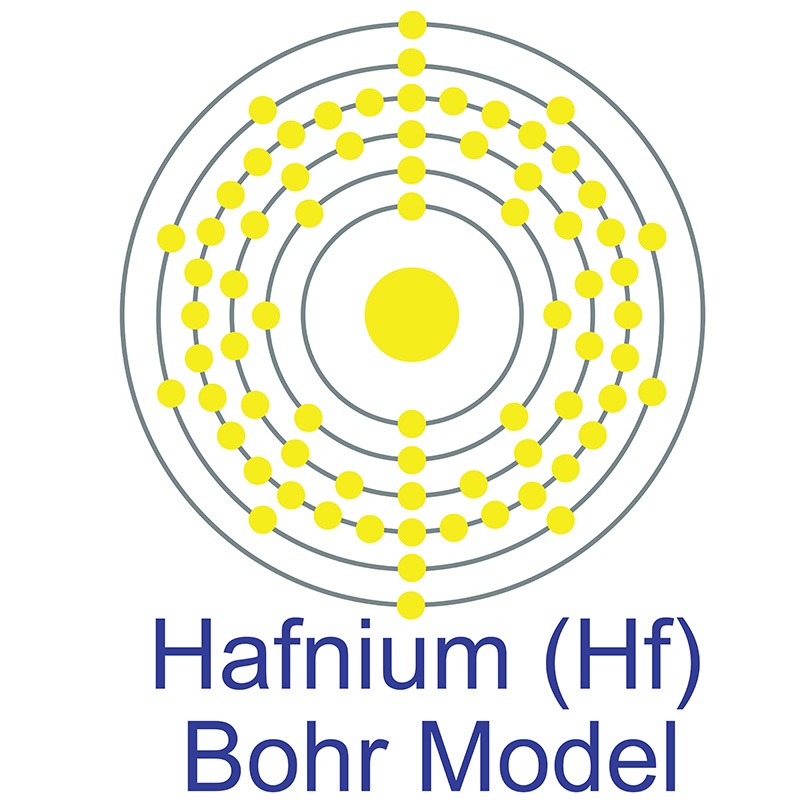
Hafnium(Hf) atomic and molecular weight, atomic number and elemental symbol Hafnium is a Block D, Group 4, Period 6 element. The number of electrons in each of Hafnium's shells is 2, 8, 18, 32, 10, 2 and its electronic configuration is [Xe] 4f14 5d2 6s2. In its elemental form hafnium's CAS number is 7440-58-6.The hafnium atom has a radius of 156.4.pm and it's Van der Waals radius is 200.pm. Hafnium is not toxic. Hafnium is one of the Group IV transition elements that is refined from various zirconic mineral deposits. Hafnium is available as metal and compounds with purities from 99% to 99.999% (ACS grade to ultra-high purity); metals in the form of foil, sputtering target, and rod, and compounds as submicron and nanopowder. It's primary uses are due to its ability as a nuclear "getter" or absorber of neutrons. It is a primary component in nuclear control rods for this purpose. It also finds uses as a dopant in the alloy of Elemental Hafniumsteel and Hafnium Bohr Modeltitanium. It is also used in the production of mantles for high intensity incandescent lamps. Hafnium is replacing polysilicon as the principle gate or electrode material in metal oxide semiconductor field effect transistors (MOSFETs) which are the basis for all modern semiconductors. As semiconductors have gotten smaller, the limiting factor in further size reduction has been the ability of the silicon oxide gate to perform below 10 angstroms where leakage occurs. Recent research has been devoted to the development of High-k materials which can function as a di-electric barrier or gate with lower leakage. Using hafnium based alloys as this di-electric gate has allowed for the development of MOSFET gates smaller than 10 angstroms. This allows for further size reduction, reduced switching power requirements and improved performance. Hafnium was first discovered by Dirk Coster in 1923. See Hafnium research below.

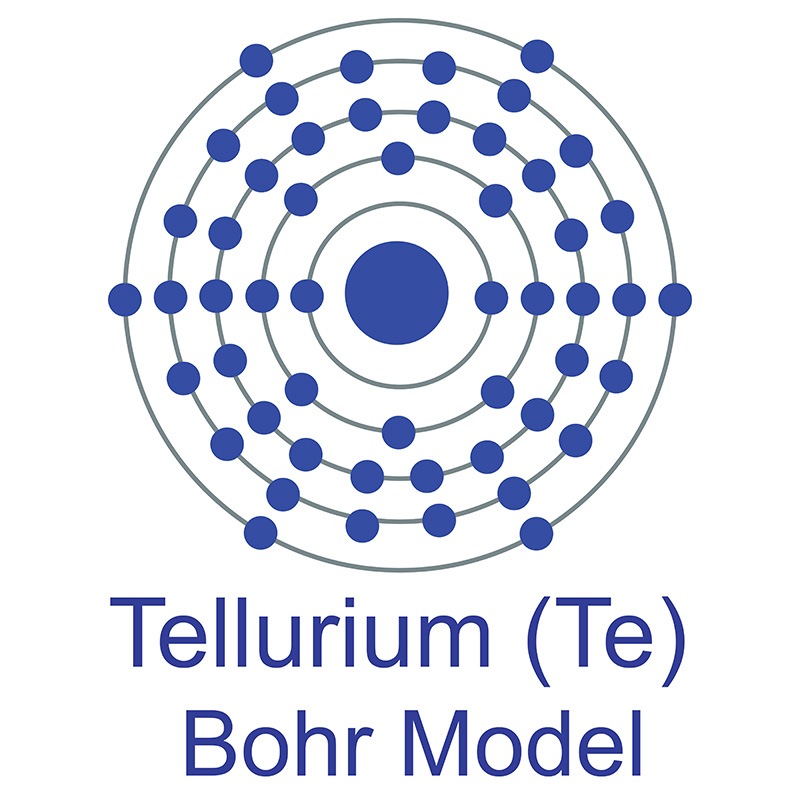
Tellurium(Te)atomic and molecular weight, atomic number and elemental symbolTellurium is a Block P, Group 16, Period 5 element. The number of electrons in each of Tellurium's shells is 2, 8, 18, 18, 6 and its electronic configuration is [Kr] 4d10 5s2 5p4. In its elemental form tellurium's CAS number is 13494-80-9. Tellurium is very toxic and can cause birth defects. The tellurium atom has a radius of 143.2.pm and it's Van der Waals radius is 206.pm. Tellurium is a p-type semiconductor, and shows greater conductivity in certain directions, depending on alignment of the atoms. It is grown in crystalline form with other elements such as indium telluride. Its conductivity increases slightly with exposure to light which makes many tellurides candidates for solar energyapplications. Tellurium improves the machinability of copper and stainless steel, and its addition to lead decreases the corrosive action of sulfuric acid on lead and improves its strength and hardness. Tellurium is used as Tellurium Bohr Modela basic ingredient in blasting caps, and is added to cast iron for chill control. Tellurium is used in ceramics. Bismuth telluride has been used in thermoelectric devices. Iron is available as metal and compounds with purities from 99% to 99.999% (ACS grade to ultra-high purity); metals in the form of foil, sputtering target, and rod, and compounds as submicron and nanopowder. Tellurium was first discovered by Franz Muller von Reichenstein in 1782. The name Tellurium originates from the Greek word 'Tellus' meaning Earth. See Tellurium research below.

PRODUCT CATALOG News Foil Submicron & Nanopowder Tolling Ultra High Purity Sputtering Target Crystal Growth Rod, Plate, Powder, etc. Home

Have a Question? Ask a Chemical Engineer or Material Scientist   Request an MSDS or Certificate of Analysis


Search by Material, Product Name, Product Code, CAS Number, Formula, Element, Anion, Form, EC Number, MDL Number or PubChem ID.
German   Korean   French   Japanese   Spanish   Chinese (Simplified)   Portuguese   Russian   Chinese (Taiwan)   Italian   Turkish   Polish   Dutch   Czech   Swedish   Hungarian   Danish   Hebrew

Production Catalog Available in 36 Countries & Languages

Recent Research & Development for Hafnium

  • Fluorescence Signaling of Zr(4+) by Hydrogen Peroxide Assisted Selective Desulfurization of Thioamide. Hwang J, Choi MG, Eor S, Chang SK. Inorg Chem. 2012 Jan 19. [Epub ahead of print] PMID: 22260347 [PubMed - as supplied by publisher]

  • Hafnium metallocene compounds used as cathode interfacial layers for enhanced electron transfer in organic solar cells. Park K, Oh S, Jung D, Chae H, Kim H, Boo JH. Nanoscale Res Lett. 2012 Jan 9;7(1):74. [Epub ahead of print] PMID: 22230259 [PubMed - as supplied by publisher]

  • Synthesis of hafnium oxide-gold core-shell nanoparticles. Dahal N, Chikan V. Inorg Chem. 2012 Jan 2;51(1):518-22. Epub 2011 Dec 16. PMID: 22221284 [PubMed - in process]

  • Di-?-hydroxido-bis-[tris-(4,4,4-trifluoro-1-phenyl-acetyl-acetonato-?O,O')hafnium(IV)] dimethyl-formamide disolvate. Viljoen JA, Visser HG, Roodt A. Acta Crystallogr Sect E Struct Rep Online. 2011 Dec 1;67(Pt 12):m1822-3. Epub 2011 Nov 25. PMID: 22199601 [PubMed - in process]

  • Potential of high-Z contrast agents in clinical contrast-enhanced computed tomography. Nowak T, Hupfer M, Brauweiler R, Eisa F, Kalender WA. Med Phys. 2011 Dec;38(12):6469. PMID: 22149830 [PubMed - in process]

  • Ni ion release, osteoblast-material interactions, and hemocompatibility of hafnium-implanted NiTi alloy. Zhao T, Li Y, Zhao X, Chen H, Zhang T. J Biomed Mater Res B Appl Biomater. 2011 Nov 28. doi: 10.1002/jbm.b.31989. [Epub ahead of print] PMID: 22121018 [PubMed - as supplied by publisher]

  • Electrochemical oxide nanotube formation on the Ti-35Ta-xHf alloys for dental materials. Moon BH, Jeong YH, Choe HC. J Nanosci Nanotechnol. 2011 Aug;11(8):7428-32. PMID: 22103212 [PubMed - indexed for MEDLINE]

  • Environmentally stable flexible metal-insulator-metal capacitors using zirconium-silicate and hafnium-silicate thin film composite materials as gate dielectrics. Meena JS, Chu MC, Wu CS, Ravipati S, Ko FH. J Nanosci Nanotechnol. 2011 Aug;11(8):6858-67. PMID: 22103091 [PubMed]

  • In situ gas phase measurements during metal alkylamide atomic layer deposition. Maslar JE, Kimes WA, Sperling BA. J Nanosci Nanotechnol. 2011 Sep;11(9):8226-32. PMID: 22097559 [PubMed]

  • Tetra-kis(5,7-dimethyl-quinolin-8-olato-?N,O)hafnium(IV) dimethyl-formamide disolvate. Viljoen JA, Visser HG, Roodt A. Acta Crystallogr Sect E Struct Rep Online. 2011 Oct 1;67(Pt 10):m1428-9. Epub 2011 Sep 30. PMID: 22058710 [PubMed]

  • Synthesis, characterization, and materials chemistry of Group 4 silylimides. Cosham SD, Johnson AL, Molloy KC, Kingsley AJ. Inorg Chem. 2011 Dec 5;50(23):12053-63. Epub 2011 Nov 4. PMID: 22053704 [PubMed - in process]

  • Preparation and physical properties of early-late heterobimetallic compounds featuring Ir-M bonds (M = Ti, Zr, Hf). Curley JJ, Bergman RG, Tilley TD. Dalton Trans. 2012 Jan 7;41(1):192-200. Epub 2011 Oct 21. PMID: 22020701 [PubMed - in process]

  • New stable aryl-substituted acyclic imino-N-heterocyclic carbene: synthesis, characterisation and coordination to early transition metals. Larocque TG, Badaj AC, Dastgir S, Lavoie GG. Dalton Trans. 2011 Dec 21;40(47):12705-12. Epub 2011 Oct 18. PMID: 22006062 [PubMed - in process]

  • Sterically demanding hetero-substituted [2]borametallocenophanes of group IV metals: synthesis, structure and reactivity. Braunschweig H, Dörfler R, Mies J, Oechsner A. Chemistry. 2011 Oct 17;17(43):12101-7. doi: 10.1002/chem.201101774. Epub 2011 Sep 9. PMID: 21905138 [PubMed]

  • The role of electron localization in the atomic structure of transition-metal 13-atom clusters: the example of Co13, Rh13, and Hf13. Piotrowski MJ, Piquini P, Cândido L, Da Silva JL. Phys Chem Chem Phys. 2011 Oct 14;13(38):17242-8. Epub 2011 Aug 30. PMID: 21879054 [PubMed - indexed for MEDLINE]

  • Monte Carlo dose enhancement studies in microbeam radiation therapy. Martínez-Rovira I, Prezadoa Y. Med Phys. 2011 Jul;38(7):4430-9. PMID: 21859044 [PubMed - indexed for MEDLINE]

  • Electronic structure characterization of La incorporated Hf-based high-k gate dielectrics by NEXAFS. Yamamoto T, Ogawa S, Kunisu M, Tsuji J, Kita K, Saeki M, Oku Y, Arimura H, Kitano N, Hosoi T, Shimura T, Watanabe H. J Nanosci Nanotechnol. 2011 Apr;11(4):2823-8. PMID: 21776638 [PubMed - indexed for MEDLINE]

  • Oxygen-containing gas-phase diatomic trications and tetracations: ReO(z+), NbO(z+) and HfO(z+) (z=3, 4). Brites V, Franzreb K, Harvey JN, Sayres SG, Ross MW, Blumling DE, Castleman AW Jr, Hochlaf M. Phys Chem Chem Phys. 2011 Sep 7;13(33):15233-43. Epub 2011 Jul 15. PMID: 21761073 [PubMed]

  • Tris(?-cyclo-penta-dien-yl)hafnium(III). Burlakov VV, Arndt P, Spannenberg A, Rosenthal U. Acta Crystallogr Sect E Struct Rep Online. 2011 May 1;67(Pt 5):m629. Epub 2011 Apr 22. PMID: 21754338 [PubMed]

  • Synthesis of freestanding HfO2 nanostructures. Kidd T, O'Shea A, Boyle K, Wallace J, Strauss L. Nanoscale Res Lett. 2011 Apr 5;6(1):294. PMID: 21711786 [PubMed - in process]
Customers for this product have also looked at:
Thulium Telluride Tellurium 2-Ethylhexanoate Tellurium Fluoride Tellurium Oxide Tellurium Bars
Tellurium Chloride Tellurium Pellets Tellurium Sputtering Target Tellurium Oxide Nanopowder Tellurium Nitrate
Antimony Telluride Tellurium Foil Tellurium Powder Tellurium Meta Tellurium Oxide Pellets

Recent Research & Development for Tellurium

  • Multi-metal(loid) methylation in methanoarchaea is linked to central intermediates of methanogenesis. Thomas F, Diaz-Bone RA, Wuerfel O, Huber B, Weidenbach K, Schmitz RA, Hensel R. Appl Environ Microbiol. 2011 Oct 14. [Epub ahead of print] PMID: 22003009 [PubMed - as supplied by publisher]

  • Synthesis, structure, and bonding of orthorhombic r(5)au(2)te(2) (R = lu, ho, dy, y). Electronic structure of the binary parent valence compound eu(5)as(4). Chai P, Corbett JD. Inorg Chem. 2011 Nov 7;50(21):10949-55. Epub 2011 Oct 12. PMID: 21991925 [PubMed - in process]

  • Glucose-6-Phosphate Dehydrogenase Protects Escherichia coli from Tellurite-Mediated Oxidative Stress. Sandoval JM, Arenas FA, Vásquez CC. PLoS One. 2011;6(9):e25573. Epub 2011 Sep 30. PMID: 21984934 [PubMed - in process]

  • Microbial processing of tellurium as a tool in biotechnology. Turner RJ, Borghese R, Zannoni D. Biotechnol Adv. 2011 Sep 1. [Epub ahead of print] PMID: 21907273 [PubMed - as supplied by publisher]

  • Measurement of the ?? Decay Half-Life of ^{130}Te with the NEMO-3 Detector. Arnold R, Augier C, Baker J, Barabash AS, Basharina-Freshville A, Blondel S, Bongrand M, Broudin-Bay G, Brudanin V, Caffrey AJ, Chapon A, Chauveau E, Durand D, Egorov V, Flack R, Garrido X, Grozier J, Guillon B, Hubert P, Hugon C, Jackson CM, Jullian S, Kauer M, Klimenko A, Kochetov O, Konovalov SI, Kovalenko V, Lalanne D, Lamhamdi T, Lang K, Liptak Z, Lutter G, Mamedov F, Marquet Ch, Martin-Albo J, Mauger F, Mott J, Nachab A, Nemchenok I, Nguyen CH, Nova F, Novella P, Ohsumi H, Pahlka RB, Perrot F, Piquemal F, Reyss JL, Richards B, Ricol JS, Saakyan R, Sarazin X, Simard L, Simkovic F, Shitov Y, Smolnikov A, Söldner-Rembold S, Stekl I, Suhonen J, Sutton CS, Szklarz G, Thomas J, Timkin V, Torre S, Tretyak VI, Umatov V, Vála L, Vanyushin I, Vasiliev V, Vorobel V, Vylov Ts, Zukauskas A; NEMO-3 Collaboration. Phys Rev Lett. 2011 Aug 5;107(6):062504. Epub 2011 Aug 4. PMID: 21902318 [PubMed - in process]

  • Synthesis and characterization of wurtzite ZnTe nanorods with controllable aspect ratios. Zhang J, Jin S, Fry HC, Peng S, Shevchenko E, Wiederrecht GP, Rajh T. J Am Chem Soc. 2011 Oct 5;133(39):15324-7. Epub 2011 Sep 12. PMID: 21899348 [PubMed - in process]

  • A homometallic tricapped cubane cluster: [(Cp*Mo)4B4H4(?4-BH)3] (Cp* = ?5-C5Me5). Thakur A, Sahoo S, Ghosh S. Inorg Chem. 2011 Sep 5;50(17):7940-2. Epub 2011 Aug 11. PMID: 21834507 [PubMed - in process]

  • Selective antimicrobial activity associated with sulfur nanoparticles. Schneider T, Baldauf A, Ba LA, Jamier V, Khairan K, Sarakbi MB, Reum N, Schneider M, Röseler A, Becker K, Burkholz T, Winyard PG, Kelkel M, Diederich M, Jacob C. J Biomed Nanotechnol. 2011 Jun;7(3):395-405. PMID: 21830480 [PubMed - indexed for MEDLINE]

  • Semiconductor detectors allow low-dose-low-dose 1-day SPECT myocardial perfusion imaging. Nkoulou R, Pazhenkottil AP, Kuest SM, Ghadri JR, Wolfrum M, Husmann L, Fiechter M, Buechel RR, Herzog BA, Koepfli P, Burger C, Gaemperli O, Kaufmann PA. J Nucl Med. 2011 Aug;52(8):1204-9. PMID: 21810589 [PubMed - indexed for MEDLINE]

  • CsTe2O(6-x): novel mixed-valence tellurium oxides with framework-deficient pyrochlore-related structure. Siritanon T, Li J, Stalick JK, Macaluso RT, Sleight AW, Subramanian MA. Inorg Chem. 2011 Sep 5;50(17):8494-501. Epub 2011 Jul 27. PMID: 21793494 [PubMed - in process]

  • Bioactivity of the conjugation of green-emitting CdTe quantum dots with a carborane complex. Wu C, Shi L, Li Q, Zhao J, Selke M, Yan H, Wang X. J Nanosci Nanotechnol. 2011 Apr;11(4):3091-9. PMID: 21776675 [PubMed - indexed for MEDLINE]

  • Isolation and characterization of an environmental cadmium- and tellurite-resistant Pseudomonas strain. Chien CC, Jiang MH, Tsai MR, Chien CC. Environ Toxicol Chem. 2011 Oct;30(10):2202-7. doi: 10.1002/etc.620. Epub 2011 Aug 10. PMID: 21766319 [PubMed - in process]

  • An ultrasensitive hydrogen peroxide biosensor based on electrocatalytic synergy of graphene-gold nanocomposite, CdTe-CdS core-shell quantum dots and gold nanoparticles. Gu Z, Yang S, Li Z, Sun X, Wang G, Fang Y, Liu J. Anal Chim Acta. 2011 Sep 2;701(1):75-80. Epub 2011 Jul 4. PMID: 21763811 [PubMed - indexed for MEDLINE]

  • Synchronous determination of mercury (II) and copper (II) based on quantum dots-multilayer film. Ma Q, Ha E, Yang F, Su X. Anal Chim Acta. 2011 Sep 2;701(1):60-5. Epub 2011 Jun 17. PMID: 21763809 [PubMed - indexed for MEDLINE]

  • Procedure-Controlled Selective Synthesis of 5-Acyl-2-iminothiazolines and their Selenium and Tellurium Derivatives by Convergent Tandem Annulation. Wang Y, Zhang WX, Wang Z, Xi Z. Angew Chem Int Ed Engl. 2011 Jul 14. doi: 10.1002/anie.201101948. [Epub ahead of print] No abstract available. PMID: 21761522 [PubMed - as supplied by publisher]

  • Synthesis, structures and ab initio studies of selenium and tellurium bis(carbodithioates and carbothioates). Kato S, Tani K, Ishida M, Nonogaki J, Ebihara M, Hayashi S, Nakanishi W, Niyomura O, Ando F, Koketsu J. Dalton Trans. 2011 Aug 28;40(32):8156-69. Epub 2011 Jul 13. PMID: 21750832 [PubMed - in process]

  • Electrical bistability in self-assembled hybrid multilayers of phospholipid and nanoparticles. Yuan B, Hu SX, Lu NY, Xu F, Zhou K, Ma YQ, Li M. Nanotechnology. 2011 Aug 5;22(31):315303. Epub 2011 Jul 12. PMID: 21747161 [PubMed - indexed for MEDLINE]

  • Organomercury(II) and tellurium(II) compounds with the "pincer" ligand 2,6-[O(CH2CH2)2NCH2]2C6H3--stabilization of an unusual organotellurium(II) cationic species. Beleaga A, Bojan VR, Pöllnitz A, Rat CI, Silvestru C. Dalton Trans. 2011 Sep 21;40(35):8830-8. Epub 2011 Jul 11. PMID: 21743935 [PubMed - in process]

  • Differentiation between the motor and sensory fascicles of the peripheral nerves from adult rats using annexin V-CdTe-conjugated polymer. Meng X, Lu L, Wang H, Liu B. Neurol India. 2011 May-Jun;59(3):333-8. PMID: 21743158 [PubMed - indexed for MEDLINE]

  • Tellurium tetrachloride and diphenyl ditelluride cause cytotoxicity in rat hippocampal astrocytes. Roy S, Hardej D. Food Chem Toxicol. 2011 Oct;49(10):2564-74. Epub 2011 Jul 1. PMID: 21742007 [PubMed - in process]


American Elements is a copyrighted U.S. Trademark. All rights reserved.