Yttrium Telluride (Y2Te3) is a crystal grown product generally immediately available in most volumes. Technical, research and safety (MSDS) information is available as is a Reference Calculator for converting relevant units of measurement.
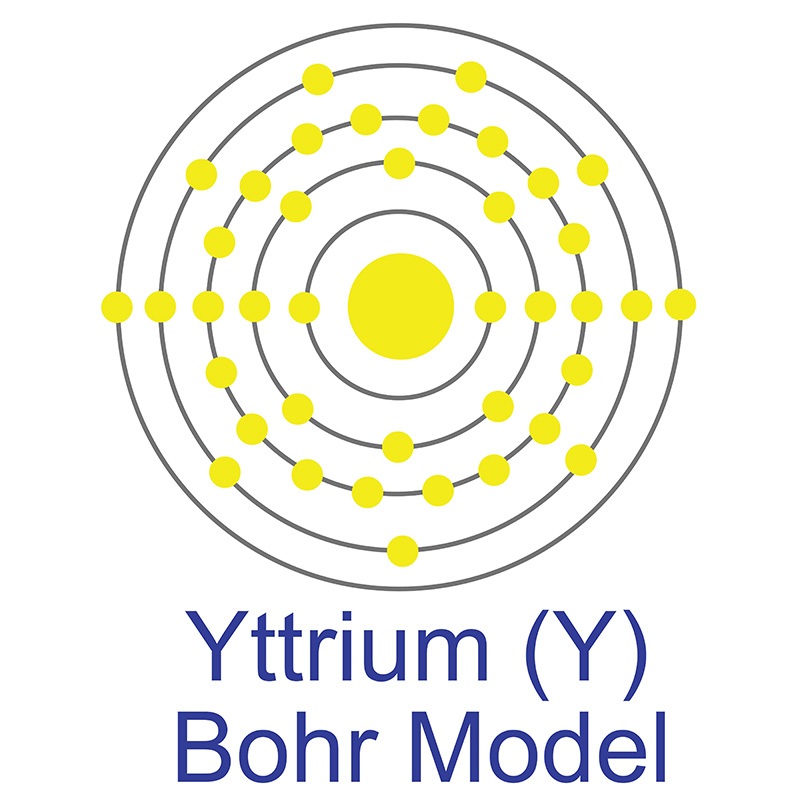
Yttrium is a Block D, Group 3, Period 5 element. The number of electrons in each of Yttrium's shells is 2, 8, 18, 9, 2 and its electronic configuration is [Kr] 4d1 5s2. In its elemental form Yttrium's CAS number is 7440-65-5. The yttrium atom has a radius of 177.6.pm and it's Van der Waals radius is 200.pm. Insoluble compounds of Yttrium are non-toxic, although water soluble compounds are somewhat toxic. Yttrium has the highest thermo-dynamic affinity for oxygen of any element. This characteristic is the basis for many of its applications. While not part of the rare earth series, it resembles the heavy rare earths which are sometimes referred to as the “yttrics” for this reason. Another unique characteristic derives from its ability to form crystals with useful properties. Yttrium is available as metal and compounds with purities from 99% to 99.999% (ACS grade to ultra high purity); metals in the form of foil, sputtering target, and rod, and compounds assubmicron and nanopowder. Some of the many applications of yttrium include in ceramics for crucibles for molten reactive metals, in florescent lighting phosphors, computer displays and automotive fuel consumption sensors.Yttria stabilized zirconium oxide are used in high temperature applications, such as in thermal plasma sprays to protect aerospace high temperature surfaces and as an electrolyte in solid oxide fuel cells. The name Yttrium originated from a Swedish village near Vaxholm called Yttbery where Yttrium was discovered. Crystals of the yttrium-iron-garnet (YIG) variety are essential to microwave communication equipment. The phosphor Eu:Y2O2S creates the red color in televisions. Crystals of the yttrium-aluminum-garnet (YAG) variety are utilized with neodymium in a number of laser applications. Yttria can also increase the strength of metallic alloys. Yttrium was first discovered by Johann Gadolin in 1794. See Yttrium research below.
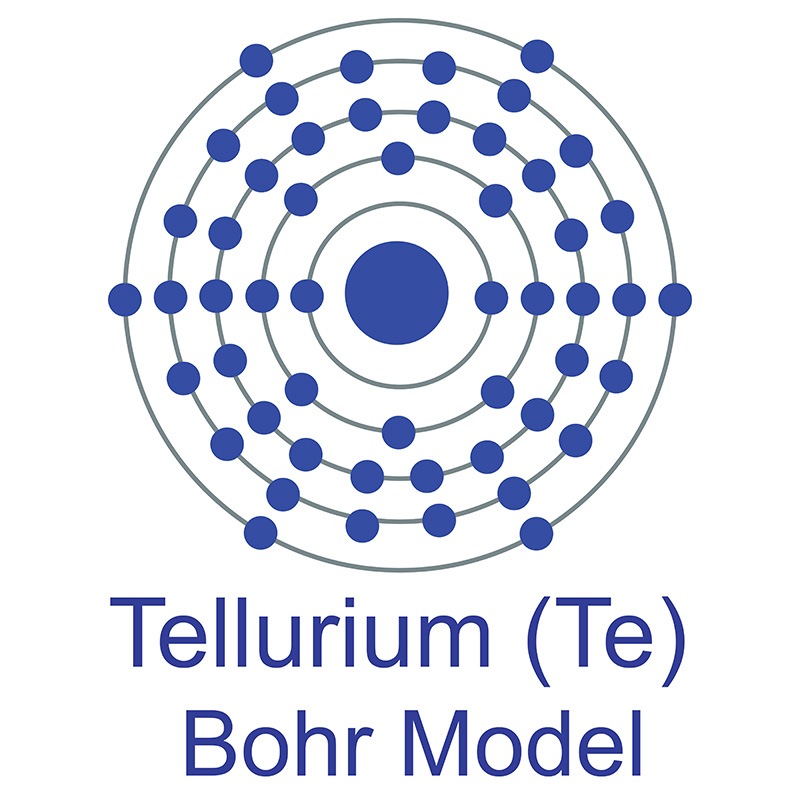
Tellurium is a Block P, Group 16, Period 5 element. The number of electrons in each of Tellurium's shells is 2, 8, 18, 18, 6 and its electronic configuration is [Kr] 4d10 5s2 5p4. In its elemental form tellurium's CAS number is 13494-80-9. The tellurium atom has a radius of 143.2.pm and it's Van der Waals radius is 206.pm. Tellurium is a p-type semiconductor, and shows greater conductivity in certain directions, depending on alignment of the atoms. It is grown in crystalline form with other elements such as indium telluride. Its conductivity increases slightly with exposure to light which makes many tellurides candidates for solar energyapplications. Tellurium improves the machinability of copper and stainless steel, and its addition to lead decreases the corrosive action of sulfuric acid on lead and improves its strength and hardness. Tellurium is used as a basic ingredient in blasting caps, and is added to cast iron for chill control. Tellurium is used in ceramics. Bismuth telluride has been used in thermoelectric devices. Iron is available as metal and compounds with purities from 99% to 99.999% (ACS grade to ultra-high purity); metals in the form of foil, sputtering target, and rod, and compounds as submicron and nanopowder. Tellurium was first discovered by Franz Muller von Reichenstein in 1782. The name Tellurium originates from the Greek word 'Tellus' meaning Earth. See Tellurium research below.
American Elements semi conducting materials are crystal structures produced from ultra high purity starting materials synthesized by our high purity production facility which includes several large electric muffle furnaces, a tube furnace for hydrogen reduction, 50 gallon glass-lined Pfaudler reactors supported by our analytical laboratory containing X-ray diffraction, SEM, AA, BET surface area, and ICP Spectrometry for trace metals analysis. See a discussion of American Elements Ultra High Purity and Analytical capabilities. See Crystal Growth for processes used to fabricate semiconductor materials, which include:
Crystal "pulling" by the Czochaiski method for production of semiconductor materials
Flux growth and gradient freeze
Directional solidification of fluorites using both the Bridgman-Stockbarger and float zoning techniques
PACKAGING SPECIFICATIONS FOR BULK & RESEARCH QUANTITIES
Typical bulk packaging includes palletized plastic 5 gallon/25 kg. pails, fiber and steel drums to 1 ton super sacks in full container (FCL) or truck load (T/L) quantities. Research and sample quantities and hygroscopic, oxidizing or other air sensitive materials may be packaged under argon or vacuum. Shipping documentation includes a Certificate of Analysis and Material Safety Data Sheet (MSDS). Solutions are packaged in polypropylene, plastic or glass jars up to palletized 440 gallon liquid totes.
Low-Fluence Q-Switched 1,064-nm Neodymium-Doped Yttrium Aluminum Garnet Laser for the Treatment of Facial Partial Unilateral Lentiginosis in Koreans.
Lee Y, Choi EH, Lee SW.
Dermatol Surg. 2011 Sep 7. doi: 10.1111/j.1524-4725.2011.02147.x. [Epub ahead of print]
PMID:
22093176
[PubMed - as supplied by publisher]
Successful Treatment of Cosmetic Mucosal Tattoos Via Q-Switched Laser.
Kirby W, Chen C, Desai A, Desai T.
Dermatol Surg. 2011 Aug 23. doi: 10.1111/j.1524-4725.2011.02135.x. [Epub ahead of print]
PMID:
22093036
[PubMed - as supplied by publisher]
Letter: successful treatment of multiple miliary osteomas of the face using an erbium-doped yttrium aluminum garnet laser.
Ortiz AE, Ross EV.
Dermatol Surg. 2011 Oct;37(10):1548-50. doi: 10.1111/j.1524-4725.2011.02112.x.
PMID:
22092945
[PubMed - in process]
Commentary on Treatment of Acne Scars in Asian Patients using a 2,790-nm Fractional Yttrium Scandium Gallium Garnet Laser.
Perez M.
Dermatol Surg. 2011 Oct;37(10):1470-2. doi: 10.1111/j.1524-4725.2011.02116.x. No abstract available.
PMID:
22092942
[PubMed - in process]
Fractional Thermoablation Using an Erbium-Doped Yttrium Aluminum Garnet Fractionated Laser for the Treatment of Pulsed Dye Laser-Resistant Port Wine Stain Birthmarks.
Toren KL, Marquart JD.
Dermatol Surg. 2011 Sep 14. doi: 10.1111/j.1524-4725.2011.02160.x. [Epub ahead of print] No abstract available.
PMID:
22092921
[PubMed - as supplied by publisher]
The effect of erbium-doped: yttrium, aluminium and garnet laser irradiation on the surface microstructure and roughness of double acid-etched implants.
Kim JH, Herr Y, Chung JH, Shin SI, Kwon YH.
J Periodontal Implant Sci. 2011 Oct;41(5):234-41. Epub 2011 Oct 31.
PMID:
22087414
[PubMed - in process]
120-W 2-?m THULIUM:YTTRIUM-ALUMINIUM-GARNET VAPOENUCLEATION OF THE PROSTATE: 12-MONTH FOLLOW-UP.
Muir G.
BJU Int. 2011 Nov 15. doi: 10.1111/j.1464-410X.2011.10816.x. [Epub ahead of print] No abstract available.
PMID:
22085314
[PubMed - as supplied by publisher]
120-W 2-µm thulium:yttrium-aluminium-garnet vapoenucleation of the prostate: 12-month follow-up.
Netsch C, Pohlmann L, Herrmann TR, Gross AJ, Bach T.
BJU Int. 2011 Nov 15. doi: 10.1111/j.1464-410X.2011.10767.x. [Epub ahead of print]
PMID:
22085294
[PubMed - as supplied by publisher]
An Unusual Organoyttrium Alkyl Complex Containing a [C(5) HMe(3) (?(3) -CH(2) )-C(5) H(4) N-?](-) Ligand and an Elusive Cyclopentadienide-Based Scandium Tuck-Over Zwitterion Obtained by C?H Bond Activation.
Jian Z, Cui D.
Chemistry. 2011 Nov 14. doi: 10.1002/chem.201102378. [Epub ahead of print]
PMID:
22083978
[PubMed - as supplied by publisher]
Radioembolization versus Standard Care of Hepatic Metastases: Comparative Retrospective Cohort Study of Survival Outcomes and Adverse Events in Salvage Patients.
Bester L, Meteling B, Pocock N, Pavlakis N, Chua TC, Saxena A, Morris DL.
J Vasc Interv Radiol. 2011 Nov 11. [Epub ahead of print]
PMID:
22079516
[PubMed - as supplied by publisher]
Quantitative evaluation of scintillation camera imaging characteristics of isotopes used in liver radioembolization.
Elschot M, Nijsen JF, Dam AJ, de Jong HW.
PLoS One. 2011;6(11):e26174. Epub 2011 Nov 3.
PMID:
22073149
[PubMed - in process]
Lasers or light sources for treating port-wine stains.
Faurschou A, Olesen AB, Leonardi-Bee J, Haedersdal M.
Cochrane Database Syst Rev. 2011 Nov 9;11:CD007152.
PMID:
22071834
[PubMed - in process]
Treating and Downstaging Hepatocellular Carcinoma in the Caudate Lobe with Yttrium-90 Radioembolization.
Ibrahim SM, Kulik L, Baker T, Ryu RK, Mulcahy MF, Abecassis M, Salem R, Lewandowski RJ.
Cardiovasc Intervent Radiol. 2011 Nov 9. [Epub ahead of print]
PMID:
22069121
[PubMed - as supplied by publisher]
catena-Poly[[tetra-kis-(hexa-methyl-phospho-ramide-?O)bis-(nitrato-?O,O')yttrium(III)] [silver(I)-di-?-sulfido-molybdenum(VI)-di-?-sulfido]].
Zhang J.
Acta Crystallogr E Struct Rep Online. 2011 Sep 1;67(Pt 9):m1206-7. Epub 2011 Aug 6.
PMID:
22065643
[PubMed]
Yttrium-90 Time-of-Flight PET/CT Is Superior to Bremsstrahlung SPECT/CT for Postradioembolization Imaging of Microsphere Biodistribution.
Kao YH, Tan EH, Ng CE, Goh SW.
Clin Nucl Med. 2011 Dec;36(12):e186-7.
PMID:
22064104
[PubMed - in process]
End-functionalized Polymerization of 2-Vinylpyridine through Initial C-H Bond Activation of N-Heteroaromatics and Internal Alkynes by Yttrium Ene-diamido Complexes.
Kaneko H, Nagae H, Tsurugi H, Mashima K.
J Am Chem Soc. 2011 Nov 7. [Epub ahead of print]
PMID:
22059504
[PubMed - as supplied by publisher]
Catalytic, Enantioselective Intramolecular Hydroamination of Primary Amines Tethered to Di- and Tri-substituted Alkenes.
Chapurina Y, Ibrahim H, Guillot R, Kolodziej E, Collin J, Trifonov A, Schulz E, Hannedouche J.
J Org Chem. 2011 Nov 7. [Epub ahead of print]
PMID:
22059438
[PubMed - as supplied by publisher]
Size effect of endohedral cluster on fullerene cage: Preparation and structural studies of Y(3)N@C(78)-C(2).
Ma Y, Wang T, Wu J, Feng Y, Xu W, Jiang L, Zheng J, Shu C, Wang C.
Nanoscale. 2011 Nov 7. [Epub ahead of print]
PMID:
22057827
[PubMed - as supplied by publisher]
MDCT Necrosis Quantification in the Assessment of Hepatocellular Carcinoma Response to Yttrium 90 Radioembolization Therapy: Comparison of Two-dimensional and Volumetric Techniques.
Galizia MS, Töre HG, Chalian H, McCarthy R, Salem R, Yaghmai V.
Acad Radiol. 2011 Nov 2. [Epub ahead of print]
PMID:
22054801
[PubMed - as supplied by publisher]
Q-switched laser treatment of amiodarone pigmentation.
Bernstein EF.
J Drugs Dermatol. 2011 Nov 1;10(11):1316-9.
PMID:
22052315
[PubMed - in process]
Multi-metal(loid) methylation in methanoarchaea is linked to central intermediates of methanogenesis.
Thomas F, Diaz-Bone RA, Wuerfel O, Huber B, Weidenbach K, Schmitz RA, Hensel R.
Appl Environ Microbiol. 2011 Oct 14. [Epub ahead of print]
PMID:
22003009
[PubMed - as supplied by publisher]
Synthesis, structure, and bonding of orthorhombic r(5)au(2)te(2) (R = lu, ho, dy, y). Electronic structure of the binary parent valence compound eu(5)as(4).
Chai P, Corbett JD.
Inorg Chem. 2011 Nov 7;50(21):10949-55. Epub 2011 Oct 12.
PMID:
21991925
[PubMed - in process]
Glucose-6-Phosphate Dehydrogenase Protects Escherichia coli from Tellurite-Mediated Oxidative Stress.
Sandoval JM, Arenas FA, Vásquez CC.
PLoS One. 2011;6(9):e25573. Epub 2011 Sep 30.
PMID:
21984934
[PubMed - in process]
Microbial processing of tellurium as a tool in biotechnology.
Turner RJ, Borghese R, Zannoni D.
Biotechnol Adv. 2011 Sep 1. [Epub ahead of print]
PMID:
21907273
[PubMed - as supplied by publisher]
Measurement of the ?? Decay Half-Life of ^{130}Te with the NEMO-3 Detector.
Arnold R, Augier C, Baker J, Barabash AS, Basharina-Freshville A, Blondel S, Bongrand M, Broudin-Bay G, Brudanin V, Caffrey AJ, Chapon A, Chauveau E, Durand D, Egorov V, Flack R, Garrido X, Grozier J, Guillon B, Hubert P, Hugon C, Jackson CM, Jullian S, Kauer M, Klimenko A, Kochetov O, Konovalov SI, Kovalenko V, Lalanne D, Lamhamdi T, Lang K, Liptak Z, Lutter G, Mamedov F, Marquet Ch, Martin-Albo J, Mauger F, Mott J, Nachab A, Nemchenok I, Nguyen CH, Nova F, Novella P, Ohsumi H, Pahlka RB, Perrot F, Piquemal F, Reyss JL, Richards B, Ricol JS, Saakyan R, Sarazin X, Simard L, Simkovic F, Shitov Y, Smolnikov A, Söldner-Rembold S, Stekl I, Suhonen J, Sutton CS, Szklarz G, Thomas J, Timkin V, Torre S, Tretyak VI, Umatov V, Vála L, Vanyushin I, Vasiliev V, Vorobel V, Vylov Ts, Zukauskas A; NEMO-3 Collaboration.
Phys Rev Lett. 2011 Aug 5;107(6):062504. Epub 2011 Aug 4.
PMID:
21902318
[PubMed - in process]
Synthesis and characterization of wurtzite ZnTe nanorods with controllable aspect ratios.
Zhang J, Jin S, Fry HC, Peng S, Shevchenko E, Wiederrecht GP, Rajh T.
J Am Chem Soc. 2011 Oct 5;133(39):15324-7. Epub 2011 Sep 12.
PMID:
21899348
[PubMed - in process]
A homometallic tricapped cubane cluster: [(Cp*Mo)4B4H4(?4-BH)3] (Cp* = ?5-C5Me5).
Thakur A, Sahoo S, Ghosh S.
Inorg Chem. 2011 Sep 5;50(17):7940-2. Epub 2011 Aug 11.
PMID:
21834507
[PubMed - in process]
Selective antimicrobial activity associated with sulfur nanoparticles.
Schneider T, Baldauf A, Ba LA, Jamier V, Khairan K, Sarakbi MB, Reum N, Schneider M, Röseler A, Becker K, Burkholz T, Winyard PG, Kelkel M, Diederich M, Jacob C.
J Biomed Nanotechnol. 2011 Jun;7(3):395-405.
PMID:
21830480
[PubMed - indexed for MEDLINE]
Bioactivity of the conjugation of green-emitting CdTe quantum dots with a carborane complex.
Wu C, Shi L, Li Q, Zhao J, Selke M, Yan H, Wang X.
J Nanosci Nanotechnol. 2011 Apr;11(4):3091-9.
PMID:
21776675
[PubMed - indexed for MEDLINE]
Isolation and characterization of an environmental cadmium- and tellurite-resistant Pseudomonas strain.
Chien CC, Jiang MH, Tsai MR, Chien CC.
Environ Toxicol Chem. 2011 Oct;30(10):2202-7. doi: 10.1002/etc.620. Epub 2011 Aug 10.
PMID:
21766319
[PubMed - in process]
An ultrasensitive hydrogen peroxide biosensor based on electrocatalytic synergy of graphene-gold nanocomposite, CdTe-CdS core-shell quantum dots and gold nanoparticles.
Gu Z, Yang S, Li Z, Sun X, Wang G, Fang Y, Liu J.
Anal Chim Acta. 2011 Sep 2;701(1):75-80. Epub 2011 Jul 4.
PMID:
21763811
[PubMed - indexed for MEDLINE]
Synchronous determination of mercury (II) and copper (II) based on quantum dots-multilayer film.
Ma Q, Ha E, Yang F, Su X.
Anal Chim Acta. 2011 Sep 2;701(1):60-5. Epub 2011 Jun 17.
PMID:
21763809
[PubMed - indexed for MEDLINE]
Procedure-Controlled Selective Synthesis of 5-Acyl-2-iminothiazolines and their Selenium and Tellurium Derivatives by Convergent Tandem Annulation.
Wang Y, Zhang WX, Wang Z, Xi Z.
Angew Chem Int Ed Engl. 2011 Jul 14. doi: 10.1002/anie.201101948. [Epub ahead of print] No abstract available.
PMID:
21761522
[PubMed - as supplied by publisher]
Synthesis, structures and ab initio studies of selenium and tellurium bis(carbodithioates and carbothioates).
Kato S, Tani K, Ishida M, Nonogaki J, Ebihara M, Hayashi S, Nakanishi W, Niyomura O, Ando F, Koketsu J.
Dalton Trans. 2011 Aug 28;40(32):8156-69. Epub 2011 Jul 13.
PMID:
21750832
[PubMed - in process]
Electrical bistability in self-assembled hybrid multilayers of phospholipid and nanoparticles.
Yuan B, Hu SX, Lu NY, Xu F, Zhou K, Ma YQ, Li M.
Nanotechnology. 2011 Aug 5;22(31):315303. Epub 2011 Jul 12.
PMID:
21747161
[PubMed - indexed for MEDLINE]
Organomercury(II) and tellurium(II) compounds with the "pincer" ligand 2,6-[O(CH2CH2)2NCH2]2C6H3--stabilization of an unusual organotellurium(II) cationic species.
Beleaga A, Bojan VR, Pöllnitz A, Rat CI, Silvestru C.
Dalton Trans. 2011 Sep 21;40(35):8830-8. Epub 2011 Jul 11.
PMID:
21743935
[PubMed - in process]
Differentiation between the motor and sensory fascicles of the peripheral nerves from adult rats using annexin V-CdTe-conjugated polymer.
Meng X, Lu L, Wang H, Liu B.
Neurol India. 2011 May-Jun;59(3):333-8.
PMID:
21743158
[PubMed - indexed for MEDLINE]
Tellurium tetrachloride and diphenyl ditelluride cause cytotoxicity in rat hippocampal astrocytes.
Roy S, Hardej D.
Food Chem Toxicol. 2011 Oct;49(10):2564-74. Epub 2011 Jul 1.
PMID:
21742007
[PubMed - in process]