American Elements Logo and U.S. Registered Trademark


NANOPARTICLES, NANOPOWDER, NANOTUBES, NANOFLUID, ULTRA FINE, SURFACE FUNCTIONALIZED NANO CRYSTAL, MAGNETIC NANOPARTICLES, NANOHORNS, SUBMICRON, -325 MESH, SHOT, GRANULES, FLAKE, HIGH SURFACE AREA METAL AND OXIDE POWDER

Specializing in ultrafine and fine, metal, nanoparticles and powder, American Elements is capable of producing nano scale, submicron and small mesh particle size materials.

32.4 (A)/00.011


Hydrogen                                 Helium
Lithium Beryllium                     Boron Carbon Nitrogen Oxygen Fluorine Neon
Sodium Magnesium                     Aluminum Silicon Phosphorus Sulfur Chlorine Argon
Potassium Calcium Scandium Titanium Vanadium Chromium Manganese Iron Cobalt Nickel Copper Zinc Gallium Germanium Arsenic Selenium Bromine Krypton
Rubidium Strontium Yttrium Zirconium Niobium Molybdenum Technetium Ruthenium Rhodium Palladium Silver Cadmium Indium Tin Antimony Tellurium Iodine Xenon
Cesium Barium Lanthanum Hafnium Tantalum Tungsten Rhenium Osmium Iridium Platinum Gold Mercury Thallium Lead Bismuth Polonium Astatine Radon
                                   
    Cerium Praseodymium Neodymium Promethium Samarium Europium Gadolinium Terbium Dysprosium Holmium Erbium Thulium Ytterbium Lutetium    
    Thorium Protactinium Uranium Neptunium Plutonium Americium Curium Berkelium Californium Einsteinium Fermium Mendelevium Nobelium Lawerencium    

(click on an element to view our products)


American Elements'
manufacturing emphasizes nanoparticles, nanopowder, nanotubes, nanowire, quantum dots, submicron, - 325 mesh, shot and high surface area metal and powder with particle distribution and particle size controlled and certified. We produce larger - 40 mesh, - 100 mesh, -200 mesh range sizes and < 0.5 mm, 2 mm, 5 mm and other mm size shot, granules, lump, flake and pieces, too. Our technical teams are experts in not just the chemical properties of advanced materials, but also their physical properties and morphology.

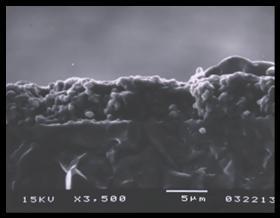
solid oxide fuel cell cathode and electrolyte cross section by SEM
American Elements is capable of producing most compounds and metals, and numerous alloys, in the submicron and nanopowder or nanoparticles or nanocrystals range and atomized metallic powders in sizes as low as - 325 mesh to ultrafine particle. Surface areas as high as 140 m 2 /g have been achieved. Certain catalytic metallic powders, such as platinum, can be produced in the submicron and nano particle range. If you are working with a material that is not in our catalog, but you require it in the submicron or nanoparticle range, we can probably produce it.

American Elements' longstanding experience in nanotechnology , began with the development of a complete line of nanoscale oxides. One example is commercially available zinc oxide nanoparticles, marketed under the trade name " Z-MITE™ ", these uniformly-sized nanocrystals are available with diameters from 10 to 200 nm. The nano-sized particles are 99+% pure, and are available uncoated, for use in aqueous mediums, and coated for use with organic solvents. Among the benefits of this application of nanotechnology is the creation of reactive surface area as high as 45 m 2 /g square meters per gram of nanopowder. The nanoparticles are available in both dispersion and dry powder form. The combination of small particle size, ultra high surface area, and Zinc Oxide's inherent antimicrobial properties makes this new nanomaterial an excellent next generation candidate for numerous high technologies, including as an antibacterial and antifungal agent integrated into textiles and bandages. For detailed product information on the uses and applications of Z-MITE™, see Z-MITE™ PRODUCT INFORMATION.

American Elements can "grow" larger then typical particle sizes for materials to, for example, create particle distributions in the 20 to 70 micron range for materials that are naturally produced in the 2 to 8 micron range. This allows our customers to use them in plasma spray guns and in other deposition technologies that can be blocked by particles that are either too small or too large for the delivery system. Graphene is a nanoscale ultra thin film or foil with thicknesses as small as 1 nanometer which can be produced from either silicon carbide or graphite flake processing. Recently, carbon nanotubes have been demonstrated to create the "darkest" known material absorbing all wavelengths or "colors" of light which will prove useful in solar and electronic applications.

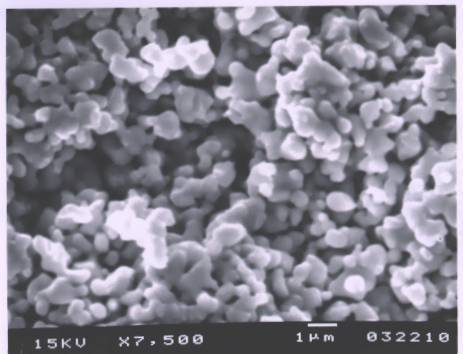
SEM of solid oxide fuel cell anode powder (Nickel Cermet) American Elements can also achieve very high surface area ranges up to 130 square meters per gram (m2/g) for products useful in environmental groundwater remediation, electrical, battery, dielectric and magnetic and fuel cell applications, and optical, imaging and catalyst functions. Nanometal™ nanomaterials can now be found in drug vehicles, sunscreens, anti-microbial, anti-biotic and anti-fungal bandages, textiles and fibers, scratch resistance polishes, and are being researched for their potential uses in biomedical, bioscience and pharmaceutical requirements.

Surface Functionalized Nanomaterials. Surface Functionalized Nanoparticles such as Dodecanethiol Functionalized Gold Nanoparticles have controlled surface chemistries which can provide novel methods to change the adhesion (wetting) properties of the particles, re-order their interfacial region or enhance the dispersion properties of the nanopowder in polymers, plastics and coatings for improved magnetic, fluorescent, dielectric, and catalytic properties. Surface Functionalized Nanoparticles have particular application in LEDs, drug delivery systems, sensors and electronics.

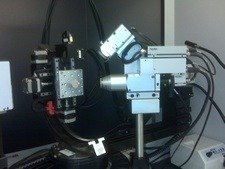
Silicon Nanoparticles have been shown to dramatically expand the storage capacity of lithium ion batteries without degrading the silicon during the AE X-Ray Diffraction Unit for crystal structure analysis and certificationexpansion/contraction cycle that occurs as power is charged and discharged. Silicon has long been known to have an excellent affinity for storage of positively charged lithium cations making them ideal candidates for next generation lithium ion batteries. However, the quick degradation of silicon storage units has made them commercially unfeasible for most applications. Silicon Nanowires however, cycle without significant degradation and present the potential for use in batteries with greatly expanded storage times.

American Elements physical morphology capabilities include aerosol, thermal and sol-gel methods, attrition, ball and jet milling, atomization, particle growth by fusion and sintering, and co-precipitation and screening classification. Analysis and certification include particle distribution by laser diffraction, BET surface area analysis, phase analysis by X-ray diffraction and SEM.

American Elements complete line of nanoparticles, nanopowders, nanotubes, nanocrystals and nanometal are now marketed under the tradename Nanometal™ , and include passivated, ultra high purity, high purity, 99%, 99.9%, 99.99% and 99.999% forms of the following:


Aluminum Nanoparticles Cobalt Nanoparticles Iron Oxide Nanopowder Niobium Oxide Nanopowder Thulium Nanoparticles
Aluminum Nitride Nanoparticles Cobalt Oxide Nanopowder Lanthanum Nanoparticles Palladium Nanoparticles Tin Nanoparticles
Aluminum Oxide Nanopowder Copper Nanoparticles Lanthanum Oxide Nanopowder Platinum Nanoparticles Tin Oxide Nanopowder
Antimony Nanoparticles Copper Oxide Nanopowder Lead Oxide Nanopowder Praseodymium Nanoparticles Titanium Carbide Nanoparticles
Antimony Oxide Nanopowder Dysprosium Nanoparticles Lithium Manganese Oxide Nanoparticles Praseodymium Oxide Nanopowder Titanium Nanoparticles
Antimony Tin Oxide (ATO) Nanoparticles Dysprosium Oxide Nanopowder Lithium Nanoparticles Rhenium Nanoparticles Titanium Nitride Nanoparticles
Barium Titanate Nanoparticles Erbium Nanoparticles Lithium Titanate Nanoparticles Ruthenium Nanoparticles Titanium Oxide Nanopowder
Beryllium Nanoparticles Erbium Oxide Nanopowder Lithium Vanadate Nanoparticles Samarium Nanoparticles Tungsten Carbide Nanoparticles
Bismuth Oxide Nanopowder Europium Nanoparticles Lutetium Nanoparticles Samarium Oxide Nanopowder Tungsten Nanoparticles
Boron Carbide Nanoparticles Europium Oxide Nanopowder Magnesium Nanoparticles Silicon Carbide Nanoparticles Tungsten Oxide Nanopowder
Boron Nitride Nanoparticles Gadolinium Nanoparticles Magnesium Oxide Nanopowder Silicon Nanoparticles Vanadium Oxide Nanopowder
Calcium Carbonate Nanoparticles Gadolinium Oxide Nanopowder Manganese Nanoparticles Silicon Nanotubes Ytterbium Nanoparticles
Calcium Chloride Nanoparticles Gold Nanoparticles Manganese Oxide Nanopowder Silicon Nitride Nanoparticles Yttria stabilized Zirconia
Calcium Oxide Nanopowder Hafnium Oxide Nanopowder Molybdenum Nanoparticles Silicon Oxide Nanopowder Yttrium Nanoparticles
Calcium Phosphate Nanoparticles Holmium Nanoparticles Molybdenum Oxide Nanopowder Silver Nanoparticles Zinc Oxide Nanopowder
Carbon Nanohorns Indium Nanoparticles Neodymium Nanoparticles Strontium Carbonate Nanoparticles Zirconium Nanoparticles
Carbon Nanoparticles Indium Oxide Nanopowder Neodymium Oxide Nanopowder Strontium Titanate Nanoparticles Zirconium Oxide Nanopowder
Carbon Nanotubes Iridium Nanoparticles Nickel Nanoparticles Tantalum Nanoparticles  
Cerium Nanoparticles Iron Cobalt Nanopowder Nickel Oxide Nanopowder Tantalum Oxide Nanopowder  
Cerium Oxide Nanopowder Iron Nanoparticles Nickel Titanium Nanopowder Terbium Nanoparticles  
Chromium Oxide Nanopowder Iron Nickel Nanopowder Niobium Nanoparticles Terbium Oxide Nanopowder  
Cobalt Iron Nanopowder        


PRODUCT CATALOG Price Quote Tolling Ultra High Purity Sputtering Target Crystal Growth Advanced Materials Information Center


Recent Research & Development for Nanoparticles

  • Reversible Mechanical Induction of Optical Activity in Solutions of Soft-Matter Nanophases. Arteaga O, Escudero C, Oncins G, El-Hachemi Z, Llorens J, Crusats J, Canillas A, Ribó JM. Chem Asian J. 2009 Sep 29. [Epub ahead of print] PMID: 19790206 [PubMed - as supplied by publisher]


  • "Soft" Calcium Crosslinks Enable Highly Efficient Gene Transfection Using TAT Peptide. Baoum A, Xie SX, Fakhari A, Berkland C. Pharm Res. 2009 Sep 30. [Epub ahead of print] PMID: 19789962 [PubMed - as supplied by publisher]


  • Enhanced catalytic dehydrogenation of LiBH(4) by carbon-supported Pd nanoparticles. Xu J, Yu X, Ni J, Zou Z, Li Z, Yang H. Dalton Trans. 2009 Oct 21;(39):8386-91. Epub 2009 Aug 26. PMID: 19789792 [PubMed - in process]


  • Bis(3-methyl-2-pyridyl)ditelluride and pyridyl tellurolate complexes of zinc, cadmium, mercury: Synthesis, characterization and their conversion to metal telluride nanoparticles. Kedarnath G, Jain VK, Wadawale A, Dey GK. Dalton Trans. 2009 Oct 21;(39):8378-85. Epub 2009 Aug 24. PMID: 19789791 [PubMed - in process]


  • On-chip manipulation of continuous picoliter-volume superparamagnetic droplets using a magnetic force. Zhang K, Liang Q, Ma S, Mu X, Hu P, Wang Y, Luo G. Lab Chip. 2009 Oct 21;9(20):2992-9. Epub 2009 Jul 9. PMID: 19789755 [PubMed - in process]


  • Crystallization in heat-treated fluorochlorozirconate glasses. Johnson J, Weber J, Kolesnikov A, Schweizer S. J Phys Condens Matter. 2009 Sep 16;21(37):3751031-3751036. PMID: 19789720 [PubMed]


  • Poly(hydroxyalkanoates)-based polymeric nanoparticles for drug delivery. Errico C, Bartoli C, Chiellini F, Chiellini E. J Biomed Biotechnol. 2009;2009:571702. Epub 2009 Sep 17. PMID: 19789653 [PubMed - in process]


  • Gold Nanoparticles Enter Rat Ovarian Granulosa Cells and Subcellular Organelles, and Alter In-Vitro Estrogen Accumulation. Stelzer R, Hutz RJ. J Reprod Dev. 2009 Sep 29. [Epub ahead of print] PMID: 19789424 [PubMed - as supplied by publisher]


  • A Novel Route in Bone Tissue Engineering: Magnetic Biomimetic Scaffolds. Bock N, Riminucci A, Dionigi C, Russo A, Tampieri A, Landi E, Goranov VA, Marcacci M, Dediu V. Acta Biomater. 2009 Sep 26. [Epub ahead of print] PMID: 19788946 [PubMed - as supplied by publisher]


  • Effect of hydroxyapatite on the biodegradation and the biomechanical stability of polyester nanocomposites for orthopaedic applications. Jayabalan M, Shalumon KT, Mitha MK, Ganesan K, Epple M. Acta Biomater. 2009 Sep 26. [Epub ahead of print] PMID: 19788944 [PubMed - as supplied by publisher]


  • Exogenous DNA Uptake of Boar Spermatozoa by a Magnetic Nanoparticle Vector System. Kim TS, Lee SH, Gang GT, Lee YS, Kim SU, Koo DB, Shin MY, Park CK, Lee DS. Reprod Domest Anim. 2009 Sep 29. [Epub ahead of print] PMID: 19788517 [PubMed - as supplied by publisher]


  • Electrospray technique for solid lipid-based particle production. Trotta M, Cavalli R, Trotta C, Bussano R, Costa L. Drug Dev Ind Pharm. 2009 Sep 30. [Epub ahead of print] PMID: 19788405 [PubMed - as supplied by publisher]


  • Magnetic Resonance Imaging of Chondrocytes Labeled with Superparamagnetic Iron Oxide Nanoparticles in Tissue-Engineered Cartilage. Ramaswamy S, Greco JB, Uluer MC, Zhang Z, Zhang Z, Fishbein KW, Spencer RG. Tissue Eng Part A. 2009 Sep 29. [Epub ahead of print] PMID: 19788362 [PubMed - as supplied by publisher]


  • Facile photochemical synthesis and characterization of highly fluorescent silver nanoparticles. Maretti L, Billone PS, Liu Y, Scaiano JC. J Am Chem Soc. 2009 Oct 7;131(39):13972-80. PMID: 19788331 [PubMed - in process]


  • Hetero-epitaxial anion exchange yields single-crystalline hollow nanoparticles. Park J, Zheng H, Jun YW, Alivisatos AP. J Am Chem Soc. 2009 Oct 7;131(39):13943-5. PMID: 19788329 [PubMed - in process]


  • Rhodium Nanoparticles Supported on Carbon Nanofibers as an Arene Hydrogenation Catalyst Highly Tolerant to a Coexisting Epoxido Group. Motoyama Y, Takasaki M, Yoon SH, Mochida I, Nagashima H. Org Lett. 2009 Sep 29. [Epub ahead of print] PMID: 19788269 [PubMed - as supplied by publisher]


  • Wavelength-Dependent Differential Interference Contrast Microscopy: Selectively Imaging Nanoparticle Probes in Live Cells. Sun W, Wang G, Fang N, Yeung ES. Anal Chem. 2009 Sep 29. [Epub ahead of print] PMID: 19788254 [PubMed - as supplied by publisher]


  • Dispersing nanoparticles in a polymer matrix: are long, dense polymer tethers really necessary? Smith GD, Bedrov D. Langmuir. 2009 Oct 6;25(19):11239-43. PMID: 19788206 [PubMed - in process]


  • Fabrication of Functional Silver Nanobowl Arrays via Sphere Lithography. Xu M, Lu N, Xu H, Qi D, Wang Y, Chi L. Langmuir. 2009 Oct 6;25(19):11216-20. PMID: 19788203 [PubMed - in process]


  • Effect of PCBM Concentration on Photoluminescence Properties of Composite MEH-PPV/PCBM Nanoparticles Investigated by a Franck-Condon Analysis of Single-Particle Emission Spectra. Tenery D, Gesquiere AJ. Chemphyschem. 2009 Sep 28;10(14):2449-2457. [Epub ahead of print] PMID: 19787692 [PubMed - as supplied by publisher]


Recent Research & Development for Nanopowders

  • Morphology and electrochemical behavior of Ag-Cu nanoparticle-doped amalgams. Acta Biomater. 2008 May;4(3):717-24. Epub 2008 Jan 26.

  • Development of Sr and CO(3) co-substituted hydroxyapatites for biomedical applications. Acta Biomater. 2008 May;4(3):656-63. Epub 2007 Nov 1.

  • Modification of ceramic microfilters with colloidal zirconia to promote the adsorption of viruses from water. Water Res. 2008 Mar;42(6-7):1726-34. Epub 2007 Oct 25.

  • Photocatalytic reduction of nitrate in wastewater using ZnO nanopowder synthesized by solution combustion method. J Nanosci Nanotechnol. 2007 Nov;7(11):4069-72.

  • Catalytic efficiency of iron(III) oxides in decomposition of hydrogen peroxide: competition between the surface area and crystallinity of nanoparticles. J Am Chem Soc. 2007 Sep 5;129(35):10929-36. Epub 2007 Aug 11.

  • High modulus nanopowder reinforced dimethacrylate matrix composites for dental cement applications. J Biomed Mater Res A. 2007 Sep 1;82(3):651-7.

  • Synthesis method of nanomaterials by pulsed plasma in liquid. J Nanosci Nanotechnol. 2007 Sep;7(9):3157-9.

  • Titanium dioxide (TiO(2)) nanoparticles filled poly(D,L lactid acid) (PDLLA) matrix composites for bone tissue engineering. J Mater Sci Mater Med. 2007 Jul;18(7):1287-98. Epub 2007 Jan 9.

  • Characterization of physico-chemical properties and pharmaceutical performance of sucrose co-freeze-dried solid nanoparticulate powders of the anti-HIV agent loviride prepared by media milling. Int J Pharm. 2007 Jun 29;338(1-2):198-206. Epub 2007 Feb 9.

  • Removal of C.I. Acid Orange 7 from aqueous solution by UV irradiation in the presence of ZnO nanopowder. J Hazard Mater. 2007 May 8;143(1-2):95-101. Epub 2006 Sep 3.

  • Pulsed wire discharge apparatus for mass production of copper nanopowders. Rev Sci Instrum. 2007 May;78(5):056105.

  • Preparation of Nd:YAG nanopowder in a confined environment. Langmuir. 2007 Mar 27;23(7):3947-52. Epub 2007 Feb 28.

  • Characterization of fine grain Ba0.995Y0.005TiO3 ceramics obtained from gel-precursor nanopowder. J Nanosci Nanotechnol. 2007 Mar;7(3):1014-20.

  • Metastable tetragonal phase CdWO4 nanoparticles synthesized with a solvothermal method. J Colloid Interface Sci. 2007 Feb 15;306(2):281-4. Epub 2006 Oct 28.

  • Small-molecule analysis with silicon-nanoparticle-assisted laser desorption/ionization mass spectrometry. Anal Chem. 2007 Jan 15;79(2):434-44.

  • General synthesis of extended fused oligothiophenes consisting of an even number of thiophene rings. Chemistry. 2007;13(2):548-56.

  • Electrospinning biomedical nanocomposite fibers of hydroxyapatite/poly(lactic acid) for bone regeneration. J Biomed Mater Res A. 2006 Dec 1;79(3):643-9.

  • Influence of the processing route on microstructure and mechanical properties of the polycrystalline NiAl. J Microsc. 2006 Oct;224(Pt 1):12-4.

  • [Upconversion of oxide Y2O3 doped with (Yb3+ , Er3+) ions with 978 nm excitation] Guang Pu Xue Yu Guang Pu Fen Xi. 2006 Aug;26(8):1396-9. Chinese.

  • Multiple nano-blast synthesis of PT/8Y-ZP composite nanopowders. J Nanosci Nanotechnol. 2006 Jun;6(6):1625-31.

Recent Research & Development for Nanotubes

  • In-Situ Heating Study on the Structural Change of Surfactant-Templated Germanium Oxide Mesostructure. J Phys Chem B. 2008 Sep 6. [Epub ahead of print]


  • Wrapping of Single-Walled Carbon Nanotubes by a pi-Conjugated Polymer: The Role of Polymer Conformation-Controlled Size Selectivity. J Phys Chem B. 2008 Sep 6. [Epub ahead of print]


  • Dye-Sensitized Solar Cells Based on Oriented TiO2 Nanotube Arrays: Transport, Trapping, and Transfer of Electrons. J Am Chem Soc. 2008 Sep 6. [Epub ahead of print]


  • Carbon nanotubes as photoacoustic molecular imaging agents in living mice. Nat Nanotechnol. 2008 Sep;3(9):557-62. Epub 2008 Aug 17.


  • DNA nanotubes with programmable circumferences, structures from ice moulds, the strongest material ever measured, explosive gold nanoparticles, and more. Nat Nanotechnol. 2008 Sep;3(9):522-3. No abstract available.


  • Immunological profile of a Plasmodium vivax AMA-1 N-terminus peptide-carbon nanotube conjugate in an infected Plasmodium berghei mouse model. Vaccine. 2008 Sep 1. [Epub ahead of print]


  • Laser Directed Growth of Carbon-Based Nanostructures by Plasmon Resonant Chemical Vapor Deposition. Nano Lett. 2008 Sep 5. [Epub ahead of print]


  • Self-Organized Regular Arrays of Anodic TiO2 Nanotubes. Nano Lett. 2008 Sep 5. [Epub ahead of print]


  • Three Dimensional Single-Walled Carbon Nanotubes. Nano Lett. 2008 Sep 5. [Epub ahead of print]


  • Noncovalent Assembly of Carbon Nanotubes and Single-Stranded DNA: An Effective Sensing Platform for Probing Biomolecular Interactions. Anal Chem. 2008 Sep 4. [Epub ahead of print]


  • Strong p-Type Doping of Individual Carbon Nanotubes by Prussian Blue Functionalization. Small. 2008 Sep 3. [Epub ahead of print] No abstract available.


  • Femtonewton Force Sensing with Optically Trapped Nanotubes. Nano Lett. 2008 Sep 4. [Epub ahead of print]


  • Thermal Stability of Graphene and Nanotube Covalent Functionalization. Nano Lett. 2008 Sep 4. [Epub ahead of print]


  • Adsorption on Nanotubes Having Equilateral Triangular Geometry with First- and Second-Neighbor Interactions: Attractive First Neighbors. Langmuir. 2008 Sep 4. [Epub ahead of print]


  • Monitoring of carboxylic carbon nanotubes in surface water by using multiwalled carbon nanotube-modified filter as preconcentration unit. Environ Sci Technol. 2008 Aug 15;42(16):6100-4.


  • Improving Photocurrent Generation: Supramolecularly and Covalently Functionalized Single-Wall Carbon Nanotubes-Polymer/Porphyrin Donor-Acceptor Nanohybrids. Chemistry. 2008 Sep 2. [Epub ahead of print]


  • Effect of carbon nanotubes on cellular functions in vitro. J Biomed Mater Res A. 2008 Sep 2. [Epub ahead of print]


  • Macroscopically ordered water in nanopores. Proc Natl Acad Sci U S A. 2008 Sep 2. [Epub ahead of print]


  • Direct observation of dark excitons in individual carbon nanotubes: inhomogeneity in the exchange splitting. Phys Rev Lett. 2008 Aug 22;101(8):087402. Epub 2008 Aug 21.


  • Luminescence decay and the absorption cross section of individual single-walled carbon nanotubes. Phys Rev Lett. 2008 Aug 15;101(7):077402. Epub 2008 Aug 14.

Recent Research & Development for Nanfluid

  • Nanofluid two-phase flow and thermal physics: a new research frontier of nanotechnology and its challenges. Cheng L, Bandarra Filho EP, Thome JR. J Nanosci Nanotechnol. 2008 Jul;8(7):3315-32. PMID: 19051876 [PubMed]


  • Universal critical-like scaling of dynamic properties in symmetry-selected glass formers. Drozd-Rzoska A, Rzoska SJ, Paluch M. J Chem Phys. 2008 Nov 14;129(18):184509. PMID: 19045416 [PubMed - in process]


  • Nanofluids droplets evaporation kinetics and wetting dynamics on rough heated substrates. Sefiane K, Bennacer R. Adv Colloid Interface Sci. 2008 Oct 17. [Epub ahead of print] PMID: 19019321 [PubMed - as supplied by publisher]


  • An in-vivo experimental study of temperature elevations in animal tissue during magnetic nanoparticle hyperthermia. Salloum M, Ma R, Zhu L. Int J Hyperthermia. 2008 Nov;24(7):589-601. PMID: 18979310 [PubMed - indexed for MEDLINE]


  • Controlling nanoparticle delivery in magnetic nanoparticle hyperthermia for cancer treatment: experimental study in agarose gel. Salloum M, Ma RH, Weeks D, Zhu L. Int J Hyperthermia. 2008 Jun;24(4):337-45. PMID: 18465418 [PubMed - indexed for MEDLINE]


  • Synthesis of nanosized ZnO by high frequency induction method. Chang H, Tsai MH. J Nanosci Nanotechnol. 2008 Feb;8(2):828-33. PMID: 18464414 [PubMed]


  • Submerged arc spray synthesis of TiO2 nanoparticles with desired form sphericity using process characterization and optimization. Chen LC, Ho CC. J Nanosci Nanotechnol. 2008 Feb;8(2):518-26. PMID: 18464365 [PubMed]


  • Contact line motion and dynamic wetting of nanofluid solutions. Sefiane K, Skilling J, MacGillivray J. Adv Colloid Interface Sci. 2008 May 19;138(2):101-20. Epub 2007 Dec 31. PMID: 18275931 [PubMed]


  • Beyond the Maxwell limit: thermal conduction in nanofluids with percolating fluid structures. Eapen J, Li J, Yip S. Phys Rev E Stat Nonlin Soft Matter Phys. 2007 Dec;76(6 Pt 1):062501. Epub 2007 Dec 17. PMID: 18233882 [PubMed]


  • Mean-field versus microconvection effects in nanofluid thermal conduction. Eapen J, Williams WC, Buongiorno J, Hu LW, Yip S, Rusconi R, Piazza R. Phys Rev Lett. 2007 Aug 31;99(9):095901. Epub 2007 Aug 28. PMID: 17931019 [PubMed]


  • Effect of temperature on rheological properties of copper oxide nanoparticles dispersed in propylene glycol and water mixture. Kulkarni DP, Das DK, Patil SL. J Nanosci Nanotechnol. 2007 Jul;7(7):2318-22. PMID: 17663246 [PubMed - indexed for MEDLINE]


  • A study on the effects of temperature and volume fraction on thermal conductivity of copper oxide nanofluid. Jwo CS, Chang H, Teng TP, Kao MJ, Guo YT. J Nanosci Nanotechnol. 2007 Jun;7(6):2161-6. PMID: 17655010 [PubMed - indexed for MEDLINE]


  • Carbon nanofibers: a novel nanofiller for nanofluid applications. Lee KJ, Yoon SH, Jang J. Small. 2007 Jul;3(7):1209-13. No abstract available. PMID: 17492733 [PubMed - indexed for MEDLINE]


  • Evaluation on dispersion behavior of the aqueous copper nano-suspensions. Li X, Zhu D, Wang X. J Colloid Interface Sci. 2007 Jun 15;310(2):456-63. Epub 2007 Mar 1. Erratum in: J Colloid Interface Sci. 2007 Oct 15;314(2):749. PMID: 17395195 [PubMed]


  • Magnetic nanoparticles for interstitial thermotherapy--feasibility, tolerance and achieved temperatures. Wust P, Gneveckow U, Johannsen M, Böhmer D, Henkel T, Kahmann F, Sehouli J, Felix R, Ricke J, Jordan A. Int J Hyperthermia. 2006 Dec;22(8):673-85. PMID: 17390997 [PubMed - indexed for MEDLINE]


  • Mechanism of thermal transport in dilute nanocolloids. Eapen J, Li J, Yip S. Phys Rev Lett. 2007 Jan 12;98(2):028302. Epub 2007 Jan 10. PMID: 17358654 [PubMed - indexed for MEDLINE]


  • Effect of nanoparticle sizes and number densities on the evaporation and dryout characteristics for strongly pinned nanofluid droplets. Chon CH, Paik S, Tipton JB Jr, Kihm KD. Langmuir. 2007 Mar 13;23(6):2953-60. PMID: 17338500 [PubMed - indexed for MEDLINE]


  • Effect of aggregation kinetics on the thermal conductivity of nanoscale colloidal solutions (nanofluid). Prasher R, Phelan PE, Bhattacharya P. Nano Lett. 2006 Jul;6(7):1529-34. PMID: 16834444 [PubMed - indexed for MEDLINE]


  • Modeling transient absorption and thermal conductivity in a simple nanofluid. Vladkov M, Barrat JL. Nano Lett. 2006 Jun;6(6):1224-8. PMID: 16771584 [PubMed - indexed for MEDLINE]


  • Temperature dependent rheological property of copper oxide nanoparticles suspension (nanofluid). Kulkarni DP, Das DK, Chukwu GA. J Nanosci Nanotechnol. 2006 Apr;6(4):1150-4. PMID: 16736780 [PubMed - indexed for MEDLINE]

Recent Research & Development for Surface Functionalized Nano Crystal

  • Colorimetric Protein Sensing by Controlled Assembly of Gold Nanoparticles Functionalized with Synthetic Receptors. Aili D, Selegård R, Baltzer L, Enander K, Liedberg B. Small. 2009 Jul 8. [Epub ahead of print] PMID: 19588465 [PubMed - as supplied by publisher]


  • Gold nanoparticles for molecular diagnostics. Radwan SH, Azzazy HM. Expert Rev Mol Diagn. 2009 Jul;9(5):511-24. PMID: 19580434 [PubMed - in process]


  • Effect of Crystal Size and Surface Functionalization on the Cytotoxicity of Silicalite-1 Nanoparticles. Petushkov A, Intra J, Graham JB, Larsen SC, Salem AK. Chem Res Toxicol. 2009 Jul 6. [Epub ahead of print] PMID: 19580308 [PubMed - as supplied by publisher]


  • Review: bioanalytical applications of biomolecule-functionalized nanometer-sized doped silica particles. Knopp D, Tang D, Niessner R. Anal Chim Acta. 2009 Aug 4;647(1):14-30. Epub 2009 Jun 6. PMID: 19576381 [PubMed - in process]


  • Rapid Raman Imaging of Stable, Functionalized Nanoshells in Mammalian Cell Cultures. Huang Y, Swarup VP, Bishnoi SW. Nano Lett. 2009 Jul 2. [Epub ahead of print] PMID: 19572746 [PubMed - as supplied by publisher]


  • Fluorescent Single-Walled Carbon Nanotubes Following the 1,3-Dipolar Cycloaddition of Pyridinium Ylides. Bayazit MK, Coleman KS. J Am Chem Soc. 2009 Jul 1. [Epub ahead of print] PMID: 19569688 [PubMed - as supplied by publisher]


  • Surface Enhanced Raman Spectroscopy combined with Atomic Force Microscopy for ultrasensitive detection of Thrombin. Bizzarri AR, Cannistraro S. Anal Biochem. 2009 Jun 26. [Epub ahead of print] PMID: 19563767 [PubMed - as supplied by publisher]


  • Detection of polycyclic aromatic hydrocarbon (PAH) compounds in artificial sea-water using surface-enhanced Raman scattering (SERS). Péron O, Rinnert E, Lehaitre M, Crassous P, Compère C. Talanta. 2009 Jul 15;79(2):199-204. Epub 2009 Mar 31. PMID: 19559865 [PubMed - in process]


  • Preparation of alkanethiolate-functionalized core/shell Fe3O4@Au nanoparticles and its interaction with several typical target molecules. Zhao X, Cai Y, Wang T, Shi Y, Jiang G. Anal Chem. 2008 Dec 1;80(23):9091-6. PMID: 19551935 [PubMed - in process]


  • Synthesis and characterization of Au-attached single-walled carbon nanotube bundles. Jeong GH, Suzuki S, Kobayashi Y. Nanotechnology. 2009 Jul 15;20(28):285708. Epub 2009 Jun 24. PMID: 19550010 [PubMed - in process]


  • The Synthesis of Magnetic and Fluorescent Bi-functional Silica Composite Nanoparticles via Reverse Microemulsion Method. Wang G, Wang C, Dou W, Ma Q, Yuan P, Su X. J Fluoresc. 2009 Jun 23. [Epub ahead of print] PMID: 19548073 [PubMed - as supplied by publisher]


  • Vapor-Sensitive Bragg Mirrors and Optical Isotherms from Mesoporous Nanoparticle Suspensions. Kobler J, Lotsch BV, Ozin GA, Bein T. ACS Nano. 2009 Jun 19. [Epub ahead of print] PMID: 19537764 [PubMed - as supplied by publisher]


  • Formation and Size Tuning of Colloidal Microcapsules via Host-Guest Molecular Recognition at the Liquid-Liquid Interface (dagger). Patra D, Ozdemir F, Miranda OR, Samanta B, Sanyal A, Rotello VM. Langmuir. 2009 Jun 18. [Epub ahead of print] PMID: 19537702 [PubMed - as supplied by publisher]


  • Photoinitiated Coupling of Unmodified Monosaccharides to Iron Oxide Nanoparticles for Sensing Proteins and Bacteria. Liu LH, Dietsch H, Schurtenberger P, Yan M. Bioconjug Chem. 2009 Jun 17. [Epub ahead of print] PMID: 19534519 [PubMed - as supplied by publisher]


  • Solvent-free fluids based on rhombohedral nanoparticles of calcium carbonate. Li Q, Dong L, Deng W, Zhu Q, Liu Y, Xiong C. J Am Chem Soc. 2009 Jul 8;131(26):9148-9. PMID: 19534465 [PubMed - in process]


  • Forces between functionalized silica nanoparticles in solution. Lane JM, Ismail AE, Chandross M, Lorenz CD, Grest GS. Phys Rev E Stat Nonlin Soft Matter Phys. 2009 May;79(5 Pt 1):050501. Epub 2009 May 5. PMID: 19518405 [PubMed - in process]


  • Integrating structure control over multiple length scales in porous high temperature ceramics with functional platinum nanoparticles. Kamperman M, Burns A, Weissgraeber R, van Vegten N, Warren SC, Gruner SM, Baiker A, Wiesner U. Nano Lett. 2009 Jul;9(7):2756-62. PMID: 19518088 [PubMed - in process]


  • Carboxyl enriched monodisperse porous fe(3)o(4) nanoparticles with extraordinary sustained-release property. Liu X, Hu Q, Fang Z, Wu Q, Xie Q. Langmuir. 2009 Jul 7;25(13):7244-8. PMID: 19507833 [PubMed - in process]


  • Trastuzumab-functionalized nanoparticles of biodegradable copolymers for targeted delivery of docetaxel. Sun B, Feng SS. Nanomed. 2009 Jun;4(4):431-45. PMID: 19505246 [PubMed - in process]


  • Voltammetry and Redox Charge Storage Capacity of Ferrocene-Functionalized Silica Nanoparticles. Beasley CA, Murray RW. Langmuir. 2009 Jun 8. [Epub ahead of print] PMID: 19505118 [PubMed - as supplied by publisher] Related Articles


PRODUCT LIST

  • Aluminum: Al
    • Scandium-aluminum alloy: Sc-Al
    • Yttrium-aluminum alloy: Y-Al
    • Aluminum oxide: Al2O3
    • Aluminum metal: Al
    • Aluminum ammonium sulfate: NH4Al2(SO4)12·2H2O
    • Aluminum chloride: Al2Cl6·3H2O
    • Aluminum fluoride: AlF3·3H2O
    • Aluminum isopropoxide: (CH3)2CHO3Al
    • Aluminum nitrate : Al2(NO3)9·3H2O
    • Aluminum phosphate: AlPO4
    • Aluminum potassium sulfate: AlK(SO4)12·2H2O
    • Aluminum sulfate: Al2(SO4)3
  • Antimony: Sb
    • Antimony metal: Sb
    • Antimony oxide: Sb2O3
    • Antimony sulfide: Sb2S3
    • Antimony Iodide: SbI3
    • Potassium Antimonyl Tartrate: K(SbO)C4H4O1/2·6H2O
    • Antimony Polycrystalline Ingot: Sb
    • Antimony Polycrystalline Chunk: Sb
    • Antimony Targets: Sb
    • Antimony Shaped Charge: Sb
    • Antimony Selenide Polycrystalline Ingot: Sb2Se3
    • Antimony Selenide Polycrystalline Chunk: Sb2Se3
    • Antimony Selenide Targets: Sb2Se3
    • Antimony Selenide Shaped Charge: Sb2Se3
    • Antimony Telluride Polycrystalline Ingot: Sb2Te3
    • Antimony Telluride Polycrystalline Chunk: Sb2Te3
    • Antimony Telluride Targets: Sb2Te3
    • Antimony Telluride Shaped Charge: Sb2Te3
  • Arsenic: As
    • Arsenic metal: As
    • Arsenic oxide: As2O3
  • Barium: Ba
    • Barium acetate: Ba(C2H3O2)2
    • Barium bromide: BaBr2
    • Barium carbonate: BaCO3
    • Barium chloride: BaCl2
    • Barium fluoride: BaF2
    • Barium hydroxide: Ba(OH8)2·2H2O
    • Barium nitrate: Ba(NO3)2
    • Barium sulfate: BaSO4
  • Beryllium: Be
    • Beryllium metal: Be
    • Beryllium-copper alloy: Be-Cu
    • Beryllium oxide: BeO
    • Beryllium acetate basic: Be4O(C2H3O2)6
    • Beryllium nitrate: Be(NO3)2
    • Beryllium sulfate: BeSO4·4H2O
  • Bismuth: Bi
    • Bismuth metal: Bi
    • Bismuth fluoride: BiF3
    • Bismuth iodide: BiI3
    • Bismuth nitrate: Bi(NO3)3·5H2O
    • Bismuth oxide: Bi2O3
    • Bismuth oxychloride: BiOCL
    • Bismuth oxynitrate: BiONO3
    • Bismuth Polycrystalline Ingot: Bi
    • Bismuth Polycrystalline Chunk: Bi
    • Bismuth Targets: Bi
    • Bismuth Shaped Charge: Bi
    • Bismuth Selenide Polycrystalline Ingot: Bi2Se3
    • Bismuth Selenide Polycrystalline Chunk: Bi2Se3
    • Bismuth Selenide Targets: Bi2Se3
    • Bismuth Selenide Shaped Charge: Bi2Se3
    • Bismuth Telluride Polycrystalline Ingot: Bi2Te3
    • Bismuth Telluride Polycrystalline Chunk: Bi2Te3
    • Bismuth Telluride Targets: Bi2Te3
    • Bismuth Telluride Shaped Charge: Bi2Te3
  • Boron: B
    • Ferroboron: Fe-B
    • Boron carbide: B4C
    • Boron nitride: BN
    • Boric Acid: H3BO3
    • Boron Phosphate: BPO4
    • Potassium Tetrafluoroborate: KBF4
  • Cadmium: Cd
    • Cadmium metal: Cd
    • Cadmium Acetate: Cd(C2H3O2)2·xH2O
    • Cadmium Bromide: CdBr2
    • Cadmium Chloride: CdCl2
    • Cadmium Fluoride: CdF2
    • Cadmium Iodide: CdI2
    • Cadmium Nitrate: Cd(NO3)2·4H2O
    • Cadmium Oxide: CdO
    • Cadmium Sulfate: CdSO4·xH2O
    • Cadmium Polycrystalline Ingot: Cd
    • Cadmium Polycrystalline Chunk: Cd
    • Cadmium Targets: Cd
    • Cadmium Shaped Charge: Cd
    • Cadmium Telluride Polycrystalline Ingot: CdTe
    • Cadmium Telluride Polycrystalline Chunk: CdTe
    • Cadmium Telluride Targets: CdTe
    • Cadmium Telluride Shaped Charge: CdTe
  • Calcium: Ca
    • Calcium metal: Ca
    • Calcium-magnesium alloy: Ca-Mg
    • Calcium-aluminum alloy: Ca-Al
    • Calcium-silicon alloy: Ca-Si
    • Calcium hydrade: CaH2
    • Calcium stabilized zirconia: CaO + ZrO2
    • Calcium acetate: Ca(C2H3O2)2·xH2O
    • Calcium bromide: CaBr2·xH2O
    • Calcium carbonate: CaCO3
    • Calcium chloride: CaCl2·6H2O
    • Calcium fluoride: CaF2
    • Calcium nitrate: Ca(NO3)2·4H2O
    • Calcium oxalate: CaC2O4
    • Calcium oxide: CaO
    • Calcium sulfate: CaSO4
  • Carbon: C
    • Graphite: C (Electrode, Powder Crystalline Flake, Amorphous)
    • Boron carbide: B4C
    • Silicon carbide: SiC
    • Tungsten carbide: WC
  • Cerium: Ce
    • Cerium metal: Ce
    • Ce-rich mischmetal:
    • Cerium oxide: CeO2
    • Cerium acetate: Ce(C2H3O2)3
    • Cerium carbonate: Ce)2 CO3)3
    • Cerium hydrate: Ce(OH)4
    • Cerium nitrate: Ce(NO3)3
    • Cerium ammonium nitrate: (NH4)2Ce(NO3)6
    • Cerium chloride: CeCl3
    • Cerium fluoride: CeF3
    • Cerium 55 concentrate: CeO2
    • Cerium-Rich rare earth carbonate: (Ce,La,Nd,Pr)2(CO3)3
    • Cerium bromide: CeBr3
    • Cerium oxalate: Ce(C2O4)3·xH2O
    • Cerium sulfate: Ce(SO4)3·8H2O
  • Cesium: Cs
    • Cesium acetate: CsC2H3O2
    • Cesium bromide: CsBr
    • Cesium carbonate: Cs2CO3
    • Cesium chloride: CsCl
    • Cesium fluoride: CsF
    • Cesium iodide: CsI
    • Cesium nitrate: CsNO3
    • Cesium sulfate: Cs2SO4
  • Chromium: Cr
    • Chromium metal: Cr
    • Feerochromium: Fe-Cr
    • Chromium silicon alloy: Cr-Si
    • Ammonium dichromate: (NH4)2Cr2O7
    • Chromium chloride: [Cr(H2O)4Cl2]Cl2·2H2O
    • Chromium nitrate: Cr(NO3)3·9H2O
    • Chromium oxide: Cr2O3
    • Chromium potassium sulfate: CrK(SO4)2·12H2O
    • Potassium dichromate: K2Cr2O7
  • Cobalt: Co
    • Cobalt metal: Co
    • Samarium-Cobalt Alloys: Co
    • Cobalt oxide: Co2O3
    • Cobalt oxalate: CoC2O4·2H2O
    • Samarium-Cobalt Magnets
    • Cobalt acetate: Co(C2H3O2)2
    • Cobalt bromide: CoBr2
    • Cobalt carbonate: CoCO3·xH2O
    • Cobalt chloride: CoCl2
    • Cobalt fluoride: CoF2·4H2O
    • Cobalt nitrate: Co(NO3)2·6H2O
    • Sodium hexanitrocobaltate: Na3Co(NO2)6
  • Dysprosium: Dy
    • Dysprosium metal: Dy
    • Dysprosium oxide: Dy2O3
    • Dysprosium fluoride: DyF3
    • Dysprosium acetate: Dy(C2H3O2)3·4H2O
    • Dysprosium bromide: DyBr3·xH2O
    • Dysprosium carbonate: Dy2(CO3)3·xH2O
    • Dysprosium chloride: DyCl3·6H2O
    • Dysprosium nitrate: Dy(NO3)3·5H2O
    • Dysprosium oxalate: Dy2(C2O4)3·xH2O
    • Dysprosium sulfate: Dy2(SO4)3·8H2O
  • Erbium: Er
    • Erbium metal: Er
    • Erbium oxide: Er2O3
    • Erbium fluoride: ErF3
    • Erbium acetate: Er(C2H3O2)3·xH2O
    • Erbium carbonate: Er(CO3)3·xH2O
    • Erbium chloride: ErCl3·6H2O
    • Erbium nitrate: Er(NO3)3·5H2O
    • Erbium oxalate: Er(C2O4)3·xH2O
    • Erbium sulfate: Er(SO4)3·8H2O
  • Europium: Eu
    • Europium metal: Eu
    • Europium oxide: Eu2O3
    • Europium acetate: Eu(C2H3O2)3·xH2O
    • Europium carbonate: Eu2(CO3)3·xH2O
    • Europium chloride: EuCl3·6H2O
    • Europium chloride: EuCl2
    • Europium fluoride: EuF3
    • Europium nitrate: Eu(NO3)3·5H2O
    • Europium oxalate: Eu2(C2O4)3·xH2O
    • Europium sulfate: Eu2(SO4)3·8H2O
  • Gallium: Ga
    • Gallium metal: Ga
    • Gallium chloride: GaCl3
    • Gallium fluoride: GaF3
    • Gallium nitrate: Ga(NO3)3·xH2O
    • Gallium oxide: Ga2O3
    • Gallium sulfate: Ga2(SO4)3·xH2O
    • Gallium Polyethylene Bottles: GaSb
    • Gallium Antimonide Polycrystalline Ingot: GaSb
    • Gallium Antimonide Polycrystalline Chunk: GaSb
    • Gallium Antimonide Targets: GaSb
    • Gallium Antimonide Shaped Charge: GaSb
    • Gallium Antimonide Single Crystal: GaSb
    • Gallium Arsenide Polycrystalline Ingot: GaAs
    • Gallium Arsenide Polycrystalline Chunk: GaAs
    • Gallium Arsenide Targets: GaAs
    • Gallium Arsenide Shaped Charge: GaAs
    • Gallium Arsenide Single Crystal: GaAs
    • Gallium Arsenide Test Grade Wafers: GaAs
    • Gallium Indium Antimonide Twinned/Single Crystal
    • Gallium Indium Arsenide Twinned/Single Crystal
    • Gallium Phosphide Polycrystalline Chunk: GaP
    • Gallium(II) Telluride Polycrystalline Ingot: GaTe
    • Gallium(II) Telluride Polycrystalline Chunk: GaTe
    • Gallium(II) Telluride Targets: GaTe
    • Gallium(II) Telluride Shaped Charge: GaTe
    • Gallium(II) Telluride Single Crystal: GaTe
    • Gallium(III) Telluride Polycrystalline Ingot: Ga2Te3
    • Gallium(III) Telluride Polycrystalline Chunk: Ga2Te3
    • Gallium(III) Telluride Targets: Ga2Te3
    • Gallium(III) Telluride Shaped Charge: Ga2Te3
    • Gallium(III) Telluride Single Crystal: Ga2Te3
  • Gadolinium: Gd
    • Gadolinium metal: Gd
    • Gadolinium oxide: Gd2O3
    • Gadolinium acetate: Gd(C2H3O2)3·xH2O
    • Gadolinium bromide: GdBr3·xH2O
    • Gadolinium carbonate: Gd2(CO3)3·xH2O
    • Gadolinium chloride: GdCl3·6H2O
    • Gadolinium fluoride: GdF3
    • Gadolinium nitrate: Gd(NO3)3·6H2O
    • Gadolinium oxalate: Gd2(C2O4)3·xH2O
    • Gadolinium sulfate: Gd2(SO4)3·xH2O
  • Germanium Ge
    • Germanium metal: Ge
    • Germanium oxide: GeO2
    • Germanium chloride: GeCl4
    • Ammonium hexafluorogerminate: (NH4)2GeF6
    • Germanium Polycrystalline Ingot: Ge
    • Germanium Polycrystalline Chunk: Ge
    • Germanium Targets: Ge
    • Germanium Shaped Charge: Ge
    • Germanium Single Crystal: Ge
    • Germanium Telluride Polycrystalline Ingot: GeTe
    • Germanium Telluride Polycrystalline Chunk: GeTe
    • Germanium Telluride Targets: GeTe
    • Germanium Telluride Shaped Charge: GeTe
  • Gold: Au
    • Gold metal: Au
    • Barium ammonium tetrachloroaurate: NH4AuCl4·xH2O
    • Gold chloride: AuCl3
    • Gold cyanide: AuCN
    • Gold hydroxide: Au(OH)3
    • Gold iodide: AuI
    • Gold sulfide: Au2S3
    • Hydrogentetrachloroaurate: HAuCl4·xH2O
    • Potassium dicyanoaurate: KAu(CN)2
    • Potassium tetrabromoaurate: KAuBr4
    • Potassium tetrachloroaurate: KAuCl4
    • Sodium tetrachloroaurate: NaAuCl4·xH2O
    • Gold Shaped Charge: Au
    • Gold Foil: Au
    • Gold Sputtering Target: Au
  • Hafnium: Hf
    • Hafnium oxide: HfO2
    • Hafnium oxychloride: HfOCl2·8H2O
    • Hafnium sulfate: Hf(SO4)2
  • Holmium: Ho
    • Holmium metal: Ho
    • Holmium oxide: Ho2O3
    • Holmium chloride: HoCl3
    • Holmium nitrate: Ho(NO3)3
    • Holmium acetate: Ho(C2H3O2)3·xH2O
    • Holmium bromide: HoBr3·xH2O
    • Holmium carbonate: Ho(CO3)3·xH2O
    • Holmium fluoride: HoF3
    • Holmium oxalate: Ho(C2O4)3·xH2O
    • Holmium sulfate: Ho2(SO4)3·8H2O
  • Indium: In
    • Indium metal: In
    • Indium oxide: In2O3
    • Indium acetate: In2(C2H3O2)2·xH2O
    • Indium bromide: InBr3
    • Indium chloride: InCl3
    • Indium fluoride: InF3
    • Indium nitrate: In(NO3)3·5H2O
    • Indium sulfate: In2(SO4)3·xH2O
    • Indium Ingot: In
    • Indium Targets: In
    • Indium Shaped Charge: In
    • Indium Foil: In
    • Indium Antimonide Polycrystalline Ingot: InSb
    • Indium Antimonide Polycrystalline Chunk: InSb
    • Indium Antimonide Targets: InSb
    • Indium Antimonide Shaped Charge: InSb
    • Indium Antimonide Single Crystal: InSb
    • Indium Arsenide Polycrystalline Ingot: InAs
    • Indium Arsenide Polycrystalline Chunk: InAs
    • Indium Arsenide Targets: InAs
    • Indium Arsenide Shaped Charge: InAs
    • Indium Arsenide Single Crystal Ingot: InAs
    • Indium Phosphide Polycrystalline Ingot: InP
    • Indium Phosphide Polycrystalline Chunk: InP
    • Indium Phosphide Targets: InP
    • Indium Phosphide Shaped Charge: InP
    • Indium Phosphide Single Crystal Ingot: InP
    • Indium Phosphide Wafers: InP
    • Indium Phosphide Arsenide Twinned/Single
    • Indium Phosphide Arsenide Crystal
    • Indium Selenide Polycrystalline Ingot: In2Se3
    • Indium Selenide Polycrystalline Chunk: In2Se3
    • Indium Selenide Targets: In2Se3
    • Indium Selenide Shaped Charge: In2Se3
    • Indium Sulfide Polycrystalline Ingot: In2S3
    • Indium Sulfide Polycrystalline Chunk: In2S3
    • Indium Sulfide Targets: In2S3
    • Indium Sulfide Shaped Charge: In2S3
    • Indium Telluride Polycrystalline Ingot: In2Te3
    • Indium Telluride Polycrystalline Chunk: In2Te3
    • Indium Telluride Targets: In2Te3
    • Indium Telluride Shaped Charge: In2Te3
  • Iodine: I
    • Iodine acid: HIO3
    • Iodine oxide: I2O5
    • Periodic acid: H5IO3
  • Iridium: Ir
    • Iridium metal: Ir
    • Ammonium hexachloroiridate: (NH4)3IrCl6
    • Iridium chloride: IrCl3·xH2O
    • Iridium oxide: IrO2
    • Potassium hexachloroiridate: K2IrCl6
  • Iron: Fe
    • Iron metal: Fe
    • Ammonium trisoxaltoferrate: (NH4)3Fe(C2O4)3·3H2O
    • Ammonium iron sulfate: (NH4)2Fe(SO4)2·6H2O
    • Iron chloride: FeCl2·4H2O
    • Iron fluoride: FeF2·4H2O
    • Iron nitrate: Fe(NO3)3·9H2O
    • Iron oxide: Fe2O3
    • Iron sulfate: FeSO4·7H2O
    • Potassium ferrocyanide hydrate: K4Fe(CN)6·xH2O
    • Ferroboron: Fe-B
    • Ferrochromium: Fe-Cr
    • Ferromanganese: Fe-Mn
    • Ferromolybdenum: Fe-Mo
    • Ferrosilicon: Fe-Si
    • Ferrovanadium: Fe-V
    • Ferrotungsten: Fe-W
  • Lanthanum: La
    • Lanthanum metal: La
    • La-rich mischmetal
    • Lanthanum oxide: La2O3
    • Lanthanum acetate: La(C2H3O2)3
    • Lanthanum bromide: LaBr3·xH20
    • Lanthanum carbonate: La2(CO3)3
    • La-rich rare earth carbonate
    • Lanthanum nitrate La(NO3)3
    • Lanthanum chloride: LaCl3
    • Lanthanum fluoride: LaF3
    • Lanthunum-rich lanthanide chloride: (Ln,La)Cl3
    • Lanthanum-rich lanthanide nitrate: (Ln,La)(NO3)3
    • Lanthanum sulfate: La2(SO4)3·xH20
  • Lithium: Li
    • Lithium metal: Li
    • Lithium chloride: LiCl
    • Lithium carbonate: Li2CO3
    • Lithium hydroxide: LiOH·H2O
    • Lithium acetate: Li2C2H3O2·2H2O
    • Lithium bromide: LiBr
    • Lithium fluoride: LiF
    • Lithium nitrate: LiNO3
    • Lithium sulfate: Li2SO4
  • Lutetium: Lu
    • Lutetium metal: Lu
    • Lutetium oxide: Lu2O3
    • Lutetium acetate: Lu(C2H3O2)3·xH2O
    • Lutetium carbonate: Lu2(CO3)3·xH2O
    • Lutetium chloride: LuCl3·6H2O
    • Lutetium fluoride: LuF3
    • Lutetium nitrate: Lu(NO3)3·xH2O
    • Lutetium sulfate: Lu(SO4)3·8H2O
  • Magnesium: Mg
    • Magnesium metals: Mg
    • Magnesium oxide: MgO
    • Fused magnesite
    • Caustic calcined magnesite
    • Dead burned magnesite
    • Magnesium aluminate spinel
    • Magnesium acetate: Mg(C2H3O2)2·4H2O
    • Magnesium bromide: MgBr2·6H2O
    • Magnesium chloride: MgCl2·6H2O
    • Magnesium fluoride: MgF2
    • Magnesium nitrate: Mg(NO3)2·6H2O
    • Magnesium sulfate: MgSO4
  • Manganese: Mn
    • Manganese metal: Mn
    • Ferromanganese: Fe-Mn
    • Manganese oxide: MnO2
    • Manganese carbonate: MnCO3
    • Manganese acetate: Mn(CH3COO)2·4H2O
    • Manganese nitrate: Mn(NO3)2
    • Manganese bromide: MnBr2·4H2O
    • Manganese chloride: MnCl2·4H2O
    • Manganese sulfate: MnSO4·xH2O
  • Molybdenum: Mo
    • Molybdenum metal: Mo
    • Molybdenum oxide: MoO3
    • Ferromolybdenum: Fe-Mo
    • Sodium molybdenum oxide: Na2MoO4·2H2O
    • Ammonium molybdate: (NH4)2Mo2O7
    • Sodium molybdenum: NaMoO4·2H2O
  • Neodymium: Nd
    • Neodymium metal: Nd
    • Neodymium oxide: Nd2O3
    • Neodymium acetate: Nd(C2H3O2)3
    • Neodymium carbonate: Nd2(CO3)3
    • Neodymium hydrate: Nd(OH)3
    • Neodymium nitrate: Nd(NO3)3
    • Neodymium chloride: NdCl3
    • Neodymium fluoride: NdF3
    • Neodymium oxalate: Nd2(C2O4)3·xH2O
    • Neodymium sulfate: Nd2(SO4)3·8H2O
  • Nickel: Ni
    • Nickel metal: Ni
    • Nickel oxide: NiO
    • Ammonium nickel sulfate: (NH4)2Ni(SO4)2·6H2O
    • Hexaamminenickel bromide: {Ni(NH3)6}Br2
    • Hexaamminenickel chloride: {Ni(NH3)6}Cl2
    • Hexaamminenickel iodide: {Ni(NH3)6}I2
    • Nickel acetate: Ni(C2H3O2)2·4H2O
    • Nickel bromide anhydrous: NiBr2
    • Nickel carbonate: NiCO3
    • Nickel chloride: NiCl2
    • Nickel nitrate: Ni(NO3)2·6H2O
    • Nickel oxalate: NiC2O4·2H2O
    • Nickel sulfate: NiSO4·7H2O
    • Potassium tetracyanonickelate: K2Ni(CN)4·xH2O
  • Niobium: Nb
    • Niobium metal: Nb
    • Niobium oxide: Nb2O5
    • Ammonium hexafluoroniobate: NH4Nb2F5
  • Osmium: Os
    • Ammonium hexachloroosmate: (NH4)2OsCl6
  • Palladium: Pd
    • Pallidium metal: Pd
    • Ammonium hexachloropalladate: (NH4)2PdCl6
    • Trans-Diamminedichloropalladium: Pd(NH3)2Cl2
    • Trans-Diamminedinitropalladium: Pd(NH3)2(NO2)2
    • Palladium bromide: PdBr2
    • Palladium chloride: PdCl2
    • Palladium iodide: PdI2
    • Palladium nitrate: Pd(NO3)2
    • Palladium oxide: PdO
    • Potassium hexachloropalladate: K2PdCl6
    • Potassium tetrabromopalladate: K2PdBr4
    • Potassium tetranitropalladate: K2Pd(NO2)4
    • Tetraamminepalladium chloride: [Pd(NH3)]4Cl2·H2O
    • Tetraamminepalladium nitrate: [Pd(NH3)4](NO3)2
  • Phosphor also see Y2O3, Eu2O3, Gd2O3, and Tb2O3.
    • Phosphor for trichromatic lamp: (Blue, Red, Green)
    • Phosphor for color TV screen: (Blue, Red, Green)
  • Platinum: Pt
    • Platinum metal: Pt
    • Ammonium hexabromoplatinate: (NH4)2PtBr6
    • Ammonium hexachloroplatinate: (NH4)2PtCl6
    • Cis-diaamminedichloroplatinum: Pt(NH3)2Cl2
    • Trans-diaamminedichloroplatinum: Pt(NH3)2Cl2
    • Trans-diaamminedinitroplatinum: Pt(NH3)2(NO2)2
    • Platinum chloride: PtCl2
    • Platinum oxide hydrate: PtO2
    • Platinum sulfide: PtS2
    • Tetraammineplatinum chloride: [Pt(NH3)4]Cl2·xH2O
    • Tetraammineplatinum nitrate: Pt(NH3)4(NO3)2·xH2O
    • Tetraammineplatinum tetrachloroplatinate: [Pt(NH3)4][PtCl4]
  • Potassium: K
    • Potassium hexabromoplatinate: K2PtBr6
    • Potassium hexachloroplatinate: K2PtCl6
    • Potassium tetrabromoplatinate: K2PtBr4
    • Potassium tetrachloroplatinate: K2PtCl4
    • Potassium tetracyanoplatinate: K2Pt(CN)4
    • Potassium acetate: KC2H3O2
    • Potassium bromide: KBr
    • Potassium carbonate: K2CO
    • Potassium chloride: KCl
    • Potassium dihydrogen phosphate: KH2PO4
    • Potassium fluoride: KF
    • Potassium iodide: KI
    • Potassium nitrate: KNO3
    • Potassium oxalate: K2C2O4·H2O
    • Potassium perchlorate: KClO4
    • Potassium periodate: KIO4
    • Potassium persulfate: K2S2O8
    • Potassium sulfate: K2SO4
  • Praseodymium: Pr
    • Praseodymium metal: Pr
    • Praseodymium oxide: Pr6O11
    • Praseodymium fluoride: PrF3
    • Praseodymium acetate: Pr(C2H3O2)3·3H2O
    • Praseodymium bromide: PrB3
    • Praseodymium carbonate: Pr2(CO3)3·8H2O
    • Praseodymium chloride: PrCl3·7H2O
    • Praseodymium nitrate: Pr(NO3)3·6H2O
    • Praseodymium oxalate: Pr2(C2O4)3·xH2O
    • Praseodymium sulfate: Pr2(SO4)3·xH2O
  • Rhenium: Re
    • Rhenium metal: Re
    • Ammonium perrhenate: NH4ReO4
    • Perrhenic acid: HReO4
    • Potassium hexabromorhenate: K2ReBr6
    • Potassium hexachlororhenate: K2ReCl6
    • Rhenium sulfide: Re2S7
  • Rhodium: Rh
    • Rhodium metal: Rh
    • Ammonium hexachlororhodate: (NH4)3RhCl6
    • Chlorocarbonylbis(triphenylphosphine)rhodium: [RhCl(CO)((C6H5)3P)2]
    • Chlorotris(triphenylphosphine)rhodium: [RhCl(C6H5)3P)3]
    • Chloropentaamminerhodium chloride: [Rh(NH3)5Cl]Cl2
    • Potassium hexachlororhodate: K3RhCl6
    • Rhodium acetylacetonate: Rh(C5H7O2)3
    • Rhodium chloride: RhCl3·xH2O
    • Rhodium oxide: Rh2O3
    • Sodium hexachlororhodate: Na3RhCl6
  • Rubidium: Rb
    • Rubidium bromide: RbBr
    • Rubidium chloride: RbCl
    • Rubidium nitrate: RbNO3
    • Rubidium perchlorate: RbClO4
    • Rubidium sulfate: Rb2SO4
  • Ruthenium: Ru
    • Ruthenium metal: Ru
    • Ammonium hexachlororuthenate: (NH4)2RuCl6
    • Dichlorotris(triphenylphosphine)ruthenium: [RuCl2((C6H5)3P)3]
    • Hexaammineruthenium chloride: {Ru(NH3)6}Cl2
    • Potassium hexachlororuthenate: K2RuCl6
    • Ruthenium chloride: RuCl3·xH2O
    • Ruthenium oxide: RuO2·xH2O
  • Samarium: Sm
    • Samarium metal: Sm
    • Samarium-cobalt alloy: Sm-Co
    • Samarium oxide: Sm2O3
    • Samarium acetate: Sm(C2H3O2)3·3H2O
    • Samarium bromide: SmBr3·6H2O
    • Samarium carbonate: Sm2(CO3)2·xH2O
    • Samarium chloride: SmCl3·6H2O
    • Samarium fluoride: SmF3
    • Samarium nitrate: Sm(NO3)3·6H2O
    • Samarium oxalate: Sm2(C2O3)3·xH2O
    • Samarium sulfate: Sm2(SO4)3·8H2O
  • Scandium: Sc
    • Scandium metal: Sc
    • Scandium-aluminum alloy: Al-Sc
    • Scandium oxide: Sc2O3
    • Scandium acetate: Sc(C2H3O2)3·xH2O
    • Scandium chloride: ScCl3·xH2O
    • Scandium fluoride: ScF3
    • Scandium nitrate: Sc(NO3)3·5H2O
    • Scandium oxalate: Sc(C2O4)3·5H2O
    • Scandium sulfate: Sc2(SO4)3·5H2O
  • Selenium: Se
    • Selenium metal: Se
    • Selenious acid: H2SeO3
    • Selenium dioxide: SeO2
  • Silicon: Si
    • Silicon metal: Si (monocrystal, polycrystal)
    • Silicon Carbide: SiC
    • Ferrosilicon: Fe-Si
    • Calcium-silicon alloy: Ca-Si
    • Chromium-silicon alloy: Cr-Si
    • Silicon oxide: SiO2
    • Silicon Polycrystalline Ingot: Si
    • Silicon Polycrystalline Chunk: Si
    • Silicon Targets: Si
    • Silicon Shaped Charge: Si
    • Silicon Cylinders: Si
    • Silicon Wafers: Si
    • Silicon Arsenide Polycrystalline Ingot: SiAs
    • Silicon Arsenide Polycrystalline Chunk: SiAs
    • Silicon Phosphide Polycrystalline Ingot: SiP
    • Silicon Phosphide Polycrystalline Chunk: SiP
  • Silver: Ag
    • Silver acetate: AgC2H3O2
    • Silver bromide: AgBr
    • Silver carbonate: Ag2CO3
    • Silver chloride: AgCl
    • Silver fluoride: AgF
    • Silver iodide: AgI
    • Silver nitrate: AgNO3
    • Silver oxide: Ag2O
    • Silver perrhenate: AgReO4
    • Silver phosphate: Ag3PO4
    • Silver sulfate: Ag2SO4
    • Silver triocyanate: AgSCN
    • Potassium dicyanoargentate: KAg(CN)2
  • Sodium: Na
    • Sodium acetate: NaC2H3O2
    • Sodium bromide: NaBr
    • Sodium carbonate: Na2CO3
    • Sodium chloride: NaCl
    • Sodium dihydrogen phosphate: NaH2PO4
    • Sodium fluoride: NaF
    • Sodium hydrogen sulfate: NaHSO4
    • Sodium nitrate: NaNO3
    • Sodium oxalate: Na2CO4
    • Sodium sulfate: NaSO4
  • Strontium: Sr
    • Strontium acetate: Sr(C2H3O2)2
    • Strontium bromide: SrBr2
    • Strontium carbonate: SrCO3
    • Strontium chloride: SrCl2·6H2O
    • Strontium fluoride: SrF2
    • Strontium nitrate: Sr(NO3)2
    • Strontium sulfate: SrSO4
  • Tantalum: Ta
    • Tantalum metal: Ta
    • Tantalum oxide: Ta2O5
    • Potassium tantalfluoride: K2TaF7
  • Tellurium: Te
    • Tellurium metal: Te
    • Tellurium oxide: TeO2
    • Tellurium Polycrystalline Chunk: Te
    • Tellurium Shaped Charge: Te
  • Terbium: Tb
    • Terbium metal: Tb
    • Terbium oxide: Tb4O7
    • Terbium acetate: Tb(C2H3O2)3·xH2O
    • Terbium bromide: TbBr2·xH2O
    • Terbium carbonate: Tb2(CO3)3·xH2O
    • Terbium chloride: TbCl3·6H2O
    • Terbium fluoride: TbF3
    • Terbium nitrate: Tb(NO3)3·6H2O
    • Terbium oxalate: Tb(C2O4)3·10H2O
    • Terbium sulfate: Tb2(SO4)3·8H2O
  • Thallium: Tl
    • Thallium acetate: TlC2H3O2
    • Thallium bromide: TlBr
    • Thallium chloride: TlCl
    • Thallium iodide: TlI
    • Thallium nitrate: TlNO3
    • Thallium sulfate: Tl2SO4
  • Thorium: Th
    • Thorium metal: Th
    • Thorium nitrate: Th(NO3)4·xH2O
    • Thorium oxide: ThO2
  • Thulium: Tm
    • Thulium metal: Tm
    • Thulium oxide: Tm2O3
    • Thulium acetate: Tm(C2H3O2)3·xH2O
    • Thulium bromide: TmBr3
    • Thulium carbonate: Tm2(CO3)3·xH2O
    • Thulium chloride: TmCl3·6H2O
    • Thulium fluoride: TmF3
    • Thulium nitrate: Tm(NO3)3·5H2O
    • Thulium oxalate: Tm(C2O4)3·6H2O
    • Thulium sulfate: Tm(SO4)3·8H2O
  • Tin: Sn
    • Tin metal: Sn (Ingot, Solder)
    • Tin oxide: SnO2
    • Tin chloride: SnCl2
    • Ammonium hexafluorostannate: (NH4)2SnF6
    • Tin Ingot: Sn
    • Tin Chunk: Sn
    • Tin Shaped Charge: Sn
    • Tin Arsenide Polycrystalline Chunk: SnAs
    • Tin Selenide Polycrystalline Ingot: SnSe
    • Tin Selenide Polycrystalline Chunk: SnSe
    • Tin Selenide Targets: SnSe
    • Tin Selenide Shaped Charge: SnSe
    • Tin Telluride Polycrystalline Ingot: SnTe
    • Tin Telluride Polycrystalline Chunk: SnTe
    • Tin Telluride Targets: SnTe
    • Tin Telluride Shaped Charge: SnTe
    •  
  • Titanium: Ti
    • Titanium metal: Ti
    • Titanium oxide: TiO2
    • Ammonium hexafluorotitanate: (NH4)2TiF6
    • Ammonium titanyl oxalate: (NH4)2TiO(C2O4)2·H2O
  • Tungsten: W
    • Tungsten metal: W
    • Ferrotungsten: Fe-W
    • Tungsten carbide: WC
    • Tungsten oxide: WO3
    • Ammonium tetrathiotungstate: (NH4)2WS4
    • Ammonium tungstate: (NH4)2WO4
    • Sodium tungstate: NH2WO4·2H2O
  • Vanadium: V
    • Ferrovanadium: Fe-V
    • Vanadium oxide: V2O5
    • Ammonium metavanadate: NH4VO3
    • Potassium metavanadate: KVO3
    • Vanadyl sulfate: VOSO4·xH2O
  • Ytterbium: Yb
    • Ytterbium metal: Yb
    • Ytterbium oxide: Yb2O3
    • Ytterbium acetate: Yb(C2H3O2)2·4H2O
    • Ytterbium bromide: YbBr3·6H2O
    • Ytterbium carbonate: Yb2(CO3)3·xH2O
    • Ytterbium chloride: YbCl3·6H2O
    • Ytterbium fluoride: YbF3
    • Ytterbium nitrate: Yb2(NO3)3·5H2O
    • Ytterbium oxalate: Yb2(C2O4)3·10H2O
    • Ytterbium sulfate: Yb2(SO4)3·8H2O
  • Yttrium: Y
    • Yttrium metal: Y
    • Yttrium-aluminum alloy: Y-Al
    • Yttrium oxide: Y2O3
    • Yttrium stabilized zirconia: Y2O3 + ZrO2
    • Yttrium nitrate
    • Yttrium chloride
    • Yttrium acetate: Y(C2H3O2)3·4H2O
    • Yttrium carbonate: Y2(CO3)3·3H2O
    • Yttrium fluoride: YF3
    • Yttrium oxalate: Y2(C2O4)3·9H2O
    • Yttrium sulfate: Y(SO4)3·8H2O
  • Zinc: Zn
    • Zinc metal: Zn
    • Zinc oxide: ZnO
    • Zinc acetate: Zn(OAC)2·xH2O
    • Zinc bromide: ZnBr2
    • Zinc chloride: ZnCl2
    • Zinc fluoride: ZnF2
    • Zinc iodide: ZnI2
    • Zinc nitrate: Zn(NO3)2·6H2O
    • Zinc sulfate: ZnSO4
    • Zinc Ingot: Zn
    • Zinc Chunk: Zn
    • Zinc Shaped Charge: Zn
    • Zinc Telluride Polycrystalline Ingot: ZnTe
    • Zinc Telluride Polycrystalline Chunk: ZnTe
    • Zinc Telluride Targets: ZnTe
    • Zinc Telluride Shaped Charge: ZnT