| Product |
Product Code | Order or Specifications |
| In-80% Pb-15% Ag-05% |
IN-PBAG-01-P.05AG |
 |
Indium Lead Silver is one of numerous metal alloys sold by American Elements under the tradename AE Alloys™. Generally immediately available in most volumes, AE Alloys™ are available as bar, Ingot, ribbon, wire, shot, sheet, and foil. Ultra high purity and high purity forms also include metal powder, submicron powder and nanoscale, targets for thin film deposition, and pellets for chemical vapor deposition (CVD) and physical vapor deposition (PVD) applications.American Elements produces to many standard grades when applicable, including Mil Spec (military grade); ACS, Reagent and Technical Grade; Food, Agricultural and Pharmaceutical Grade; Optical Grade, USP and EP/BP (European Pharmacopoeia/British Pharmacopoeia)and follows applicable ASTM testing standards.Typical and custom packaging is available. Primary applications include bearing assembly, ballast, casting, step soldering, and radiation shielding.
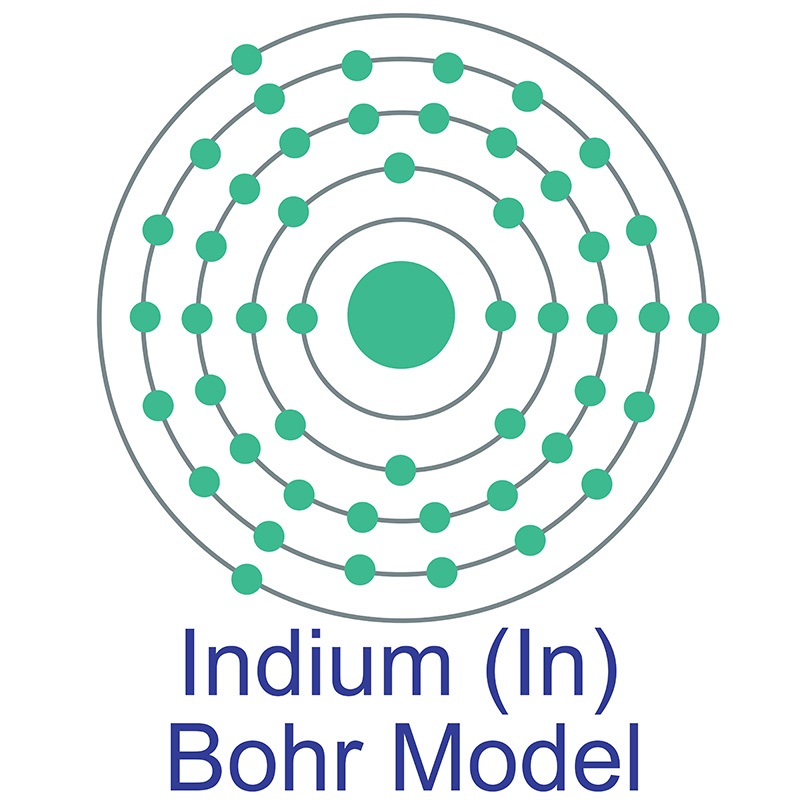
Indium is a Block P, Group 13, Period 5 element. The number of electrons in each of Indium's shells is 2, 8, 18, 18, 3 and its electronic configuration is [Kr] 4d10 5s2 5p1. In its elemental form indium's CAS number is 7440-74-6. The indium atom has a radius of 162.6.pm and it's Van der Waals radius is 193.pm. Indium is only slightly toxic. Indium has found application in semi-conductor materials and other electronic applications. It is used to make low-melting alloys, such as an alloy of 24% indium - 76% Indium is liquid at room temperature. It is used in making bearing alloys, germanium transistors, rectifiers, and photoconductors. It can be plated onto metal and evaporated onto glass, forming a mirror as good as that made with silver but with more resistance to atmospheric corrosion. Indium is available as metal and compounds with purities from 99% to 99.9999% (ACS grade to ultra-high purity); metals in the form of foil, sputtering target, and rod, and compounds as submicron and nanopowder. Indium is also used in various metal alloys (See AE Alloys). Indium was first discovered by Ferdinand Reich in 1863. See Indium research below.
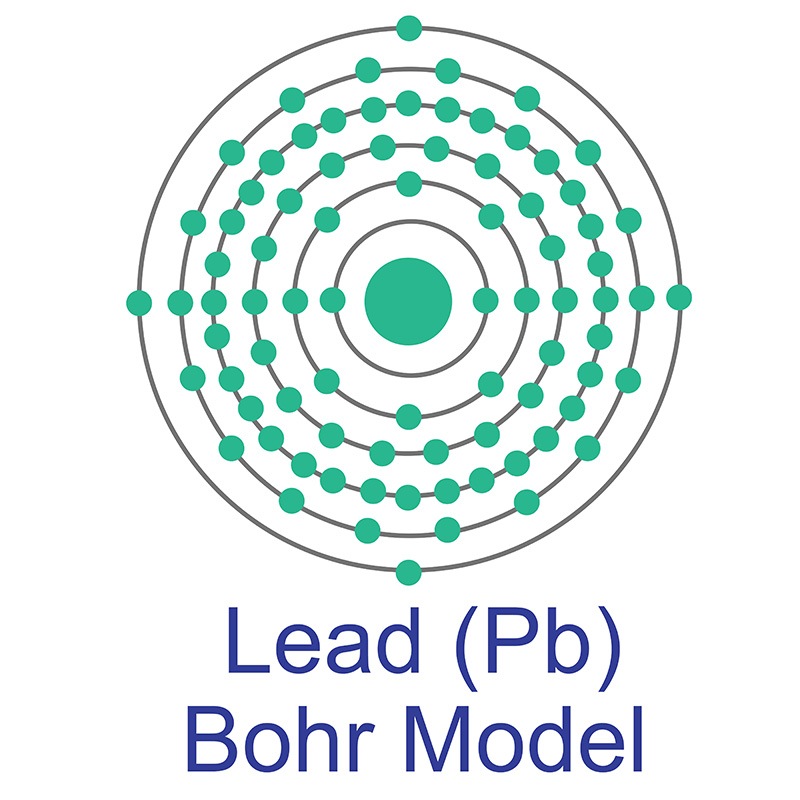
Lead is a Block P, Group 14, Period 6 element. The number of electrons in each of Lead's shells is 2, 8, 18, 32, 18, 4 and its electronic configuration is [Xe] 4f14 5d10 6s2 6p2. In its elemental form lead's CAS number is 7439-92-1. The lead atom has a radius of 175.pm and it's Van der Waals radius is 202.pm. Lead and its compounds are poisonous. Lead is a bluish-white metal of bright luster, naturally occurring as a mixture of four stable isotopes: 204Pb (1.48%), 206Pb (23.6%), 207Pb (22.6%), and 208Pb (52.3%). It is highly resistant to corrosion and can be used to contain corrosive liquids such as sulfuric acid. Great quantities of Lead, both as the dioxide and the metal, are used in batteries, cable covering, plumbing, and ammunition. Alloys include solder, type metal, and various antifriction metals and compounds. Lead is extremely effective at absorbing sound and vibration. It is also used as radiation shielding for X-ray equipment and nuclear reactors. Oxides of Lead are used in producing fine "crystal glass" and "flint glass" of a high index of refraction for achromatic lenses. Lead ceramics and crystalline material have a wide range of industrial and optical applications, including infrared detection and imaging. Lead-based semiconductors, such as lead telluride, lead selenide and lead antimonide are finding application in photovoltaic (solar energy) cells and infra red detectors. Lead was first discovered by Early Man. The origin of the name Lithium comes from the Greek word protos meaning "first". See Lead research below.
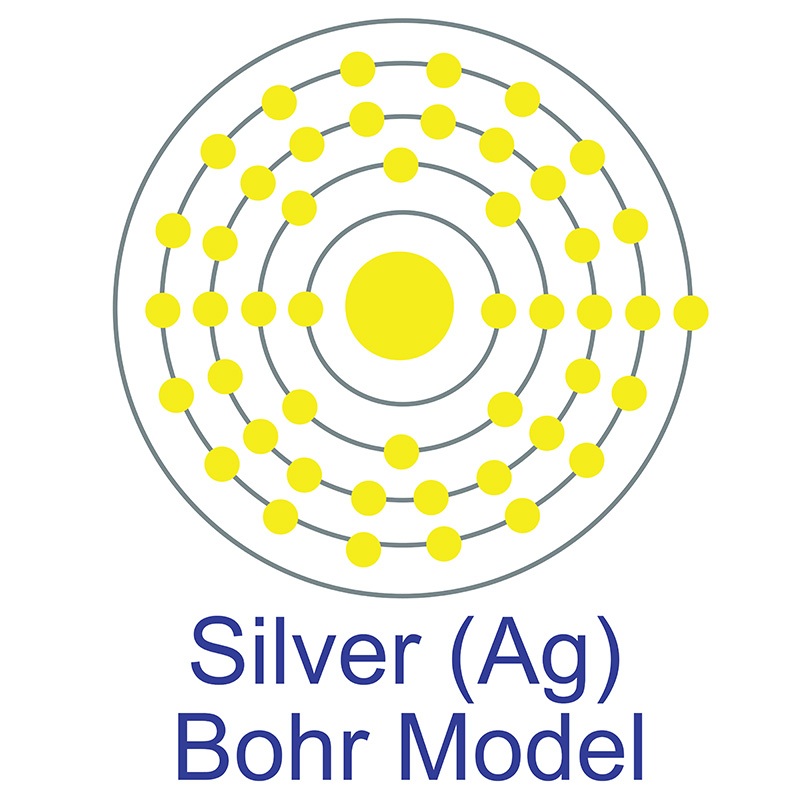
Silver is a Block D, Group 11, Period 5 element. The number of electrons in each of Silver's shells is 2, 8, 18, 18, 1 and its electronic configuration is [Kr]4d10 5s1. In its elemental form silver's CAS number is 7440-22-4. The silver atom has a radius of 144.5.pm and it's Van der Waals radius is 144.pm. Silver is not toxic although most silver salts are poisonous. Silver has a brilliant white metallic luster. It is a little harder than gold and is very ductile and malleable, being exceeded only by gold and perhaps palladium. Pure silver has the highest electrical and thermal conductivity of all metals, and possesses the lowest contact resistance. It is stable in pure air and water, but tarnishes when exposed to ozone, hydrogen sulfide, or air containing sulfur. Silver nitrate has wide application in painting, xerography, chemical electroplating, in components for electric batteries and in medicine as catalyst. Silver chloride is another important compound, due to its ductility and malleability. The organic compounds of the element are used in the coating of several metals and in dynamite or other explosive bars. Metallic silver is used as a catalyst of several oxidation reactions such as those of ethanol and other alcohols. Silver is available as metal and compounds with purities from 99% to 99.9999% (ACS grade to ultra-high purity); metals in the form of foil, sputtering target, and rod, and compounds as submicron and nanopowder. Silver was first discovered by Early Man. Silver was named after the Anglo-Saxon word "seolfor" or "siolfur" meaning 'silver'. See Silver research below.
|
| Formula |
CAS No. |
In Pb Ag |
7440-74-6 7439-92-1 7440-22-4 |
|
|
|
|
|
|
|
Search by Material, Product Name, Product Code, CAS Number, Formula, Element, Anion, Form, EC Number, MDL Number or PubChem ID. |
|
Recent Research & Development for Alloys
- Tailoring nanostructured, graded, and particle-reinforced Al laminates by accumulative roll bonding.
Göken M, Höppel HW.
Adv Mater. 2011 Jun 17;23(22-23):2663-8.
PMID:
21823248
[PubMed - in process]
- Highly monodisperse core-shell particles created by solid-state reactions.
Radmilovic V, Ophus C, Marquis EA, Rossell MD, Tolley A, Gautam A, Asta M, Dahmen U.
Nat Mater. 2011 Aug 7. doi: 10.1038/nmat3077. [Epub ahead of print]
PMID:
21822262
[PubMed - as supplied by publisher]
- Aerosol Deposition of Hydroxyapatite and 4-Hexylresorcinol Coatings on Titanium Alloys for Dental Implants.
Kim SG, Hahn BD, Park DS, Lee YC, Choi EJ, Chae WS, Baek DH, Choi JY.
J Oral Maxillofac Surg. 2011 Aug 6. [Epub ahead of print]
PMID:
21821331
[PubMed - as supplied by publisher]
- Progress in the Removal of Di-[2-Ethylhexyl]-Phthalate as Plasticizer in Blood Bags.
Simmchen J, Ventura R, Segura J.
Transfus Med Rev. 2011 Aug 4. [Epub ahead of print]
PMID:
21820855
[PubMed - as supplied by publisher]
- Antibacterial effect of silver-platinum coating for orthodontic appliances.
Ryu HS, Bae IH, Lee KG, Hwang HS, Lee KH, Koh JT, Cho JH.
Angle Orthod. 2011 Aug 2. [Epub ahead of print]
PMID:
21810004
[PubMed - as supplied by publisher]
- Influence of metal alloy and the profile of coronary stents in patients with multivessel coronary disease.
Abreu Filho LM, Forte AA, Sumita MK, Favarato D, Meireles GC.
Clinics (Sao Paulo). 2011;66(6):985-9.
PMID:
21808863
[PubMed - in process]
- A combined arc-melting and tilt-casting furnace for the manufacture of high-purity bulk metallic glass materials.
Soinila E, Pihlajama¨ki T, Bossuyt S, Ha¨nninen H.
Rev Sci Instrum. 2011 Jul;82(7):073901.
PMID:
21806193
[PubMed - as supplied by publisher]
- Waste-recycling Monte Carlo with optimal estimates: Application to free energy calculations in alloys.
Adjanor G, Athe`nes M, Rodgers JM.
J Chem Phys. 2011 Jul 28;135(4):044127.
PMID:
21806110
[PubMed - as supplied by publisher]
- Role of electronic excitation in the amorphization of ge-sb-te alloys.
Li XB, Liu XQ, Liu X, Han D, Zhang Z, Han XD, Sun HB, Zhang SB.
Phys Rev Lett. 2011 Jul 1;107(1):015501. Epub 2011 Jun 29.
PMID:
21797549
[PubMed - in process]
- Prediction of the operating point of dendrites growing under coupled thermosolutal control at high growth velocity.
Mullis AM.
Phys Rev E Stat Nonlin Soft Matter Phys. 2011 Jun;83(6-1):061601. Epub 2011 Jun 2.
PMID:
21797374
[PubMed - as supplied by publisher]
- Metal Anion-Alkyl Ammonium Complexes as Direct Write Precursors to Produce Nanopatterns of Metals, Nitrides, Oxides, Sulfides, And Alloys.
Radha B, Kiruthika S, Kulkarni GU.
J Am Chem Soc. 2011 Jul 26. [Epub ahead of print]
PMID:
21790160
[PubMed - as supplied by publisher]
- Characteristics of InGaN-based concentrator solar cells operating under 150X solar concentration.
Yang CC, Jang CH, Sheu JK, Lee ML, Tu SJ, Huang FW, Yeh YH, Lai WC.
Opt Express. 2011 Jul 4;19 Suppl 4:A695-700. doi: 10.1364/OE.19.00A695.
PMID:
21747536
[PubMed - in process]
- Determination of the magnetic ground state in the martensite phase of Ni-Mn-Z (Z = In, Sn and Sb) off-stoichiometric Heusler alloys by nonlinear AC susceptibility.
Umetsu RY, Fujita A, Ito W, Kanomata T, Kainuma R.
J Phys Condens Matter. 2011 Aug 17;23(32):326001. Epub 2011 Jul 25.
PMID:
21785185
[PubMed - in process]
- Effects of phase constitution on magnetic susceptibility and mechanical properties of Zr-rich Zr-Mo alloys.
Suyalatu, Kondo R, Tsutsumi Y, Doi H, Nomura N, Hanawa T.
Acta Biomater. 2011 Jul 19. [Epub ahead of print]
PMID:
21784180
[PubMed - as supplied by publisher]
- Bioactive glass microspheres as osteopromotive inlays in macrotextured surfaces of Ti and CoCr alloy bone implants: Trapezoidal surface grooves without inlay most efficient in resisting torsional forces.
Keränen P, Moritz N, Alm JJ, Ylänen H, Kommonen B, Aro HT.
J Mech Behav Biomed Mater. 2011 Oct;4(7):1483-91. Epub 2011 May 30.
PMID:
21783158
[PubMed - in process]
- Effect of the combination of dithiooctanoate monomers and acidic adhesive monomers on adhesion to precious metals, precious metal alloys and non-precious metal alloys.
Ikemura K, Kojima K, Endo T, Kadoma Y.
Dent Mater J. 2011 Jul 28;30(4):469-77. Epub 2011 Jul 21.
PMID:
21778614
[PubMed - in process]
- Nanoporous PtAg and PtCu alloys with hollow ligaments for enhanced electrocatalysis and glucose biosensing.
Xu C, Liu Y, Su F, Liu A, Qiu H.
Biosens Bioelectron. 2011 Sep 15;27(1):160-6. Epub 2011 Jul 7.
PMID:
21778046
[PubMed - in process]
- Pt/Cr and Pt/Ni catalysts for oxygen reduction reaction: to alloy or not to alloy?
Escaño MC, Gyenge E, Nakanishi H, Kasai H.
J Nanosci Nanotechnol. 2011 Apr;11(4):2944-51.
PMID:
21776658
[PubMed - in process]
- In vitro evaluation of the electrochemical behaviour of stainless steel and Ni-Ti orthodontic archwires at different temperatures.
Pakshir M, Bagheri T, Kazemi MR.
Eur J Orthod. 2011 Jul 19. [Epub ahead of print]
PMID:
21771804
[PubMed - as supplied by publisher]
- Multifrequency atomic force microscopy: compositional imaging with electrostatic force measurements.
Magonov S, Alexander J.
Microsc Microanal. 2011 Aug;17(4):587-97. Epub 2011 Jul 19.
PMID:
21771386
[PubMed - in process]
- Magnetic resonance imaging evaluation of intervertebral test spacers: an experimental comparison of magnesium versus titanium and carbon fiber reinforced polymers as biomaterials.
Ernstberger T, Buchhorn G, Heidrich G.
Ir J Med Sci. 2009 Aug 20. [Epub ahead of print]
PMID: 19693644 [PubMed - as supplied by publisher]
- Ultrasonic irradiation and its application for improving the corrosion resistance of phosphate coatings on aluminum alloys.
Sheng M, Wang C, Zhong Q, Wei Y, Wang Y.
Ultrason Sonochem. 2010 Jan;17(1):21-5. Epub 2009 Aug 6.
PMID: 19692286 [PubMed - in process]
- Plasma reduction of bronze corrosion developed under long-term artificial ageing.
Novakovic J, Papadopoulou O, Vassiliou P, Filippaki E, Bassiakos Y.
Anal Bioanal Chem. 2009 Aug 15. [Epub ahead of print]
PMID: 19685234 [PubMed - as supplied by publisher]
- First-principles studies on alloying and simplified thermodynamic aqueous chemical stability of calcium-, zinc-, aluminum-, yttrium- and iron-doped magnesium alloys.
Velikokhatnyi OI, Kumta PN.
Acta Biomater. 2009 Aug 14. [Epub ahead of print]
PMID: 19683600 [PubMed - as supplied by publisher]
|
| American Elements is a copyrighted U.S. Trademark. All rights reserved. |
|
|