American Elements Logo and U.S. Registered Trademark


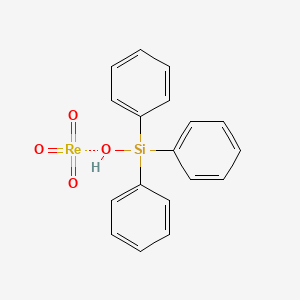
Trioxo(triphenylsilyloxy)rhenium(VII)
C18H15O4ReSi
60624-60-4
Product Product Code Order or Specifications
(2N) 99% Trioxo(triphenylsilyloxy)rhenium(VII)      RE-OM-02 Contact American Elements
(3N) 99.9% Trioxo(triphenylsilyloxy)rhenium(VII) RE-OM-03 Contact American Elements
(4N) 99.99% Trioxo(triphenylsilyloxy)rhenium(VII) RE-OM-04 Contact American Elements
(5N) 99.999% Trioxo(triphenylsilyloxy)rhenium(VII) RE-OM-05 Contact American Elements
Trioxo(triphenylsilyloxy)rhenium(VII) is generally immediately available in most volumes. High purity, submicron and nanopowder forms may be considered.American Elements produces to many standard grades when applicable, including Mil Spec (military grade); ACS, Reagent and Technical Grade; Food, Agricultural and Pharmaceutical Grade; Optical Grade, USP and EP/BP (European Pharmacopoeia/British Pharmacopoeia)and follows applicable ASTM testing standards.Typical and custom packaging is available. Additional technical, research and safety (MSDS) information is available as is a Reference Calculator for converting relevant units of measurement.

Rhenium(Re) atomic and molecular weight, atomic number and elemental symbol Rhenium is a Block D, Group 7, Period 6 element. The number of electrons in each of Rhodium's shells is 2, 8, 18, 32, 13, 2 and its electronic configuration is [Xe] 4f14 5d5 6s2. In its Rhenium Bohr Model elemental form rhenium's CAS number is 7440-15-5. The rhenium atom has a radius of 137.1.pm and it's Van der Waals radius is 200.pm. The toxicity of Rhenium has not yet been established . Rhenium is the fourth densestelementexceeded only by that of platinum, iridium, and osmium . It has the second highest melting point exceeded only by tungsten and carbon . Rhenium is available as metal and Elemental Rheniumcompounds with purities from 99% to 99.999% (ACS grade to ultra-high purity); metals in the form of foil, sputtering target, and rod, and compounds as submicron and nanopowder. Because of this, thermocouples made of Tungsten/Rhenium alloy is are used when temperatures will rise to 2000 C and rhenium wire is used in photoflash lamps for photography. It is widely used as filaments for mass spectrographs and ion gauges. Rhenium was first discovered by Walter Noddack in 1925 in the Rhine region of Germany. The name Rhenium originates from the Latin word 'Rhenus' meaning "Rhine" after the place of discovery. See Rhenium research below.

Silicon(Si) atomic and molecular weight, atomic number and elemental symbolSilicon is a Block P, Group 14, Period 3 element. The number of electrons in each of Silicon's shells is 2, 8, 4 and its electronic configuration is [Ne] 3s2 3p2. In its elemental form silicon's CAS number is 7440-21-3. The silicon atom has a radius of 117.6.pm and it's Van der Waals radius is 210.pm. Silicon is not toxic but can cause chronic respiratory problems if inhaled as a fine silica or silicate dust. Asbestos silicates are carcinogenic. Silicon isElemental Silicon one of man's most useful elements. It makes up 25.7% of the earth's crust, by weight, and is the second most abundant element, being exceeded only by oxygen. The Czochralski process is commonly used to produce single crystals of silicon used for solid-state or semiconductor devices. Silica, as sand, is a principal ingredient of glass, one of the most inexpensive of materials with excellent mechanical, optical, thermal, and electrical properties. Silicon is available as metal and compounds with purities from 99% to 99.9999% (ACS grade to ultra-high purity); metals in the form of foil, sputtering target, and rod, and compounds as submicron and nanopowder. Ultra high purity silicon can be doped with boron, gallium, phosphorus , or arsenic to produce silicon for use in Silicon Bohr Moleculetransistors, solar cells, rectifiers, and other solid-state devices which are used extensively in the electronics and space-age industries. Hydrogenated amorphous silicon has shown promise in producing economical cells for converting solar energy into electricity. Silcones are important products of silicon. They range from liquids to hard, glasslike solids with many useful properties. Silicon was first discovered by Jons Berzelius in 1823. The name Silicon originates from the Latin word "silex" which means flint or hard stone. See Silicon research below.

Formula CAS No. Appearance Molecular Weight
C18H15O4ReSi 60624-60-4   509.6
ISOTOPES News Foil Submicron & Nanopowder Tolling Ultra High Purity Sputtering Target Crystal Growth Rod, Plate, Powder, etc. Home

Have a Question? Ask a Chemical Engineer or Material Scientist   Request an MSDS or Certificate of Analysis


Search by Material, Product Name, Product Code, CAS Number, Formula, Element, Anion, Form, EC Number, MDL Number or PubChem ID.
German   Korean   French   Japanese   Spanish   Chinese (Simplified)   Portuguese   Russian   Chinese (Taiwan)   Italian   Turkish   Polish   Dutch   Czech   Swedish   Hungarian   Danish   Hebrew

Production Catalog Available in 36 Countries & Languages

PACKAGING SPECIFICATIONS FOR BULK & RESEARCH QUANTITIES


Typical bulk packaging includes palletized plastic 5 gallon/25 kg. pails, fiber and steel drums to 1 ton super sacks in full container (FCL) or truck load (T/L) quantities. Research and sample quantities and hygroscopic, oxidizing or other air sensitive materials may be packaged under argon or vacuum. Shipping documentation includes a Certificate of Analysis and Material Safety Data Sheet (MSDS). Solutions are packaged in polypropylene, plastic or glass jars up to palletized 440 gallon liquid totes.


Show me more forms of Rhenium
 
Customers for this product have also looked at:
Rhenium Nanoparticles Rhenium Sheet Rhenium Wire Rhenium Chloride Rhenium Acetylacetonate
Rhenium Pellets Rhenium Foil Rhenium 2-Ethylhexanoate Rhenium Oxide Rhenium Fluoride
Potassium Hexachlororhenate Rhenium Sputtering Target Rhenium Telluride Rhenium Powder Rhenium Oxide Pellets


Recent Research & Development for Rhenium

  • pH-driven dynamic stereoinduction: epimerization upon dimerization in rhenium(i) complexes. Alvarez CM, Carrillo R, García-Rodríguez R, Miguel D. Chem Commun (Camb). 2011 Oct 10. [Epub ahead of print] PMID: 21983699 [PubMed - as supplied by publisher]

  • N-Heterocyclic carbenes as p*-acceptors in luminescent Re(i) triscarbonyl complexes. Casson LA, Muzzioli S, Raiteri P, Skelton BW, Stagni S, Massi M, Brown DH. Dalton Trans. 2011 Oct 10. [Epub ahead of print] PMID: 21983680 [PubMed - as supplied by publisher]

  • In Vitro and In Vivo Evaluation of Melanin-Binding Decapeptide 4B4 Radiolabeled with (177)Lu, (166)Ho, and (153)Sm Radiolanthanides for the Purpose of Targeted Radionuclide Therapy of Melanoma. Ballard B, Jiang Z, Soll CE, Revskaya E, Cutler CS, Dadachova E, Francesconi LC. Cancer Biother Radiopharm. 2011 Oct;26(5):547-56. Epub 2011 Oct 4. PMID: 21970319 [PubMed - in process]

  • Efficacy of radiosynovectomy in rheumatoid arthritis. Liepe K. Rheumatol Int. 2011 Oct 1. [Epub ahead of print] PMID: 21964982 [PubMed - as supplied by publisher]

  • Biological dosimetry after radiosynoviorthesis with rhenium-186 sulphide and erbium-169 citrate. Klett R, Schnurbus-Duhs A, Mödder G, Schmid E, Voth M. Nuklearmedizin. 2011 Sep 20;50(6). [Epub ahead of print] PMID: 21931934 [PubMed - as supplied by publisher]

  • Observation of inductive effects that cause a change in the rate-determining step for the conversion of rhenium azides to imido complexes. Travia NE, Xu Z, Keith JM, Ison EA, Fanwick PE, Hall MB, Abu-Omar MM. Inorg Chem. 2011 Oct 17;50(20):10505-14. Epub 2011 Sep 9. PMID: 21905647 [PubMed - in process]

  • Influence of the metal center and linker on the intracellular distribution and biological activity of organometal-peptide conjugates. Hu W, Splith K, Neundorf I, Merz K, Schatzschneider U. J Biol Inorg Chem. 2011 Sep 7. [Epub ahead of print] PMID: 21898043 [PubMed - as supplied by publisher]

  • Complexes in context: Attempting to control the cellular uptake and localisation of rhenium fac-tricarbonyl polypyridyl complexes. Balasingham RG, Coogan MP, Thorp-Greenwood FL. Dalton Trans. 2011 Sep 6. [Epub ahead of print] PMID: 21897946 [PubMed - as supplied by publisher]

  • Luminescent rhenium(i) polypyridine fluorous complexes as novel trifunctional biological probes. Louie MW, Fong TT, Lo KK. Inorg Chem. 2011 Oct 3;50(19):9465-71. Epub 2011 Aug 30. PMID: 21894912 [PubMed - in process]

  • Rhenium-catalyzed allylation of C-H bonds of benzoic and acrylic acids. Kuninobu Y, Ohta K, Takai K. Chem Commun (Camb). 2011 Sep 20;47(38):10791-3. Epub 2011 Sep 5. PMID: 21892483 [PubMed - in process]

  • [Influence of antitumor system rhenium-platinum on biochemical state of the liver]. Ivchuk VV, Polishko TM, Golichenko OA, Shtemenko OV, Shtemenko NI. Ukr Biokhim Zh. 2011 May-Jun;83(3):76-84. Ukrainian. PMID: 21888057 [PubMed - indexed for MEDLINE]

  • Synthesis and Preliminary Bioevaluation of (99m)Tc(CO)(3)-17a-Triazolylandrost-4-Ene-3-One Derivative Prepared via Click Chemistry Route. Dhyani MV, Satpati D, Korde A, Banerjee S. Cancer Biother Radiopharm. 2011 Oct;26(5):539-45. Epub 2011 Sep 1. PMID: 21883014 [PubMed - in process]

  • 17 e(-) rhenium dicarbonyl CO-releasing molecules on a cobalamin scaffold for biological application. Zobi F, Blacque O, Jacobs RA, Schaub MC, Bogdanova AY. Dalton Trans. 2011 Sep 1. [Epub ahead of print] PMID: 21881676 [PubMed - as supplied by publisher]

  • Luminescent rhenium(i) complexes with acetylamino- and trifluoroacetylamino-containing phenanthroline ligands: Anion-sensing study. Ng CO, Lai SW, Feng H, Yiu SM, Ko CC. Dalton Trans. 2011 Sep 27;40(39):10020-8. Epub 2011 Aug 30. PMID: 21879085 [PubMed - in process]

  • Reactions of the inner surface of carbon nanotubes and nanoprotrusion processes imaged at the atomic scale. Chamberlain TW, Meyer JC, Biskupek J, Leschner J, Santana A, Besley NA, Bichoutskaia E, Kaiser U, Khlobystov AN. Nat Chem. 2011 Aug 14;3(9):732-7. doi: 10.1038/nchem.1115. PMID: 21860464 [PubMed - in process]

  • Rhenium ethoxy- and hydroxycarbene complexes with thiophene substituents. Lotz S, Landman M, Olivier AJ, Bezuidenhout DI, Liles DC, Palmer ER. Dalton Trans. 2011 Oct 7;40(37):9394-403. Epub 2011 Aug 15. PMID: 21842102 [PubMed - in process]

  • Chemoradionuclide therapy with (186)re-labeled liposomal Doxorubicin: toxicity, dosimetry, and therapeutic response. Soundararajan A, Bao A, Phillips WT, McManus LM, Goins BA. Cancer Biother Radiopharm. 2011 Oct;26(5):603-14. Epub 2011 Aug 11. PMID: 21834653 [PubMed - in process]

  • Two different hydrogen bond donor ligands together: a selectivity improvement in organometallic {Re(CO)3} anion hosts. Ion L, Nieto S, Pérez J, Riera L, Riera V, Díaz J, López R, Anderson KM, Steed JW. Inorg Chem. 2011 Sep 5;50(17):8524-31. Epub 2011 Aug 11. PMID: 21834508 [PubMed - in process]

  • A young source for the Hawaiian plume. Sobolev AV, Hofmann AW, Jochum KP, Kuzmin DV, Stoll B. Nature. 2011 Aug 10;476(7361):434-7. doi: 10.1038/nature10321. PMID: 21832996 [PubMed]

  • Precursor-directed assembly of complex oxide nanobeads: the role of strongly coordinated inorganic anions. Nikonova OA, Nedelec JM, Kessler VG, Seisenbaeva GA. Langmuir. 2011 Sep 20;27(18):11622-8. Epub 2011 Aug 17. PMID: 21830800 [PubMed - in process]
Customers for this product have also looked at:
Silicon Chloride Silicon Foil Aluminium Silicon Magnesium Alloy Silicon Nanoparticles Silicon Pellets
Silicon Fluoride Silicon Metal Silicon Acetate Solution Silicon 2 - Ethylhexanoate Silicon Oxide Pellets
Calcium Silicon Alloy Silicon Oxide Sililcon Nanoparticles Silicon Sputtering Target Silicon Wire

Recent Research & Development for Silicon

  • Contractile cell forces exerted on rigid substrates. Köser J, Gaiser S, Müller B. Eur Cell Mater. 2011 May 28;21:479-487. PMID: 21623572 [PubMed - as supplied by publisher]

  • Atomic force microscopy investigations of heterogeneities in the adhesion energies measured between pathogenic and non-pathogenic Listeria species and silicon nitride as they correlate to virulence and adherence. Park BJ, Abu-Lail NI. Biofouling. 2011 May;27(5):543-559. PMID: 21623482 [PubMed - as supplied by publisher]

  • Competitive protein adsorption on polysaccharide and hyaluronate modified surfaces. Ombelli M, Costello L, Postle C, Anantharaman V, Meng QC, Composto RJ, Eckmann DM. Biofouling. 2011 May;27(5):505-518. PMID: 21623481 [PubMed - as supplied by publisher]

  • A highly selective colorimetric and ratiometric fluorescent chemodosimeter for imaging fluoride ions in living cells. Zhu B, Yuan F, Li R, Li Y, Wei Q, Ma Z, Du B, Zhang X. Chem Commun (Camb). 2011 May 27. [Epub ahead of print] PMID: 21623434 [PubMed - as supplied by publisher]

  • A Carpet Cloak for Visible Light. Gharghi M, Gladden C, Zentgraf T, Liu Y, Yin X, Valentine J, Zhang X. Nano Lett. 2011 May 27. [Epub ahead of print] PMID: 21619019 [PubMed - as supplied by publisher]

  • Study of Thioflavin-T Immobilized in Porous Silicon and the Effect of Different Organic Vapors on the Fluorescence Lifetime. Hutter T, Amdursky N, Gepshtein R, Elliott SR, Huppert D. Langmuir. 2011 May 27. [Epub ahead of print] PMID: 21619016 [PubMed - as supplied by publisher]

  • Enantioselective Total Synthesis of a Natural Iridoid. Lee S, Paek SM, Yun H, Kim NJ, Suh YG. Org Lett. 2011 May 27. [Epub ahead of print] PMID: 21619009 [PubMed - as supplied by publisher]

  • Reversible On/Off Conductance Switching of Single Diarylethene Immobilized on a Silicon Surface. Uchida K, Yamanoi Y, Yonezawa T, Nishihara H. J Am Chem Soc. 2011 May 27. [Epub ahead of print] PMID: 21618972 [PubMed - as supplied by publisher]

  • Assembly of horseradish peroxidase within supported cationic bilayers. Leão-Silva AC, Naves AF, Pereira EM, Petri DF, Carmona-Ribeiro AM. Biotechnol Prog. 2011 May 2. doi: 10.1002/btpr.640. [Epub ahead of print] PMID: 21618457 [PubMed - as supplied by publisher]

  • Silicon-Neuron Design: A Dynamical Systems Approach. Arthur JV, Boahen K. IEEE Trans Circuits Syst I Regul Pap. 2011;58(5):1034-1043. PMID: 21617741 [PubMed]

  • Silicon efflux transporters isolated from two pumpkin cultivars contrasting in Si uptake. Mitani-Ueno N, Yamaji N, Ma JF. Plant Signal Behav. 2011 Jul 1;6(7). [Epub ahead of print] PMID: 21617377 [PubMed - as supplied by publisher]

  • Simultaneous Detection of Eight Food Allergens Using Optical Thin-film Biosensor Chips. Wei W, Han J, Wu Y, Yuan F, Chen Y, Ge Y. J Agric Food Chem. 2011 May 26. [Epub ahead of print] PMID: 21615118 [PubMed - as supplied by publisher]

  • n-Channel Semiconductor Materials Design for Organic Complementary Circuits. Usta H, Facchetti A, Marks TJ. Acc Chem Res. 2011 May 26. [Epub ahead of print] PMID: 21615105 [PubMed - as supplied by publisher]

  • Drugs, the Internet and change. Walsh C. J Psychoactive Drugs. 2011 Jan-Mar;43(1):55-63. PMID: 21615008 [PubMed - in process]

  • Compact hybrid TM-pass polarizer for silicon-on-insulator platform. Alam M, Aitchsion JS, Mojahedi M. Appl Opt. 2011 May 20;50(15):2294-8. doi: 10.1364/AO.50.002294. PMID: 21614124 [PubMed - in process]

  • Reduction of light reflection at silicon-plate surfaces by means of subwavelength gratings in the terahertz region: errata. Kuroo S, Oyama S, Shiraishi K, Sasho H, Fukushima K. Appl Opt. 2011 May 20;50(15):2255. doi: 10.1364/AO.50.002255. PMID: 21614119 [PubMed - in process]

  • Electrical and thermal conductivity of low temperature CVD graphene: the effect of disorder. Vlassiouk I, Smirnov S, Ivanov I, Fulvio PF, Dai S, Meyer H, Chi M, Hensley D, Datskos P, Lavrik NV. Nanotechnology. 2011 Jul 8;22(27):275716. Epub 2011 May 25. PMID: 21613685 [PubMed - in process]

  • Improvement of resistive switching in Cu/ZnO/Pt sandwiches by weakening the randomicity of the formation/rupture of Cu filaments. Zhuge F, Peng S, He C, Zhu X, Chen X, Liu Y, Li RW. Nanotechnology. 2011 Jul 8;22(27):275204. Epub 2011 May 25. PMID: 21613680 [PubMed - in process]

  • ENERGY AND ANGULAR DEPENDENCE OF ACTIVE-TYPE PERSONAL DOSEMETER FOR HIGH-ENERGY NEUTRON. Rito H, Yamauchi T, Oda K. Radiat Prot Dosimetry. 2011 May 24. [Epub ahead of print] PMID: 21613268 [PubMed - as supplied by publisher]

  • Interfacial Immobilization of Monoclonal Antibody and Detection of Human Prostate-Specific Antigen. Zhao X, Pan F, Cowsill B, Lu JR, Garcia-Gancedo L, Flewitt AJ, Ashley GM, Luo J. Langmuir. 2011 May 25. [Epub ahead of print] PMID: 21612249 [PubMed - as supplied by publisher]


USA Science & Engineering FestivalSponsors of the United States Science & Engineering Festival on April 28, 2012 in Washington D.C. Please join us and our customers & co-sponsors NASA, Lockheed Martin and the Department of Defense inspiring the next generation of scientists and engineers.


  Print this Page
Periodic table of the elements science and academic information, elements and advanced materials data, scientific presentations and all pages, designs, concepts, logos, and color schemes herein are the copyrighted proprietary rights and intellectual property of American Elements. American Elements is a U.S. Registered Trademark. © 2001-2012. American Elements. All rights reserved.
Learn Six Sigma


American Elements is a copyrighted U.S. Trademark. All rights reserved.